
Illustrators: Jessie Wilcox Smith (American, 1863-1935)
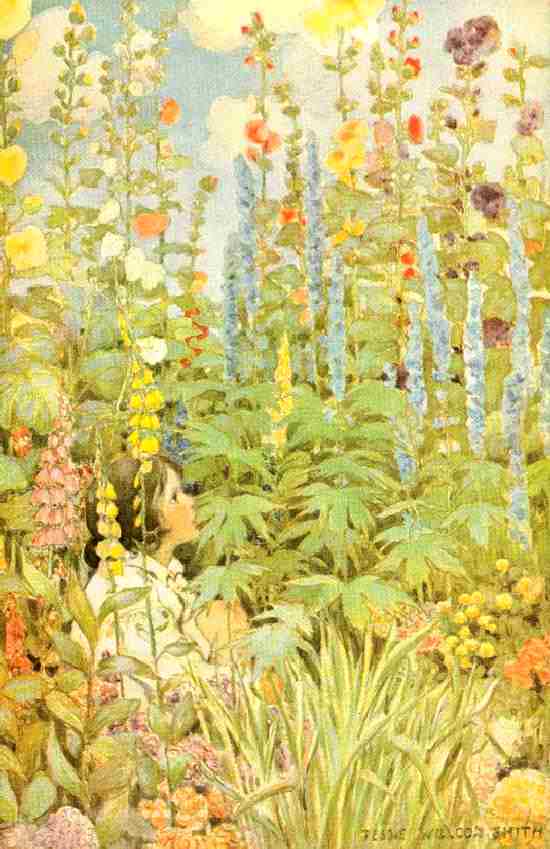
Figure 1.--This boy in this 1905 illustration by Jessie Wilcox Smith is almost lost in the flowers. It is not possible to tell much about his clothing, but it is a charming depiction of childhood. It originally appeared in the Scribner edition of Robert Lewis Stevenson's "A Child's Garden of Verses".
|
|
Jessie Wilcox Smith was one of the most prolific and highly aclaimed women illustrators from the early 20th century. Althouigh she began her career later than most, she is regarded as the premier female American illustrator during the early 20th century. Certainly she is one of the most noted American illustrators addressing the world of the child. She is one of HBC's favorite illustrators. Most of her drawings were of children. Many of these are truly magical. Her illustrations are not the best for HBC's puposes. Her drraightmanship is superp, but the clothing is often not an important part of her drawings. Her illustrations often do not involve a detailed drawing of the children's clothes. Rather the child's may almost be hidden in a forest of bushes are under the covers. Her illistrations are, however, magical depictions of idealized, but not unrealistically protrayed childhood.
Parents
Jessie was the daughter of Charles Henry and Katherine De Witt Smith. hey were wealthy and aart of high society.. Her father was awalthy investment banker.
Childhood
Jessie was born in Philadelphia during 1863. She exhibited no special talent or interest in drawing as a child. Her parent's soial status and money, however, afforded her a;; the priviliges of wealth and high scociety.
Education
Jesie attended the vest private schools. She studied to be a kindergarten/primary school teacher and actually worked as teacher for several years. Incredibly, she came to her life's work by accident. While beginning to teach school, she found that chronic back problems made it difficult to bend down. And teachers working with younger children have to come down to their level on a daily basis. Her family persuaded her to take an art class, because a female relative was teaching it. [Kosor] She began at the very proper Philadephia school of Design for Women. After this introduction, she showed so much talent and found she enjoyed drawing that she decided to take formal classes at the Pennsylvania Academy of the Fine Arts (1885). Her teachers included Thomas Eakins, a noted photographer and realist artist. She began using photographs as a basis for her images. And her style became increaingly replstic. She graduated from the Academy and began her drawing career (1888).
Early Efforts
Jessie Wilcox Smith was one of the most prolific and highly aclaimed women illustrators from the early 20th century. Fortunately for Smoth, at the time she graduated, lithography was making great strides. This meant thhat it was increaing possible to publish illistrtions. Her first credit came just before graduation from the acdemy. It was 'Three little maids all in a row'. It was published by the popular St. Nicholas Magazine. She was also fortunate that illustration was one of the few careers besides teaching and nursing seen as suitable for young women. This was especially trie if the imges were chuldren and motherhood. Thus women illutrators had an in for the chilren's book trade. She was not, however, immediately successful as an illustrator. She worked in the production department of The Ladies' Home Journal (1889), the year after she graduated from the Pennsylvania Academy of the Fine Arts. She worked there for 5 years. Among other assignments, shefirst fine tuned and then designed advertisements. [Kosor] She wanted to do more and decided that she needed further instruction. Then she got her first book commision. It was to illustrate a modest collection of poems by Mary Wiley Staver, New and True (1892).
Howard Pyle
Smith enrolled as a student at Drexel Institute of Arts and Sciences (1894). She studied under Howard Pyle. Pyle influenced a generation of American illustrators who he encouraged to shhot for the most prestigious publishing houses in America. His major thesis was to carefully study a subject and to these paint or draw what one knows best to bring the subject alive. [Reed] Smith later wrote that Pyle cleared "... all the cobwebs an cibfusions that so beset the path of the art stidemy." [Nudelman] Smith was one of his oldest students. Another important Pyle student was Frank Schoonover. It was at Drexel that she met Elizabeth Shippen Green and Violet Oakley and they became life-long friends and associates . Smith obtained a commission through Pyle to illustrate an edition of Evangeline (1897) which she worlked on with Oakley. Together with another Pyle student they rented a studio. Green joined them later. [Plant]
The Golden Age of Illustration
Jessie Wilcox Smith was among the elite members of the Golden ahe of Illustrators. In the age before TV ans CDs and at the dawn of radio and the mob=vies, mass circulation magazines were prime-time illustrators. And there was areat demand fir illustrations. Some of the most important magazines were not hust monthlys, but weeklies. Some of the most important magazines were: Collier's, Lasies' Home Journal, andSatuday Evenong Post.
Career
Smith's career began to blossom after the turn-of-the 20th century. Every thing together for her. Smith with her friends Green and Oakley leased an old inn on the outskirts of Philadelphia. Scribners Magazine published one of her drawings. She worked with Green on two calendars (1902) that received favorable notice and helped to establish their reputation as illustrators. the most important illustrations were in the "The Child", which showcased her ability to draw wonderful images of childhood. The images appeared in book the subsequent year (1903). Smith's career was perfectly timed. Advances in lithogrphybcolor printing and an expanding America magazine industry created a great demand for color illustrations. Smith's abilities combined with her experiences at the Ladies Home Journal and industries contacts through Pyle uniquely equipped her to produce and market her work. And with all the women mostly at home, it was they who purchased these magazines. Images of childhood were thus in great demand. And her talent was soon recognized. In a short time she was thrust from an entry-level position in an advertising workhouse to the front cover of the most important magazines in America. She became a sought out illustator for both mgazine features and books. Smith during the 1910s sold illustrations to many of the important magazines of the early 20th century America: Century, Collier's Weekly, Ladies' Home Journal, Leslie's, Harper's, McClure's, Scribners, and Woman’s Home Companion. Her cover illustrations for Good House Keeping were particularly notable. She was as a result, probanly the most popular female illustrator diring the early 20th century. One of her projects was illustrating Frances Hodgson Burnett's "In A Closed Room" which appeared in McClure's (1904). As with Little Lord Fauntleroy, it was serialized before being published in book form.
Body of Work
Smith produced an incredible body of work. She was published in a variety of different formats. The book illustrations are perhaps best remembered today, but at the time the magazine illutrations were the most infkuential and widely circulated.
Advertisements: She created wonderful ads for Cream of Wheat, Campbell’s Soup, and Ivory Soap, and other products seeking to project a wholesome image. She also did ads for the Red Cross. Her bet known items were magazine covers which cout net her $1,500, a substantial sum in the early-20th century.
Articles: She illustrated expose articles like "While the Mother Works:
A Look at the Day Nurseries of New York" in Century (1902).
Books: She illustrated over 40 books. Some of her most beutiful illustrtins are in the Scribners Classic edition of Robert Louis Stevenson's A Child's Garden of Verses (Scribner, 1905) which especially showcased her talents for draeing yoing children. She illustrated many other outstanding children's books, including the classic The Water-Babies (1916). Other important works included: Louisa May Alcott, Little Women (Brown, 1915); James Fenimore Cooper, The Last of the Mohicans (Houghton, 1910); and Johanna Spyri, Heidi (Mac Kay, 1922). Another wonderful production was Samuel McChord Crothers, The Children of Dickens. Many of the children's books she illustrated are still in print, in part because the illustrations appeal to adults for whom they provide a nostalgic look at early 20th century Ammerica.
Calendars: As mentioned above she did calendars. The ealy ones with Green helped establish her reputation.
Magazine Covers: Smith not only did book illustrators, but also contributed many magazine covers and illustrations. Her first illuistrations apperared in the famed monthly magazine for children--St. Nicholas. This was the same magazine in which Little Lord Fauntleroy first appeared as well as an early outlet for Norman Rockwell. She is most associated with Good Housekeeping. It was one of the major American mass-circulartion magazines and brought her work into millions of Americans homes every month for nearly two decades (1917-33). In all she did more than 200 covers for Good Housekeeping.
Adverisements: Smith not only illustrated magazine covers and articles, but also advertisments. she was very effective in selling products which were of interet to women. Big name comaies like Cream of Wheat, Campbell’s Soup, Ivory Soap and Kodak engaged her. She also did appeals for the Red Cross.
Plates: She produced series of stand-along drawings. One such series was "The Seven Ages of Childhood" appearing in The Ladies' Home Journal (1908-09).
Cards: We once saw cards with her images. Mother's Day cards wereespecially common. We see that less commonly today in our more jded age. Smith images project more than anything innosence which is today sadly out of style.
Posters:
Portraits:
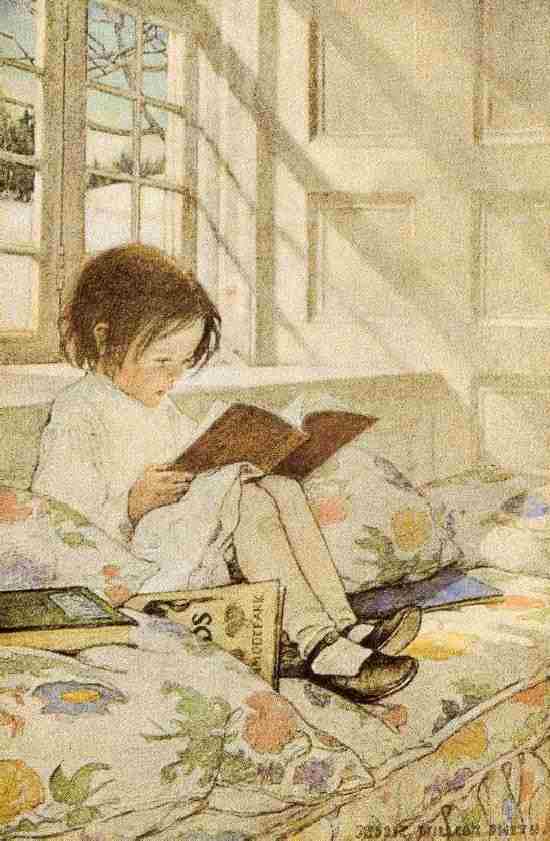
Figure 2.--This is another Jessie Wilcox Smith illustration from the 1905 Scribner edition of Robert Lewis Stevenson's "A Child's Garden of Verses". The child pictured here is a girl. The illustration is one of Smith's many enchanting depictions of the ordinary, private moments of childhood. Few illustrators have suceeded in capturing this so beautifully.
|
|
Imagery
Smith drew winderful imahes of women and children, often together. The images of children are varied, but the one consistent theme is innosence. The children are depicted playing, reading books, lost in their thoughts, or enjoying a cuddle. Smoth's warm and wonderfully gentle character was perfect for attracting the interest of female magazin readers, both in articles and avertisements. Her focus was on younger children. she might do school-age girls, but rarely boys. As a result we do not see her illustrating action scenes or the kind of violence and ction tht appealed to boys. That was part of the Golden age of illustration. Her niche was younger childre and their ply as wrell as quiet introspection and reading.
Clothing
While Smith focused on children. Her drawings did not always provide detailed Smith was so prolific and her illustrations did not always provide drawings of their clothing. Her illustrations are not the best for HBC's puposes. Her draughtmanship is superb, but the clothing is often not an important part of her drawings. Her illustrations often do not involve a detailed drawing of the children's clothes. Rather the child's may almost be hidden in a forest of bushes are under the covers. Her illustrations were so numerous and widely dessiminated as well as immenmsly appealing that that they undoubtedly more than depicted children and children's clothes. One historian reports, "She painted the
universal child, but the dresses and playsuits they wore helped shape the dressing habits of a generation of children." [Plant] In particilar her illustrations in Good Housekeeping becaise they were so widely circulated, must have been very influetial.
Focus
From an early point after leaving Pyle, Smith's work began focusing on children, childhood, and motherhood. She made a concious decission to concentrate on children and their world. She is one of HBC's favorite illustrators. Most of her drawings are of mothers, babies, and children. Her best illustrations depict the ordinary, often private moments, usually of pre-school or very young children such as playing in the garden or with their toys at home. She also addressed the concerns of small children such as fear of the dark. She also illustrated books for children, both featuring drawings on children, but imaginative drawings for children and their mothers.
Style
There is a wonderful charm about Wilcox's drawing, a magic I find difficult to describe. A Canadian admirer tells us, "Her illustrations are clearly influenced by the Art Nouveau style, especially illustrators like Maurice Denis and Vuillard. Her drawings are clear and concise, something new in illustrations for that time." They are almost photographic in nature, but unlike most phototographs capture the inner-most thoughts ans personality of her subjects.
Medium
Smoth worked with both pen and the brush. She seemed most at ease, howver, working with charcoal, adding watercolor washes. She also sometimes varnished the drawing so as to add oil highlights. [Reed] Smith is one of those illustrators like Rockwell which seem to bridge ther gap between artist and illustrator. Some of her drawings seem almost like impresionist paintings.
Family Life
Smith never married and had a family of her own. Given the tenderness with which she depicted children, these seems rather surprising.
Later Life
Smith's eyesight deteriorated in her later years. She stopped doing the Good Housekeeping covers in 1933 beause of this and other health problems. She had always wanted to travel and finally visited Europe in 1933, but her deterioating health made it difficult for her to enjoy the expeience. She died peacefully in her sleep in 1935 at her Cogs Hill home in Chestnut Hill, Philadelphia at age 72 years.
Assessment
Many of Smith's drawings of children are truly magical. Perhaps somewhat idealized, her illustrations are realistic protrayals of early 20th century childhood--at leat the childhood of white, prospeous middleclass children. One of the key features of her illustrations is her ability to create an image from ther child's poit of view. In this she proved very influential among the following generation of illustrators. Her illustrations ranged from imaginative fairy tale illustrations to every day domestic scenes brought to life in a magical way. One historian writes, "Smith changed and enlarged the appreciation of children in American popular culture by her enormously sympathetic portrayals." [Reed]
Sources
Kosor, Susan. "Jessie Willcox Smith," The National Museum of American Illustration, website accessed July 25, 2002.
Nudelman, Edward. Jessie Willcox Smith: American Illustrator (Pelican, 1990).
Plant, Bud. "Jessie Wilcox Smith," Illustrated Books website accessed July 25, 2002..
Reed, Roger T. "Jessie Wilcox Smith", Atist's Biographies, website accessed July 25, 2002.
HBC

Navigate the Boys' Historical Clothing Artist pages:
[Return to the Main individual illustrator page]
[Chronology]
[Countries]
[Individuals]
[Styles]
Navigate the Boys' Historical Clothing Web Site:
[About Us]
[Introduction]
[Activities]
[Biographies]
[Chronology]
[Clothing styles]
[Countries]
[Literary]
[Bibliographies]
[Contributions]
[FAQs]
[Glossaries]
[Images]
[Registration]
[Tools]
[Boys' Clothing Home]
Created: July 25, 2002
Last updated: 8:57 AM 9/6/2016