Life cover showing a boy during the winter thinking about a Caribbean cruise.
Reginal Birch (English/American, 1856-1943)
One of the best known 19th century illustrators is Reginal Birch who drew the classic illustrations for the first edition of Little Lord Fauntleroy. Famed Anglo-American illustrator Reginal Birch was born in London during 1856. His family moved to America at 6 years of age and he grew up in San Francusco. He returned toEurope for studies in Germany (Munich) and Italy. I have few details, however, on his childhood or how he was dressed as a boy. Birch was a noted illustrator of the day, regularly illustrating stories in America's legendary St. Nichlos Magazine. On l'appela le "Gibson des enfants" pour ses innombrables dessins à la plume parus dans le Saint-Nicolhas américain. Presumably Birch met Mrs. Burnett throughtheir work at St. Nicholas. He was personaly chosen by her to illustrate her immensly popular book.
Hilda Boswell
A HBC reader suggests hat Hilda Boswell should be included in the HBC illustrator list. To see the covers of some of her works, look at covers.
We note some beautiful images by Clara M. Burd from the 1910s through the 30s. We know very little about her at this time. She was an art student at the Chase School and National Academy of Design in New York. She then went to France and studied at Courtois and Colarossi in Paris. Later she pursued portrait painting with Renardo and her work was received including awards. Her professional career pursued illustrating children's books, designing stained glass, and painting children's portraits. She often painting scenes from historical periods. They are lovely images, but we are unsure about their accuracy.
George Reiter Brill was one of the best known American illustrators in the late 19th and early 20th century. His drawings were often featured in major northeastern newspapers, especially New York and Philadelphia newspapers. Unlike many of the illustrators that we have chosen here, he was not particularly known for his drawings of children. Even so, we have noted some particularly beautiful drawings of early 20th century children.
Randolph Caldecott (American)
Randolph Caldecott was a noted illustrator of children's books. His name is best known today for the prestigious Caldecott Award for illustrating children's literature.
Palmer Cox (Canadian/United States, 1840-1924)
Palmer Cox was born in Quebec, Canada, but his career is primarily associated with the United States. He began life working for the railroad, but then decided to become an illustrator and studied drawing in San Francisco. He is best known as a children's writer and illustrator, creating the famous Brownie characters. The Cox Brownie stories appeared in the famous St. Nicholas Magazine and the Ladies Home Journal. His his series of funny verse cartoons about the mischievous, but kind-hearted Brownies proved enormously popular. The Brownie stories are meant for younger children to introduce nooks to them. They are meant to be read aloud. Thus they are great for both teachers as well as parents reading stories at bed time. Many American children webt to sleep with these warmheated, but fun creatures in their heads. There are many characters in each Cox Brownie picture. The children have fun follow the adventures of their favorite Brownies. The Brownies are today virtually unknown to modern children and their parents. They were, however enormously important to earlier generations grom the 1880s into the 1930s. Cox's importance is more related to his genius in advertising and marketing.
Gordon Grant (American, 1875- )
A prominent Americam illustrator in the early 20th century was Gordon Grant. He was the illustrator in the initial printing of Penrod. Grant was a painter, printmaker, illustrator and writer. He was born San Francisco, Calif. in 1875. He studied at the Lambeth & Heatherley Art School, London. His Penrod illustrations were wonderfull illustrations, beutifully capturing Penrod and his friends as written. Penrod's face, however, vary greatly from drawing to drawing. Penrod was always drawn wearing knickers. The knickers were drawn as both over- and below-the-knee styles.
Ruth Mary Hallock (American, early/mid 20th century)
We know little about Ruth Mary Hallocks. We know she illustrated illustrated children's books in the 1940s and 50s, but apparently much of her work was earlier. We have noted her dreamy illustrations in Storyland--Stories in Music Appreciation (1939) and Conrad's Magic Flight (1950), on which she worked with another illustrator--Kevin Royt. One sorce reports her as active from 1903-36. The image here shows a little boy with longish hair wearing a blue tunic suit with above the knee bloomer knickers. The drawing depicts a 1900s scene but was done by Hallock in 1940.
George Hughes (American, 19??-??)
George Hughes drew covers for the Saturday Evening Post during 1948-62. These were prestigious assisnments as the Post was one of the most important of the American mass-circulation magazines. Unfortunately we know next to nothing avout him. We have found one Post cover from 1950 about a boy's new Eton suit.
Frances Tipton Hunter was was born Howard, Pennsylvania,(1896). When she was only 6 years old, her mother died. Her father felt unable to care for a young girl so she was taken in by her Aunt and Uncle who lived in Williamsport, Pennsylvania. Sge had a middle-class unbringing and attended highschool which was not all that common at the time. She was bright academically and it cwas in highschool that her artistic talents began to be recognized. She graduated from Williamsport High School (1914). She then moved to Philadelphia where she pursued artistic studies at the Philadelphia Museum of Industrial Arts. She graduated with honors. She went on to the Pennsylvania Academy of Fine Arts and the Fleisher Art Memorial, again awarded honors. An art scholarship helped her move to New York. She was employed illustrating children’s fashion for department stores. This was the beginning of an art career which included the 1920s-50s. Like many women illustrators, she was especially noted for drawing children and their pets. She would become one of the most respected American illustrators of the mid-20th century. Not only were her drawing skills superb, but few illutrators have denonstrated such an intuitive understanding of children. A good example is a Saturday Evening Post cover (1937) depicting a mother buying winter underwear for her son dressed in period knickers. The Post was one of the most popular mass-cirulation magazines at the time.From Covers of the Saturday Evening Post, 1995.] Frances Hunter contributed a number of covers to the Post between 1936 and 1941. >
Eugene Iverd was born in in St. Paul, Minnesota as George Ericson (1893). He was a popular American illustrator, teacher, and artist. He graduated from high school in Wasecam, Minnesota and received degrees from the Saint Paul School of Art and The Pennsylvania Academy of Fine Arts in Philadelphia. Iverd settled in Erie, Pennsylvania (1921). He began teaching as an art instructor at the Erie school district and worked at Academy High School. He was a uperb teacher and several of his students became notable arits in their own right: Wilbur Adams, Albert Hintenach, Robert Joy, Joseph Plavcan, Harry Simpson, and Lester Roesner. Many of his high school students went on to the Academy of Fine Arts in Philadelphia. He gradually shifted away from teaching to a career in commercial art. He cretd a a series of four calendars for the Erie Lithograph Co. He also worked for the U.S. Lithograph Co. in Brooklyn. He is best known or his covers whih appeared on several mass-market magazines (American Magazine, Ladies Home Journal, McCall's, and Saturday Evening Post. Other commercial work included the Dorrance Co. (Campbell's Soup), Monarch Foods, Winchester Western Company, Pure Oil Cooperation, and Iodent Toothpaste. His work also appeared in a range of lesser publications, including Successful Farming, Christian Herald, The Rotarian, and the Buffalo Evening News. Iverd used the children of Erie as models. He pusued his career Erie, a small city. and did not move to a large Metropolitan area which he easily could have because of the quality of his work. He wanted to work in Eire because he could easily secureng child models that he explained had the 'glow of sunshine in them'.
Charles Kerins is a wonderful American illustrator that left us wonderful images of children from the mid-20th century. He was born in Brookline, Massaxgusetts (1915) where he and his siblings were raised. Charles was the second of four children, three boys and a girl, all of whom graduated from college. This was during the golden age of American illustratorrs so as a boy he would have been exposed to books with these srunning illustrations. His parents were Charles and Annabelle Kerins,both attentive and loving parents. The family summered in Old Orchard Beach, Maine. He became an avid reader as a boy and from an early age showed a talent for drawing. His father, a successful businessman, died of a heart attack (1928). Charles was 12 years old at the time.Charles and his siblings were raised by their widowed mother. As a youth, he often went to the Boston Museum of Fine Arts or the Isabelle Stewart Gardner Museum to study favored paintings. Kerins did wonderful covers for Catholic magazines, but bt the time he worked, Catholics had entered the American and a Catholic president was evebn elected (1960). Thus his images depict the general American experience at the time. Because he did a great deal of work for Catholic magazines, he is not well known to the wider American public.
Maria L. Kirk is another woman illustrator from the early 20th century. She did some lovely book illustrations, but we know verey little about her at this time. One of her best know commission was an edition of Alice and Wonderland (1904-07). Notavly Alice wears a gold and not a blue dress.
The destinctive illustrations were done by Frank Xavier Leyendecker. He was the younger brother of J.C. Leyendecker. They were two of the most prolific and well know illustrators of the 20th century.They worked just as lithograpic technology made possible georgious color illustrations. Joseph was born in Germany (1874) and Frank (1876). His parents brought Joseph and Frank to America as young boys (1882). From an early age they both domstrated a prodigious talent. Their parents did their best to encourag his talent, but as immigrants, there financial circumstances were limited. Frank is generally considered the "lesser" Leyendecker. Joseph had a longer and more notable career. This should not take away from the prodigeous talents of Frank. Many art historians believe that it was Frank that created the style in which both drew. Frank did colorful and creative illustrations for posters, cover art, book plates, advertising, and much more. He did covers for mahor magazines like Vanity Fair, Life, and Vogue. He also did advertisements for important companies like Durham Hosiery, Remington Guns, Palmolive, Howard Watches, and Willy's Motors. His brother specialized more in clothing.
J.C. Leyendecker (American, 1874-19??)
The illustration here is by JC Leyendecker-- Joseph Christian Leyendecker. He was one of perhaps the greatest generation of American illustrators that worked just as lithograpic technology made possible georgious color illustrations Joseph was born in Germany (1874). His parents brought Joseph and his younger brother, Frank, to America as young boys (1882). From an early age he domstrated a prodigious talent. His parents did their best to encourag his talent, but as immigrants, there financial circumstances were limited. Joseph at age 12 completed his primary education (1889). His parents did not have the money to afford to support him in secondary school or any kind of art school. Joseph became an apprentice at the age of 15 to the J. Manz & Co., a Chicago engraving firm. (At the time, illystrations had to be engraved to be printed in newspapers and magazines.) While working at Manz he studied at the Chicago Art Institute. An important illustrator there was John H. Vanderpoel, a noted anatomist.Joseph began as a erand boy and rapidly rose to staff illustrator. Like other of the great illustrators, Leyendecker developed his own distinct style. He did wonderful book illustrations, but not many children's books. He is probably best know for his many Satuday Evening Post covers and his clothing illustrations. He was the creator of one of the icons of American advertising--the Arrow Shirt man. He worked for other clothing companies and did several illustrations for Right-Posture Boys Clothes.
Don Martin (American, 19??- )
Don Martin was not an illustrator that has left us insightful images of children which is what we are primaily focused on here. Martin does, however, need to be included on our list of American illustators because of his illustrations which appealed to children and teenagers. Actually, we shouldn't say children, because that appeal was very much to boys. The magic of Martin's drawings was almost completely lost oin girls. Martin's primary vehicle was Mad Magazine during the 1960s. Martin published a collection of his work in 2007. [Martin]
Mary Emma Musselman was born in Lancaster County, Pennsylvania (1880). Her parents were Benjamin Franklin Musselman and Anna Jane (nee Herr) Musselman. She had a brother, Benjamin Ovid Musselman. Shev lived for years in Philadelphia, Pennsylvania where she began as a lndscape artist, living with her mother but gradually (1900s). From an early point she began focusing on fashion. We note some of her work on children's fashions in the Women's Home Companion (1912). She became one of the top fashion illustrarors of the early-20th century. M. Emma Musselman produced some of the top drawings as a fashion illustrator during the early years of the 20th century. She produuced some of the most striking illustrations of Amrrican women. Mussleman became a popular illustrator of fashions, in primt media, both in magazines and newsprint. Her illustrations were used for the paper doll cutout clothes which were very popular as a magazine feature. She continued as a contributor major magazines, especially women's magazines like Ladies Home Journal and , Women's Home Companion. She moved to New York (1935). There she married a divorced man, Jack Watts Bagley in Manhattan (1936). We know of no children.
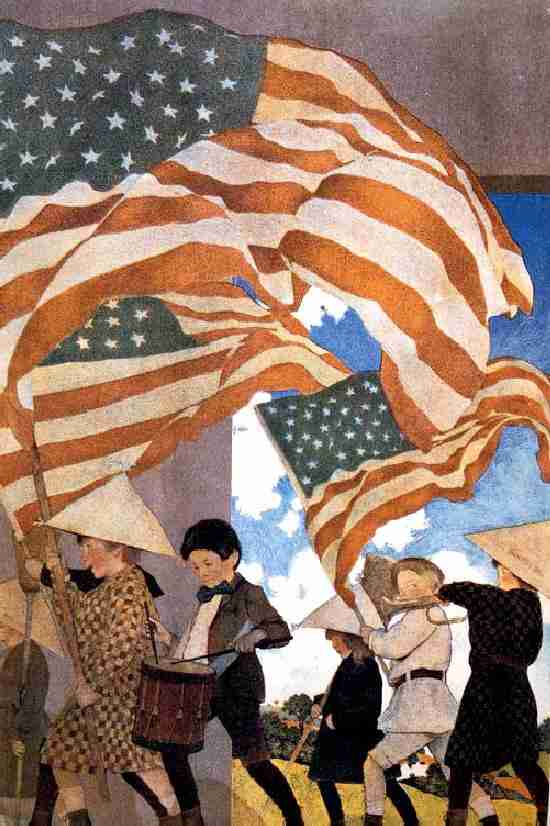
Maxfield Parish was perhaps the most popular American illustrator in the inter-war era. He had one of the longest careers of any American illustrator. He produced some enchanting illustrations for children's books and some imaginative magazine covers. Many of his prints are stunning. This was only a part of his extensive output. There were ambitious murals and machine-tooled maquettes. Some of his last works were hauting landscapes. Some art historians believe that Parish's work has been reporoduced more than any other American illustrator
Arthur Rackham
Arthur Rackmn is well known for his Mother Goose illustrations.
One of the most well-known an beloved illustrators is Norman Rockwell. Rockwell's early illustrations were done for St. Nicholas magazine, the same magazine which first published Little Lord Fauntleroy. He also worked for other juvenille publications. He sold his first cover painting to the Saturday Evening Post in 1916 and ended up doing over 300 more. Presidents Eisenhower, Kennedy, and Johnson sat for him for portraits, and he painted other world figures, including Nassar of Egypt and Nehru of India. In his later years he addressed social issues like the Civil Rights movement. He is perhaps best known by many for his Scout drawings.
Louis Schroeder (American, ??)
We have little information on American illustrator Louis Schroeder at this time. e know that he did a lot of illustrations for the Amerucan Scouting magazine Boys' Life A exanple of his work is a hockey story in 1932.
Frank Scooner was a noted illustrator from the Golden Age of Illustration. In a short biographt,. he talks about his youth and how much he loved the outdoors. He spent much of his time in the woods, walking along streams and fishing. In spite of this, his mother refused to cut his hair and at least on some occassions he wore dresses even at school age.
Another illustrator of Little Lord Fauntleroy was F. M. Spiegle. Unfortunately I have noinformation on this illustrator, nor do I know if he did only individual illustrations or heillustrated an edition of Mrs. Burnett's book. It looks like a fairlya simple drawing of Cedric rather than illustrating a scene from the book. The drawing appears to be an early one, but I have no information on the date.
Jessie Wilcox Smith is one of the most prolific and highly aclaimed women illustrators from the early 20th century. She is one of HBX's facorote illustrators. Her drawings of children are truly magical. Her illustrations are not the best for HBC's puposes. Her drraightmanship is superp, but the clothing is often not an important part of her drawings. Her illustrations often do not involve a detailed drawing of the children's clothes. Rather the child's may almost be hidden in a forest of bushes are under the covers. Her illistrations are, however, magical depictions of idealized, but not unrealistically protrayed childhood.
Storer was active at the the turn of the century. Her illustrations are some of the most enchantiung images of early 20th century childhhod that we know. She drew many wonderfull illustrations of children for Robert Lewis Stevenson's A Child's Garden of Verses first published in 1885. Her illustrations may have been in a later addition. Another source has her most active from 1909-14. We would be very interested in any information HBC readers may have on this truly great American illustrator.
We note illustrations by Charkes Darter Weldon. Many have oriental themes or settings. He did water colors and illustratiins for books and magazines. We have not been able to find any biographical information. We note an illustration from a story in St. Nicholas Magazine (Decenber 1906). The story was 'Captain June' by Alice Hegan Rich. The caption was 'All day long the boys played down by the river-bank'. We beliece the scene is set in China or Japan. The boys seem to be making kites.
There are countles images of Tom Sawyer by a miriad of illustrators. In addition it is apopular play for school groups to stage with often imaginative attempts at costuming. Schools all over the worls stage productions of Tom Sawyer, one example of how American or British boyhood heros dominate in the popular mind. True Williams was the original illustrator of Tom Sawyer. Williams worked on each of Twain's books previously published by the American Publishing Company. He did 160 of Tom Sawyer's 162 illustrations. The book was not a long one and these illustrations and chapter headings did a lot to increase the size of the book to what the public expected. Twain was very pleased with the illustrations which he called "rattling pictures." Twain made no suggestions about the illustrations. They were all conceived by Williams on his own as he read the book.
Blanche Fisher Wright
Blanche Fisher Wright is the illustrator of The Real Mother Goose, originally published in 1916. It is a real classic, still in print, and the illustrations are classic turn of the 20th century. Pretty much the full text and illustrations are on line at Mother Goose. Click on the cover to look at the contents. She also did the lesser known Peter Patter's Pretty Book of Rhymes. One HBC reader reports liking the illustrations better, but the rhymes are not in the same class as The Real Mother Goose. The Mother Goose stories are of course some of the best known nursery rhymes.
N.C. Wyeth (United States, 18??- )
N.C. Wyeth is perhaps the most famoos of all American illustrators of children's books. As a boy growing up in the 1940s, I remember that his drawings were especially striking to me. He was the youngest of four boys. His mother wo grew up without sisters, dearly wanted alittle girl. Wyeth illustrated boys' adventure books, but did realtively few illustrations of children. His illustrations are marvelous. I remember them in books I read as a boy in the 1940s. I remember in particular Black Arrow and The Boy's King Arthur. He had a way of drawing the most amazing people and events, but making them look very realistic and ordinary. [Michaelis]
Sources
Martin, Don. The Completely Mad Don Martin two volumes (Running Press, 2007).
HBC

Navigate the Boys' Historical Clothing Artist pages:
[Return to the Main illustrator page]
[Return to the Main national illustrator page]
[Return to the Main artist page]
[Chronology][Countries][Individuals][Styles]
Navigate the Boys' Historical Clothing Web Site:
[Introduction] [Activities][Biographies][Chronology] [Clothing styles][Countries][Literary]
[Bibliographies][Contributions][FAQs][Glossaries][Images][Links][Registration][Tools]
[Boys' Clothing Home]
Created: December 10, 2001
Last updated: 3:52 AM 4/15/2020