Biographical Details on Boys' Clothing Styles (G-L)
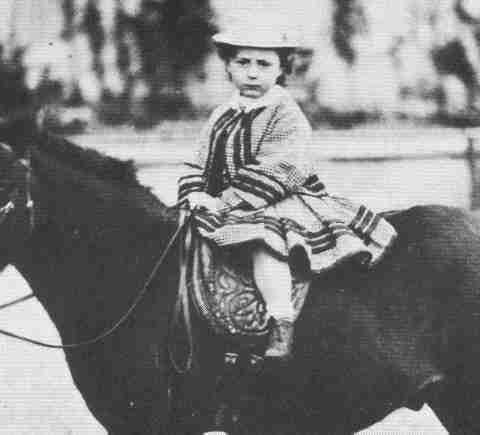
Figure 1.--This English boy, the Honorable George Lambton, wears a dress just like that of his sister. The photograph was taken in the 1860s.
Many famous and not so famous men remember the clothing and hair styles they wore as boys.
Not so many years ago it was all up to mom how junior was dressed. In some cases, especially in the late-19th and early-20th Century, moms in Europe and America let their imaginations run wild, choosing
elaborate Fauntleroy and
kilt outfits for their darling sons. The wife in affluent families rarely worked and thus she had a great deal of time, and in some cases the assistance of nannies and governesses, to see to the care and dressing of their children. The results were very little boys kept in dresses. Ever after they passed out of dresses, little and not little boys done up in dress-like tunics and kilts and lacy Fauntleroy suits and kilts as well as more manly sailor suits.
Available information on individuals from G-L are listed below. This page is still being developed. If you have any historical information to add, do let me hear from you.
G
Gable, Clark (US): Clark Gable was perhaps the most popular male film star in the 1930s and early 40s. As a little boy he wore dresses, but we have little additional information about his childhood clothes.
Gaileo Galilei (Italy, 1564-1652): Gaileo Galilei was an Italian Renaissance astronomer, physicist, engineer, philosopher, and mathematician. He is commonly seen as the father of modern science. Before Galileo there were important scoentific disciveries that appear in the histoty books. The individuals involved, howevr, were more philopophers than scientist because the scientific method had not been devised. It was Galileo that placed experimentation and not just observation at the hear of scientidic inquiry. And Galileo combined experimentation with controls--essentially creating the scientific method. As a result. Galileo played a central role in the scientific revolution that began during the Renaissance. As a result, Galileo is a primry candidte for the greatest scientists of all time. Galileo made major contributions to the fields of physics, astronomy, cosmology, mathematics and philosophy. He improved on the telescope that enabled him tp observe and describe the moons of Jupiter, the rings of Saturn, the phases of Venus, sunspots, and details on the rugged lunar surface. And like some modern scientists, he had a flair for self-promotion. This earned him powerful friends and made dangerous enenmie. His promotion heliocentrism brought him before religious authorities in part because he rediculed Pope Urban VIII. He was eventually forced to recant and placed under house arrest, ending his scientific carer, but not his ideas and the scientific method.
Garfunkle, Art (US): Art remembers being the Rabbi's pet and closing the service with a song that brought tears to the congregation. He says he liked doing it, both because he liked to sing, but also because he was dressed in a satin ribbon with a big lace
collar.
Gary, Romaine ( ): Romaine had a claustrophobic relationship with his mother. He was an only child and later wrote, "I am not saying that mothers should be prevented from loving their young. I am only saying that they should have some one else to love as well." Details on Romaine and other older children are described by Michele Slung in The Only Child Book (Ballentine).
Gandhi, Mohandas Karamchandi (India, 1869-1947): Mohandas was born in Porbandar, a small town along the western coast of India (1869). It was actually a tiny principality in Kathiawar. This was a microcosim of the pathwork construction that made up the British Raj. His middle-class family was part of the Raj. They were of the Vaishya caste. His granfather was the Dewan (Prime Minister) of Porbandar and Mohandas' father essentially inherited the post. His mother, Putlibai, was by all accounts a loving, gentle, almost saintly person. Mohandas attended the local primary school, but did not particularly impress his teachers. He was not good at math. At ahe 7, the family moved to Rajkot. This was another pricipality in Kathiawar. His father was apointed Dewan. There Mohandas coninued his primary education and continued on in the local seconary school. Despite working hard he was still a rather mediocre student. He was also a very shy and timid youth. It was from this not very auspicious beginning that Gandhi went on to become the genius of the independence movement, developing a tactic of non-violence. He is today the most beloved of all India's leaders.
Geronimo (Mexico/United States, 18??- ): Geronimo is today one of the best known Native American leaders. He was an Apache (Chiricahua) chief and medicineman. He was the last native American to offer effectivecresistance to the U.S. calvalry. He and is tribe fought both the Mexicans and the Americans. He fought the Ameeicanbs fir an incredible 25 years. He writes, "Afterca few days' skirmishing we ttcked a freigh trainthat was coming in wih supplies for th Fort. We killed some of the menabd captured the others. These prisoners our chief offered to trade for the Indianswhom the soldiers had captured at the massacre in the tent. This the officers refused, so we killed our prisoners, dibanded and went into hiding inthe mountains. Of those who took prt in this affair I m the only one now living." [Geronimo]
Gifford, Leroy (US, 18??-??): Two images from Fargo, North Dakota taken by photographer Authur Bentley appear to preserve for prosperity the day that Leroy D. Gifford was breeched. We know nothing about Leroy, except that he appears to be about 10 or 11 years old. A close analysis of the photograph, however, does provide some interesting conclusions. Please let me know if you agree or if you have any thoughts on these images.
Giudice, Maria (Italy, 1880-1953): Maria Giudice was an Italian socialist activist. She was a teacher in primary schools. She became active in political activity with the socialist labor unions and in the party (early 1900s). She begn living together Carlo Civardi (1903), but thgey never married. Many Socialists at the time questioned traditional values like marriage. They had seven children. Carlo died during World War I (1917). The Socialist Party resisted Italy's entry into the War. Her political activity ended when the Fascist party seized power and forbid non-Fascist political parties and labor organizations (mid-1920s).
Goebbels, Joseph (Germany, 1897-1945): Joseph was reportedly raised by a weak father and domineering mother who idolized him. He apparently had few friends as a boy. His club foot made him an object of derision to other children. It also kept him out of World War I. He was an excellent student and earned a Ph.D in German literature. Goebels joined the NAZI Party after meeting Hitler in 1925. Hitle appointed him Gauleiter, or party governor, in Berlin. He founded the Party magazine Der Angriff (The Attack). After HItler sized power he made Goebels Minister of Propaganda and National Enligtenment in 1933. He served in that position until killing his six children and himself in Hitler's Berlin bunker at the end of the War.
Göering, Herman (Germany, 1893-1946): The Reichmarshal's mother was kept by a half Jewish Austrian nobleman, perhaps even his father. Hermann was apparently a cheerfully unruly boy. He was sent to a military boarding school at the age of 11 where he was punished for choosing his half Jewish
godfather as a great German. His school mates found out about it and
paraded him around the school with a placard hung around his neck, "Mein
Pate ist ein Jude" ("My Godfather is a Jew."). The humiliated Hermann ran
off home. Heydrich who organized the Holocaus had a similar experience. G�ring was an air ace during World War I. He played a major role in Hitler's rise to power and estanlishment of a dictatorship. He oversaw the creation of the Luftwaffe and was given other major assignments by Hitler, including organizing the Holocaust. Failures of the Luftwaffe agter ininial successes destroyed his influence with Hitler. He was tried as a war criminasl at Nuremerg. He committed suicide before his execution.
Goldman, Emma (Lithuania/United States, 1869-1940): Emma Goldman became involved in the Americn Labor Movement as a fevent Anarchist, earning the nick name "Red" Emma. She was born in in Kaunas (Kovno), Lithuania to middle-class Jewish parents (1869). Her parents ran a small inn. Anarchists assasinated Tsar Alexander III (1881). His reactionary son, Alexander II, launched terrible pogroms against Jews. The family feeling threatened moved to St. Petersburg when she was 13 years old. She got a job in a corset factory, an interesting choice given the feminst principles she later expoused. It was in the factory that she was first exposed to radical socilaist and anarchist thought. One concept that that made sence to her was the use of revolutionary violence to bring about social change. A view she continued to hild after emigrating to America.
Gorchakov, Prince Alexander Mikhailovich (Russia, 1798-1883): Prince Alexander Mikhailovich Gorchakov, later Duke Gorchakov.
The Gorchakov family were aristocrats, descended from the first tsars and related to all the important aritocratic families of Russia. Prince Gorchakov was chancellor of the Russian Empire (1863-83). Prince Gorchakov devoted himself primarily to foreign affairs, but took some part in the great internal reforms of Alexander II. istorians rate him as a highly competent diplomat and credit him with some of Tsarist Russia's diplomatic succeses. He helped Russia recpver from the Crimean War diplomatically. His relationship with German Chancellor Bismarck deterioratd, leding to a break when Kaiser Wilhelm refused to renew the Reinsurance Treary that Gorchakov and Mismarck had crafted. Art was Gorchakov great passion. He collected contemporary 19th century painting from Belgium and the Netherlands. As a result, the Hermitage Amsterdam has imprtant paintings by these often unknown Belgian artists (Eurgene de Block, Theodore Fourmois, Nicaise de Keyser, Joseph Stevens, Louis Gallait and Florent Willems). Here is a portrait of the Duke's sons in 1848 by Nicaise de Keyser.
Gould, Jay (United States, 1836-92): Jason 'Jay' Gould was born in Roxbury, New York (1836). The family patriarch was a Scottish immigrant at a time tht New York was still an English colony and tge western and northern areas part of the frontier. Gould rose from modest circumstances to become one of the richest Americans ever. He played a njor role in the development of the American railroad industry as both a developer and speculator. Progressive Journalists and histotians have depicted him as the archetypal 19th century capitalist robber baron. Less ideologically fixed authors in recent years have suggested a more nuanced view of Gould. There is no doubt that he was a rapacious businessman. It is also the casr that the railroad industry he helped build played a major role in the Federal victory in the Civil War which ebded slavery. It is also true that the indistriual expansion of the United States facilitated by the railroad network that Goild helped build made possible the highest standard of living in the world and wages well above European levels. Often onntted in a discussion of the Robber Barons like Gould is that they laid the foundation for the industrial strength that destroyed the great totalitarian states of the 20th century.
Grant, Carry (US/England, 1904- ): The movie actor was told his
mother disappeared when he was 9 years old. She was actually put away in a mental hospital. Carry wore shorts as a boy. One picture show him at about 6 or 7 wearing a plain sweater, shorts, and knee socks.
Greene, Graham (England, 1904-91): Noted English author Graham Greene was one of a number writers who were very unhappy at their private schools. Graham had a hard time, not only because hedidn't like sports, but becausehis father was the headmaster. His father thought he was disturbed and set him to a therapist. One of his most noted books is The Power and the Glory. He is also known for his Cold War books, The Quiet American and Our Man in Havana.
Gregorian, Vartan (Iran, 1934): Vartan Gregorian is the famous American intellectual, academic, and university president. He was born in 1934, Tabriz, Iran. He belonged to the small Armenian Christian community in
Tabriz where he grew up. He came from a rather poor family and has
written interestingly in his recent book, The Road to Home (2003), about the family's need to blend into the Islamic culture of Iran during the 1930s.
Grove, Andy (Hungary/United States, 1936- ): Few corporations have had a greater impact on the world as Intel. And Intel's Chairman during the critical era of the personal computer was Andrew S. Grove, a Hungarian Jew. Andy was born in Hungary as András István Gróf (1936). This was of course not an auspacious time to begin life as a Jew. He narrowly missed the NAZI roundups and shipment to the death camps (1944). He was a pre-teen at the time and looked on evading the NAZIs as a great adventure, not fully comprending what was at stake. His father had wisely prepared the family for what was to come. he and his mother managed to hide with the help of friends. His father was seized and sent to a forced labor camp, but managed to survive. After surviving the NAZIs, Grove had adverse, although less horific, experiences with the Communists that replaced them. He had been taunted for being a Jew, now he was taunted for being the son of a businessmen. He was a good student and earned excellent grades in secondary school during the 1940s. He was, however, denied access to university because the Communist authorities labeled him a 'class alien'. He writes, "It's hard to describe the feelings of an 18-year old as he grasps the nature of a social stigma directed at him." [Grove] Such actions like this, limiting the prospects of its talented youth is one of the many reasons that Communist regimes reported such poor economic results. Andy as the Soviet tanks poured into Hungary, he escaped from Communist-controlled Hungary at the age of 20 years seizing the opportunity presented from the Hugarian Revolution (1956). He evntually moved to the United States. Contrast the restrictions on his aspiratioins under Communism this to what Grove managed to achieve with Intel with Capitalism in his adopted country, America.
Gumble, Brian (US, 1948- ): Longtime anchor for the NBC "Today"
program. Brian was dressed in short pants suits as a boy. I've seen
pictures of him at about 5 with a collarless Eton short pants suit,
rather long shorts with ankle socks. In another picture at about 7 or so with his brother, both in a short pants suit. I'm not quite sure when he made the transition to longs.
H
Halsted, William S. (1862-1922) - William Hasted is commonly seen as the father of American surgery. He was born in New York City (1852). His father was a successful businessman with Halsted, Haines and Company. Bill had a privlidged childhood. As was common for children from wealthy families, Bill was educated at home by tutors. He was an indifferent student. He was sent to a boarding school in Monson, Massachusetts when he was 10 yeas old (1862). He did not take to the strict dscipline. It must have been a shock for a pampered boy. He ran away from the school. His father then chose a different school, Phillips Academy in Andover, Massachusetts, the brst known prep schoolin Amerca. He finished there (1869). His academic performancewas medicore. Halsted entered Yale College (1870). He was extreek\ly outgoing and athletic. He was captain of the football team, played baseball and rowed crew. His academic perforancewas undestinguised. He then entered Columbia University College of Physicians and Surgeons (1874), graduating with a Doctor of Medicine degree (1877). It was there that he began to seriously apply himself. American surgery was still quite primitive. He went tob Germany for further studies. hen he reyurned hime, despite becoming adicted to cocaine while working on anaestehesi, he begn to revoutioniza American surgery. Because of the cocaine the outgoing, sociable Halsted became reticent, and very private. The cocaine addiction destroyed his successfl New York practce. He continued his work at the John Hopkins Instiute in Baltimore.
Hammarshold, Dag - (Sweden ): The United Nations diplomat's mother took great care with Dag's clothes. He wore white Little Lord Fauntleroy suits with knicker pants. He had long ringlet curls. sometimes with a hairbow.
Hart, Gary - (19??- ): Hary Hart was a senator from Colorado and presidential contender in the 1970s. The author Gail Sheehy in her book Character: America's Search for Leadership, wrote about Hart, "Gary Hart is a double man. All his life he has lived a lie. Severely restricted by his upbringing from experimenting in any of the ways normal for a bright, imaginative boy, Hart broke out at 24 and seems to be stuck in a perpetual adolescence." Apparently he had an unloving, fundamentalist mother. I don't know the details about his childhood.
Hausman, John - (UK?, 1903- ): The noted actor/director was very nicely dressed as a young boy. I saw a picture of him at about 4 and he looked like a beautiful little girl in a frilly dress and curls. I saw another picture as an older boy, about 13 or 14 and he was in long pants. He was educated at Clifton College, but had a very urbane, European background. He started out with a career in international finance, but after losing everything in the Depression, was drawn to Hollywood because he was married to a movie star.
Hays, William Harrison Sr. - (US, 1879-1954): William Harrison Hays was born in Sullivan, Indiana (1879). He played an important role in Republican politics. He rose to hairman of the Republican National Committee (1918-21). And he managed Senator Warren G. Harding's presidential campaign (1920). President Harding appointed him Postmaster General. Until after secure World war II, this was a highly political appointment because of the opportunity it provided for rewarding supporters with government jobs. After only a year in office, Hays resigned to become with the support of the Hollywood movie studios to become the first president of the Motion Picture Producers and Distributors of America (MPPDA), a position he held until he retired (1945). Hays is best known as the force behind Hays Code which provided guidelines for censoring American movies.
Halsey, William - (US, 1882-19??): William "Bull" Halsey was born in 1882. All we know about hisboy hood clothing at his time is that he wore sailor suits as a boy. He entered the U.S. Naval Accademy at Anapolis in 1900. He was popular, but not abilliant student. He graduated 43rd in a class of 62. He was a part of the Geat White Fleet that President Theodore Rooseveltsent on a world tour. It called at Yokahama which was Halsey's first experience with the Japanese. More were to come in World War II.
Hearst, William Randolph (US, 1863-1951): William Randolph Hearst was the only child of George Hearst, a self-made multimillionaire. His father made his money principally in the Western staples of mining and ranching. Wiiliam's mother was Phoebe Apperson Hearst. His father who had no interest in journalism accepted the San Francisco Examiner to satidty a gambling debt (1887). It was a snall part of the Heast family holdings. At age 23 William took over operation of the paper which his father had no interest in managing (1887). William was impressed by New York newspaper tycoon Joseph Pulitzer. Using Pulitzer as a model. He turned the The Examiner into the most important Pacific Coast newspaper and the foundation for the greatest media empire in American history. The paper became the same combination of reformist, investigative reporting and lurid sensationalism that Pulitzer pioneered. Pulitzer and Hearst became known for what was labeled 'yellow journalism'. Hearst married Millicent Willson in New York City (1903). They had five sons (George, William Randolph Jr., John and twins Randolph and David). He is noted for San Simeon and the art he collected there. He was a fervant Isolationist and used his papers to fight Presidenr Roosevelt's efforts to resist NAZI aggression in Europe.
Hemingway, Earnest - (US, 1898-1961?): Rugged American novelist Earnest Hemmingway was born in 1898 and raised
in Oak Park, Ill. His tough guy, hard boiled style had a profound
influence on other American authors. His father taught him to love outdoor sports. In contrast to this image, he was rather a coddled child, a least when he was young. His mother who prided herself on her culture and who did have a beautiful voice, however, dressed him and his older sister as twins and insisted he practice a musical instrument. She was very disappointed that none of her children had notable musical talent. Ernest in fact liked to use the music room to stage boxing matches. He seems to have gone from dresses to regular boys clothes without the transition of kilts or other fancy suits which was a common convention at the time.
Hess, Rudolf - (German, 1893-19 ) The NAZI Vice-Führer was born in Egypt where his father had established an import-export business. Growing up in a villa surrounded by a luxurious garden, Rudolf received a disciplined, Teutonic upbringing that clashed with his romantic temperament and the exotic Near East setting. He was an early supporter od Adolf Hitler and during the early years his closest associate. He gradually lost influence in the NAZI hierarchy. He is best remembered for a dramatic flight to Britain (May 1941). He in the run-up to Barbarossa to prevent a two-front war. He was tried and found guilty at Nirremberg, but did not get a death sentence because he was not directlt involved in the Holocaust.
Heydrich, Reinhard - (Germany, 1904-42): Reinhard Heydrich is considered by most to be the architect of the Holocaust. Adolf Eichmann is often seen as the director of the Holocaust. Eichmannwas in fact primarily the administrator of the Holocaust. It is Heydrich more than any other single individual who planned the Holocaust.
Himmler, Heinreich - (German, 18??-1945): SS Reichführer Himmler represents the true embodiment of evil in the 20th century. He grew up in a middleclass German family. His was a school administrator at a gymnasium (academically selective seconadry school). He could be extrenmrly cruel to the boys in pstchological ways. One boy remembers how he and his brother were expelled by being pubically humiliated before the class when their farher could not pay the school fees. His farher had an interest in romanticised German history which hr passed on to his son. Heireich and his brothes were outfitted in dresses and sailor suits as boys. He was not a brilliant student, but did very well because he was extremely dilogent. He was dissapointed in World War I becaue he did not complete officer cadet training before the War ended. One biograpger mainatins that although he was strongly anti-semmetic that the Holocaust was forced on him by Hitler from above and Heydrich from below.
Hippocrates (Greece, 460-375 BC): Hippocrates was born on the island of Cos (460 BC). He was the foremost Greek physician of the Classical Era. He is commonly cited as the father of Western medicine. As wih many important figures of the day, it is virytually impossible to differentiate fact from unverified tradition concerning this important figure. Over the centuries his stature as a revered physciam mean there is no factual account of his life. Some 60 medical texts have survived bearing his name, most of which scholars believe were not actually written by him. He was especially noted for his his ethical standards expressed in the Hippocratic Oath, one of the texts hemay not have actually written. He died in Larissa, Thessaly (375 BC). The tradition he founded, however, is one of the jewels of Western civilaztion. Many of the socities that cticize the West, rely on Westerm medical technology. And never do they stop to ask why it is that this technology hasbeen developed in the West and not in their societies,
Hitler, Adolf - (Austria/Germany, 1889-1945): Adolf Hitler is arguably the most evil individual in modern history. He is a good example of how individuals do matter in history. Major economic and social forces may largely frive history, but time and again individuals have arrise that have directed events for good or evil. Hitler was born in Austria to an abusive father who was a minor customs official. His mother was loving a permisive. He was an inteligent boy who was unmotivated and did poorly at school. After his mother died, he went to Vienna hoping to be an artist. After he failed the admissions exam he was cast adrift, living in great poverty. It was hear that he appears to have acquired a deep-seated anti-Semitism in reaction to Vienna's large prosperous Hewish population. For Hitler World war I was a refuge from poveety and failure. After the War he rose in the German nationalist movement to become Chancellor of Germany and lead that great nation into the most terrible war in hitory and to the commission of horendous crimes in the name of the German people. At the end he blamed his failure on the the German people and their lack of commitment.
Holroyd, Michaek - (England, 19??- ): English author Michael Holroyd is one of the notable literary biographers of the 20th century. His massive biography of George Bernard Shaw is widely proclaimed as the definitive work on the famed English writer. Holroyd's authobiography provides an interesting glimpse of his and his father's childhood. His father Basil and uncle Andrew wore dresses in the years before World War I. I'm not sure yet how Michael was dressed.
Hood, John Bell - (United States, 1831-79): No one ever questioned the bravery of Confederate Genera John Bell Hood, but his command of the Army of Tennessee was a disaster for the Confederacy. Hood was born in Owingsville, Kentucky during 1831. He grew up in Kentucky's bluegrass region of central Kentucky near Mt. Sterling. His paternal grandfather was Lucas Hood who served in the Indian Wars under famed General "Mad" Anthony Wayne. His grandfather fought at Fallen Timbers. His maternal grandfather James French, served in the Revolutionary War. His father wanted him to be a doctor. Instead Hood through the assisance of an uncle, Congressman Richard French, secured an appoitment to West Point. There his academic career was average, but he awarded a large number of demerits--some by Superintendent Col. Robert E. Lee. Despite the demerits, Hood graduated 44th out of 52 in the class of 1853. Hood served in South Carolina and then with the calvary in Texas. When the Southern states seceeded, Hood was awarded a commission as a 2nd Lieutenant in the Army of Northern Virginia. He rapidly rose in rank. He was severely wounded at Gettsburg, but upon recovering joined the Army of Tennessee. Hood had proven a daring an effective commander under the command of Lee, but when given command of the Army of Tennessee he proved a disaster. After the War he fathered a large family.
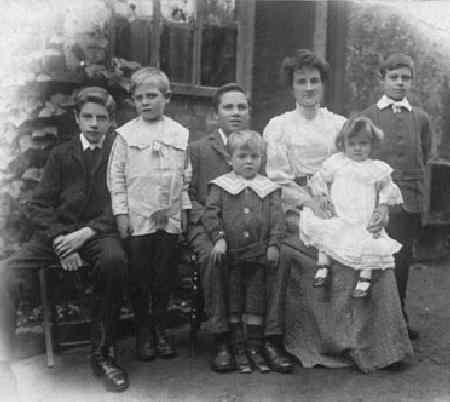
Figure 2.--This is the Hope family in 1907. It may have been taken just befor the family emmigrated to Anerica. Bob or Leslie at the time is the little boy in the middle.
Hope, Bob - (American, 1903): English born Bob Hope grew up in America. Bob was the fifth of seven sons. He was born Leslie Townes Hope in Eltham, England on May 29, 1903. His English father, William Henry Hope, was a stonemason--his Welsh mother Avis Townes Hope, an aspiring concert singer. Leslie's father in 1907 brought his family to Cleveland, Ohio. Bob went one to become perhaps America's most beloved comedian. The boys were dressed in a variety of juvenile suits with large collars when then they were little. In America they wore knickers although they wore long pants in England.
Hopkins, Anthony - (Wales, 1937- ): The British actor Anthony Hopkins was raised in Walses. I watched a Bravo (US cable netwok) TV profile on Hopkins. Seems he hated school. But what surprised me was that the video about his school days was stock footage on schools with boys wearing smocks. Obiously French images having nothing to do with Wales and schools in Wales. Strange that they would show repeated images of french schools while the naration and comments from Hopkins himself explained how abusive his schools were and how much he hated school.
Hoss, Rudolf Franz Ferdinand - (German, E1900-46): The infamous commandant of Auschwitz was born in Baden, near the French frontier. His father was a bigoted, sexually suppressed, fanatic Catholic, who after fathering Rudolf and his younger sister, had taken an oath of celibacy. He dedicated Rudolf to God, intending that he be a priest. Assuming the mantel of a saint, he proclaimed Rudolf's sister an angel and made the Rudolf's boyhood a torture of pertinence, prayers, lies, and guilt feelings. At the age of 17 he escaped by enlisting in the calvary.
Hughes, Charles Evans (United States, 1862-1948): Charles Evans Hughes was an important figure in early-20th century America. Charles was born in Glens Falls, New York (1862). He was the soin of an English immirant and Baptist preacher. His parents educated him at gome until mhe entered college. His career was primarily associated with the U.S. judicial system. He is a wear Supree Court justice who left the Court and then retuned, in his case as the Chief Justice. Her served on the Court (1910-16), leaving it to run for president after being mominated by the Reoblicans. He lost in a very close electiom to President Wilson (November 1916). Wilson's campaign slogan that seens to have carried the day was that 'He kept us out of war." Only a few months later, however, the United States entered the War (April 1917). Hughes then served as Secretary of State in the Hardng and Cooldidge Administarions. Hughes played a major role in the Washington Naval Arms Limitations Conference, leading to substantail cuts in Naval arms spending. He was then appointed by President Cooldidge to be the 11th chief justice of the United States (1930–41). It was Hughes who as Chief Justic led the Court during the Depression era when major issues arose ocer the scope and role of Government as a result of President Roosevelt's New Deal legislation. This led to the President's effort after his massive electoral victory (1936) to pack the Court (1937). The issues were finally determined when the President's Court appointments changed the compsition of the Court. Hughes died (1941).
Hugo, Victor-Marie (France, 1802-85): Victor Hugo is generally recognized as the greatest French author of the 19th century. He wrote in different forms, including novels, plays and poems. Victor-Marie was born in Besançon during the Napoleonuc era in 1802. His parents were Joseph-Léopold-Sigisbert Hugo and Sophie Trébuchet. His father was a fervant supporter of the Revolution and a military officer who rose to the rank of general. The marriage of his parents failed, although there was no divorce. Victor was raised by his mother, but a relationship continued between his parents. Léopold was appoined military governor of an Italian province near Naples. Victor's mother brought the familt to Italy to be near General Hugo. Subsequently General Hugo was transferred to Spain and the family followed him there. Victor's mother Sophie became involved with General Victor Lahorie, who had once been her husband's commander. Lahorie was executed for plotting against the Emperor (1812).
Humprey, Hubert H. (United States, 1911-78): Hubert Huprey was elected vice president of the United States with President Lyndon Johnson in 1964. He was one of the towering figures of Americam liberalism. He burst upon the American scene at the 1948 Democratic Convention when he delivered a stiring keynote address on civil rights. He would later play a key role in the passage of the land-mark 1964 Civil Rights Act. He was the Democratic nominee in the 1968 presidential election, but was defeated by former vice-president Richard Nixon. Humprey was one of the most decent, fair politicans in American history. He was the engine for liberal political ideas, He thought up what would become the Peace Corps. Nuclear arms control was another issue he championed. He also strongly supported American food aid to poor countries. We note a stirring speech in which he recounted the hunger and poverty of the third world and argued that it would not only be a moral failure for America not to provide food aid, buut it would bed evil. He accused the Eisenhower Administration of bring "intelectually and spiritually baren". We do not disagree with America offering food aid to starving pedoples. There was a critical lapse in his thinking. Food aid did not address the basic issue--why is the Third World poor and why is America rich and able to produce such a large surplus. Humprey would talk about God's bounty. And it is true tht America is gifted with productive land. But so are other countries. It is the American free enterprise capitalism that has turned the potential into reality. But this was never one of the key policies he championed. And we would offer that in this regard that Senator Humprey was himself "intelectually and spiritually baren". This is a failing that modern liberals continue to make. It pains me to say this as I so admire Humprey. But it is a simple fact that American food aid had no lasting impact on the Third World, but look at the impact that free market capitalism has had on countries like Brazil, China, India, Korea, Taiwan, Singapore, and others. Senator Humprey can also be faulted for his failure to speak out passionately about the great evil of the day-- totalitarian Communism.
I
J
Jesus (Palestine, about 6/4 BC - 33 AD): Jeus was born in Betheham, but the precise year is unknown, but was about 6-4 BC. His crusifiction and death is commonly dated at about 33 AD. Christians of course see him as the son of God and part of the Holy Trinity. Religious people will differ on this, but what is undisputed fact is that Jesus was a historical figure on which the Christian Church was built. We know a great deal about his life, although little about his childhood. His teachings were recorded in some detail by the Appostles. Often not fully appreciated is the revolutionary nature of his teachings. They contrast markedly from the ethical principles that were developed throughout the Middle East and familiar to those of us who are familiar with the Jewish Old Testament, basically a reinteration of the Code Of Hamurabli (1741 BC). The older books of the Old Tetament were written some time after that, especially when you consider that there was an oral tradition before they were set down. Our modern concept of morality are essentially based on Jesus' moral teaching expresed in the New Testament. These teachings include precepts like the Golden Rule and the Good Samaritan and the emphasis on the value of the human life. Christians of course have not always followed these teachings. But the great arc of Western civilization has been toward a fuller appreciation and implentation of Jesus' moral principles. Interestingly the third great Abrahamic religion which rose in the Midle East, six centuries after Jesus, Islam, recognized Jesus as an important prophet, but not a deity. Mohammed in the Koran rejected much of Jesus' ethical teachings and reverted to the older ethical standards of the Middle East as expessed in the Old Testament. This difference comes into play when you consider why modernity was first achieved in the Christain West and the Arab Muslim Middle East is both poor and backward. Only the Arab countries sitting on vast pools of oil have emerrged from poverty in the modern world.
Jones, Sir William (England, 17??-??): William Jones, the renowned "Oriental Jones". William was an academic prodigy. His mother was a widow, but instilled in him the teachings of thegreat thinkers of thec day like John Locke. John reportedly recited Shakesper at age 4 and knew The Tempest by heart at age 13. He majored in the Classics at Oxford. Jones in 1778, after the British conquest of India from the French, was offered the post of justice on the Supreme Court of Bengal. The Governor Gerneral at the time was William Hastings who had an appreciation for Indian culture. Unlike most British, who spurned Indian culture, Jones actually learned Sanskrit, perhaps the first Westerner to do so. With his previous academic
training and knowledge of languages (Latin, Greek, Hebrew, Arabic, and Persian), he was the first to grasp the similarities in these languages and their common origins that today has come to be known as the Indo-European language pool. Jones founded the Asiatic Societyb of Bengal and the societies periodic publications Provided a platform for researchers throughout India to share their findings. One of those findinds was to introduce Buddhism to the West.
Joyce, James (Ireland, 1882-1941): James Joyce the Irish novelist and poet was born in Dublin. (1882), His father was John Stanislaus Joyce and May Joyce. His farther who was born in 1849 came from an upper middle class family. He grew up in comfortable circumstances, epecially by Irish standards of the day. His father had access to an upper-class Catholic education, but made little of it. He enrolled in Queens College as a medical student, but never earned his degree. Instead of studying, he devoted his energies to singing, atletics, acting, and disapation. He married May in 1880 and provided her pregancies, miscairages, child bearing, near peurny, and financial distress. James, the second child, was born in 1882. James' father was a wasteral and his mother and brothers and sisters had a very difficult childhood. He was reportedly his father's pet. James wore sailor suits as a boy of 7 years of age. We do not yet have additional details on his boyhood clothes.
K
Kant, Immanuel (Germany, 1724-1804): Immanuel Kant was a Prussian philosopher who is commonly seen as one of the great philosphers and a key figure in the development of modern philosophy. Immanuel was born in Königsberg, East Prussia (1724). He showed an aptitude for learning as a boy. He attended the Collegium Fridericianum. He enrolled at the University of Königsberg (1740) and there he stayed throughout his long career. spent his whole career. He argued that fundamental concepts structure the human experience, His cebtral tennannt was that reason rather than religion was the source of morality. His contributions to metaphysics, epistemology, ethics, and aesthetics was immense and had a major impact on the many philosophical movements that followed him. His master work was The Critique of Pure Reason (1781). Kant throughout his career kept returning to the question, "What can we know?" His answer while often stated variously basically was that our knowledge is constrained by mathematics and the science of the natural, empirical world. Kant insisted that kit was not possible enter the realm of speculative metaphysics beyond the experiencs of the sences. Kant explains these basic constraints are dueto te fact that the mind plays an active role in interpreting experience and limiting the mind's access only to the empirical realm of space and time. Kant responded to his predecessors by arguing against the empiricism of the French philosophes who contended that the mind was a blank slate (tabula rasa ). He also rejecting the Rationalist contention that pure, a priori knowledge of a mind-independent world was possible. While Kant today is a toweing figure in philodsophy, the American founding fathers were far more influenced by the French Enlightenment and phiosophs. A factor here was timing. as america moved toward revolution, Kant had only begun to write and he wrote in Gernany which few Americans spoke. Also Kant was much less intereted in goverment than the phiosophs. Kant died in Königsberg (1804).
Kästner, Erich (Germany, 1899-1974): Erich Kästner was a famous German writer of children's stories. He is probably best known for his book Emil and the Detectives. He was popular both in Germany and other countries, mostly within the German speaking world. He was well known in the Scandnavia and the Netherlands, but less so in France and English speaking countries. He was drafted at the age of 17 and was apauled both by the brutality of German military training as well as the War itself. Thus he became a life-long pacifist and as the NAZIs appeared on the political landscape, anti-NAZI.
Kelly, Gene (US, 1912-96): Gene's mother gave dancing lessons. Sheinsisted all her boys take dancing lessons. There is a cute picture of him as a boy, about 7 or 8 years old in a nice sailor suit. Gene wanted to be a baseball player and hated dancing. He thought it was sissy. Later as a teenager he began to like it--especially as it helped to meet girls.
Kerensky, Alexander Feodorovich (Russia, 1881-19??): Kerensky participated in the 1917 revolution aganst the Tsar. He was a moderate socialist believing in a democratic government. He succeeded Prince Lvov's Provisional Government. Kerensky's Government was overthrown by Lenin's Bolshevicks (November 1917). Krensky eventually emigrated to the United States.
Kertész, André (Hungary/US, 1894-1985): André Kertész was American of of Hungarian ancestry. He was born in 1895, but we have no details on his childhood at this time. He is one of the most prolific photographers of the 20th century. Like Cartier-Bresson (??) or Doisneau (French), he is one of the great masters of humanistic photography, which sympathetically focuses on the life of common people. Kertesz during the 1930s lived and worked in Paris and published several collections of his photographs. One of his best known is Enfants published in 1933. Some of the photographs were taken in the classroom and wonderfully record French school life.
Kessel, Joseph (Russia/France, 1898-1979): French author and journalist Joseph Kessel led an interesting life. His father and he made some very importaht decesions that saved their lives. He was born in a strange place for a French author--Villa Clara, Entre Ríos, Argentina. And his father was not French, but a Jewish Lithuanian dictor. Joseph was born in Argentina because his father traveled so widely. Joseph grew up as a boy in Orenburg, Russia situated in the Urals between Europe and Asia. His father took the family to France (1908). a fortuitous move. Joseph thus learned France and was educated in Nice and Paris. He was this flunt un Russian and French. He served in World War I as a French pilot--one of the most dangerous military activities of the War. He would serve again as an aviator during World War II, this time as France was occupied with the Free French 342 'Lorraine' bomber Squadron of the British Royal Air Force. Kessel and his nephew Maurice Druon translated Anna Marly's song 'Chant des Partisans' from the originl Russian into French. The song became an iconic World war II song and one of the anthems adopted by the Free French Forces during the War. Kessel authored wrote several popular novels and books that were later produced as films. The best known is 'Belle de Jour' directed by Buñuel. (1967). Kessel was a member of the Académie française (1962-79).
Kirk, Sir John (Scotland/England, 1832-1922): Sir John Kirk was a Scottish physician, naturalist, explorer, and British diplomat. He served as Consul General in Zanzibar. As that Arab Sultunate was central to the Arab slave trade in East Africa, he played an important role in ending the Indian Ocean slave trade. John was born in Barry, Angus, near Arbroath, Scotland. We know nothing about his parents or childood other than he grew up in Scotland. While he grew up in and was educated in Scotland, his adult life was primarily spent in England. An elder brother was the engineer, Alexander Carnegie Kirk. John himself earned a medical degree from the University of Edinburgh. As a natralist he became interested in Africa which linked him to join Dr. David Livingstone on the Second Zambezi Expedition from Zanzibar as a botanist (1858-64). This assoiciation caused him to become commited to ending the slave trade in Africa. He, however, was not impressed with Livingstone as a expedition leader writing that he was 'out of his mind and a most unsafe leader'. He remained in Zanzibar when Linvingston left for his next expedition. Kirk would be appointed British Vice Consul to the Zanzibar Sultunate. He would spend the next several decades in Zanzibar, rising to Consul General. He worked tirelessly to end the Indian Ocean slave trade. Krk was an avid photographer and botanist and published many papers from his findings on Zanzibar and the Comorro Iskands and travels in East Africa. He developed a strong relationship with successive directors of the Royal Botanic Gardens, Kew.
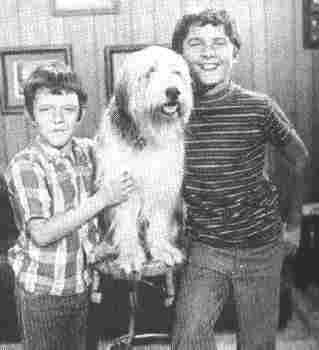
Figure 3.--The TV show "The Brady Bunch" was a showcase for 1970s American fashions. Here Christopher Knight (Peter) and Michael Lookinland (Bobby) appear in the typical dress of the era, "t" shirts, colored collared shirts, and jeans. Notably, they never wore short pants, even though many American boys were beginning to wear shorts for casual wear.
Knight, Christopher (US, 1960?- ): Americans will remember Christopher better as Peter Brady of TV's The Brady Family. The clothes worn by Chris and his co-stars are a good reflection of what American boys were wearing in the 1970s, "t" shirts, long pants, jeans, bell-bottoms, and jackets with wide collars. It is notable that none of the boys wore short pants, even though American boys were beginning to wear shorts more commonly as leisure wear--especially cutoffs. One episode ("The Liberation of Marcia Brady") had Peter dressing up in the uniform of the Sunshine Girls (Girl Scouts) in an effort to show
how foolish it was for his sister to join a Boy Scout-like group. Peter appeared in the girl's uniform, a green dress and knee socks--but never in short pants. We are not sure why American TV in the 1970s never pictured boys in shorts, perhaps the producers felt boys watching the show would not approve.
Koivunen, Aatto (Finland, 1874-1924): Aatto (actualf Adolf but often inicated as Eve) was born illegitimate. This and other indescretions led to his mother being punished (pilloried) by the church and the family lands conficated. This no doubt affected his social and polittical outlook. He seems to have acquired the name Koivunen. He became involved in the local workers movement fom an early point, although he also founded a sucessful insulation business. He learned English and had friendly relations with Russians. He was thus drawn into the Bolshevick Camp in the Civil War.
As the commander of the Pispalan (region of Finland) Red Guards, he led a local Red Guard foce in the Finish Civil War after the Russian Revolution. He became a rakennuseristäjä (home builder). He married Hilma Nikkilä (1877- ) and they had four children before World War I. Their sons were Martin and Reino and trheir twin daughters were Asta and Martha. Hilma was at first interested in the youh movement. He and Hilma became deeplicks and the Red Guards. He commanded a Red Guard force of more than a thousand men in the Battle of Tampere. The town qas the third klargest in Finland, more than 60,000 peole. It Finland's most important town and thus became the center of the Finnish labour movement. Tampere had played a majo role of the 1905 general strike and the townbecame a stronghold for the trade unions and the Social Democratic Party. It was then a stringhold for the Red Guards. The whole family, including the girls, and son-in-law Gunnar Keltamäki joined the struggle. His wife Hilma was also a fervent Bolshevick. She help found the Pispalan female Guard. Their son Martin was killed in the fighting at Epilänharju (March 26, 1918). Koivunen after the Battle of Tampere retired to the east toward the Gulf of Vankimotista. He was, however, captured. He was held in a prison camp. He was tried for treason and sentenced to life in prison. He had contracted malaria in the prion camp. He was released (1921). He was, however subsequently release and participated in Finnish poltics as a Communist. He died of complications from Malaria (1928).
Koop, C. Everett - ( ): U.S. surgeon General was a bit puggy as a boy. One picture at 5 years old shows him in a very smart sailor suit worn with knee socks.
Korczak, Dr. Janusz (Poland, 1879-1943): Dr. Korczak, a Christian, ran an orphanage in Warsaw for poor Jewish children and stayed with his Jewish orphans on the train to Treblinka, refusing all chances to rescue himself. Before the War he was a celebrated author, founding a successful children's newspaper. He was a pediatrician who hobnobbed with Warsaw's rough street urchins. He was also a Polish Army officer who scribbled tracts on child psychology at field offices under bombardment. An impish, solitary man, often abrupt or quitoic with adults, but capable of endless patience, warmth, and humor with children. He devoted his entire, celibate life to their care. At age 30 he gave up a promising medical practice to found an orphanage for poor Jewish kids (abandoned, brutalized, or orphaned) that became admired throughout Europe. Later he took a Catholic orphanage under his wing also. He trained the children in cleanliness and discipline, tenderly sat with the weeping or sick ones at night, took temperatures, told stories. Solemnly, he collected his orphans' baby teeth and built a castle from them. With instinctive empathy for their many losses--and at a time when most orphans were themselves thought of as refuse, beaten and starved in other orphanages--he insisted on each child's right to a locked drawer in which to treasure bits of string and broken junk, "memories of a lost love." He shocked everyone by his stubborn respect for the child. Other educators were outraged by his children's court, in which the orphans could sue and judge each other and their teachers. But Korczak insisted that it was only by living democratically that the children could absorb the lessons of individual rights and respect for the law. Student teachers flocked to learn from him. He would begin by taking them to a laboratory, sitting a youngster behind a X-ray machine, and exhorting the startled students. "Before you raise a hand to a child ... remember what his frightened heart looks like." At the end, old sick and exhausted, Korczak was still protective of those frightened hearts. He hobbled around the nightmarish ghetto streets to scrounge and beg for just one more crust for his orphans. And not only crusts: he tried to arrange a visit to a church garden so they could see a flower one last time. He organized concerts, Passover seders, and helped the starving children perform a Tagore play about "reconciling oneself to death." A biography by Betty Jean Lifton gives more details: The King of Children (Farrar, Straus, and Giroux, 1988?).
Krock, Arthur: (US, 1886-1974): Arthur Krock was a renowed American jurnalist. He was born in Glasgow, Kyntucky in 1886. This was a bad year for Americn boys. Coming 1 year after the appearnce of Little Lord Fauntleroy suits, he crew up wearing both kilt suits and Fauntleroy suits. He also faced the problem that his mother adored ringlet curls. He went on to attend Princeton and take up reporting in Louisville and Washington. He was hired by the New York Times in 1927, becoming their Washington correspondent in 1932. Krock's controversial columns were thoughtful and generally conservative. He won four Pulitzer awards.
Krupp Family: Germany: Friedrich Krupp (1787-1826) founded the Krupp family dynasty. He built a small steel foundry in Essen while the Germans states were still controlled by Napoleon (1811). This was before the the onset of the industrial revolution in Germany which lagged behind industrial developmebt in Britain. It was his son Alfred (1812-87) which turned the family foundary with five mployees into a huge industrial enterprise. He became known as "the Cannon King" and "Alfred the Great". It was Alfred that made the decesion to invest in new technology to become a major manufacturer of railway material and locomotives and the time when Germany began building a major railway system. He also mde a major commitment to the Bessemer process. He acquired mines in Germany and France to supply his factories. Along with astute business and technical decesions, Alfred made an important commitment to his workers. He subsidized worker housing and offered health and retirement benefits. Krupp entered the armaments business (1840s). They sold steel cannons to the Russian, Turkish, and Prussian armies. The demand and high margins for armaments led the compazny to increasing commit its efforts to weapons manufacture. About half the company output was weapons (1880s). Krupp became the world's largest industrial company. And tht was before the European arms race began in earnest.
L
La Follette, Robert Marion, Jr. (US, 1895-1953): Robert Marion La Follette, Jr. was the son of the vennerable Robert Marion La Follette from Wisconsin. His father had been a leader in the progressive movement. He had voted against entering World War I and after the War became one of the 'irreconcilables' that opposed President Wilson's Treaty and membership in the League of Nations. Robert Jr. worked with his father and when his father died was elected to finish out his Senate term (1925). He was then relected as a Republican (1928) and subsequently in the Depression era as Progressive (1934 and 40). He became known as 'Young Bob' and a champion of organized labor and supported much New Deal legislation, a rare senator with Republican association that supported the New Deal. He received substantial naional recognition as chairman of a special Senate investigating committee, commonly called the La Follette Civil Liberties Committee (1936-40). The Committee exposed the objectionable techniques (surveillance, physical intimidation and other often illegal methods) used by corporations to prevent workers from organizing. While supporting President Roosevelt on New Deal legislation, he broke with President Roosevelt over foreign policy, particularly the President's move to stand aganst Hitler and the NAZIs. The breaking port was the 1938 naval expansion bill. (The bill which was to fund the carriers that stopped the Japanese after Pearl Harbor.) What might have thought thathis commitment to civil liberties might have affected his thinking about the NAZIs, but his opposition to war was much stronger. Like his father he was adamently opposed to war and did not appreciate the national security implications. He is an example of how an inately good man can do great harm, in this case weakning the ability of the President to confront totalitarian powers that threatend the very existence of Western civilization. La Follette became a prominent spokesman for the isolationists. He helped found the America First Committee that attempted to prevent American aid to France and Britain under seige by the NAZIs.
Lambert, George (US, 1873-1930): George Lambert was the famboyant and often hard-hearted son of a Baltimore railway engineer and an English mother. Raised in the outback of New South Wales, he eventually established himself as Australia's leading painter. I don't have a much information about how the children were raised. Their mother appears to havev preferred long, but not shoulder length hair. The boys were dressed in the increasingly popular style of short pants and knee socks during the 1910s.
Lambtons - (England, 1860s): John George Lambto, First Earl of Durham played a key role in extending the sufferage in England he also played an important role in building modern Canada. While I have no infornmation on his boyhood clothes. Images from the 1860s show that his grandson Georege Lambton wearing the exact same dress as his older sister.
Lanoux, Armand - (France, 1913-83): Lanoux was born in Paris (1913). He had many jobs, including village teacher, artistic designer (candy boxes), bank clerk, artist, journalist, media expert, and author. Duing World War II he was drafted as a reserve liutenant. After the German victory, he spent the rest of the War in a Gernan POW camp. After the War he became an editor for the literary journal Artheme Fayard (1950) and editor of the magazine À la page (1964). He played an important role in French media. He chaired the Committee on French television (1958-59), and was appointed Secretary General of Radio and Television International University. His left-wing oroentation show with his membership in the France-USSR Association. By the 1960s, the crimes of Stalin and totalitarian nature of the Soviet Union were widely known. He helped draft the 'Code des Usages'. He authored several books in different genres: the novel, non-fiction, chronicles, drama, and poetry. He is perhaps best known for his novel When the tide goes out. He took a specil interest in Honoré de Balzac in his work.
Lawrence, D.H. - (England, 1885-1930): D.H. Lawrence was one of the most important figures in early 20th century English literature. He wrote, novels, stories, and poems. He was also a noted critic. He even painted. He is perhaps best known for his poetry. Some authorities point to 'Snake' and 'How Beastly the Bourgeoisie is' as his most notable poems. His father was a hard drinking coal miner. At a time when British boys without means did not attend secondary school, he earned a scholarship to Nottingham High School.
Lecanuet, Jeans - (France, 1920-93): Jean Adrien François Lecanuet was a French centrist politician of some note during the 1970s. He was born to a modest middle-class family and chievely interested in liture as student. He was a brilliant schoilar, earning his diploma at the age of only 22 years, becoming the youngest agrégé (full professor) in France. This occured juat as France had fallen to NAZI German during World War II. He was not in the Army as he was a university student. He joined the Resistance, a very dangerous undertaking. He was picked up by the Gestapo (August 1944), but managed to escape just as the Allies liberated France guaranteeing is survival. Rather than pursuing an academic career in literature after the War, Lecanuet turned to politics. Under the Fourth Republic, he held ministerial posts numerous times (11 appointments in 10 years) and was a member of the Christian-Democratic Popular Republican Movement (MRP). The many posts show just how chaotic French politics were. He ran for presidenti and was supported by Paul Reynaud. He advocated ehat he callef modernity and European integration presenting himself as a third way between Gaullism the Socialist/Communist Left. His 'modern-style' was new in France and journalists beganb calling him the 'the French Kennedy'. He forecd DeGualle into a runn-off election against François Mitterrand. He founded the Reforming Movement with Jean-Jacques Servan-Schreiber (1972). French politics and thriughout much of Europe, however, varies from the United States in that there was no strong popular support for capitlism. Nothing like the Tea Party that emerged in the United States. Thus cnbdidates like Lecanuet were essentially advocating socialism ligh. Thus France today is stuck with uncimpetitive industry and a welfare system that the country has to go into debt to afford, a debt that continues to grow every year.
Leech, Robin - (England, 1945?- ): In one of his enumerable TV shows he mentioned how his mother sent him off to America as a boy in short trousers. I don't know any more details, including his age, at the time. He is well known to Americans as the host of the "Life style of the Rich and Famous." In another TV spot he explains how he grew up in Harrow. He mentions that was where Winston Churchill went to school. Churchill went to the posh school on top the hill, Robin school was at the bottom of the hill and decidedly not posh. He wrote a weekly column about his school which was published in the "Harrow Examiner?" for about 4 years. Apparently the school required short pants. The editor never said a word to him about the school column. When he left school at 15, still wearing his school shorts, he went to see the editor who simply pointed to a desk and offered him a job.
(van) Leeuwenhoek, Antonie Philips - (Netherlands, 1632-1723): Antonie Philips van Leeuwenhoek was born in Delft (1632). His father was a brewer. Leeuwenhoek spent most of his life in and around Delft. Virtually nothing is known about his childhood. We know that he attended a school near Leyden. He went to live with his uncle in Benthuizen. He was apprentice to a linen-draper's shop at the age of 16 years. He was a Dutch merchant who because of his earnings was able to pursue a passion for science. And his passionwas with the new telescope and the wonderous things that hat he was able to see. He is known as 'the Father of Microbiology'. Leeuwenhoek developed a fascination with lens-making. His interest in microscopes, as well as his knowledge of glass processing, resulted in important scientific advances. The ability of lenses to magify was discovered soon after the invention of glass. Lens were deeloped by the Romans with tha ability to magnify some six times. Dutcg spectacke makers Zacharias Jansen and his father Hans started experimenting with lenses, inventing the first compound microsope (1595). It was basically a novelty and nothing much came of it. While many people at the time were working with telescopes, Leeuwenhoek took the early microscope and improved it, creating a scientific intrument. He was for decades virtually the only person working with them. It was Leeuwenhoek was established that living orgznisms were made up of cells.
Leeuwenhoek is believed to have made over 200 microscopes that had a rang of magnification capabilities. He also made over 500 optical lenses. He used copper or silver to make frames for his microscopes. He seems to have reached magnification of 275 times. As aesult, he was the first humsn to observe bacteria. Leeuwenhoek died in Delft (1723).
Lenin--Vladimir Ilyich Ulyanov -(1870-1924): Lenin had assured the Russian people that the suspension of bourgeois freedoms was to be temprary during the Revolution and Civil War. He promissed the Russians that they were creating a state which would allow greater freedoms than anything experienced in the Western bourgeois democracies. On the contrary, Lenin played a part in creating the foundation for a police state. Here the Bolsheviks can not be uniqueky faulted. They at first simply recreated their version of Tsarists institutiins which included a secret police (the Okhrana). arbitrary arrest and courts, and Siberian exiles at hard labor. Under Lenin and especially Stalin, however, the Soviets created a much more efficent police states than the Tsars ever imagined.
Lewis, C.S. - (Ireland/U.K., (1898-1963): Medieval scholar a Oxford, he wrote children's books for his own amusement, but the Narnia Chronicles became classics of children's literature, although more read in Britain than America. It was finally done as a nmportant film in 2006. His mother was a brilliant mathematician and his father was a solicitor. He lived in a large, drafty house with untold little hideaways. He began writing at about 5 and created his own imaginary world with his younger brother. He continued to write his fantasies until he was packed away to strict, formal boarding school at 12. He writes in detail about the school in his book Surprised by Joy.
He made reference to clothing a couple of times, first, the suit he wore when he first went off to boarding school where he suffered from the strict discipline.. He described his knickers as particularly uncomfortable as they had button-down legs, and the buttons left painful impressions in his skin. He wore a stiff Eton collar and a bowler hat. I don't believe this was a uniform per se, just the style his father dressed him in to go off to school. I haven't yet located a photo of such pants. The other fashion he described was from his teen years, when "knuttery" was the style (I have not found this word in any other source). He described this outfit as a wide tie with a pin in it, the suit coat cut long, the trousers worn high in order to show off colorful socks, and brogue shoes with "immensely wide laces.
He lived the life of a bachelor scholar until late in his life he met an American poet and author, a married woman with two children. He was captivated by her and the boys, but had difficulty with adjusting his bachelor habits and the ethics of the relationship as she was still, if unhappily, married friend. She contracts cancer which devastates him, but marries her before she dies. The story of his later years is nicely depicted in a British docudrama.
Liszt, Franz - (Hungary, 1811- ): The famed compser, Franz Lisztwho Richardsawasthe greatest musician of all time was born in a small Hungariam village (1811). Liszt's parents were German-speaking Austrians, but as Franz was born in Hungarian speaking territory he considered himself to be a Hungarian, but never learned to speak the language and reportedly knew only a smattering of Hungarian words.
Hungary at the time was part of the multi-national Austrian Empire. His father Adam was an accomplished musician in his own right. His father plauyed cello, guitar, piano, and violin. He mixed in the highest musical circles. He knew Beethoven and Hadyn among other musical luminries. He passed on his musical knowledge to his talented son. He noticed Franz listening intently to his piano playing and began to teach him to play at age 7 years and musical composition at age 8 years. He began participating in public performances in provincial cities age 9 years (1820). He so imoressed the audiences that money became availble to study in Vienna. Franz made his first public performance in Vienna at age 11 years and was warmly received (1822). . He had acomposition published at age 12 years, avariation of a walzby Diabelli (1823). When his father died, Listz relocated to Paris (1827). He lived with his mother and supported her by teaching piano and composing piano pieces. He began reading romantic poets and novelists. Johann Weinrich Geine and Victor Hugo were particularly important. It was listenung to a benefit performance including violin virtuoso Niccolo Pagannini that chaned his life (1832). He set out to do on th piano what Pagannini did on his violin.
Lindbergh, Charles - (US,1902-72?): Charles Lindbergh was once of the most respected americans of the 1920s and 30s. He was the famed Lone Eagle who in 1927 flew the Atantic solo. He became one of the most admired American of the inter-War era. A photograph of Lindburgh with his mother shows him at about 5 years of age with beautiful curls and dressed in a sailor suit. His mother reportedly constantly hovered over him, but was not outwardly affectionate. When he was older, she would always put him to bed with a handshake. His father was distant. Once when his son fell into a river, he didn't jump in after him--expecting the boy to learn to swim. Lindbergh's reputation was diminished when after war broke out in Europe, he returned from England and joined the isolationists in the effort to prevent America from aiding Britain and France. This mixed with a deeply felt anti-Semitism that prevented him from recoiling from NAZI Germany for ever marred, but did not entirely destroy his reputation.
Livingston, David (England, 1813-73): Dr. David Libingston was one of the most aclaimed individuals of the 19th century for his missionafry work, explotation, and anti-slavery campaigner. David was born in the Scottish mill town of Blantyre (1813). He grew up in poverty-stricken famioly Scottish family. From the age of 10 to 25 years, he worked in a mill. His father Neil Livingstone was a Sunday school teacher and teetotaller who was obbsessed with religioin. This influenced the yonung David weho was also obsessed with scimce and nature. His father did not like this because he thought science was the anthiesis of religion, but despite this, Libingston cominerd the two. He would lter sgift frommissonary work to expolortion. He first was excited bout missonsry work bd whbn be kerned ghat meducal skills wre nassett, he sudied to become a doctor whole working 14 hour days in the mill. He was especilly interested in China, but with the Opium Wars he shifted to nAfrica. Robert Moffat, an important early frican missionry cused him to set his future on Africa with tales describing his remote station, glowing in the morning sun with "the smoke of a thousand villages where no missionary had been before." The London Missionary Society (LMS) senty Livinngston off to Africa (1840). Heworked fr 10 years as a conventional missionary in southern Africa. He opened a string of stations, but produced very few converts. in "the regions beyond," where he settled down to station life, teaching school and superintending the garden. After 4 years, he married Moffat's daugther Mary (1845). The LMS eventually stopped financing Livingston becacause he conveted so few. Libingston for his part became nceasingly interested in exploration and anti-slavery work. He sent his family home to Britin to free him up for exoloration. Livingstone accomplished some of the most prodigious—and most dangerous—explorations of the 19th century. He finally reached the concluson that to attrct Africns to Christ he needed to develop he economy abd create prosperity. His solutuoin was to find a river that led into the interior and to open a 'Missionary Road' -— "God's Highway". He disaterously seized upon the Zanbezi. Despite his explprtions, Livingstom never realized that outhern frica was a vast ekevated olain. there were no great rivers leaduing into the South African interior. While failing as an explorer. Hi dispasrches from Africa would captivate the Briutish public and ignite the capaign against slavery.
Llewellyn-Davies family (England, 1890s-1900s): Scottish author J.M Barrie's London home was very close to Kensington
Gardens and it was here that he first met the Llewellyn Davies boys--George, Jack and Peter. Soon he was a frequent visitor to their house where he would tell the boys stories. One of these stories was about the youngest boy, Peter, who, according to Barrie, would one day fly away to Kensington Gardens so that he might be a boy forever. When children died, Peter would take them on a journey to a place called Never Never Land. When George heard the story, he said that "dying must be an awfully big adventure!". Barrie wrote the words down. They would later became the most famous words spoken in Peter Pan. Their mother had an artistic flair and often dressed the boys in berets and smocks.
Lockridge, Jr. Ross (US, 1914-48): Ross Lockridge, Jr. was the famous and tragic author of the novel, "Raintree County." When the book was published in 1948, it instantly became a best-seller and was hailed as the 'great American novel'. Up to this point, Lockridge was a virtual unknown although he had nurtured ambitions to be a writer from his childhood. The book is set in Indiana, Lockridge's home state. It isset during the American Civil War and has sometimes been compared to Gone With the Wind in its panormanic portrait of the culture of the period, albeit with a northern setting.
Lodge, Henry Cabot Jr. (US, 1902-85): Henry Cabot Lodge Jr. was born in Nahant, Massachusetts (1902). He was a member of a legendary political family. His father was George Cabot Lodge, a poet. His grandfather was was Senator Henry Cabot Lodge, great-great-grandson of Senator Elijah H. Mills, and great-great-great-grandson of Senator George Cabot. Lodge attended St. Albans School in Washington, D.C. and graduated from Middlesex School. He graduated cum laude from Harvard University (1924). He was elected to the Senate, a rare Republicn victory in a Democrtic landslide (1936). He served with desinction in Europe during World War II. He helped convince Gen. Eisenhower to run for president (1952). Eisenhower ppointd him to be the United Nations ambassador. Vice-President Nixon did not attempt to placate the conservatives at the1960 Republicn Convntion, believing that his anti-Communist record guaranteed their support. He chose Lodge for his vice-presidential running mate.
Long, Huey Pierce, Jr. (US, 1893-1935): President Roosevelt considered the flamboyant Louisana Democrat, Huey Long, the most dangerous person in America. He was elected govenor of Louisiana and became a fixture in state politics where he was called the Kingfish. There he became known for his radical populist policies. He served as Governor (1928-32) and U.S. senator (1932-35). He initially backed President Roosevelt and the New Deal. He soon, however, broke with the President, unhappy with the moderate character of the New Deal (June 1933). He founded the Share Our Wealth program (1934). The moto was "Every Man a King". He proposed wealth redistribution measures that during the Depression had considerable appeal. They would be financed by a net asset tax on large corporations and wealthy individuals. Roosevelt believed that Long would use his Share Our Wealth Foundation to challenge him in the 1936 election. Long was a talented and charismatic politicans. He was probably the only man in America with the political presence to take on Roosevelt. As gover he achieved considerable popularity for the social progeams he sponsored. He was willing to take forceful action against entrenced interests and was not particularly bothered about legal niceties. He achieved virtual absolute control of the state government. His enemies charged tht he had dictatorial tendencies which along with his populist appeal made him so dangerous. He was assasinated at the Louisiana State Capitol in Baton Rouge (September 8, 1935). He died two days later. He is reoportedly to have said "God, don't let me die. I have so much left to do." as he died.
Longfellow, Henry Wadsworth (US, 1807-82): Henry Wadsworth Longfellow was one of the most noted American poet of the 19th century. He was a professor of modern language at Harvard University. Many of his poems such as "The Village Blacksmith" and "The Song of Hiawatha" (1855) are classics of American litrature. There were other important works. "Evangline" (1847) deat with the expulsaion of the Arcadians. "Paul Revere's Ride" (1863) was a classic of the Revolution. Longfellow had five children. His wife was tragically killed while playing with the locks of the children's hair which caught fire.
Louis, Murray - (US, 19- ): Famous choreographer. I saw bits of a PBS documentary about Murray and his friend Alwin Nikolais who was also a choreographer. One described his embarrassment at taking dancing lessons at the YMCA. He apparently sneaked to his classes so his friends wouldn't know.
Lowell, Robert - (US, 19 ): Two time Putlizer prize winning poet. I watched a profile on him, part of the PBS series, "Voices and Visions." Some of the profile dealt with his childhood, part of the video accompanying the reading of his poems included a boy, always dressed in shorts and knee socks. The camera did not show the boys face, except in a reflection on the water. He was showing in several different outfits, including a short pants blue suit with blue knee socks. In one of his poems he talks about playing with the little anchor which was part of his sailor suit. His mother apparently babied him a bit, and asked the local librarian (I think) not to let him check out rough adventure and war books.
Loti, Pierre (France, 1850-1924): French mariner and nocelist, Pierre Loti, recalls some details of his childood, including pinafores and curls. Loti went on to lead
a rather coloful naval career. He drew upon his travels for his writing. One of his books inspired Puchini's Madame Butterfly.
Luther, Martin (Germany, 1483-1546):
Martin Luther was born in Eisleben, an old town in central Germany. Eisleben was a small town in Saxony one of the states of the Holy Roman Empire. He grow up in Mansfeld, Magdeburg, and Eisenach. Not a great deal is known of his childhood. The availavle accounts suggest that he was an especially sensitive boy and took an early interest in religion. The images of Christ he was exposed to as a stern judge as well as the firy torments of Hell terrified him. The Reformation began when a German monk, Martin Luthur nailed his "95 Thesis" on the church door in Wittenberg (1517). Luthur was offended by the papal sale of indulgences. As the pope had authoirized the indulgences, the Church could hardly accept Luthur's call for reform. The problem was that even though indulgences were not a critical element of Catholic doctrine, papal infalibility was. The Church ordered Luther to retract his statements and to submit to Church authority. Instrad Luthur became more intransigent and expanded his call for reform to include central aspects of the Roman Catholic faith, the sacramental system and insisted that salvation was based on on personal religiouds faith based on an understanding of the guidance contained in the Bible.
Sources
Geronimo. With S.M. Barrett. Geronimo: The True Story of America's Most Ferocious Wrrior (1906), 144p. this is a kind of autobiography by Geronimo himself. President Roosevelt gave author S.M Barrett, an Oklahoma superintendent of schools, permission to intervie Geronimo while he was arisoner at Fort Still, Oklahoma.