|
The HBC biography section is for people or families that have achieved some degree of notariety or fame. HBC readers in many cases have submitted family portraits. HBC has until now not added them to the biography section. We believe now that this is a mistake. Many of the HBC readers contributing family portraits can also provide details about the boy and him family. This background information help us to assess social trends and put the fashions involved in perspective. This is just why the biographical section is an important part of HBC. As a result, HBC has decided to create pages for these relatively unknown people, when some basic family data is available. Incidentally if you find a relative here, please do tell us somehing about him. Here we are listing these biographies alpahabetically to facilitate looking up individual names. The alphabdetical list is the primary data base in this section. While we have not persued geneolgical resreach on these individual, having the names and in many cases the loaction provide the potential to acquire more back ground information in the future which may provide additonal insights into the fashion and life style trends.
Tadashi Yoshihara was a recruit of the Imperial Japanese Navy. The portrait is undated, but was taken in the late-1930s or early 40s. He was 17 years old and came from Kagawa Prefecture. The portrait was taken at Port Aiura where he was a raw recruit. Note their are no insignias on his uniform. Even though Tadashi is writen first, that is his family name. Japanese names usually consist of a family name (surname), followed by a given name. This naming order is quite common in Asian countries within the Chinese cultural sphere (China, Japan, Korea and Vietnam). In the album where this portrait was found was a portrait was taken of his younger sister in her sailor suit school uniform.
This Japane school boy appears attentive and serious for what is likely a studio portrait commemorating his entrance into a particular school or grade level. The boy also shows evident pride in wearing his brand new school uniform and cap. Education has always been very important to the Japanese and this boy would have been keenly aware of his family's happiness and approval as they took him to the photographer's studio to have this picture taken. This original old photograph is in poor condition with creases as well as scratches, stains, fading and discoloration. The photo appears to have been previously mounted in an album as there is some torn paper from the album stuck to the back of the photo. The Japanese 'S. Takahayashi' is hand-written in English script across the front of the photo. The photo dates from the early- to mid-20th century. It is difficulkt to assess the date of these school uniform portrairs as the uniforms did not change much over a long period. The portrait was acquired in the historic city of Shizuoka, Japan near the foot of Mt. Fuji.
We see Robbie McGregor and Everett Tallmadge in a wonderful early snapshot. This wonderful photograph is a good example of what the Kodak Brownie and amateur photography provided sharply increased views of everday life. Before 1900 there are few images of children playing. After 1900 there are rnumerable such images. This snapshot is undated, but woyld have been taken in the very early-1900s. Two little boys are dressed in fancy clothes for play, but that was common at the time. One boy wears a fancy Fauntleroy blouse, the other a sailor suit. They are in the back yard at 3314 9th (now Elliot) ave South, Minneapolis. The house belonged to the wealthy Tallmadge family. Robbie probably lived next door. The inscription on the back reads "playing with sand".
A dealer tells us this boy's name was Minnie Tamn. We are not entirely sure about that. We had thought that Minnie was a girl's name. Perhaps it was his mother's name. Or perhaps Minnie was not as gender specific as we had thought. He lived in Minnesota. The boy has a straw hat with a large, round crown and narrow brim. He wears a knee pants suit. He has a collar buttoning jacket and long-cut knee panrs. The jacket looking rather like a suit has a button pocket. His shirt has a very small ruffled collar. We see a small bow, but it is difficult to make out. He wears lihjt-colored ribbed stockings and high-button shoe. He has high-button shoes. The portrait is not dated. We would guess it was taken in the 1870s, but the early 80s is possible.
This postcard format portrait looks to have been taken during World War I. This boy was M.H.Tappan, Jr. who grew up to be a prominent jeweler in Sherman, Texas. Many boys during the 1910s had military or other costumes, including cowboys, Indians, firemen, policmen, etc. We suspect the portrait was taken in 1917 or'18, but it is not dated. It was quite "de rigeur" for American moms and dads to have their kids dress up like soldiers and nurses and loved to have their photographs taken in the costumes.
Here we see Vivian Tavinia with a sibling. They are probanly two girls having fun in what looks to be park. They are wearing rompers and a short pants play suit. The garment on the right might be called a shortall, but we think that was an American term. The snapshot is undated, but looks to us like the 1930s. There is a name on the back, something like Vivian Tavinia, an Italian name. Click on the image if you want to see the back. We are not sure which of the children is Vivian, but they are likeky siblings given the matching hair styles. Vivian is a name that was used for boys and girls. I was much more common for girls in America during the 1930s. We assume the same is the case in England. Based on the page boy hair cuts, we think that the children are girls, but we are not positive. A reader writes, "It really could go either way to me. Though I suspect you are correct."
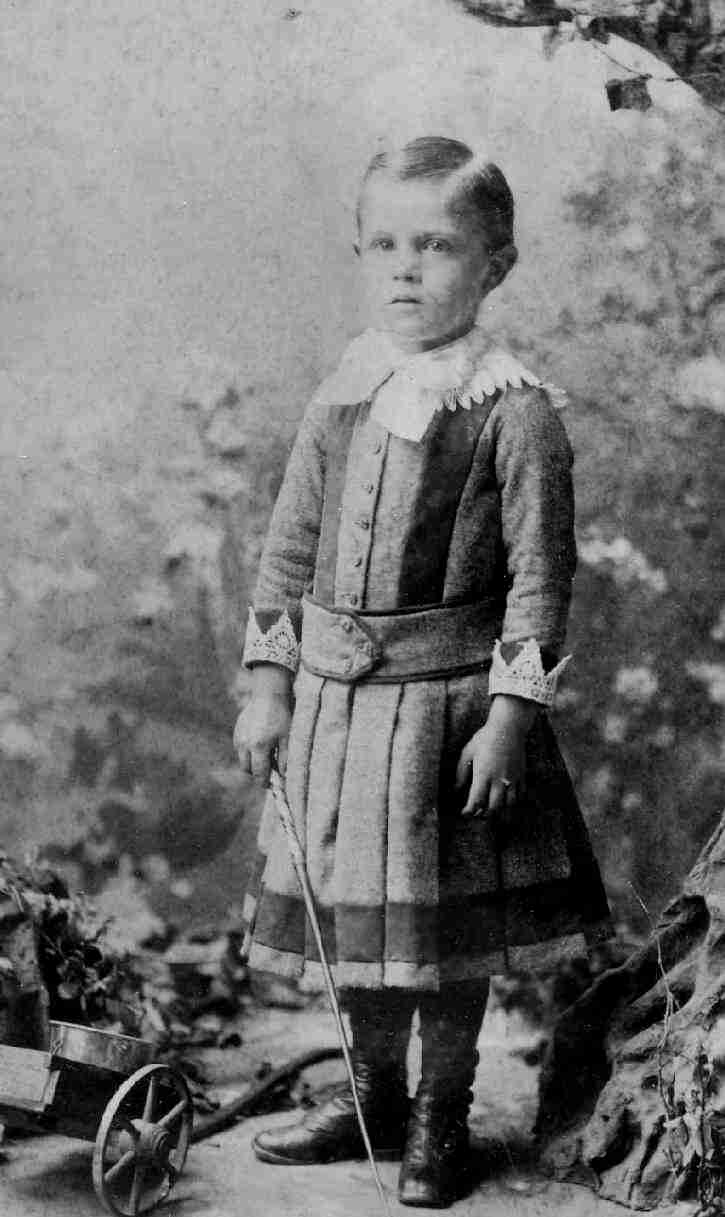
Here we have a cabinent portrait of Arthur N. Taylor. The portrait was taken by the R.B. Lewis Studios in Wood Square, Hudson, Massachusetts. On the reverse they claim "Graceful posing, artistic lighting ... cloudy weather no objection". It is undated, but we would guess was taken in the 1880s.
He is dressed in a fancy pleated dress with lace cuffs and collar. He was photographed with a stick. I think it is too slender to be a walking stick, so it may be some kind of riding crop? Alongside him is a little toy cart with a tin pail in it. We do not know if these are studio props or items Arthur brought with him.
Atril D. Taylor had his portrait taken in 1926. He was 3 years old, but must have been close to his fourth birthday. He wears a short pants outfit with kneesocks. His shirt is the open-collar style so popular in the 1920s and 30s.
This AZO postcard portrait is a pre-1918 AZO (two triangles up and two down). We see two Cassville, Wisconsin boys celebrating their first communion. The namen on the back is "? and Lyle Taylor". We assumed the boys were brothers as they were photographed together and dressed so similarly. But it seems strange if they were brothers that whoever wrote the notation would not know both names. They both wear dark (probably navy blue) Norfolk knicker suits, probably with black long stockings. These suits were very popular for First Communion suits and could be worn sfterwards as the boy's best suit. Their lapel decorations seem a little different. The boys look about 7-9 years old. At the time, some parents delayed the older child's First Communion so siblings could do the ceremony together. The postcard not marked Cassville but this was purchased with other Cassville postcards and the Taylor family was from Cassville.
Nadar was the best known commercial photographer in late 19th century France. He had a popular Paris studio. He photographed the most famous people in France as well as ordinary people. The Albumen cabinent portrait here is of 4 year old Maurice Terrillon. Maurice was born November 24, 1889 and died May 24, 1894. We do not know what happened to him. The portrait seems to have been taken some time before his death. Maurice wears a tartan dress with a large lace collar. Tartan was a popular pattern for boy's dresses because it suggests a kilt. There is weiting on the back which we can not yet read.
This is a 1/9th plate cased Daguerreotype portrait of a young school age boy about 12-13 years old. A slip of paper found inside the case identifies the image as, Alex Mitchell Teuford. There is no indication where he lived. The boy wears a small white collar and black bow or stock. He wears a dark collar buttoning jacket. Often these jackets were done with brass buttons with prominately show in the portraits. The button here seem to be cloth covered and the jacket is left unbuttoned, and least the part that shows in the portrait. The dealer believed that the portrait was taken in the 1850s. We can not yet, hoever, differehtiate 1840s and 50s Dags so we are not sure about the date. We know these jackets were popular in the 1850s, but we have less information on the 40s.
This cabinet portrait shows Theodore Red Eagle dressed in his summer clothing. The portrait was taken by Oscar Drum at the Parsons Gallery in Pawhuska, Oklahoma Territory. It was numbered number 39 in pen on the front of the card mount. Numbers like that are unusual on cabinent cards. We suspect that the photographer made portraits of a school or some other group. There is a pen description on the back, "Theodore Red Eagle. That is the way Indian children drill in summer". This suggests he was in a school groop. The portrait is undated, but was probably taken in the 1890s. The Olkahoma Territiry was organized in 1890. And as the mount style was common before 1900, the portrait was taken in the 1890s. He looks to be wearing a kind of tunic without pants. We can't tell if there is a long clothing hanging down behinf him or if it is some kind of pole.
This charming snapshot comes from a small Wlesh town. It was taken in 1q905. The boy is Teifryn Thomas, son of the postmaster of Llechryd, a village where the photo was taken. The boy wears a tunic suit with knee trousers and long black stockings. (American boys usually has bloomer knickers rather than knee pants.) Notice the sailor styling. The boy is about 7-8 years old. He is showing off his new tricycle and seems very pleased with himself. It seems to have with metal wheels without any rubber or perhaps the metal rims have a rubber surface. Oerhaps a reader who knows more about trikes can explain this better.
We have two rather similar portraits of Chicago boy Earl Sanderson Thomson. We suspect that Sanderson was his mother's name. The portraits are undated, but the clothing and mount styles allow us to date them at the turn-of-the 20th century. We would guess 1898-1903, in part of the shift in mount styles. We not only know the boy's name, but we know his age. The two portaits show him at 4 and 9 years of age. The two portraits show how popular the sailor suit was. Earl wears a dark sailor suit in both portrairs. He wears a sailor suit with an open jacket at age 4 years. The second portrait sh0ws him wearing a sailor blouse at age 9 years. The detailing on both is rather plain. Both portraits were taken at the Brund Studios.
The boy in this cabinet card portrait is Herbert Thrift. He seems ti have identified himself on the back of the mount. He is riding a steel-wheeled tricycle, presumably a studio prop. . He is dresses in a Fauntleroy blouse an enormous floppy bow, knee pants, and black long stockings. He also wears a cap, but I'm not sure just what type it was. The photogrpher was Davis and Douglas, 58 South Main St., Fall River, Massachsetts. The portrait, however, was not taken un the studio. The back has writing in pencil Hurbert Thirft, Last ?881, 5 Years Old in Pawtucket". Wecdo nt know what 'Last' meant. We at first thought that meant the portrait ws takrn in 1881, but we do not believe this was the case. Neither the mount or the clothes look to date to 1881. We would say the 1890s is more likely.
The studio portrait of Count Nicolas Alexandrovitch Tolstoi (1907-17) was taken in 1913 when he was 6 years old and only 4 years before his early death. I am not sure if he is related to the famous author. Nor do I know if his death was connected to the Revolution hich broke out in 1917. He wears light colored sailor suit with knee pants and brown long stockings.
This cabinet c portrait was taken by the Price studio in Dover, New Jersey. The boy is Bryant Tonking. He wears a light-colored summer Fauntleroy with aectangular collar and floppy bow. The lace collar is repeated at the cuffs and the blouse front also protudes under his buttoned jacket. The light-colored knee psants suit is worn ewith dark long stockings (probably blsck) and high-top shoes. The portrait is undated, but the white whicker furnoture and creased knee pants suggest the early 1900s to us.
This carte de visite (CDV) pprtrait is of Oskar and Toni von Treskow of a noted Prussian nobel family. The portrait is undated, but looks like the 1860s to us. Toni, the little girl, wears a white baby dress. Oskar, the boy, wears a cut-away jacket suit which he wears with long pants or only slightly shortened length pants. The jacket has Zouave-styled embroidery. Pantalettes were still worn by girls and younger boys. In this case Oskar seems to have white frills sewed onto the hem of his pnts to emulate pantalettes. We haven't noted this practice before. The cildren look to be about 2-4 years old. The portrait was taken by A & F Zeuschner, Posen, Germany. Posen was the capital of a province contested for centuries between Poland and Prussia/Germany.
Here is a studio portrait of Gordon Tripp of Utica, New York. The dog is also identified on the back as "Duke."
Gordon wears a light-colored single-breasted knickers suit with what look like matching knee socks. The knickers have a sharp crease. He has a bowtie and low-cut, brown oxford shoes. He looks to be about 10-11 years old.
Here we see Dick Trippe in a Christmas scene. Is proper name would have been Richard Trippe. Dick didn;t have much of a Christmas tree, but he has a great tain set. Its a little difficult to see what he is wearing as it is almost all black. He wears a short pants black suit with a very large white collar and floppy bow. Large collars and fkloppy bows were less common after World warI,but we still some younger boys wearing them. He wears black long stockings and high-top shoes. The portrait was taken in 1921. He looks about 7 years old. We do not know where he lived in the United states.
Here we have a portrait of Harry E. Trolich. We are not positive about the spelling of the boHe is an American boy, although we are not sure where he lived. y's name as the writing on the back is indestinct. He was born in 1868. We have a portrait taken about 1877. He wears a kneepants suit with what looks like a bowler-style hat. He has light-colored stripped long stockings. Harry died at a very young age in 1886. We do not know why he died.
This boy certainly had a patriotic family. At least he has a very patriotic name. George looks to be about 7 years old. He wears whay looks like a boater hat with large bow. He has a rather loud pattern knee pants suit and a blouse with a ruffled collar and matching wrist ruffles. The portrait is undated, but we would guess was taken in the late 1880s or early-90s. George's father was the studio photographer who took the portrait. He is photographed with a tricycle, although it is difficult to see the third wheel.
This cabinet card is a is a difficult one. The very serious looking boy pictured is identified, but the writing is gard to red, something like Georgie Thuman/Truman/Thunian. Or maybe the first letter of the last name is an 'F'. Perhps readers will be able to figure it out. The date is also hard to read, but looks like April 3, 1881. Georgie looks to be about 2-3 years old. He wears a fancy dress made to look like a kilt suit. It has a lace collar and is trikmmed in lace. The skirt is pleated. We do not know what the color was. The studio was J.F. Green in Meriden, Connecticut.
This CDV portrait shows Frank Tuche. He has elaborate ringlet curls. Most boys at the time had short hair. Earlier boys had longer hair, but not long ringlet curls. He is wearing what looks like a checkered jump-suit. Actually it was a two-pice button-on outfit. These suits were very popular for American boys in the 1860s and 70s. The buttons are covered by a fabric waistband. The studio was J. Pitcher Spooner Studio in Stockton, California.
This photo postcard portrait is of the the three Ticker boys. The boys are Kenneth, Clarence, and Don Tucker. They are cousins rather than brothers. Te portrait is undated, but was orobably taken around 1900. We do not know where in America hey lived. The boys all wear white outfits. The younger boy wears a Russian blouse suit. The other two seem to be wearing blouses and knee pants. All three look to be wearing white long stockings and double strap shoes. This was a kind of dessy casual summer outfit.
This press photo shows Mrs. Richard Tucker with her sons Richard and Sam. The boys look to be about 6-9 years old. They wear identical Eton lapelless blazers with Eton collars and neck ties. We are not sure what color the blazers were, perhaps light blue. They wears the blzers with summdery dshort pnts, drk abkle socks and two bar closed-toe sandals. Mother is fashionanly dressed for a social outing. The press caption read, "At Greentree Fair: Mrs. Richard Ticker, with her sons , Richard at left and Sam at the annual Greetree Fair at the Manhasset, L.I. estate of Mrs. Payne Whitney, June 18th." 'Social register' is added as a tagline. L.I. means Long Island which includes some toney bed room communities for New York City. This is useful information because it provides the social class background for Mrs. Tucker's and the boy's clothing. Boys from affluent families were more likely to wear short pants suits as well as sandals. Short pants suits were not as uncommon in the 1930s as they would become, but there was a defite social class divide here.
Ambrose Turner ws an English boy born in November 1835. He was the youngest son in the family. We believe that the Turner family was an affluent family, but have no specific detais. We do not know much about him at this time. He died in 1910. ll that we know about how Ambrose was dressed as a boy is a combination underwear garment his mother Ann Turner made for him when he was about 4 years old. Unfortunately we do not have a portrait of Ambrose. Photography was not yet a viable commercial process. As far as we know no painted portrait exists. Thus we do not know know how Ambrose was dressed. A age 4 he might not have been breeched and may have still worn dresses. Or he might worn a skeleton suit or though in 1840 they were going out of style.
This cabinet card shows an American boy wearing a knee pants suit with some Norfolk syling. And he wears black long stockings. He also has a soft, turned-up hat. We know the bow is Ed Turner as he has written his name on the back--although not very clearly. The studio set is a classical balustrade and vase. Unfortunately the portrait is undated which is unfortunate as it would help build time frames for various fashiins and vabinet cared features. The dealer suggsts the 1970s. We think the late-70s is certainly possible, but the early-80s seem more likely. The sjort knee panrs and blacl long stockings are both clues. We also think the soft hat is more charactetistic of the 80s. The photigrapher was WW Darnell in Redforth, Virginia.
Maurice Carmichael Tweedie had his portrait taken in Hastings during 1878. The studio was Bloomfield & Co. Maurice looks to be about 8-9 years old. We know nothing about his family, but given the fashionable outfit, we would guess he came from an affluent family. Maurice wears a kneepants sailor suit. It is not a traditional suit, but it does have the classic "V" front. Notice that he wears a collar and floppy bow in addition to the sailor collar and scarf. We know there are pockets because Maurice has in hands in one, not a common pose. The classic sailor suit three stripe motif appears in several locations including the pants legs. The pants also have stripes and buttons down the side. The knee pants are cut shirter than the mid-calf length common in the 1860s. He wears three-quarter length socks rather than long stockings that were more common in America.

Navigate the Boys' Historical Clothing Web Site:
[Return to the Main ordinary biography alphabetical page]
[Introduction]
[Activities]
[Biographies]
[Chronology]
[Clothing styles]
[Countries]
[Topics]
[Bibliographies]
[Contributions]
[FAQs]
[Glossaries]
[Images]
[Registration]
[Tools]
[Boys' Clothing Home]