|
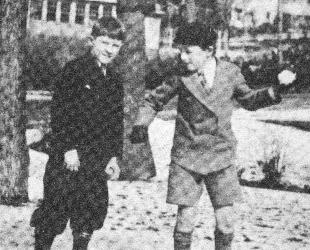
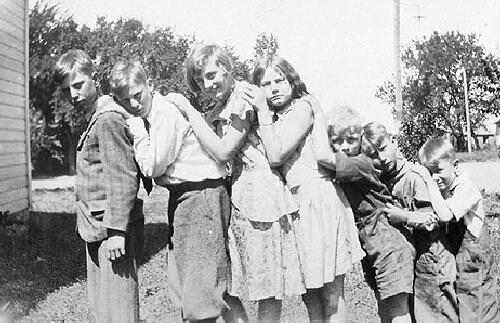
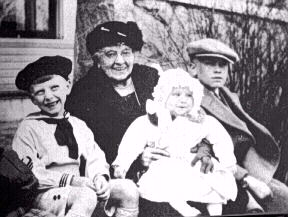
The 1930s were dominated by the Great Depression. This affected both the public mood and affluence, both matters which have a carry on effect on fashion and familiy spending. The unusual divergence between European and American clothes continued in the 1930s. European boys tended to wear short pants and knee socks or long stockings as well as a variety of country specific styles like kilts, lederhosen, sailor suits, and smocks. There were still major differences from country to country. And many of the destinctive country styles persisted in the 1930s, in some cases the last decade in which these styles were still prevalent. It was still possible to identify nationality from the clothes worn at leat for the larger countries (England, France, and Germany). And these countries strongly influenced styles in the smaller countries making it difficult to identify nationality in photographs from these countries. German styles were especially important in Eastern and Central Europe. Headwear was quite varied. American boys wore flat caps, at least at the beginning of the decade. English boys wore peaked school caps. French boys wore berets. German boys had more varied headwear. We see military styled school caps, sailor caps, and Schirmm�tze. Eton suits stiff collars and long trousers became increasingly less common in England as the decade progressed. Increasingly English schools turned to brightly colored and stripped blazers with short grey pants. Sailor suits for older boys disappeared in Britain and America, but were still seen on the Continent. Pants and trousers also varied from country to country and as the decade progressed
Short pants were still rather long at the beginning of the decade, showing the continued influence of knee pants. We begin to see shorter lengths by mid-decade. Mothers in France and other European countries increasingly selected shorter length shorts for boys. Very young American boys at the beginning of the decade wore shorts, but by the time they reached 8 or 9 years old, they wanted to wear knickers. Knickers by the end of the decade, however, had begun to go out of fashion. Most American boys, however, tended to wear knickers, although mostly changed from long stockings to knee socks. Long stockings continued to be common seasonal wear in Germany and Central and Eastern Europe. By the end of the decade, older American boys were wearing long pants and many younger boys short pants. We also see more American boys wearing ankle socks. Sneakers became increasingly popular for casual wear in America.
The 1930s will be ever associatef with the Great Depression which forever changed the political and social fabric in Europe and America. The Depression meant broken dreams and failed for many. But it wasn't all "Gloomy Sundays" and meatless Fridays--entertainment encouraged everyone to look on the brighter side of life. While many lost the ability to
buy fashionable clothes, they did not lose their interest in fashionable clothes or fashionable live styles. Movies which were now the "talkies" were more popular than ever before. Often the popular movies show cased wealthy people and their problems rather than the problems of the unemployed and dispossed. This appears to have reflected what people
wanted to see at the moview. Songs like "We're In the Money" were far more popular than "Brother Can You Spare a Dime?" Readers could ponder social ills in the thought-provoking novel Of Mice and Men or escaping into a sweeping historical epic like Gone With the Wind, to let them forget everyday cares for a while.
The 1930s is considered by many as one of the most elegant period for menswear, as men gravitated toward the English drape style and the sportswear industry exploded. Little folks' clothes also continued to develop into comfottable and attractive styles. The clothes worn by children during the 1930s seem to many as quite perfect, tailored and so simple in line. Dresses were short and so were a young man's pants. Girls of all ages wore the classic Chanel suit while boys had a choice of the older style business suit, the Norfolk with knickers and if he were inclined to be dressy, the English Eton suit of short jacket, vest (when of self-fabric), trousers and a derby, if you please! Under the smart little coats girls wore party dresses of crepe georgette, voile or crépe de chine exquisitely handworked with tiny tucks, smocking, piping and fine pleating yet retaining the over-all simple effect.
|
Youngsters now had quite a wardrobe of play or sports clothes ranging from basic rompers, sun suits to snow suits.
Boys still commonly wore suits. This was the last decade that American boys
commonly wore suits, although it continued to be common for British boys for
another decade. Of course the American boys wore knicker suits and the English boys
short pants suits. I'm less sure of European boys.
Sweaters were very commonly worn in America and Eurooe in the days before
central heating. Virtually all sweaters at the time were wool. Grey sweaters were
extremekly common in Engkand while more diverse colors were seen in other countries.
A wide variety of pants were worn in the 1930s. Anmerican boys mostly wore
knickers. Cord knickers were nost common for play and school. Many boys wore longs,
but shorts were mostly worn by younger boys or during the summer. British and
European boys commonly wore shorts all ydear round. Kniclers were not much worn in
England, but secondary school boys common wore them on the continent. Long pants
were commonly worn by German boys during the winter, but some boys wore shorts all
year round.
Kneesocks were comnonly worn by boys in England and Europe, especially boys wearing short pants. Solid color knnesocks were most common in Europe, although some boys did wear kneesocks with paterned tops. American boys also wore kneesocks, usually patterned ones, especially boys wearing knickers. Many American boys wearing short pants began wearing ankle socks.
Most boys bu the 1930s were wearing oxford-style shoes. Sandals were popular for school-age boys in Britain and to a lesser extent France. Many American boys wre tennis shoes which had appeared in the 1920s.
Many varied caps were worn by boys during the 1930s. American boys wore beanies, white sailor caps, and for dressier occasions, peakd caps. British boys mostly wore peaked caps. French boys might wear berets. German boys increasingly wore military-styled Hitler Youth after the NAZIs seized power in 1933.
A revolution in clothing materials was made possible in the late 1930s. The American Dupont Corporation in 1938 invented the first synthetic fiber from protelum--nylon. World War II (1939-45) intervened, however, before the new fiber could be used extensively for commercial production of clothes. The War blocked shipments of silk from Japan and China. As a result, much of the early production og nylon was made to make parachute shutes. Commercial development of nylon and many other synthetic fibers to come was not possible until after the War.
With the stock market crash of 1929, life changed drastically for many consumers. The lifestyles of the most affluent, however, were little affected. The popular Prince of Wales, a fashion leader for men, and his cousin started wearing trousers with zipper fly closures, and the rest of the world soon followed. Improvements in the technology for knitting fancy-patterned hosiery made it possible for men to wear plaid, chevron, and argyle socks. Boys were soon sorting flashy argyle and other patterned knee socks with their knickers. Some knee socks were solid color, but has a pattern at the top. More conservative moms might stick to grey and navy or black. The removable stiff Eton collar passed from the scene by the end of the decade.
|
We have begun to develop some pages on boys' clothing in individual countries during the 1930s. As HBC has expanded we have been able to expand out discussion of 1930s styles to individual countries, at least America and the larger European countries. We hope to eventially get to some of the other European countries as well. There were considerable differences from country to country. American fashions were destinctive, but changing. There were still enough country differences in Europe that it was possible to identify the country from period photographs. American boys commonly wore flat caps and knickers, at the beginning of the decade as was common in the 1920s. This was, however, changing. Boys in rural areas still wore overalls. Long pants were becoming increasingly common by the end of the decade. Short ponts were also worn, but they were not nearly as common as in Europe. They were most common for younger boys or for boys from aflluent families. Major changes occured in English fashions after World War I. This was a general trend that occurred throughout Europe and North America. Dress even for children was still relatively formal in the early 20th century. This was a trend noticeable even before the War, but the deprivations and priorities of the War undoubtedly affected how people viewed formal dress. The 1920s and 30s were very similar. The basic difference is that the post-World War trends we observe in the 1920s were nore advanced in the 30s. We see a range of trends. Younger boys no longer wore dresses to any extent. And we see fewer English boys wearing kilts. The peaked school camp became virtually universal. School garments were a major fashion component. Boys at the time unless from wealthy families had much smaller wardrobes than modern boys. We also notice the gaberdine raincoat. French boys stull wore berets in the 1930s, the last decade in which they were common. Younger boys wore rompers and blouses. Smocks were common at primary school, but not much after school. Short pants were very common. Older boys might wear knickers, especially during the colder winter weather. They were, however, not nearly as common in America. Quite old boys in Europe during the 1930s wore short pants or knikers.
Often the choice was made by the parents. School uniforms were not commonly required.Many boys wore knee socks. Long stockings were not very common, byt we see some children wearing them for formalm occassions. French boys also wore a distinctive cloak garment in the winter. We do not see this worn in other countries, except perhaps in Belgium. German fashions are particularly important. German'y large fashion and cloyhing industry affected styles throughout Central and Eastern Europe. We note a wide range of outfits worn bybItakian boys during the 1930s. Rompers might be worn by younger boys in fashionable families, although we are unsure when they first appeared. Sandals appear to have been especially popular. School photographs can be a useful indicator of clothing styles. Many boys went barefoot, especially in rural areas and the south. Some boys in primary school wore smocks, but there were no uniforms in secondary schools.
Thank you for your interest in our site. If using any of our material, partially or in full, we ask that you always provide an active hyperlink to the pages that you have consulted.

Navigate the Historic Boys' Clothing Web Site:
[Introduction]
[Activities]
[Biographies]
[Chronology]
[Clothing styles]
[Countries]
[Essays]
[Photography]
[Bibliographies]
[Contributions]
[FAQs]
[Glossary]
[Glossary]
[Images]
[Links]
[Registration]
[Tools]
[Boys' Clothing Home]
Navigate the Historic Boys' Clothing Web chronological pages:
[Return to the Main 20th century fashion chronology page]
[Return to the Main fashion chronology page]
[Early 1800s]
[Mid-1800s]
[The 1880s]
[The 1900s]
[The 1910s]
[The 1920s]
[]
[The 1940s]
[The 1950s]
[The 1960s]
[The 1970s]
[The 1980s]
[The 1990s]