|
Australian boys' clothes were initially simply British clothes as Austrlalia was colonized by British settlers in the 19th century. The warmer Austrlalian climate necesitated some modifications, but clothing styles were esentially English until after World War II. This was especially true of dress clothes. Australian boys wore short pants and knee socks, some times even to 15 or 16, sometimes older if their school required a short pants uniform. Gradually Australians have developed their own styles. After the War, especially by the 1960s, Australian boys' clothes began to diverge more from English styles. The Australian climate and more easy going, casual life styles were important factor. The increasing American influence was probably another factor. Clothes are generally casual in Australia. School uniforms are still required at many schools, but styles have become increasingly casual. Since the 1970s, as in many other countries, jeans have become very popular with young people. Sun safe clothes have become important in recent years.
Australia is an island, a huge island and for that reason is commonly called the island continent. It is the world's largest island and sixth largest country in area (7.7 million sq km). The country has a roughly rectangular shape, about 4,000 km from east to west and 3,200 km from north to south. Given that north south range, few counries have more diverse climatic conditions. The coastline is some 36,700 km long. It is probably the most isolated point on earth, other than perhaps New Zealand or Easter Island. Australia was the end point for the first human migration out of Africa. Leaving the Aboriginies as Australia's first humans and with the rise of ocean levels with the ebbing of the Ice Age, leaving them isolated there. Australia separates the Indian and Pacific Ocean. While emense, large areas of the country are arid and can not be used for agriculture, still Australia is so lrge that there are substantial arable areas and Australia has an important agricultural sector. Some of the arid aeeas can be used for extensivve licestock grazing. Australia is basically the southern limits of the South Pacific. Which is why, after Japan conquered most of the South Pacific in the World War II Pacific War, Japan tageted Australia. Large areas of northern Australia are located in the tropics. Southern Australia has a more temperate climate. Tamania, the most southern part of Australia, not only has a temperate climate, but is exposed to the Antarctic climate and Antarctic currents. Australi's European settlement began at Botiny Bay (1770). But the focus soon shifted to Sydnet Cove, better known roday, as Sydney Harborv, one of the world's finest natural landnmarks, Two Australia's most notable klabdmarks are located in Sydney Harboor--the Sydney Harbor Bridge and the Sydbney Opera House. The third of course is located in the dry center of Austrakia=--the Big Red Rock (Ayers Rock or Uluru).
Australia's great heritage must be its unique flora abnd fauna. And the aborigenes or a living remanent of the eastern-most movement of man's first foray out of Africa. Australia's modern history is largely an apendage of English history transplanted to Oceania. Australia was Europeanly settled in 1788. The level of immigration increased in the 19th century after the end of the Napoleonic Wars in Europe. Queensland became a state in 1859. There was Scottish stock in Australian convicts, free settlers and senior managers (the first governor of the country came from Islay).
The original settlers were of course convicts--the susposed dregs of English society. The success of those convicts is testimony to the injustices in English society at the time. And they have given Australis a democratic, informality that is a characteristic of the national character. Australians played an important role in assistng Britain in the two World Wars of te 20th century, but played a heavy price. Germany made the mistake twice of making military calculations without considering the Dominions and Amnerica. Because Australia was assisting Britain when the Japanese struck in World War II, it was virtually defenseless. The country was saved, however, by the American Pacific Fleet. This transformed the national outlook and essetially cut the umbilical cord with Britain.
Australia in the early-21st century had one of the strongest economies in the world, but the country's economic future is unclear, although This is not fully understood in Australia or thevleft-wing mainline media. The country has one of the highest living standards in the world based on percapita income. High consumer and realestate priuces are often not considered in assessing living standards. Australia was one of the British Dominions and thus inherited both democreacy and capitalism from Britain. The primary sectors which propelled Australia into the modn world were first agricultural (grain and ranching) and minining (coal and iron). With those underpinings, Australia has develope a strong services sector whiuch is now the largest part of the economy, accounting for around three-quarters of gross domestic product and an even higher proportion of jobs. The industrial manufacrured sector, however, is realively small. Australia has an increasingly important and growing financial sector and a very sophisticated financial services sector. The country economy is aided by a strong legal system and the rule of law prorecting property rights. This has belped to create economic and financial ties to the the emerging economies of the Pacific abd East Asia. One economic assessment tells us, "Known as one of the great agricultural, mining and energy producers, Australia has one of the world's most open and varied economies, with a highly educated workforce and an extensive services sector. Australia's economy is considered one of the strongest, most stable and diverse in the world. In 2014, Australia entered its 23rd year of uninterrupted annual economic growth, averaging 3.4 per cent a year." Often not appreciated in assessments like this are the degree to which Australia' economy was fueld by the insatiable Chinese demand fro raw materiaks that Australia could privide. Now that Chinese growth is cooling off, the full impact on Australia is yet to be seen. The Australia dollar has fallen some 30 percent, but the economic impact is still unknown. Another factor is the socialist legislation, tax policies, and regultory regime pursued by the Labour policy which has tended to retard new business formation and entreprenurial nergies. The Australian welfare state is another burden on the private sector. Australia has been relatively prident in fiscal polifies. They have pared back the once extrodinrily generous welfare system in recent years. Unlike many other deveoped countries like America and Western Europe, Australia has maintained very respobsible fiscal polifies and as a result the country's debt burden is relatively small and sustainable.
Australia was colonized in the second half of the 19th Century. At first it was a prison colony. By the 1860s large numbers of English colonists were arrtiving to take advantage of the the vast expanses of inexpenive land. As a result, the photographic record provides an almost complete record of fashions. Austrlian boys fashions in the early-20th century wore quite similar clothes to English boys. Notfolk suits with Eton collars were common, usually kneepants and knicker suits. Shirt pants became increasingly common in the 1910s. Australian boys continued to wear mostly short pants after World War II. Clothing styles became much more casual after the War. The style of shorts worn during the 1940s and 50s were mostly the English style, rather baggy shorts worn at knee length. Flannel shorts were the most common, but after the war khaki shorts also becam popular, especially for summer wear. Increasingly by the 1960s American styles began to appear. The style of short pants began to change in the 1960s. The shorter style continental shorts became more stylish. American jeans appeared in the 1960s and proved very popular, but could not be worn at school or for any special occasion. Older boys began to wear long pants more commonly to school and for various occasions.
The original population of Australia are the aboriginies, a stone-age people. These are the dark-skinned descendents of the early human migration out of Africa at the dawn of the emergen of modern msn. They followed a route east along the coast of southern Asia, finally arriving in New Guinea and Australia, but never reaching New Zealand.
Europeans discovered Australia (17th century) and settlers began to arrive (18th century). They soon outnumbered the aboriginies. Most Australians today are of European descent. Britain was the colonial power. Thus the European people are primarily from the Britisj isles, Anglo-Celtic peoples--English, Scottish, Welsh and Irish. (Ireland until after World War I was a part of Britain.) The Irish were not originally part of the Anglo group because of cultural and religuius difference. This gradually changed as more immigrants arriced from other Europen ountries, especiasll southern and eastern Europe. Other Europeans arrived in smaller numbers--the Germans, Dutch and Scandinavians. They were quickly assisimlated into the Anglo white identity. Southern and Eastern Europeans were more slowly assisimated for cultural and racial reasons. Most of the southern Europeans are Italians and Greeks. There are also a number of Maltese, I think because part of the Maltese populsation was evacuated during World War II. There are smaller numbers of eastern Europeans and their origins are more diverse (Slavs such as Serbs, Poles, Croats, Bosniaks, Russians, Ukrainians, Macedonians and others. Non-Slavic peoples include Albanians and Hungarians. The British Government incouraged emigration to help settle the colony's vast area. Not only were convicts shipped to Australia, but later orphanbed children as well. As Australia obrained dominion status and began to assume control over its affairs, it also promoted immigration, but was highly restrictive about the racial and ethnic groups allowed to immigrate, preferring Christian Europeans. Australiaefused to accept Jews in any number during the 1930s. Since the 1960s, Australia has pursued a more racually neutral immigration policy. Thus the population is becoming more diverse. There is now a Middle-Eastern population. The largest group is Lebanese, but there are other Arans, including Egyptians. There are also some Turks. East Asians are now have an important presence in Australia. The Chinese are one of the most important of the recent immigrant groups.
Cantonese is now fourth largest language in Australia. There are also small Japanese and Koreans communities.
There are now also Southeast Asians (Filipinos, Vietnamese and Thais). There are very few Africans or Native Americans in Australia. There is a small Jewish community, mostly Ashkenazis Jews.
Australian boys until after World War II (1939-45) esentilly wore the same garments and styles as English boys. Garments such as sailor suits, Eton suits, and Norfolk jackets werewidely worn. Even Fauntleroy suits appeared. The principal difference with England was that because of the climate, more Australian boys went barefoot than in England and it did not have the same social stigma as was the case in England. Short pants were very common in Australia during the 20th century for school, play and even dressing up. After World War II, Australian boys clothes became much more casual and more adapted to the Australian rather than the English climate. These changes were especially notable beginning in the 1960s. There is also a wider range of influences with many American styles like jeans appearing in Australia. By the late 20th century sun-safe garments began to appear.
Australia was fojunded as a Btitish colony in the late-18th century. Girls fashions were essentilly the same as fashions in Britain. The only important difference we can detect is that it was more common for children to go barefoot in Australia. We see the same styles and fashion chnges over time. Australian children spent more time outdoors which affects the clothing chosen, but the stupes and basic garments were the same. Girls only wore dresses and skirts throughout the 19th century. In the 20th century, especially after World War I we begin to see rompers and shirts, but dresses continued to be the standard garment. World War II was a turning point for Australia. Contacts widen with other countries especilly the United states. We see American styles becoming popular, especially active wear. Dresses comntinue to be stndard wear. Girls only wore drsses to school. By the 1960s we begin to see girls commonly wearing garments other thn dresses. As many Australian schools have British-style uniforms, dresses and skirts coninued to be standrd at school.
Australian boys have generally worn short hair cuts. The styles appear to be similar to those in England. Our archive of Australian images is fairly limited and we can not yet make a detailed assessment of Australian hair styles. We have, however, began to develop some information. While we notice boys primarily with short hair, we have found some mostly younger boys wearing short hair. We note that a few Australian boys in the late 19th and very early 20th century with long hair, as was the fashion in England. We note one Australian boy wearing ringlet curls. More commonly the long hair was not done in ringlets.
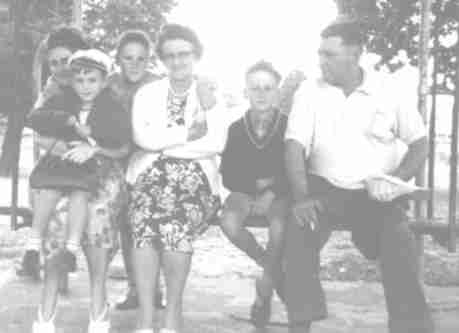
Family images are particularly informative. They often tell us more than an individual studio portrait, as valuable as those images are. Familiy photographs are especially helpful in setting the larger context of both fashions as well as providing useful sociological information. The family images show us what adults and other children were wearing along with various boys' clothing styles. We can see what girls' fashions were associated with boys; styles as well as what adults were wearing. We can also observe social interactions and better assess the social class and demographic relationship. A collection of these images over time also provides a great deal of chrnological information.
HBC has collected information on a variety of activities in which Australian boys have participated in over time. Many of these activiities involve specialized costumes. Other images show trends in Austrralian boys' clothing over time. Some of the activities include choir, choir, dance, games, religious observation, school, sport, and many other activities.
Vintage clothing is a valuable source of information that is often not available from the photographic record, especially the 19th and early-20th century photographs. Vintage clothing provide information about color not available from black and white photographs. Vintage clothing also provides information on fabriuc that often can not be determined from photographs. There are also sometiumes labels with useful information. We do not yet have many vintage Australian items.
Australia is a large country and as a result consideravle diversity among the fifferent states with the Norhern Territoties Top End having a tropical climate while Tasmania a decided temperate climate. Most of the territory of New Zealand is comprosed by the the different states: New South Wales (NSW), Queensland (QLD), South Australia (SA), Tasmania (TAS), and Victoria (VIC). The states roughly divide Australia into quadrants. Queenslans is the northeastern area of Australia and includes large area with a tropical climate. The southeast is divided among New South Wales, Victoria, and insular Tasmania. New South Wales enconpases Syndney (the Australian Capitl Trritory). Victoria is a small state, but with relatively large population nd includes Melbourn, the country's commercial center. South Australia covers south central Australia. The Northern Territory is the north cebtrl part of the country. And as the name suggests, Westerb ustralia is the western third of the country, including large areas of very lightly populatd and arid areas. The constitutional status of the Northern Territory (NT) and the Australian Capital Territory (ACT) is slightly different. The states are quite large, larger than many countries. The popultion beyond the coast, however tends to be sparce, especially as you arroach the great red center of the country which is very arid. It addition to the principal states and territories, Australia also has many islands. Many are quite small and the list for each state extensive. They are primarily importnt as tourist sites and parks. In addition to actual Australian island territory, Australia also administers several administers several islands as external territories, including Christmas Island, Cocos, Coral Sea Islands, and Norfolk Island. Australia also has played a stabilizing force in the nationl lives of several neigboring island countries like East Timpr and the Solomons, some of which were territories theu administered as part of the British Empire or Lague of Nations and United Nations mandates.
HBC has noted several Australian films of interest, but at this time can not recall the titles. Perhaps the most famous is Walkabout which shows a brother and sister in school uniforms. Another film is set at a state school in a rural area. It is a coming of age film set around a studious boy and a girl he has grown up with and the town delinquent. Many of the boys at his high school, including the boys picking on him wear short pants.
The British colonization of Australia began at about the same time that photography was developed. Thus the country has an almost complete photographic record of its history, with the exception of course of the aboriginal population. HBC has no images from the mid-19th century, but has noted some interesting images from itinerate photographers. Such photographers operated in other countries as well, serving rural populations which could not easily get to photographic studios in towns. HBC finds some of these photogtaphs interesting. Some are taken in rough surroundings. Similar portraits in America usually had the house, however primative, as the background. Not only are the backgrounds distinctive, but the boys are often emacualetly attired in the latest fashions--in sharp contrast to the rough surroundings. Boys in similar American portraits were rarely photographed individually and while they dressed up for the porttaits, rarely wore elegant attire.
The first Australian artists werec all Europeans. William Strutt, an English artist same to Melbourn just before the Gold Rush (1850). He provides us one of the earliest views of a colonial Australian family. The O�Mullane family had five children after their marriage (1840). Artists have provided some wonderful images of nature (the Outback). Alexander Schramm painted wonderful imges of ythe Outback in the 1850s. It was man's taming of nature during the 19th and early-20th centuries that was the focus. As might be expected, this was a theme also exceptionally addressed by two countries with similar experiences with nature--America and Russia. Two Australian artists, Arthur Streeton (1867-1943) and Tom Roberts (1856-1931) established an artist camp at Box Hill (near Melbourne) and later Heidelberg which has become the name of their school. Some children appear in their paintings as they were of course a part of the settlement of Australia.
Several accounts about Australian boys are available on HBC. These include both historical acoounts and individual experiences reported by HBC readers. Such individual expeiences are an important section of HBC as they help to shed light on the fashions seen in historical photographs, books, and fashion magazines. We hope to gradually expand this section as we believe it to be an important feature of our HBC site.

Navigate the Boys' Historical Clothing Web Site:
[Introduction]
[Activities]
[Biographies]
[Chronology]
[Clothing styles]
[Bibliographies]
[Contributions]
[FAQs]
[Glossaries]
[Images]
[Links]
[Registration]
[Tools]
[Boys' Clothing Home]
Navigate the Boys' Historical Clothing Australian pages
[Australian choirs]
[Autralian movies]
[Australian orphanage clothing]
[Australian school uniform]
[Australian television]
[Australian youth groups]
Navigate the Boys' Historical Clothing Web Site:
[Return to main country page]
[]
[Canada]
[England]
[France]
[Germany]
[Ireland]
[Italy]
[New Zealand]
[Scotland]
[United States]