
We are preparing a series of pages on national clothing styles. We now have over 70 countries listed in our country section. Most have a linked page with at least some basic information on clothing in that country. We have developed detailed information for several mostly European counties and the United States. Many of the country pages, however, are just being sketched out at this time. So don't expect too much yet. We have a lot of other pages to do, so it will be a while before we can focus on all the countries on our list. Of corse here we need your assisatnce. HBC does not have the capability to visit or even reserach all of these countries. Do let us know if you have any text or images to contribute about your country. We are interested in adding information about every different countries around the world. The current Euro-centric focus of HBC is because European readers have been the most willing to contribute information. We have tried to create a page for each country, even if only limited information is available. This provides a location for collecting information. We hope that our readers will contribute insights into fashion trends in their own countries. HBC has collected information on more than individual countries. The information on most of these countries still sketchy. We have, however, succeeded in collecting quite detailed infornation on America and several European countries.
We have very little information on Albania at this time, but we have begun to collect some basic information about Albania. We have developed some limited information on the country. HBC has a history page. Although a European country with a long Christian traditiin, Albania was cut off from the West after the Ottoman conquest. Albania did not emerge from Ottoman control until just before World War I (1913). Thus Ottoman ingfluence and fashion were particularly pronounced, more so than any other Balkan country. Another factor was the fact that many Albanians converted to Islam. There is a page on the monarchy and Albanian Boy Scouts. Under the Ever Hoxa and the Communists, Albania was one of the most closed socities in the world. It was even cloesed off from other Communist countries. Only after a democratic government was established (1989) has the country opene up to the outside world. Clothing styles today are largely Western, similar to other Europeans.
Andorra is one of Europe's micro states, tucked away in the eastern Pyrenees between France and Spain. The capital is Andorra la Vella. The principality dates back to the middle ages, being chartred (988). The principality as it now is constituted was formed (1278). Andorra led by two co-princes, a rare arrangement. The princes are the Spanish/Roman Catholic Bishop of Urgell and initilly the French king and since than the the President of France. There were many principalities like Andorra scatered around Europe in the early-Middle ages. Almost all were eventuallu subsummed into the forming unified nation states. We suspect have French and Spanish co-princes is why Andorra maintained its independence. The people mostly speak Catalan, but generally understand Frenh and Spanish. Andorra had an economy similar to the surrounding regions of France and Spain, but with prosperity that came with Europe's economic expansion after World War II, Andorra is today a prosperous country. Its primary industry is now tourusm, over 10 million tourists visit Andorra annually. And like several other European micro-states, there is a financial industry based on tax haven policie. Since Spain jiined the EU, ther has been a EU effort to limit tax havens. Andorra has not joined the EU, but because it is so small does not have irs own currency, but uses the Euro. The pricipality is notable for the high life expectancy.
Armenia is a small landlocked, mountainous country in the South Caucasuses. located at what might be called the cross-roads of Europe and Asia. It is a difficult country to categorize. As it is located beyond the Caucauses in might be place in Asia, but culturally it is firmly tied to Europe. Armenia is one of the oldest countries in the world with a recorded history streaching back an estimated 3,500 years. Armenians were early coverts to Christianity, but separated from the Orthodox Church when tennants of Monophysttism became widely accepted. We have an Armenian history page. It has existed as an independent country, but has often been a part of larger empires, both ancient and modern(Ottoman and Russian/Soviet). Armenia once included whay is noe eatern Turkey and the area of modern Armenia. Its history is marred by the terrible Turkish Holocaust during World War I. Armenia was thorougly integrated into the Soviet economy. It had an industrual economy including chemicals, electronics, machinery, processed food, synthetic rubber, and textile. Armenian industry relied heavily on raw materials from the rest of the Soviet Union, commonly provided without regards to actual cost. The modern Armenian economy relies heavily on investment and support from Armenians abroad. The country's industrial sector has had to adjust to being cut off from the raw materials once provided by Soviet plannets. The industrial sector is now on a more market-based footing. They export machine tools, textiles, and other manufactured goods in exchange for imported raw materials and energy. We have a portrait of an unidentified Armenia boy and his mother in the Ottoman Empire during the 1890s, before the Turks carried out the Armenian genocide. After that there was an Armenian population left in Tsarist Russia. We also notice a portrait of an Armenian boy wearing a school smock (1954). The Soviet Armenian SSR was the core of the new Armnian state that emerged from the Soviet Union (1992).
|
I believe Austrian boys clothes are today similar to German boys clothes, but I have no significant information yet on Austrian fashions. Until after World war I, we believe there were more diferences. We believe there was more of a French and Italian influence in Austria. Lederhosen were commonly worn by boys until jeans began to replace them in the 1960s. Here the pattern was similar to Bavaria. I believe that after World War I and especially the NAZI Anschluss that Austrian and German styles essentially merged. Today there is little difference between German and Austrian boys' clothing wuith the exception of the greater popularity of folk styles in Austria.
Belarus is one of the new countries created with the disolution of the Soviet Union (1992). Of course the history of Belarus is as old as that of neigboring countries. Only it has been ruled by the surrounding countries. It was for many years ruled by the Poles and Lituanian-Polish Commnwealth. As Russian power expanded east, Belarus became part of the Tsarist Empire. Belarus existed for several years as part of the Tsarist Empire and became increasingly Russified. World war I led to the Russian Revolution and Russian Civil War. The Bolshevicks attempted to regain lost Tsarist territory. This led to the Polish-Soviet War (1920-21). Belarus was split. Eastern Belarus became a constituent republic of the Soviet Union. The Soviets in alliance with the NAZIs invaded and dismembered Poland (1939). In the process Belarus was united under Soviet control until the NAZIs invaded the Soviet Union and occupied Belarus. The NAZIs treated Belarus savagely until the Red Army drove them out (1944). Belarus achieved its independence (1992). It has, however, with a largely Russified population retained close political and economic ties with Russia, more so than any other former Soviet Republic. Democracy did not takehold in Belarus. The Government is authoritarian and the people do not enjoy basic ciivil liberties. The situation is not as oppresive as the Soviet era, but highly oppresive in comparison to the rest of Europe. The ethnic make up is: Belarusian (80 percent), Russian (10 percent), and most of the rest Polish and Ukrainian. The ethnic make up was more diverse, but as a result of NAZI and Soviet occupation much more ethnically uniform. The NAZIs killed the Jews as part of the Holocaust and the Soviets deported the Poles west after the War. The religion is largely Eastern Orthodox although the Soviet atheist campaign had a significant impact. There are two official languages languages: Belarusian and Russian. Over 60 percent of the people speak Russian. Belarus is one of the few countries where the national language is spoken by a minority of the population.
|
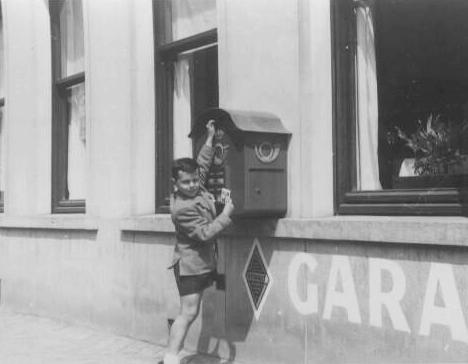
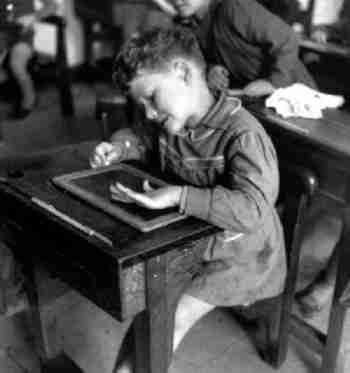
Belgium is neatly nestled betweerm the Netherlands, Germany, France, and England. There are historic ties to both the Nethermlands and Frabce and economic ties with England. we have relatively little written information on Belgian boys clothes at this time, but believe they have basically followed French syles. This is stringly suggested by the photographic record. We are sure this ids the case with the the French-speaking population (the Waloons). We are less sure ablout the Dutch-speaking Flemish. Belgium at various historical periods was part of France, as recently as the early 19th century. Belgium was at the heart of the northern Renaissance and the weaving industry was the foundation for the modern European economy. It was ruled by Spain for several centuries. Spain stamped out Protestantism, but was never able to implant the stutifying indluence of the Inquisition. Even after Belgium became an independent nation--following France's defeat in the Napolionic wars, and a brief union with the Dutch, the powerful force of language both divided the country and cemented cutural and social ties with France. One trend in the 20th century has been the cultural conservatism of Belgium. Belgium boys wear clothes similar to French styles, including school smocks, sailor suits, and short pants. While the fashions were primarily French styles, German and Dutch styles were also worn. New fashions sometimes do not become established in Belgium as quickly or old styles disaapear as quickly as in France.
Bosnia and Herzegovina is today a small Balkan state commonly referred to as just Bosnia. The country is located in the Balkans with Sarajevo as the capital. It is bordered by Croatia to the north, west and south, Serbia to the east, and Montenegro to the southeast. Monenegran Sebs are closely linked to Bosnia's historty. Bosnia is nearly landlocked, except for 20 kilometres (12 miles) of coastline on the Adriatic Sea near Neum. The central and eastern interior of the country is mountainous, the northwest is hilly, and the northeast is rather flat. Boisnia has had with a very complicated history. After the fall of Rome, Slav tribes moved into the Balans and several Slave kingdoms developed.Herzegovina was a medievl duchy that became associated with Bosnia. Historians disagree as to political developments during the medieval era. Some claim that for a tome there was an independent Bosnian kingdom. Other historians maintain that Bosnia like Croatia was from an early pont a fiefdom of Hungary. The Hungaria influence introduced a degree of diversity among the most Orthodox Slavs. Bosnia thuis developed a tolerance for religioys diversity that was unusual in Europe. The country is best known in modern history as the place where Archduke Franz Ferdinand was shot by Serbian terrorists launching World war I. At the end of the Cold War, Serbs launched an effort to annex large areas of Bosnia leading to a vicious civil war. The country is the most diverse religiously in the Balkans. Most Christians in the Balkans during Ottoman rule resisted conversion. Substabtial numbers of Bosnias converted to Islam.
Bulgaria is a small Balkan country which along with Greece, Italy, Spain, and Portugal represent Europe's southern tier. Although a small country, it has a widely diverse terrain encompassing Black Sea coastline, rivers, and a rugged mountainous interior. Because of its geogrphy, Bulgaria became a cultural and ethnic melting pot with Greek, Slavic, Ottoman, and Persian capped eith Germanic and most recently Communist influences. It thus developed a rich heritage of traditional dance, music, costumes and crafts. Situated at the foot of domed Vitosha mountain is Bulgaria's capital, Sofia, one of Europe's earliest citis dating to the 5th century BC. Bulgaria was an early Ottoman conquest and Ottoman rule lasted until the late-19th century. This long Ottomn era is one of the reasons that Bulgaria economic development lagged behinf that of much of the rest of Europe. Bulgaria made some progress since independence (1870s), but remined lrgely agricultural. The economy was damaged by more than four decades of Communist rule. The Communists attempted to industrialize alargely agricultural country. They made some progress in the physical plnt, but Communist industry was highly ineffcent meaning hat workers could not be paid living wages or Bilgarian products compete in the world market. As a result of Bulgaria's diverse history, there are destinctive folk fashions, similar in many ways to neighboring Greece. The eliete in the 19th century basically followed European, especially French fashions. Bulgaria acquired a German monarchy in the 19th century which was another European fashion inflence. Modern Bulgarian boys dress in the current pan-European fashion. What we today see as folk styles continued in rural areas as populr dress into the 20th century.
Croatia was one of the member republics of Yugoslavia that has since become independent. It was in modern history a province of the Austro-Hungarian Empire and then after World War I federated in a new country called Yugoslavia--meaning Land of the Southern Slavs. From the very inception of Yugoslavia, however, trouble developed between the Croats and Slavs. Traditional dress was still common in the 19th century. German clothing styles appear to have been very important in Croatia. By the time of World War II, Western dress was worn in Croatia, although there was still some traditional dress in the countryside. Some sources believe that gayly decorated folk costume, folk customs and folk music are the important distinctive features of the Croatian nation. Croats in the 20th century came to see these cultural elements as the way in which Croats could present themselves to the world.
We have developed some informaion on Croatian royalty.
Cyprus is the principal island in the eastern Mditerranean south of Turkey. Which means that it was the principal island known to the early Mesopotamian and Egyptian civilizations and of some importance because of copper deposits. The island is a wide plain set between two mountain ranges. Ni. Alympus is the highest elevation. Cyprus has a rich history. Neolithic remains date to 4000 BC. The island has been ruled by many countries over time, including Phoencia, Egypt, Greece,, and Rome. Christianity was introduced during the Roman era by the Apostles. Cyprus has had an agricultural economy similar to Greece and Anatolia, including wine, wheat, and olives and after the European maritime outreach to America (16th centyry), tobacco. There are also mineral deposits, especially copper which derives it names from the island. The econnomy has changed notably since World War II, divrsifying from agriculture to services. There is mow a popular tourist sector as well as light manufacturing. In recent years Cyprus has begun to develop an important financial sector More recently it has also developed into an important offshore financial sector catering to Russian and Eastern European investors. The population includes a Turkish north and Greek south. Tensions between the two groups led to the Turkish Army intervening (1974) and the country is now partioned between Turkey and Greek Cyprus. A British reader as a little boy remembers spending a few years on the island in the early 1970s.
The Czech Republic now has a relatively homogenious population of ethnic Czechs. This has not been the case over time for the different political regimes govering what is now the Czech Republic. Many different people have lived there. The Czechs were ruled for centuries by the Austrian Hapsburgs. This has meant a close association with Germany. Most recently Bohemia and Moravia was part of the Austro-Hungarian Empire. Ethnic Czechs dominated in Bohemia and Moravia. The Empire desintegrated at the end of World War I with the creation of Czechoslovakia in 1919. The country was dominated by the Czechs, but had important Slovak and German minorities. The German minority was concentrated in the Sudetenland, but also lived in smaller numbers throughout the country, mostly in cities. There was also a small Jewish population. Slovaks were concentated in Slovakia. We do have some information on the Sudetenland which is now part of the Czech Republic. The country was dismembered by Hitler and the NAZIs in 1938-39 even before World War II. The Jews were murdered in the Holocaust. It was reconstituted after the War and after a Communist coup became a Soviet-style People's Republic. With the fall of Communism (1989) the country continued for a few years as a united nation. As as a result of the Velvet Revolution, Czechoslovakia peacefully dividedd into the Czech Republic and Slovakia, two countries on which HBC has yet to obtain much information.
We have little information on destinctive Danish boys clothes. Small countries like Denmark in our modern age are less able to set fashion trends. This was not always the case. Before the advent of modern mass media, small communities often had destinctive dress. This is reflected in the folk costumes worn for special occasions throughout Europe. Generally speaking, however, boys' folk costumes, after breeching, were simply scaled down versions of their fathers' costumes. Danish boys in our modern era have generally followed trends sent in Germany and other Scandinavian countries. Denmark may have also have some impact on boys' clothing in other countries in tht the Princess Alexandra (1844-1925) married the English Prince of Wales and yheway their two sons were dressed had some imact on English fashions which in turn were very influential in other countries, especially America. Photographs of the royal family at the turn of the century show the young prince wearing dresses. In one photograph he wears a sailor dress--a demonstration of the popularity of sailor suits in Denmark. Social and economic factors influenced a boys clothing. Boys from families of modest income would begin wearing adult clothing sooner than boys from families with more modest incomes. This was in part because they had to enter the work plave sooner. One Danish reader reports that a relative in the 1910s at age 14 was wearing adult clothing.
|
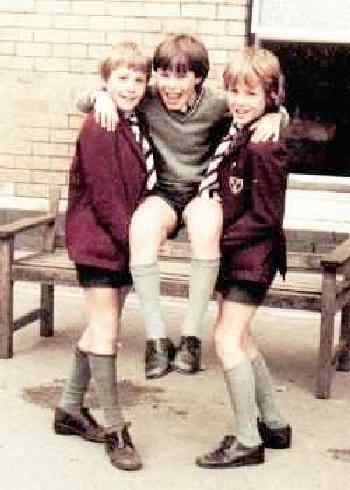
England was very influential in setting boys' fashions in the 19th Century. American parents in particular looked to England for their fashion trends. Boys fashion styles such as sailor suits, kilts, kickers, Norfolk suits, Eton suits, blazers, and others first appeared in England. School uniform had a profound impact on English boys clothes. English boys in the 1920s-40s mostly wore short pants suits with kneesocks. The shorts were generally knee length and often baggy. Almost all schools required uniforms with short pants, sometimes even for the younger boys at secondary schools. Boys often wore suit jackets or blazers for everyday wear. This began to change in the 1960s as jeans began to be worn by teenagers. Even English Boy Scouts switched to long pants in 1969. Younger boys continued to wear shorts, especially for school. The shorts began to follow the shorter more trim European styles. Modern British boys have adopted pan-European styles of sweat shirts and jeans, often topped with a baseball cap.
Estonia has for years been associated with Russia. Until 1818 it was part of the Russian Empire. As a Baltic country, Estonia was exposed to Western influences more than most areas of Russia. It was briefly independent until seized by Stalin in 1940 and then occupied by the NAZIs in 1941. After World War II it was administered as a Republic of the Soviet Union. It's location close to Finland meant that it was the only part of the Societ Union exposed to Western television. Estonia was the first part of the Soviet Union to gain independence (1991). As a result of its historical experience, Estonian fashions have been stronly influemced by Russian and German fashions.
Finland is a northern European country located between Sweden and Russia. Those two countries have dominated Finlan's history. Its closest cultural ties are with Estonia across the Gulf of Funland. Another geographic impactis from the northerly lattitudes is a harsh winter that has also played a major role in the ciuntry's devlopment. Finland is sometimes referred to as a Scandinavian country, but this is not accurate as ethnically the Finns are not Scandinavians, maning the northern German tribes. We have little information about the country at this time. The country is today an independent country, but since the 12th cebntury conquest by Sweden was ruled by either Sweden or Russia until achieving independence after World War I (1918). Economically Finland since independence has developed a modern industrial and post industrial economy. Like the Scandinavian countrues thyhave created a welfare state, but unlike southern Euriope have done so wiyh a degree of fiscal prudence. Thus fashion trends have been influenced by those two countries. Germany has also influenced fashions. We know of no destinctive Finnish boys' fashions.
|
Fauntleroy suits and sailor suits were popular in France in the late 19th Century. Sailor suits were more popular in France than in England, despite the country's limited naval tradition. Boys commonly
wore socks around the home and to school. French boys wore short
pants during the 1920s-40s. Short pants in the 1930s began to differ
from those worn in England and became shorter. Most schools did not have uniforms, but boys
commonly wore black smocks. Some private Catholic colleges (high schools) did require
uniforms, mostly blue sweaters and shorts with white knee socks. Clothing styles changed significantly, especially after the Paris Student Riots of 1969. Boys less commonly wore short pants. French children today most wear jeans and other long pants, adopting a kind of pan-European style.
Georgia has a fascinating history dating back millennia. It is not well know because the countrywas separated from Western Chrisendom for centuries. Since independence from the Soviet Union, the Georgian economy has benefitted from free market reforms. There are several important ethnic minorities in Georgia. The histories of Georgia and Armenia in the medieval era were linked as two small, isolated Christian kingdoms. There was during the Tsarist era an important Armenian minority in Georgia. We are unsure how the Armenian minority fared during the Soviet era, but as a multi-ethnic country we think tht there was considerable acceptance of ethnic diversuity. About 6 percent of the modern Georgian population is Armenian. There was also a Russian minority. We also notice a small Greek populations. Greeks were found in many Black Sea ports (Georgia, Turkey, the Ukraine, and Romania). Georgia was absorbed into the Tsarist Empire at the beginning of the 19th century. Russians then moved to Georgia, primarily settling in Tbilisi. The population shift was not one-way. The most famous Georgian is of course Soviet dictator Joseph Stalin. He became a staunch Russian nationalist with little interest in Georgia. Georgia declared independence (1992). When relations between the two countries deteriorated, most Russians left Georgia amid mutual recrimiations.
HBC has developed extensive information on German boys clothes. Our historic information on the 19th century is still fairly limited, but we know a great deal about the 20th century. Germany is one of the countries that have a major impact on dashions, including France and England and America in the 20th cenrury. In America we tendto see England and France as the principal fashion influences, but in Central and Eastern Europe, Germany was very imprtant. A major factor beginning in the 19th century was the large German garment industry. But the Germans seem to have used basic styles developed elsewhere rather yhan developed their own styles. We see some fashion influences from England and France. There do not appear to have been a lot of boys' clothing styles that are distinctibely German. The one exception appears to be Lederhosen, a folk style. But these and other thracgt styles have not spread to any great extent outside of Germany. One of the most popular styles in Germany was the sailor suit which was commonly worn by German boys until the 1940s. This if course was an English style, but enthusiastically adopted in Germany. German boys like most Europen boys commonly wore knee pants in the late 19th century and short pants from the 1920s through the 1950s. We have much more informnation on the 20th century. The sailor suit was an especially popular style. Younger boys wore over the knee stockings during the winter and some older boys had long pants in the colder weather. Sailor suits continued popular, even for relatively older boys through the 1940s. Few schools had uniforms. Boys in Bavaria and other places might wear leather shorts lederhosen) during the summer. As in France, styles changed substantially in the 1960s and most boys now wear jeans and other long pants. Styles are now much more casual. Many boys do not even have suits as there are so few occasions for wearing them. Modern German boys have adopted the pan-European style of jeans, sweat shirts, sneakers, and other casual clothes.
HBC has not yet been able to collect much information on the clothing worn by Greek boys. We have little historic information on Greece. We do note that the warm Medditeranean climate of Greece is an imprtant factors as was centuries of rule by the Ottoman Turks. After independence in the 19th centurty, European fashions began to have greater influence. This has been especially true since World War I (1914-18). One reader tells us that boys in Greece used to dress up for formal occasions, but this is now less common. The Greeks do have very distinctive kilt folk costumes.
HBC at this time has very limited infornation on Hugarian boys' clothing. Hopefully Hungarian readers will assisst us us in describing Hungarian styles and fashion trends. HBC at this this has insufficient information to asess chronological trends in Hungarian boys' wear. Hungarian boys wore the standard garmnts worn by other European boys. Hungary until after World War II was a largely agrarian country and we believe folk styles were still widely worn in the country side. Hungarian boys did not wear school uniforms. Some schools appeared to have required smocks in the 1960s. As a Communist Government was in power, this may have been a nationally mandated style, but HBC has only limited information at this time on school smocks.
Iceland is an island nation in the North Atlantic. The people are of largely Viking (Norwegian) ancestry, although for over five centuries it was ruled by Denmark. We have little information about Icelandic boys clothing at this time. We believe that clothing styles were similar to Scandinavia, especially Denmark. For years Denmark prohibited trade with other countries which also limited contacts. Denmark finally opened trade and move toward home rule (19th century). We do not know if there are any destinctive Icelandic fashions, although climarte has had an impact on clothing and fashion. Hopefully Icelandic readers will provide some information about their country. We have begun a Icelandic history page.
HBC has still on limited information on Irish boys clothes. We believe that Irish styles basically follow English fashions. This is certainly true today. One would in fact have difficulty differentiating between the clothes of English and Irish boys. There have been differences, especially in rural areas where poor Irish families simply did not have the money to buy fashionable clothes--especially for children. Rural dress is important because until recently that was where most Irish lived. Boys often wore dresses in rural areas. The kilt was also worn in Ireland, but not as commonly as in Scotland. In the towns and cities, boys normally dressed like English boys even in the 19th century.
Italian boys like boys in other Western European countries mostly wore shorts during the 1920s-50s. The length by the 1930s tended to be shorter than in
England. Boys generally wore smocks to school. Boys today mostly jeans and other long pants, but shorts are common for casual wear during the summer because of the warm weather. Smocks are still worn at some schools. I have so far been able to obtain very little information on Italian boys clothing. I hoping that an Italian visitor to HBC will be able to provide more information.
Latvia has for years been associated with Russia. Until 1818 it was part of the Russian Empire. It was briefly independent until seized by Stalin in 1940 and then occupied by the NAZIs in 1941. After World War II it was administered as a Republic of the Soviet Union until gaining independence in 1991. As a result, Latvian fashions have been stronly influemced by Russian fashions.
Liechenstein is a principality set in the Alps between Switzerland and Austria, just south of Germany. The Rhine River is its western border with Switzerland. The Principality was part od the Austrian Empire and Holy Roman Empire. After the Prussian defeat of Austria in the Austro-Prussian War (1866), Leichtenstein was for some reason overlooked in the peace treaty and gradually exerted its independence. Its whole modern history was oriented toward Austria, but after World War I shifted toward Switzerland. It adopted the Swiss France as its cirrency (1921). The economy was largly agricultural, but since World War II has become a financial center commonly used to avoid European Union taxes. The polpulation is mostly German speaking and Roman Catholic. We do not have much information on the Principality yet, but do have a page on Christmas.
Lithuania has experienced the same political shifts as the other Baltic countries in the 20th century. It is somewhat different than the other two Baltic republics in that Lithuania is largely Roman Catholic and is the Baltic state most closely associated with Poland. Lithuania is now an independent country.
Luxembourg is a small Grand Duchy surrounded by Belgium, France and Germany. It is a historical miracle that it has survived as an independent country. It was difficulr enough for the Futch and Belgians, for tiny Luxembourg it was a miracle. It is surprisingly rural with the dense Ardennes forest and nature parks in the north. The iron and steel indudtry had began to developp, in part because of the integration of the Grand Duchy into the German Zollverein (1842). Numerous steelworks were founded, mostly in the south. The Luxembourg works became part of the steel industrry complex in the Saarland-Lorraine-Luxembourg region, after 1871, except for Luxenmbourg all opart of the new German Empire through connection to the ecpanding German railway network. We do not yet have a page on Luxembourg, but we have a page on the royal family. There is a World War II page, but not yet a history page. We also have a page on Italaian immigration.
Macedonian is a small, landlocked Balkan country. Macedonia is best known as the ancient kingdom north of Greece which under Philip and his son Alexander proceeded to conquer much of the known world. Modern Macedonia is also located north of Greece, but it's boundaries are different than the ancient kingdom. Modern Macedonia is located in the south central Balkan Peninsula. I was conqyuered and ruled by the Ottoman Turks for several centuries. The Turks were driven out by the Greeks, Bulgars and Serbs (19th century). After World War I it became one of the provinces of the Yugoslav Kingdom and after World War II Communist Yigoslavia. It declared independence from Yugoslavia (1991), and unlike other provinces, the Serbs did not fight to hold it--probably because of the small number of ethnic Serbs living there. . Greece disputes the name Macedonia. he modern borders include by Kosovo, Serbia, Bulgaria, Greece, and Albania. This is reflected in the etnicity f the country. Macedonians comprise about 65 percent of the population. Albanians are also important, making up abnopur 25 percent, concentrated in the nothwest. Other ethic groups include Turks (4 percent), Roma (3 percent), Serbs (2 percent), and others (including Bosniaks and Vlachs). It's territory comprises the northwestern half of the larger area of ancient Macedonia which is split with Greece and Bulgaria. The capital is Skopje. The populatio is slightly over 2 million people (2002). The other majpr cities are Bitola, Kumanovo, Prilep, Tetovo, Ohrid, Veles, Štip, Kočani, Gostivar, Kavadarci and Strumica. The terraine is both rugged and beautiful, but the rugged terraine limits agriculture. Macedonia has more than 50 lakes and 16 mountains exceeding 2,000 m (6,562 ft). Despite the natural beauty, the country like most former Communist countries faces serious envoromental problems. The mpst severe is poor air quality as a result of emissions from metallurgical plants.
Malta is a small, but strategically located island located in the central Mediterranean. It has no real importance other than its location. This does not seem to have mean much in the ancient times, but it became an important posessession fought over beginning in the medieval era. Malta has a fascinating history. We also have a Malta history page. Sea power made Malta important. Air power in World War II made it vital and one of the mist bombed places during the War. The contending forces were various Christian monarchies and the Ottoman Turks. We do not yet have a Malta country page. Malta is a predominantly Catholic country. The Constitution of independent Malta establishes Catholicism as the state religion. Catholocism is deeply inbedded in many aspects of Maltese culture. The patron saints are St Paul, St Publius and St Agatha.
We have a page on First Communion in Malta. We also have a page on Maltese Scouts.
Montenegro is a small Balkan country at the southern end of the Dinaric Alps with a Adriatic coast seoarating Bosnia and Kosovo. The population is basically ethnic Serbs and its history is strongly associated with Serbia. Except for a narrow Adriatic coast, the terraine is primarily rugged mountains where medieval villages can still be found. The Bay of Kotor is an importnt coastal feature, rather like a Noregian fjord, but in warm waters. Here posuresque churches and fortified towns such as Kotor and Herceg Novi cn be found. Inland is Durmitor National Park with native wildlife including bears and wolves, and scenery including limestone peaks, glacial lakes and the 1,300m-deep Tara River Canyon. The country's administrative capital is Podgorica, but its historic capitala nd cultural center is Cetinje. Some Monegnegrians see themselves as Serbs although a strong sence of delf identity has developed. T he two countries were divided from Serbia during the Ottoman era. Albanians became increasingly present in the Kosovo region seoarating Serbia and Montenegro. Serbians began referring to Montenegrans as 'mountain Serbs'. After World War I it became a part of Yugoslavia After the disolution of Yugoslavia it has been gebnerally assocuated with Seebia, but voted for independence (2006). Within the European Uniion umnbrella, it is possible for small countries to be iundeoendent.
The Netherlands is a very small country, but has played a huge role in world history. We are just beginning to collect uinformation on on Dutch boys' fashions, but rather suspect that they were strongly influenced by German fashions and perhaps to a lesser extent English--but not French fashions. Working class boys, especiallys boys in rural areas, were more likely to wear identifiable Dutch styles--today referred to as folk styles. Folk dress persisted in some isolated areas. Since the 1970s, the primary influence seems to have been America with jeans becoming a virtual uniform for Dutch boys. I do believe, however, there are many similarities with German styles. Dutch boys have worn a lot of seasonal clothes. Stocking caps appear to have been popular. Heavy coats have not been as popular in the Netherlands as jackets and sweaters. Scarves appear to have been very popular. Boys engage in a variety of activities from choral singing to athletics. Other major activities include dance, music, school, Scouting, summer camp, and much more. Athletics seems to have been less important in the Netherlands than in America and England, in part becaise of the more academic orientation of the school system. The national holiday in the Netherlands is Queen's day, April 30. The most important holiday seaon for children is of course Christmas. The most special day during the Christmas season is Sinterklaas (St. Nicholas Day) December 5. For most children more important and exciting than Christmas day itself. All of the Netherlands is close to the North Sea or batious bodies of water such as the Zuider Zee. Thus sea outings are popular activities, especially sailing. Some boys wore short pants and knee socks during the winter, but many boys also had long sometinmes baggy oants for winter wear.
The short pants that became
widely worn in Europe during the 1920s were never as common in Norway as in other European
countries, in part because of the climate. Some little boys wore shorts and over-the-knee stockings. Shorts were not generally worn by older boys to school or for dress wear. Shorts could be used for leisure in summer though, but mostly very short compared to the English shorts, not much longer than swimming trunks, but looser. Scouts had longer shorts. Boys through the 1950s wore either knickers
with half stockings or long pants at school. After the mid-1950s knickers disappeared and boys usually wore longs, although knicker-style skiing pants continued to be worn. Boys wore shirts in the warmer months and in colder weather, sweaters or jackets or both.
Jackets were mostly of sports' fashion, but were gradually replaced by blazer-style jackets. Boys were unlikely to wear suits before confirmation at 14 or 15.
Polans is mlocated in noerhern Eastern Europe south of the Baltic Sea. It is part of the north European plain crossed by several rivers, especially the Vistula. Borders have changed widely over time. Poland was one of the great powers of medieval Europe. The population was a Slaviv people, influenced by Germany in the west and Russia in the east. Once dominating Eastern Europe, Poland was eventually conquered and partitioned by Austria Germany, and Russia and disappeared as a country from European maps. . Poland's modern existence dates from the end of World War I. Boys' clothing styles before that were primarily set by the prevailing styles in the countries that controlled Poland. After the War, German styles became very influential. Boys commonly wore short pants, often with long stocking during the winter. After the war, boys mostly wore shorts and knickers quickly disappeared. Such styles continued until the 1960s when blue jeans began to pierce the Iron Curtain. Polish boys now wear the pan-European styles blue jeans and other informal clothes.
Portugal led the European maritime outreach. HBC has been unable to acquire much information on Portugal. One HBC reader reports visiting Portugal in the 1960s and was surprised how the country contrasted with Spain. He felt that the children were not as well looked after or as well dressed as in Spain. The boys wore long shorts or long trousers. One reader reports tht it was very common for Portuguese boys to go barefoot. This presumably reflected the fact that for much of the 20th century, Portugal was a very poor country.
Hopefully our Portuguese readers will provide us some information so we can expand our coverage. We do, however, have a Portuguese-language glossary.
HBC has been able to collect little information yet on Romanian boys' clothing. Some information is available on traditional clothing. These traditional clothes were widely worn in Romania throughout the 19th century. A typical outfit was a long white jacket, wide callf-length pants, a black fez, and a red fez. The establish of an indepedent monarchy with a German dynasty presumably had an important impsct on populsarizing Western clothing styles. We note fashionably dressed boys by the early 20th century, but think we might be looking at omages from a small, affluent elite. Western European boys' clothing styles became more common after World War I. Romania appears to have been more influenced by the French or Austrian styles than other Balkan countries. Hopefully our Romanian readers will provide some information on boys' fashions in their country so we can can expand our coverage.
The pagent of Russian history is a fascinating story. Few countries have had a more exciting a sweeping historial epic. HBC has only begun to research Russian history and cultural traditions including fahions. We believe that fashions in the 19th and early 20th Century followed French styles, at least among the elete and wealthy fanmilies. There were major differences between social classes. The peasantry wore destinctive clothing. German fashions seem important in the early 20th century as was the case throughout central and eastern Europe. Sailor suits were popular. There were also domestic fashions of interest. After the Communist vistory in 1917 fashion was restricted, but still seems strongly influenced by Russian styles. We note extremecpoverty in rural areas with boys wearing ragged clothing. After World War II, we note conditions gradually improving with a better dressed population. Fashions continued, however, to be copied from European fashions. Modern Russian fashions are similar to the increasingly pan-European fashions of the 1990s. We notice that before World War I, many Russian boys even quite young boys had cropped hair. In this respect the Russians were similar to the Germans. We know that Tsar Nicholas I who succeeded Alexander II and preceded Alexander III was enamored of all things Prussian, this may have been a factor.
|
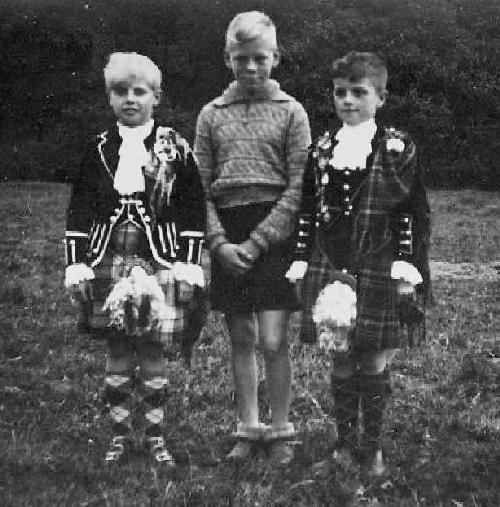
Scottish boys clothes are of course associated with the kilt. We are not sure, however, how extensively boys wore kilts in Scotland before Queen Victoria and to what extent ordinary boys wore them during the Victorian period. The Royal children are extensively photographed in them, but we know little about ordinary Scottish boys. Actually Scottish boys dressed very similarly to English boys. Historically there have been major differences between Scottish Highlnders and the Lowlanders who were significantly influenced by the neighboring English and before them the Britins and Romans. These differences gradually declined, especially after the disastrous battle of Culloden in 1746. It is the Highland kilt of course that we commonly associate with Scottish boys' wear. Highland boys, like their fathers, did once wear kilts Most Scottish boys, however, today do not own kilts and those that do seldom wear them. From the time that dedicated boys' styles began to appear in the late-18th century, Scottish boys' and other clothing have been heavily influenced by English fashion trends. With the exception of the kilt, Scottish boys have in the 19th and 20th century dressed much as English boys. There is in the 21st century virtually no difference between English and Scottish boys clothing.
Independent Serbia is a relatively new nation, but has an ancient heritage. The medieval Christan kingdom of Serbia was an important Balkans state, but was absorbed into the Ottoman Empire for sevdral centuries. Thus Serbia under Muslim rule like the Ottomans and Arabs did not experience major European developments (the Renaisance, Reformation, and Enligtenment) central to modern economic ajnd political development. Serbia reemerged as an independent country in the 19th century. Ottoman, Russian, and Austrian fashions have been important influences. It was Serbian terrorists that shot and killed Archduke Franz Ferdinand, setting in motion the course of events that launched World War I. Serbia after World War I it became the largest constiuent part of Yugoslavia--a diverse country which suffered greatly in World War II. After the removal of Communist police state controls, Yugoslavia unraveled (1990s). This resultedin a seies of terrible wars. Serbia was left separated and largely estranged from the neighboring states which had composed Yugoslavia. We have acquired little information on Serbian fashions. Ottoman, Russian, and Austrian fashions have been important influences. Serbian was one of the many European countries where people emmigrated to America in the late 19th and early 20th centuries.
Slovakia is a small cental European country south of Poland. The Slovaks were for centuries ruled by the Hapsburgs. It was part of the Austro-Hungarian Empire when it was created (1867). The Austro-Hungarian Empire disentegrated following Wrld War I (1918). The Slovaks joined the related Czechs to form Czechoslovakia, although there were tensions between the two ethnic groups. As Hitler prepared to seize Czechoslovakia, the Slovaks seceeded from the union and set up a pupet government subservient to the NAZIs. After World War II, Czexhoslovakis was reserected. The Soviets engineered a Communist coup (1948). Czechoslovakia became one of the Eastern European Soviet satellites. Soviet control collapsed (1989). Czechoslovakia emerged as a free democratic country. Tensions developed between the Slovaks and Checjs and two groups decided separate peacefully (January 1, 1993), creating Slovakia and the Czech Republic. We know relatively little about clothing styles in Slovakia. As faras we can tell, clothing trends and styles are similasr to Austria and Germany.
Slovenia is a very small country in central Europe south of Austria and east of Italy. Most of modern Slovenia waa included in the Austrian Crown Lands (Carinthia, Carniola, and Styria) and thus heaviy influenced by Austria meaning German culture.. In modern times it was a part of the Austro-Hungarian Empire After World War I it became part of the Kingdom of the Sothern Slavs (1919) which became Yugoslavia. For most of the 20th century, Yugoslavia was part of Yugoslavia with both a Royal and Communist era. After World War II, Slovenia was awarded Vebezi Giulai (1945) and later the Yugoslav zone of areas neat Trieste (1954). Sovenia was the first country to break away from Yugoslavia and managed to do so without a serious war (1991). Slovenia is perhaps best known for its mountains, ski resorts and pristine mountain lakes. A popular tourist site is Lake Bled, a glacial lake fed by hot springs. The town of Bled contains a church-topped islet and a cliffside medieval castle. The country holds most of The Julian Alps, including the highest points--Truglay and Karst. Slovenia is drained by the Drava and Sava Rivers. There are three geographic area: alpine, Pannonian and Danubian lowlandss, and the Mediterranean coast. Slovenia’s capital, Ljubljana, boasts a senic baroque facades mixed with the 20th-century architecture of native son Jože Plečnik. His iconic Tromostovje (Triple Bridge) spans the tightly curving Ljubljanica River. We have begun to work on Slovenia history. We also have a page on Solvenian immigration in America. The Slovenia economy was dominted by agriculture. The country like Austria has a long tradition of crafts, and like Austria little industry. Only in the early-20th century did Slovenia begin to modernize and diversify the economy. This continued during the royal period. Slovenia emerged as the most propsperous area of Uugoslavia and this continued during the Communist post-World War II era. Economic develop continued adter Tuto's break with Stalin (1948) and Yugoslavia developed a market-oriented 'self-management' form of socialism (communism). While this was not as efficent as market capitalism, it was more efficent than the economies of the Soviet Union and the rest of the Soviet Empire.
The Slovene economy was the star of the YUgoslav federation.
Gradually Yugoslave dominted by Serbian Communist leaderhip began to stagnate economically. Communist controls limiting market forces and rising debt levels caused increasing problems. Especially galling to the Slovenes was the Communist central government’s policy of distributing subsidies from the more prosperous northern market-oriented republics to the less-affluent and often corrupt southern republics. This essentially was a olicy punishing economic efficency and rewarding coruption and inefficency. Conined with eyhnic differences it was a major driver leading to the breakup of Yugoslavia and independence from Yugoslavia, meaning essentially Serbia and Communism. This led to major problems. The inherent unprofitability of 'socially owned' enterprises were exposed. And Slovenia lost it s markets which before independence werre primarily in the former Yugoslavia. Slovenes are predominantly Roman Catholic. Ethnically they are mostly Slavs.
Spain is an especially important country because of its influence on a host of other countries, although ironically for much of history Spain and Iberias a whole has been a backwater. This is true of both the Roman period and the European medieval era as well as the modern industrial era. This was the case largely because it is not a rich agricultural country, the primary basis of wealth through most of history. Much of Spain is both arid and rocky. And trends in Spain have varied from the rest of Western Europe. It was dominated by Muslims for an extended period as just as Wesrern Europe was emerging from the medieval era and experiencing the an ntelkectual awakening called the Renaissace, Spain was dominated by the Spanish Inquisition which impeded free thought and learning. And gold and wealth from the new American colonies enabled Spain for a brief period to plat a major histirical role. As it was a major colonial ower, it played a major role on the history and cultural traditions of many other countries, especially Latin American countries. We have begun to collect some basic information on fashion. HBC knows of no major boys fashion that developed in Spain. Boys fashions in Spain appear to be mostly a reflection of styles developed in other countries. Spanish boys commonly wore knee pants in the 19th century. Sailor suits were a popular style. By the 1930s boys commonly wore short pants and many boys wore smocks to school. After the 1960s short pants became much less common as most boys wanted to wear jeans. By the 1980s most Spanish children were wearing the pan-European styles of jeans, runnig pants, sweatshirts, and sneakers. First Communion in Spain has been a major event, as to be expected in a Catholic country. There are several important regions of Spain. We have only begun to collect information on these regions. There were important differences between those regions, but since World War II these differences have declined significantly. Some of the major regions are Andulucia, the Basque country, Castille, Catalonia, and Galicia. There is also the Canary Islands. Some information is available on individual Spanish boys.
Boys' fashions in Sweden during the 19th Century were similar
to other European countries. This began to change somewhat in the 1920s, it was
just to cold to wear short pants during the winter like the British and French.
Some boys wore shorts with long over the knee stockings. Older boy wore knickers and long pants were more common than in more southerly countries. Since the 1970s there has been little difference between the clothes worn in Sweden and other countries.
Switzerland is a small mountaneous country, in fact the most mountaneous country in Euroope. It is located in the middle of Europe, wedged between several large countries or formerly large countrues, Austria, Italy, France, and Germany. As a result, the country has to contend with an interesting mix of language (French, German, and Italian) and religious (Catholic and different protestant) groups. First communion thus can be quite varied among these different groups. Switzerland is a confederation of 22 cantons. Switzerland first appears in history as an area targetted by Ceasar in the Galic wars. Over timer it vhas acquired the destinction of being a neutral country. Swiss boys are best known in the popular mind with wearing Lederhosen and hiking in the Alps. While a few boys may have worn Lederhosen, they vwere not very common. Swiss boys more commonly dressed like boys in other European counties. Because of the large German and French speaking populations, clothing styles in those countries have been particularly popular. Italian fashions have also had some influence, but the Italian-speaking population is relatively small. We do not notive many destinctive Swiss styles.
The Ukraine is a Slavic state in southeastern Asia. The history of the Ukraine has been closely tied to in recent years. The first important Slavic state was Kiev. The Mongols destroyed the Kiev state (13th century). What is now Russian came under Mongol/Tartar domination. The Ukraine came under Lithuanian/Polish domination. With the rise of the Russian Empire, the Tsars expanded their influence into the eastern Ukraine (17th century). With the Polish partitions the Tsars seized most of the Western Ukraine (18th century. We have little information at this time on boys' clothing in the Ukraine. Given the country's historical experience, we assume that clothing styles were similar to those worn in Russia and Poland.
Ulster is a very recent constituent part of the United Kingdom. For most of its history it was just one part of Ireland, the northern counties. Beginning with the Easter Rebellion, the Irish began fighting for their independence (1916). The Catholic Church was an important part of the Irish struggle for independence. The Irish Free State left the United Kingdom in 1922, but the six northern counties with Protesant majorities voted to remain with Britain. The religious difference was the result of the Plantation of Ulster. This was the colonisation effort in northern Ireland launched during the reign of James I (early 17th century). English and Scottish Protestants were settled on land confiscated from Catholic Irish landowners. We have little information on boys clothing in Ulster. There may have been significant differences in the clothing worn by Catholic and Protesant boys in the 19th century, princiaplly because of the poverty of the rural Catholics.
Wales is one of the constiuent countries of the United Kingdom. HBC has not, however, created separated pahes on Whales as we have done for Ireland and Scotland. This was because Whales was conquuered by the English in the 12th and 13th centuries and Welsh independence largely extinguished. The conquest of Ireland and Scotland was much more recent and never as thorough as the subgegation of Wales. As a result, we ave not noted the kinds of destinctive garments and cultural destinctiveness as is the case for Ireland and Scotland.
Yugoslavia was created after the end of World War I (1914-18). It means land of the southern Slavs, uniting various Slavic principalities in the Balkans. It was built around the Serbian Kingdom which had been part of the Allied coalition which won the War. The Slavic populated provinces of the former Austro-Hungarian Empire (Bosnia, Croatia, and Slovenia) were added to form Yugoslavia. Serbia was the dominant component which was resented by the minority regions, especially Croatia. There were also minority non-Slav groups (Germans, Hungarians, Jews, and Kosovars/Albanians.) We do not yet have a page for Yugoslavia which only lasted as a nation for seven decades. We we are working on pages for the modern countries which developed out of Yugoslavia: Bosnia, Croatia Macedonia, Montenegro, and Serbia. All have histories that predate Yugislavia and which now continue after the breakup of Yuglslavia at the end of the Cold War. We also have a page on Kosovo, the future status of hich is still undecided. We have a page on Yugoslav history. Yugoslavia disentigrated in the 1990s resulting in a bitter series of internal wars as Serbia attempted to prevent withdrawl of the various constiuent parts. Until Putin invaded Ukraine, these were the last wars in Europe.
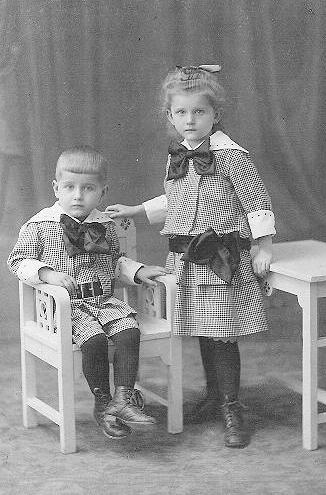
Most of the images we have archived either are identified or we can identify the country. Of couurse some countries are easier to identify than others, specially smaller countries. Here it is virtually impossible to identify the country involved. The major countries which produced the largest number of photographs, however, have many readily identifiable characteristics. or garment styles. Not all are obvious and there is no absolute way of identifying the country when there no odentifying text or unique background. Accompanying text does not need to note the country. Just the language used can help identify the country. But many can be identified with a fair degree of accuracy. Neighboring contries complicate this matter, especially when there is a close cultural relationship. Belgium is greatly influence by France. Austria, the Baltics, Czechlobakia, Denmark, and Switzerland are influenced by Germany, although influenced by Germany. The French speaking areas of Switzerland are more influenced by France. Much of Eastern Europe shows a German imprint. Here the large German fashion industry was an important factor. Ireland and to a lesser extent Norway show English influences. After World War II, especially by the 1970s we see less of these destinctive national styles. A kind of pan-European style emerges.

Navigate the Boys' Historical Clothing Web Site:
[About Us]
[Return to the Main country page]
[Introduction]
[Activities]
[Biographies]
[Chronology]
[Clothing styles]
[Bibliographies]
[Contributions]
[FAQs]
[Glossaries]
[Images]
[Registration]
[Tools]
[Boys' Clothing Home]