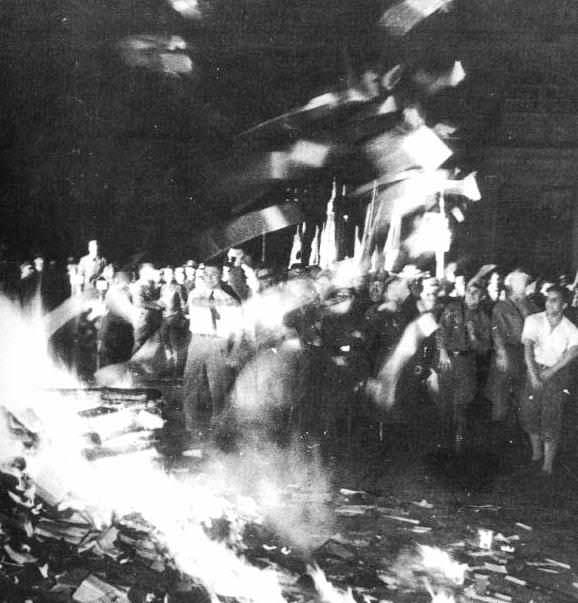
Figure 1.--Books were one of the first casulties of the NAZI regime after Hitler seized power in 1933. The NAZIs organized mass burnings of books written by Jews or expressing objectional ideas. Virtually all books by Jewish authors were destroyed. One of the most disturbing aspect of the NAZI book burings was that it was not just conducted by SA thugs, but by some of Germany's brightest, most idealistic young people. University students and even professors were enthusiastic participants. /i>
"There where books are burned, in the end prople too are burned." -- Heinrich Heine
Books were one of the first casualties of the NAZI regime when Hitler seized power in 1933. The NAZIs organized mass
burnings of books written by Jews or expressing objectionable ideas. Virtually all books by Jewish authors were destroyed.
Hitler Youth members enthusiastically committed masterpieces of the German language as well as many foreign texts to huge
bonfires. The book burnings were carefully prepared. The NAZIS seized power in January 1933. Throughout the spring of
1933, NAZI student organizations, professors, and librarians compiled an extensive lists of books they determined to be
"entartet" (degenerate) and should not be read by decent Germans. NAZI SA Stormtroopers and student groups armed with this
list on the night of May 10, 1933, surged into libraries and bookstores all over Germany. They organized Wagnerian
spectacles, marching in long lines by torchlight, singing Party songs, and chanting the twelve "theses,"--their manifesto for the "purification" of German literature and thought. They then threw the seized books on to huge bonfires. More than
20,000 books were burned on May 10 at the Berlin Opernplatz book burning alone. Many were works of Jewish authors such as
Max Brod, Albert Einstein, Franz Kafka, Richard Katz, Sigmund Freud, and Franz Werfel. German-writing authors from Prague
were Franz Kafka, Franz Werfel ("The Song of Bernadette"), Max Brod and Richard Katz. They were Jews, so their books were
burned. Thomas Mann married a Jewish woman, Katja Pringsheim, so his children were half-Jews according to NAZI
classifications. Most were by non-Jewish writers, including famous American (Jack London, Ernest Hemingway, and Sinclair
Lewis), English (H.G. Wells), French, and German (Thomas Mann--whose wife was Jewish, Erich Maria Remarque, and Rainer
Maria Rilke) writers who expressed idea differing from the NAZI world view. Erich Maria Remarque was born a Catholic
(notice his middle name). His real surname was Kramer. (Remark in reverse). His books were burned on account of his anti-
war novel All Quiet on the Western Front--the most important novel to emerge from World War I. Many of the banned
authors still living wisely emigrated, many to the United States. Also the books by the poet Rainer Maria Rilke were
burned. He was too cosmopolitan, born in Prague, living in France as secretary of Rodin. Somebody like that thoroughly
antagonized the NAZIs. The choice of degenerate authors provides a terrifying insight into the NAZI mindset. One such
author was Helen Keller, the deaf-mute who became a writer. (The handicapped in German were to be targeted by the NAZIs as
part of a eugenics program several years before the Holocaust.) Public and private libraries and book stores were advised
to ensure that they did not have the "degenerate", "un-German" books.
German Scholarship
Until Hitler, books had been revered in Germany perhaps more than any where else in Europe. The NAZI book burnings in May 1933 were one of the first shocking events of the NAZI regime. Unlike the arrests that had begun, the book burnings were widely covered in the German and foreign press. And because the NAZIs were proud of their work, there was extensive film coverage which was shown in movie news reels (the primary outlet for photo journalism at the time) all over the world. The shock was not just that books were being burned, but that it was being done at German universities--some of the world's
great centers of academic learning. The world's revulsion is not difficult to understand. What is perhaps more troubling
than the burning itself is the reaction of the German academic community. Such actions by NAZI thugs was not surprising.
The book burnings, however, were carried out by German university students. There was almost know criticism by their
professors, indeed many joined the students or endorsed their actions. [Davidson, pp. 46-47.] It was becoming apparent by
May 1933 what happened to NAZI critics, still the regime had just begun its campaign against the domestic opposition. The
virtual silence of the German academic community is shocking indeed.
One of the true historical villans is Josef Goebbels. Often in wtiting biographies there are a mix of good and bad to report. With Goebbels there is virtually no good, except that he was very good at what he did. Once in power, Hitler appointed his long-time supporter, Dr. Josef Goebbels, to head a new Ministry of Propaganda (mid-March 1933). Goebbels was not pleased. He wanted a more powerful ministry. Hitler was, however, was a good judge of talent and he he picked the ne minister with an inturive sense of capbilities. While deeply disappointed, Goebbls set out to make the most of ne post. And for the next 12 years, Goebbels after Hitler would be the most vissibl face of the regime. And after the victories faded and Hitler went into seclussion, Goebbels continued as the spokesman for the regime until the very end. He and his fmily joined thir bloved F�hrer in his Berlin bunker--the only top NAZI to do so. Once of the earliest NAZI extravangaza organized by Giebbels was a campaign against art and books with an "un-German spirit". This meant books written by Jews or Marxists, actually the two in the NAZI-mind were inseparable. When the book burnings occurred in May, German newspapers now firmly under Goebbels control, triumphantly reported on the events.
University students like much of German society, became heavily politicized in the aftermath of World War I. Many
university students were drawn to right-wing politics and gradually the NAZIs became the dominant right-wing group. There
were in 1933 two important university student groups. The first predated the NAZIs. It was the Deutsche Studentenschaft
which was founded in 1919 and to which all German university students had to belong. The second was the National Socialist
Studentenbund, a NAZI Party organization. After the NAZI takeover in January 1933 competition between the two groups
increased as it was increasingly obvious that one of the two would be disbanded. There was little or no active student
opposition to the book burnings on the part of the Deutsche Studentenschaft, in fact many members tried to "out NAZI " the
NAZI National Socialist Studentenbund. [Stratz, pp. 347-372.] One of the most disturbing aspect of the NAZI book burnings
was that it was not just conducted by SA thugs, but by some of Germany's brightest, most idealistic young people.
Preparation
Books were one of the first casualties of the NAZI regime when Hitler seized power in 1933. The NAZIs organized mass
burnings of books written by Jews or expressing objectionable ideas. Virtually all books by Jewish authors were destroyed.
Hitler Youth members enthusiastically committed masterpieces of the German language as well as many foreign texts to huge
bonfires. The book burnings were carefully prepared. The NAZIS seized power in January 1933. Throughout the spring of
1933, NAZI student organizations, professors, and librarians compiled an extensive lists of books they determined to be
"entartet" (degenerate) and should not be read by decent Germans.
The Burnings (May 10-11, 1933)
NAZI SA Stormtroopers and student groups armed with this list on the night of May 10, 1933, surged into libraries and
bookstores in university towns all over Germany. These events were also staged on May 11. They organized Wagnerian
spectacles, marching in long processions by torchlight, singing Party songs, and chanting the 12 "theses,"--their manifesto
for the "purification" of German literature and thought. The students proudly wore their caps with the colors of their
university corps. SA ans SS bands in many towns provided suitable musical accompaniment. The students then threw the
seized books on to huge bonfires. The events were choreographed. Students would announce the authors of the books and
cryptically explain why they wee being burned. One German newspaper reported some of these incantations. One
student called out, "Against class warfare and materialism: for the Volk community and an idealistic lifestyle, I deliver
to the flames the works of Marx and Kautsky." Another shouted, "Against decadence and moral decay; for discipline and
morality in family and state, I deliver to the flames the works of Heinrich Mann, Ernst Glaeder and Erich K�stner."
[Davidson, pp. 44-45.] Note the idealistic rhetoric of these young Germans. More than 20,000 books were burned on May 10 at the Berlin Opernplatz book burning alone.
12 Thesis
The Deutsche Studentenschaft had drafted 12 Thesis "against the un-German Jewish spirit in books. The title of course
was reminiscent of Luther's "95 Thesis" making it sound suitably Germanic. The content was an effort to establish the
organizations NAZI credentials. They demanded that only Germans (meaning Aryan Germans) be allowed to publish in the German
language. Any Jew publishing a book would have to publish in Hebrew and books appearing by Jewish authors, whether written
in German or not, would have to be labeled as translations. [Davidson, p. 45.] Note the lack of awareness here of the NAZI
program and this early stage of Hitler's rule. Implicit in these thesis was an assumption that Jews would continue living
in Germany and continue writing and publishing books.
Authors
The primary target of the NAZIs were Jewish authors. There were many Christian German and foreign authors also selected
for the bonfires.
Jewish authors
Jewish authors were all burned, no matter what the subject are point of view. Jewish authors included Vicki Baum, Max
Brod, Alfred Doeblin, Albert Einstein, Lion Feuchtwanger, Sigmund Freud, Heinrich Heine, Emil Ludwig (Cohn), Magnus
Hirschfeld, Franz Kafka, Karl
Kautsky, Richard Katz, Felix Salten, Kurt Tucholsky, Jakob Wassermann, Franz Werfel, and Stefan Zweig. German-writing
authors from Prague were Franz Kafka, Franz Werfel ("The Song of Bernadette"), Max Brod and Richard Katz. They were Jews, so
their books were burned. Heinrich Heine (1797-1856): Heinrich Heine one of Germany's greatest poets. Heine was Jewish, although he converted
to Protestantism when he was a student. In the NAZI scheme he was still Jewish so his books were burned. I am not sure that
he really said or wrote what you are quoting. Heine wrote poems that became part of Germany's
cultural heritage. Many of Heine's poems were set to music by famous composers like
Mendelssohn (another converted German Jew) and Johannes Brahms. It was
impossible for even the NAZIs to erase or forbid everything that came out of
Heine's pen. So they tried to proclaim that his poems were "unbekannt" (unknown). The German people however knew better, and
songs like "Die Lorelei" were sung even during World War II. A French reader writes, "I love Heinrich Heine; I have read
several times many of his poems . I have most of his work, printed in the Gothic script. How any one good burn his poems I
will never understand. German poetry is probably the most precise and sensible in the world. The German language is very
rich and well adapted for literature and music. Felix Salten: Felix Salten wrote the children's book "Bambi" that became a favorite Walt Disney movie). Carl Zuckmayer: Another great writer and playwright was Carl Zuckmayer, classified
as a "Half Jew" by the Nazis, who also emigrated to the United States.
German Christian authors
The works of many non-Jewish German writers also had their books burned. These writers had expressed ideas differing
from the NAZI world view in some way. Some of the German authors targeted were: Bertolt Brecht, Hermann Hesse?, Erich
K�stner, Thomas Mann, Erich Maria Remarque, and Rainer Maria Rilke. There were many more.
Hermann Hesse: I am not sure if the NAZIs burned the books by Hermann Hesse. I won't be surprised if they did on
account of Hesse's humanitarian philosophy. He later
became a cult figure of the "Hippies".
Erich K�stner: Erich K�stner was not Jewish and wrote some
delightful children's books like Emil and the Detectives. I don't think the NAZIs particularly objected to his
children's books, but he was a published journalist and out-spokenly anti-NAZI. Unlike many other anti-NAZIs, he did not
flee Germany after the NAZI take over. He was questioned by the Gestapo, but not arrested. His books were burned and he was not allowed to publish.
Thomas Mann: Thomas Mann married a Jewish woman, Katja Pringsheim, (so his children were half-Jews. A according to
NAZI classifications they were Mischlings. Thus his books were burned.
Erich Maria Remarque: Erich Maria Remarque was born a Catholic (notice his middle name). His real surname was
Kramer. (Remark in reverse). His books were burned on account of his anti-war novel All Quiet on the Western Front--
the most important novel to emerge from World War I.
Rainer Maria Rilke: Rilke was a German lyric poet was for a time served a
secretary to the renowned French sculptor Rodin. He eventually obtained the patronage of wealthy Germans. His prose and verse his highly musical and pervaded by a strong religious mysticism. As a boy he was coddled by his mother. She developed
refined tastes in him and dressed in frilly clothes. When his father abandoned the family, he had to pursue his education in
harsh military schools where the other boys did not appreciate his refinements. And this would not do in NAZI Germany where
the system set out to toughen boys for the coming war. His books were burned, He was just too cosmopolitan People like
him thoroughly antagonized the NAZIs.
Foreign authors
The works of many foreign authors were burned. Some of these writers included famous American (Jack London, Ernest Hemingway, and Sinclair Lewis), English (H.G. Wells), and French authors as
well as those from other countries. A corollary of this policy was, as part of their effort to destroy the Polish nation, to destroy books in the Polish language after they occupied Poland in 1939.
Permitted Works
German authors whose books were not burned were: Stefan George, Hans Grimm, Gerhart Hauptmann, and Ernst Juenger. They
were not really NAZIs, but Goebbels could not ban all non-NAZI writers. Encouraged reading were the works by Friedrich
Nietzsche (although most Germans could not comprehend what he wrote). Another favorite was Houston Stewart Chamberlain, an
Englishman who wrote philosophical works (in German!) about race and "Volk".
Chamberlain was a great admirer of Richard Wagner and married his daughter Eva. He became a German citizen in 1916. Other
foreigners who were in favor of and by the NAZIs were Sven Hedin, the Swedish world traveler and explorer and the Norwegian
Knut Hamsun who's novels were very popular. Interestingly, also some of the books by Flemish authors like Hendrik de Man, Stijn Streuvels, and Felix Timmermans were translated and read in
NAZI Germany. Hitler liked a series of novels about Atlantis bordering on science fiction. I think the author was Leo
Frobenius, who wrote Auf dem Wege nach Atlantis (On the Road to Atlantis). I know he he liked the books by Karl
May, the author of books for boys about American Indians (Winnetou, Old Shatterhand, etc.). Karl May had never
been in America. He spent some time in prison for embezzlement.
Many of the banned authors still living wisely emigrated, many to the United States. Established authors often had
the financial means to emigrate. Many others either did not have the means to do so or did not choose to do so, not fully
appreciating the dangers.
Politics
Communists and socialist authors were targeted by the NAZIs. The word "socialist" was in the party name only to attract
support from the working class, not because they had a socialist agenda. Bertolt Brecht was one of the most famous
playwrights of the 19th century. Brecht was not Jewish. He was a Marxist and therefore an enemy of the NAZIs. He left
Germany in 1933 and returned to East Berlin (the Soviet sector) in 1948. He wrote the text for Kurt Weill's "Three Penny
Opera" with the famous song "Mack the Knife". Weill was a Jew and settled in Los Angeles where most of the exiled German
writers and artists went to live during the NAZI era. (Hollywood was nearby!)
The non-Jewish authors that were burned were not only authors that wrote about politics. In fact, the choice of
degenerate authors provides a terrifying insight into the NAZI mindset. One such author was Helen Keller, the American
deaf-mute who became a writer. The handicapped in German were to be targeted by the NAZIs as part of a eugenics program
several years before the Holocaust. At first they were targeted for sterilization after assessments by hereditary courts.
After the War broke out in 1939, Hitler approved the T4 euthanasia program which killed over 50,000 Germans, probably many
more.
Libraries and Book Stores
Public and private libraries and book stores were advised to ensure that they did not have the "degenerate", "un-German"
books. I do not have details yet, but I believe that the books in public, school, and university libraries were purged of
books by the Jewish and other authors on the NAZI list. Many of the books burned in Berlin on May 10, 1933 came from the
University of Berlin library.
Books at Home
We do not yet have details on what happened in people's homes. I am not sure that it was a crime to have these books.
Certainly many educated Germans did not want to discard treasured books. It is likely that having such books would make you
suspect, so many Germans did discard them. A HBC reader tells us, "I have heard that some Germans managed to hold on to
some of their beloved books by Jewish authors by simply covering them with a dust jacket of Hitler's Mein Kampf,
Alfred Rosenberg's The Myth of the Twentieth Century or Houston Stewart Chamberlain's Die Grundlagen des
Neunzehnten Jahrhunderts.
Hitler Youth
I really don't know to what extent Hitler Youths were involved in the NAZI book burnings that took place in 1933. We
suspect that some of the older boys may have participated, but these seems to have been a night-time affair when the younger
boys would have been home. Also this was done very soon after the NAZI take over and the organization was still relatively
small. One question we have little information about is to what extent Hitler Youth boys and girls spied on neighbors and
reported what books may be in the home. We have heard charges that this occurred, but have noted few actual accounts.
Newsreels
Americans and Europeans beginning in the 1920s began to see motion picture images of world events in movie newsreels.
They were shown before feature films and in the years before television were the primary images of world events presented to
the public. Beginning in 1933 the alarming scenes of NAZI Germany were presented. These included images of the book
burnings and outrages against the Jews. It was not just the public that watched these newsreels. The new American
president, Franklin Roosevelt, after dinner in the White House would several times a week view movies with family and
guests. These viewings included the newsreels. This brought the president pictorial and sound impressions of national and
international events. And some of the first images Roosevelt saw was the book burnings and the beginning NAZI actions
against the Jews. [Freidel, p. 287.]
The Netherlands
A Dutch reader who was a boy during the occupation tells us, "When I think of it, it has been quite amazing that the
first German book we had to read in German class was Emil und die Detektive. That was in 1940 after Holland was
already occupied by the Germans. We had no idea that the author, Erich K�stner, was anti-NAZI. It never came up. Now I
have the feeling that the school administrators knew it and did it on purpose, just to see if they could get away with it.
They did, because the book remained standard reading at school. German-language books were read in Holland, especially by
educated people. Books that were burned in Germany and could not be reprinted there were published by the Amsterdam-Jewish
publisher Querido until 1941, And that was what Dutch readers wanted: Thomas Mann, Stefan Zweig, Franz Kafka, etc. Many Dutchmen did not want to read anything in German, Period! I myself have always separated the beautiful German literature that was created through the 19th and 20th centuries from 12 years of Nazi-barbarism and I still enjoy reading in German.
Personal Comments
A HBC reader who was a member of the Hitler Youth in the final years of the War writes, "I never heard about this. I
was about 1 year old when this happened. I do not remember having heard of this kind of burning even AFTER the Hitler time."
Another reader writes, "It certainly was a dark page in Germany's history book!"
Sources
Davidson, Eugene. The Unmaking of Adolf Hitler (Univesity of Missouri: Columbia, 1996), 519p.
Freidel, Frank. Franklin D. Roosevelt: Launching the New Deal (Little Brown: Boston, 1973), 574p.
Stratz, Hans-Wolfgang. "Die Studentische `Aktion wider den undeutschen Geist' im Fr�hjar 1933," Vierteljahrshefte f�r Zeitgeschichte Vol. 4, 1968, pp. 347-372. Note that the NAZI Einsatzgruppen used the same term, "Aktion" to describe the murder of Jews and other civilians in Poland and the Soviet Union during World War II.