*
NAZI era racial policies (1933-45) Mischlinge Bescheinigungen
The NAZI Era: Racial Policies (1933-45)
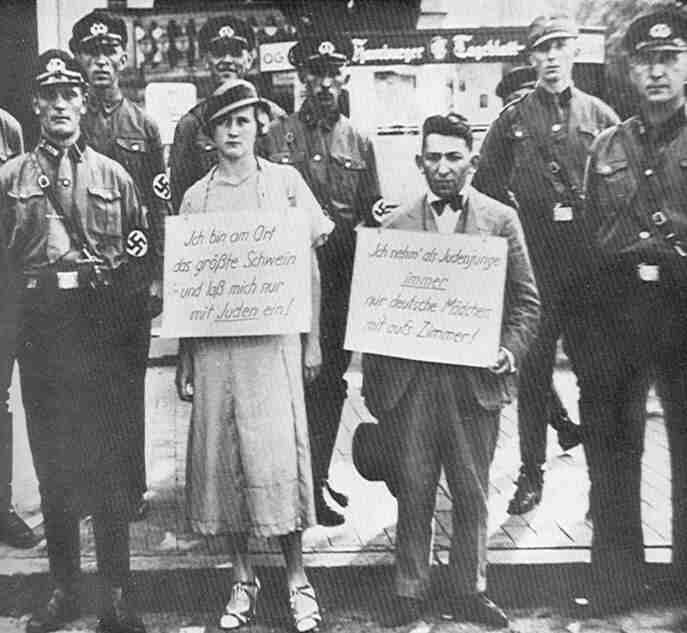
Figure 1.--These NAZI Stormtroopers are preparing to march this couple through the streets of a German city to publically humiliate them, a common tactic in the early years. The placards reads, "At this place I am the greatest swine: I take Jews to make them mine." and "As a Jewish bouy I always take German girls up to my room." The man was probably beaten marching around town.
Any understanding of the experience of German children during the NAZI era can not escape a basic understanding of the regimes racial policies. As the boys in the images posted in HBC can not speak to us, such background is needed to understand what was hoing through their heads and the experiences they had. The NAZI attitude toward the Jews is best known, but other groups were also affected. Then there was the complication of children who were of mixed ancestry--"Mischlinge". Racial background affected one legal status and standing in the society. For boys a primary consideration was membership in the Hitler Youth and the right to wear the uniform--a uniform that even many children from anti-NAZI or non-Aryan families often desired to wear.
The NAZIs gave particularly attention to education and control of the German educational system. They were well aware that it would be difficult to convert many adults and only a minority of Germand had ever voted for the NAZIs in democratic elections. The children were a different matter. They were thus determined to mold the new generation to accept NAZI pinciples. As the leader of the NAZI Teacher's League, Hans Schemm, put it: "Those who have the youth on their side control the future." As a result, after the NAZIs seized power in 1933, they quickly began applying totalitarian principles to all aspects of the German education system. Private schools were taken over or closed. Great emphasis was attached to racial "science", often termed "racial hygine", in NAZI education and this was quickly introduced into the curiculum. NAZI idelogy and physical-military training became other important aspects of the school program. Many teachers embraced the new Germany, but others were fired or left teaching. It is difficult to assess the relative importance of the two groups. It is known that many teachers were fired or replaced with political hacks during 1933-35, but HBC has no details on the numbers. Some of the best educators fled abroad. The quality of German education, once the leading system in Europe, declined. Again, however, it is difficult to assess this in quantitative terms.
Virulent anti-Semites wanted action against Jews and Aryans having exxukarelay=tions. Julius Streicher demanded the death penalty for Jews having sexual relations with Germans. Hitler addressed this in Mein Kampf, but without specific details as to just how to define a Jew or sanctions for violations. The Germans had two terms for this: Rassenschande (race defilement/shame) and Blutschande (blood defilement/shame). Another tramslation is bastardization. Hitler claimed that it was the cause of the preceived moral degradation of German society. As the NAZis became a major party, Hitler moderated speeches somewhat. [Koonz, p. 25.] The NAZIs upon seizing power adopted a policy racial shaming for Germans having sexual realtions with non-Aryans, especially Jews. This also extended to Blacks, although there were so few Blacks in Germany that this was a very limited action. When the NAZIs came to power, there was no agreed concept as to judst vhow to define a Jew. This ranged fron two Jewish parents to anyone with even one-sixteenth part Jewish ancestry. Opinion varied. Some even regarded the number of intermarriages as too small to be of any real hsrm. Others like NAZI jurust Roland Freisler regarded the vnimbers irrelevsnt and regarded such sec=xual relations as 'racial treason'. [Koonz, pp. 173-74.] Freisler published a pamphlet ptromoting the immediate banning of ll "mixed-blood" sexual intercourse (1933). He was not just talking about Jews, but all foreigners. There was no public sxupport for thisd, nor did Hitler agree. [Koonx, p.74.] Freisler's boss, Franz Gürtner, opposed it both for reasons of popular support and a range ofg problematic issues. He pointed out that there were people who did not know that they had Jewish ancestry. And this would give rise to a rash of blackmail threats.[Koonz, pp. 175-76.] Legal sanctiins were not at first possible because there was no law against it. This did not, however, prevenbt the SA from conducted extra-legal actions. Anti-miscegenation policies were a core NAZI goal. It was at first pursued informally Aryan certificate requirement. Local officials began demanding these documents before issuing marriage certificates. Systematic action, however, required a new law.
Racial Laws (1935-45)
The conerstone of NAZI laws and regulations against the Jews were the Nuremberg Laws of 1935. Many other laws and regulations preceeded and followed the Nuremberg Laws which provided the legal basis for the isolation of the Jews, seizing their property, and finally expelling them--in most cases to the Polish death camps, or more correctly German death camps in occupied Poland, where they were murdered.
Geman Führer Adolf Hitler at the Nuremberg Party Congress on September 15, 1935 announced three new laws that were to be cornerstones of German racist policies and the supression of Jews and other non-Aryans. These decrees became known as the Nuremberg Laws. They were decrees which in NAZI gErmany had the force of law forbidding contacts between Aryan Germans and Jews, espcecially marriage and srtipping Jewsof German citizenship. The first 1935 decree established the swastika as the official emblem of the German state. The second established special conditions for German citizenship that exclided all Jews. The third titled "The Law for the Protection of German Blood and German Honor" prohibited marrige between German citizens and Jews. Marriages violating this law were voided and extra-marital relations prohibited. Jews were prohibuted from hiring female Germans under 45 years of age. Jews were also prohibuted from flying the national flag. The first three Nuremberg Laws were subsequently supplemented with 13 further decrees, the last issued as late as 1943, as the NAZIs constantly refined the supression of non-Aryans. These laws affected millions of Germans, the exact number depending n precisely how a Jew was defined. That definition was published November 14, 1935. The NAZIs defined a Jew as anyone who either 1) had three or four racially full Jewish grandparents, 2) belonged to a Jewish religious community or joined one after September 15 when the Nuremberg Laws came into force. Also regarded as Jews was anyone married to a Jew or the children of Jewish parents. This included illegtimate children of even the non-Jewish partner. There appears to have been no serious public objection to these laws. [Davidson, p. 161.]
Other regulations
Many futher decrees followed and were based on the Nurenberg Laws. Jews were forced to wear a yellow Star of David on their clothes at all times so that they could be easily identified and more effectively excluded. Jews were forced to follow a strict curfew at
night. Violations of these restrictiomns could be arrested and sent to concentration camps where they were brutalized and forced to work in inhumane conditions. [Hoyt, p. 132.]
Enforcement
Four NAZIs would play key roles in imposing NAZI racisl ideologu on the German legal system. It should be noted that vthese individuals were also involved in estra-legal actions like thecFinal Sollution--actual murder. They included Roland Freisler, Franz Schlegelberger, Otto Georg Thierack, and Curt Rothenberger.
Roland Freisler (1893–1945) was a German Nazi jurist, judge, and politician who served as the State Secretary of the Reich Ministry of Justice (1934-1942) and President of the People's Court from (1942-45). He was a prominent NAZI ideologist and nirulent anti-Semite. He was a participant in the Wannsee Conference which 'regularized' the Holocaust already in motion He basically agreed to make mass murder a part of the Grerman legal system. He was appointed President of the People's Court in 1942, overseeing the prosecution of notable political crimes, including the July Bomb Plot partiucoapnts. Some of the proceedings were filmed and appeared in NAZI newsreels. He became particularly infamous for his aggressive humiliation of the defendants, and routein death penalty sentences. He was killed in the Allied bombing of Berlin when he insisted on gstering up evidence instead of heading to the bomb shelter.
Rudolph Franz Schlegelberger (1876–1970) was State Secretary in the German Reich Ministry of Justice (RMJ) who served as the NAZI Justice Minister. After Franz Gürtner's death in 1941, Schlegelberger became provisional Reich Minister of Justice (1941-42). He oversaw an escalatiion of the the number of death sentence. He authored bills expanding death sentences. In NAZI German, authoring bill essebtially mean writing laws. One such law was Poland Penal Law Provision (Polenstrafrechtsverordnung)which autorized death penalties for resistance actions like tearing down German posters. After the War, he was the highest-ranking defendant at the Judges' Trial in Nuremberg. He was sentenced to life in prison for conspiracy to perpetrate war crimes and crimes against humanity. The Court found that Schlegelberger dealt with 'life and death in disregard of even the pretense of judicial process'. Schlegelberger was sentenced to life (1947). He was released due to 'incapacity' (1950). He was awarded a monthly pension and n lived peacefully in Flensburg until his death (1970).
Otto Georg Thierack (1889-1946) was a NAZI jurist and politician. He joined the NAZI Party. After the NAZIs seized power hecvquickly from a prosecutor to President of the People's Court (Volksgerichtshof). All part of the rapid NAZIfication of the German judicial process. He replaced
Schlegelberger as Reich Minister of Justice (1942). He introduced the monthly Richterbriefe
Vorschauen and Nachschauen ("previews" and "inspections") to direct court's decisions. He immediately moved to shorten extensive paperwork involved in clemency proceedings following death sentences.
He next ordered that all 'Jews, Gypsies, Ukrainians, Poles sentenced to over 3 years, Czechs, or Germans serving a sentence of over 8 years' to be autimatically classified as 'asocial elements' and transferred to the custodybReichsführer-SS Heinrich Himmler who would pursue extermination through work. [Gellately, p. 177.] Allied occupation authorities arrested Thierack after the War. Before he could be brought to trial before the court at the Nuremberg Judges' Trial, Thierack committed suicide. taking poison in Sennelager, Paderborn.
Curt Ferdinand Rothenberger (1896-1959) was a prominent NAZI jurist. Rothenberger was a part of an informak group within the NAZI Party, headedv by Hans Frank and Roland Freisler. They set out to NAZIfy the German judicial system as qy=uickly as possible aftercseizin power. Rothenberger was appointed Senator of Justice in Hamburg where he dismissed real jurists and appointed NAZI loyalists. Jewish judges were thge first to go. [3] Interestingly, he was a rare NAZI jurist to quarel with the Gestaop. He objected to thevautomatic arrest of uindividauls relaeased from prison. He authored a major reform of the judiucial system wich Bormann brought to Hitler's attention and was apprroved. Boreman. This was the reason that Schlegelberger was replaced by Thierack. Rothenberger was appointed tate secretary tasked with judicial reform meaning expandung and streamlining the carrying out of death paenalties. He played a key role in turning released prisoners over to the SS to be worked to death. [Aly, Chroust, and Pross, p. 70.] Even so, Rothenberger fell out of favor. While athroughly NAZIfied juduiciary was what JHitler wanted, Rothenberger still wanted to retain the udea of trained quaklified jurists. Bormann concluded that this was impeding the process of a completely Naziufied judicial system. Hans Frank also criticized him. Bormann accusedc Rothenberger f plagerism and dismissing him (1943). Rothenberger was arrested after the War and was one of the defendants at the Judges' Trial. All three judiucial state secretaries (Rothenberger, Klemm and Schlegelberger) were charged at the trial. He was sentenced to 7 years in prison. Although released, thge German media began dealing into his NAZI activities, Rothenberger committed suicide (1959).
Groups
Hitler's hatred was directly especially at the Jews. Gypsies were also eventually targeted for death. The Jews were not the only racial group targetted. Blacks in Germany were not killed, but mulatto children were ostricized and sterilized. There were also religious and social groups targetted.
Germany until the rise of the NAZIs (1933) was one of the European countries with the richest traditions of Jewish life. It was also the European country that in the 19th century emancipated Jews and provided an environment in which Jews could prosper. It was to Germany and America that Polish and Russian Jews fled whem Tsar Alexander III unleased pogroms in the late 19th century. Today Germany is today viewed through the lens of the Holocaust. This should not obscure the long a rich tradition of the Jewish peopkle in Germany. It is thus an irony of history that the Holocaust of the Jewish people was launched in Germany and devestated European Jewery. Jews have lived in Germany for 16 centuries. German Jewish tradition is known as Ashkenaz Jewry as opposed to Sephardic Jewery from Spain and Portugal.
Gypsies
We do not yet have any information about Gypsies in Germany. We see what looks to be a gypsey influence on the photographic record. An example here is an unidentified Berlin boy. The Roma were strongly affected by World War II as many countries with important Roma populations were occupied by the NAZIs. Under the NAZIs. the Roma were prcecuted. Many were sent to the concentration camps. The NAZIs were unsure at first what to do with them, but then began grssing them like the Jews. It is calculated that a half million Gypsyes were killed during the World War II Holocaust.
Less know than the NAZI war against the Jews and gypsies is the NAZI actions against blacks. Less well publicized is the actions aginst blacks. The NAZIs had a special dislike of blacks because the French had used African soldiers for occupation duty in the Saar which thy occupied after World War. The result was thousands of German children with African fathers left behind when the French withdrew from the Saar. Most readers are aware of Hitler's reaction toward American black athelete Jessie Ownens at the 1936 Olympic Games. Interestingly, Ownens was very popular among spectators at the Olympic games.
Slavs
Many individuals of Slavic ethnicity were German citizens. Most were of Polish ancestry. Prussia had participated in the Polish partitions (18th century). Most of these individuals lived in eastern Germanyand were extensively involved in agriculrural labor. Prussia pursued a policy of Germanification. Large numbers of Poles migrated west to seek jobs in mines and fasctories located in the Ruhr and other industrial areas. After World War I, a new Polish state was created and some areas of eastern Germany were transferred to Poland such as the Polish Corridor. Individuals of Polish ancestry in Germany could claim Polish citizenship. Some did, but they were allowed to continuing living and working in Germany. After the NAZIs seized power they eventually began deporting Polish citizens. Germans with Polish ancestry were not targetted. Give the horrendous ations taken against Poles in the occupied territories, the tolerance show Poles in pre-War Germany is somewhat surprising. That of course does not mean that the NAZIs were not going to take any action. While we do not yet have any details, this must have been something that was being studies by SS or other think tanks working on racial issues. The fact that the NAZIs did not move against ethnic Slaves wthin the Reich proibably reflects a basic problem the Germans fasced--there were not enough of them to conquer and admionister Europe. After the War began, this was in sharp contrast to the horrendous actions taken Poles in occupied Poland. The NAZIs after the invasion of the Soviet Union also took brutal actions aginst Slavs in the occupied East. Their plans were detailed in Generalplan Ost. It is likely that had the NAZIs won the War thast they would have moved against individuals of Slavic ancestry in Germny.
Mischlinge
Mischlinge is the German word for mixed parentage of hibreeds. The NAZIs used in more in the derogatory sence of 'mongrels' or 'half-breeds'. We are uncertain about its usage. We have noted it in reference to people, especially mixtures of Germans and Jews. The term took on legal force with the passage of the Nuremberg Race Laws (1935). The Law established two basic Jewish categories. A full Jew was fefined racially anyone with three Jewish grandparents. Nore complicated was defining Mischlinge. The NAZIs established two categories of Mischlinge: first-degree (two Jewish grandparents) and second degree (one Jewish grandparents). If the person was a practicing Jew or married to a Jew they would be classified a Jew rather than a Mischlinge. Mischlinge were not classified as Jews and retained German citizenship. There were, however, many ways in which Mischlinge were descrinated against.
They were excluded from membership in the NAZI Party and most Party organizations (especially the security organizations (SA, SS, etc.). They were allowed to join the Hitler Youth, but unlike most other German children, were not forced to do so. Here experiences varied, especially because many families attempted to hide Mischlinge
status. Mischlinge as German citizens were drafted into the Germany Army, but were not appointed to officer ranks. This was somewhat complicated because there were Jews and Mischlinge in the military when the Nuremberg Laws were passed. The Navy in particular attempted to protect Jews in the service. Mischlinge were barred from the civil service and from certain professions. There were some exceptions granted to Individual Mischlinge. This was not the case for Jews. Mischlinge as individuals were not deported to the death camps in Poland. Some may have been deported because their families were deported. This does not mean that they could have survived in NAZI Germany. The NAZIs during the War focused on Jews. It is very likely had they won the War that they would have moved against Mischlinge. The question is what degree of Jewish ancestry would have invoked legal saction. As conditions deteriorated at the end of the War, the NAZIs began conscripting German Mischlinge (half Jews) and individuals related to Jews by marriage (fall 1944). [Gruner] This action is a good indication of what Mischlinge and other non-German ethnic groups in the Reich would have faced had the NAZIs won the War. One report suggess that 10,000-20,000 German Mischlingewere and marriage related individuals were recruited into special OT units.
NAZI officials are known to have studied plans to sterilize Mischlinge.
Bescheinigungen
Germans were required to obtain Bescheinigungen (certificates) demonstarting their pure Aryan descent. These certificates, especially if they showed racial "impurities" had a great impact on schooling and potenial jobs. In the case of certain groups and the degree of "impurity" it could lead to sterlization and eventually the death camps.
We do not know what kind of registration and identification system was in place in the Weimar Republic. We do know that there was no system based on race. This was the system that the the NAZIs inherited when they seized power (1933). We are not sure at this time as to just how the NAZIs went about identifying and registering Jews in Germany. Here the Nuremberg laws (1935) were critical as they defined who legally was a Jew. The law classified many Germans as Jewish, including many who did not think of themselves as Jews. What we are not sure about is the identification and registration process. We know that local NAZIs collected information, but we do not know if there was a national registry or to what extent national registry were coordinated. Nor do we know what documents adults were required to carry on their persons. Nor or we sure at what age children were involved in this process. Many government activities such as munivcipal records, schools, and other functions as in America were carried out by state (Landen) and local government. Thus there may have been differences in various areas of Germany.
Membership in the Hitler Youth was only open to Aryan boys. At first membership was nominally voluntary, but later made mandatory. In fact most German boys wanted to join. Racial background thus affected membership and the right to wear the uniform--a uniform that many children from anti-NAZI or non-Aryan families often desired to wear. Especially important to many boys was the Hitler Youth dagger, famously engraved with Blut und Ehre ("Blood and Honor"). The Hitler Youth became an important part of a boy's life by the mid-1930s. The uniform may have affected boys' clothing in general. Black shorts and white kneesocks notably were styles worn by the Hitler Youth and these styles became increasingly common in the 1930s. The NAZI promotion of health and outdoor activity may have have created an increased demand for casual and outdoor clothes.
The process of separating the Jews from German society and stealin their property was begun in ernest with the Nuremberg Law. These laws served as the basis for the stream of new laws and regulations that followed the vicious NAZI pogrom called Kristallnacht on November 8, 1938. After Kristallnacht, few Jews in Germany had any doubt about there fate unless they could ge out of Germasny.
Deportations
German Jews were not forced together in Ghettos, they were however, gradually forced out of small towns all over Gernmay and gradually deprived of their property and unable to find work forced to live in squalor and deplorable conditions. Gradually they were deported to Poland. This began even before the German invasion in 1939, but the early deportations were Jews who were found to be Polish Jews. Some Polish Jews living in Germany after World War I obtained Polish passports, but continued living in Germany. NAZI authorities studied the individual records and identified Jews born in Poland. These Polish Jews the first to be deported. The Polish authorities often did not cooperate with the NAZIs. Several incidents occurred where deported Jews suffered terribly during all kinds of weather caught between Polish and German border guards. The suffering of one youth's family promted a Jewish youth in Paris to shoot a German diplomat thus launching Kristallnacht. Once Poland had been conquered, the process became easier. German Jews would receive notification of deportation and would have to report at a specified time. Most of the deportations were to Poland. The NAZIs began deporting 6,500 German Jews from the Western Landen of Baden, the Saar, and the Plaatinate to internment camps in the French Pyrenees (Gurs, Noé, Récébédou, and Rivesaltes) which were controlled by Vichy guards (October 1940). [Grynberg] These were some of the oldest Jewish families in Germany. Some came from Mannheim where the first synagogue was built in 1664. A few were from Alt Breisach where the first Jew which arrived in 1301. A ll their homes, shops, and property were seized by local NAZI authorities. The lack of even the most basic facilities at these camps made then more deadly than deportment to Poland, at least in 1940. [Gilbert, p. 347.] The deportation of German Jews began in an organized fashion (October 1941).
The Final Sollution to what the Germans referred to as their Jewish problem was the deportation of the Reich Jews to death camps the SS built in NAZI occupied Poland. The first step was to begin killing Polish Jews. This created space in the ghettoes for the Reich Germans. They were thus deported to the ghettoes. This was in part because the Reich Germans were generally deported inregular railroad cars, probably for fear thsat it would have gebnerated criticism if German civilans saw Jews being packed into cattle cars. Of course there were was no such public relations problem with the transports from the ghettoes. After the NAZIs began closung the emptied ghettos, the transports began to be routed directly to the death camps.
Ostarbeiters
Hitler converived of short, victorious wars as he invaded Poland (1939). And at first the Wehrmacht declared just that. But the Oanzers were stoopoed at the Channel (1940). More vicyories were achieved in the Balakans (1941). And at first the invasion of the Soviet Unuin went to plan (1941), but the Red Army survived and staged a massive winter conter-offensive before Moscow and the Germns found thenselves fighting an undefaeated Britain an Soviet Uniion along with the United States. There woukd no shirt victories, but a grinding war of attrition. This men drafting more workers needed at the frint as well as expanding indistrial activity. For this foreign worketrs from the occupied territories were needed. Many came from the mostly Slavic East (Poland and the occuoied Soviet Union). Sexual relations between Reichsdeutsche (Reich Germans) the millions of foreign Ostarbeiters were also strictkly prohibited. A propaganda camapign was launched to make sure that the German people would bverepulsed by such behavior. Slavic people were depicted as Untermenschen. In addition to NAZI racial ideology, there were o=paractical matters. Polish and Soviet women working on farms began having babies in large numkbers. As a result, Ausländerkinder-Pflegestätte were opened to murder the babies away from public scrutiny. [Sierocińska]
Sources
Aly, Götz, Peter Chroust, and Pross. Cleansing the Fatherland: Nazi Medicine and Racial Hygiene (JHU Press: 1994).
Davidson, Eugene. The Unmaking of Adolf Hitler (Univesity of Missouri: Columbia, 1996), 519p.
Gellately, Robert. Backing Hitler: Consent And Coercion In Nazi Germany (2002).
Gruner, Wolf. Jewish Forced Labor Under the Nazis. Economic Needs and Racial Aims, 1938-1944 (New York: Cambridge University Press, 2006). This book was published in association with the United States Holocaust Memorial Museum.
Hoyt, Carolyn. "Stolen childhood. how one woman survived the Holocaust" McCall's August 1994, pp. 100-01, 132, and 134.
Grynberg, Anne. "Les camps de sud de la France : De l'internement," Annales. Histoire, Sciences Sociales (May-June 1993), pp. 557-66. 48e Année, No. 3, Présence du passé, lenteur de L'histoire vichy, L'occupation, les juifs.
Koonz, Claudia Koonz (2003). The Nazi Conscience (Harvard University Press: 2003).
Sierocińska, Magdalena (2016). "Eksterminacja 'niewartościowych rasowo' dzieci polskich robotnic przymusowych na terenie III Rzeszy w świetle postępowań prowadzonych przez Oddziałową Komisję Ścigania Zbrodni przeciwko Narodowi Polskiemu w Poznaniu" [Extermination of 'racially worthless'" children of enslaved Polish women in the territory of Nazi Germany from the IPN documents in Poznań]. (Warsaw, Poland: Institute of National Remembrance, 2016).