|
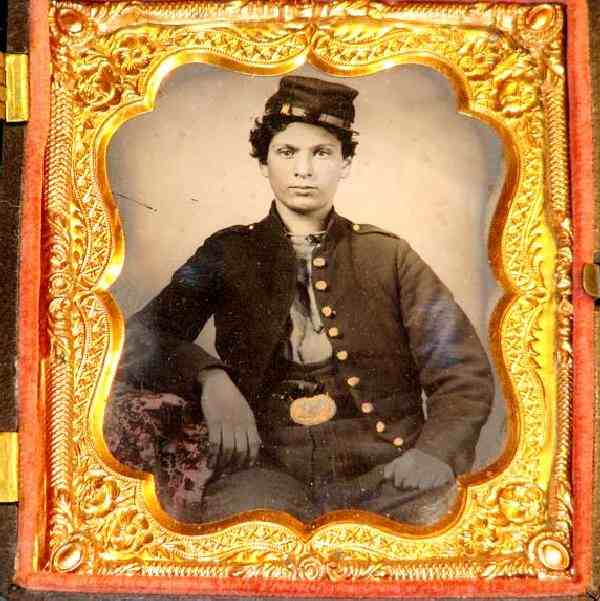
Fields] Many boys and youths served in both the Federal and Confederate Army. One author has suggested calling the American Civil War the Boys' War. Thousands of children were directly involved in the Civil War. Older boys served as soldiers. Many younger boys were also invoved, some boys as young as 11 years old. The younger boys generlly served as drummer or bugle boys. Commonly the drummer and bugle boys were 13-15 years of age. Both the Confederate and Union soldiers tried to look after the younger boys. In major engagements they were often sent to the rear when charges into fortifications were planned. In some cases they had to be forced to the rear crying. Such a scene is portrayed in the movie Glory. In addition, over 1 million boys of 17 or under served in the Federal Army alone. Beyond the use of very young boys as drummer boys and bugle boys, about 1 million boys 17 years of age and under fought with the Federal Army alone. Almost surely very large numbers of similarly aged boys fought with the Confederacy, although actual records are less available. Anither major contribution was made by Black soldiers. The most famous Black unit was the 54th Massachusetts. While the Confederates were outraged by the Federal use of Blacks, by the ebnd of the War they were considering the formation of their own Black units.
Until the Civil War, America had fought its wars with voluteers, both volunteer militis and a small all-voluteer regular army. Thus all of the soldiers at the onset of the war were volunteers. And they were relatively short enlistments as the war was expected to ve a short one, settled by a few major engagements. The United states at the onset of the War had only a small Regulat Army. The Confederacy of course had no army, but there were state militia and many in the United states Regulr Army were from the southern sttes. RegularAll of the early battles were fought with volunteers. These volunteers had little military experience and thought that the War would be quickly resolved in a few months. Few had any idea of the horrors of battle or the apaling casualties that would result from the battles. The Federal Government only introduced conscription (draft) after the terrible losses from the early battles reated a need for replacements and made it clear that only a massive military effort would succeed in defeating the Confederacy.
Both the North and South began the Civil War with the assumption that it would be fouhht like all other previous wars, both during the colonial era and then after independence. It was assumed it would be fought with volunteers and a heavy reliance on state militias. Casualties in Civil War battles beginning at Bull Run (July 1861) were unprecdented. Americans were shocked by the casualties at Bull Run, what few understood at the time was the Bull Run casualties were light compared to wht was to come. Civil War casualties actually were unparalleled not only by previoys wars, but even by the horrendous battles of the 20th century World wars--at least for Americans. The only comparable blood letting was the British disater at the Somme. This occurred because Civil War commanders did not yet adjust their tctics to the increasingl letality of weaponry. This was precisely what happened to the British at the Somme and the rsxults were the same--there had to be a resort to military conscription. The Civil War losses were so enormous that the draft had to be introduced for the first in American history, but not the last time in American history. The money-class in both the North and South could escape conscription and mny did just that. For the first year of the war, the public and military commanders optimitically believed that it would be a short War. Grant himself believed this, but after Shiloh (April 1862), he realized tht nothing short of a massive and costly military effort and occupation woyld end the war. Sherman agreed. Casualties at Shilah to comparable to Waterloo, but unlike Waterllo there were be 20 such battles to follow. Many Europeans were unaware of the enormity of the struggle unfolding in America. The british took note. The Germans did not. The Condederacy with a seies of defeats in the West, especially Tennesse and Louisian and Federal forces advancing, acted first. Facing both maaive, losses.the expiration of volunteer enlistments, and the growing size of Federal armies, President Davis passed a conscription Las through Congress--The Conscription Act (April 1862). The Act made all able body white men between 18 and 35 elgible for conscriotion. (The age would eventially be extended to age 50 years.) The act extended 1 year volunter enlistments to 3 years. There were exemptions for occupations deemed vital for the war effort. Amendments exe,pted men who owned 20 or more slaves. Thus the slave holders who brought about the war, had a way of avoiding military service. The justification for this was that the men were needed st home to control the slaves and maintain agricultural production. There was opposition to the Act especially in North Crolina and Georgia where state officials thought the act violated states rights. About half of the men involved evaded service. The Federal Government found it increasinly difficult to recruit voluteers, surely affected by the press reports providing grisly details of the canage unfolding. The terrible casualties also affected the North. The Federal Congress passed a Conscription Act (March 3, 1863), ayear after the Confederate Congress acted. This was not, however, the behgiining of conscription in the North. Five norther states began extensive drafting (fall 1862). Substantial numbers of Federal soldiers thus began enlisting becuse of the threat of conscription. Under the terms
of the Federal Conscription law, well to do men could buy their way out of the War if drafted by paying a fee, often about $300. One such individual that did was Teddy Roosevelt's father. Roosevelt while admiring his father, was later quite embarassed about this. There was considerable ressistance to the draft in the North, especially from recent immigrants in the big cities. The most notable incident was the New Yorek draft riots (1863).
Given the lethality of Civil War battle, one has to ask why the average soldier, often a youth, on both sides fought. Few people in both th North and South understood the leahality of war with gheweapons developed, but this soon became apparent. Today it seems almost incredible that you could get men to line uop face to face and fire at each other or assault fixed positions with massed formations, but that is how the war was fought. So the soldiers had to be highly motivated to get men and youth to do this. An emense number of letters survive which help answer that question and many Civil War historians have accessed this resource. [McPherson, Fields] Motivation varied sharply in the North and South. The single strongest motivation in the North was preservation of the Union. To an exent this was patrioic nationalistic fervor. And Lincoln played upon this by maneuvering to ensure that the Confederacy began the war by firing on Fourt Sumter (April 1861). But to an impressive extent Federal soldiers understood that America was the best hope of hmanity. At the time, America was the only democratic republic of any importace. Democracy was still essentilly an experiment. The rest of the world was ruled by monarchies, some of which were still absolutist in character. One is tempted to think tht young Americans understood the importace of their country better then than s the case tday. Lincoln captured this essential point in his Gettysburg Address. Freeing the slaves was another motivating factor, but Lincoln uderstood very well it was not as important as preservation of the Union. In fact the two were related. Tghe slaves could not be freed unless the Union was preserved. Thus Lincoln did not issue the Emancipation Proclmation untill after 2 years of fighting (January 1863). There were other reasons such as community and family spirit. When family and fiends gooff to war there wsas astring motivaion to follow. Motivatiion in the South was in some way similar, but tere were major differences. While the War was largely fought iover slavery. Most Confederate soldiers did not own slaves. The basic issue fior them was patriotim. Many because of the anti-slavery sentiment in the North had come to see themselves as living in a different country. And once the War began came to see themselves defending their states from a fioreign invader. This was by far the strongest motivaing factor. And the same community ad family relations at work in the Notyh were also at wiork in the South.
Many boys and youths served in both the Federal and Confederate Army. One author has suggested calling the American Civil War the Boys' War. Thousands of children were directly involved in the Civil War. Older boys served as soldiers. Many younger boys were also invoved, some boys as young as 11 years old. The younger boys generlly served as drummer or bugle boys. Commonly the drummer and bugle boys were 13-15 years of age. Both the Confederate and Union soldiers tried to look after the younger boys. In major engagements they were often sent to the rear when charges into fortifications were planned. In some cases they had to be forced to the rear crying. Such a scene is portrayed in the movie Glory. In addition, over 1 million boys of 17 or under served in the Federal Army alone. Beyond the use of very young boys as drummer boys and bugle boys, about 1 million boys 17 years of age and under fought with the Federal Army alone. Almost surely very large numbers of similarly aged boys fought with the Confederacy, although actual records are less available.
A major contribution to the Federal victory was made by Black soldiers. The most famous Black unit was the 54th Massachusetts. While the Confederates were outraged by the Federal use of Blacks, by the end of the War they were considering the formation of their own Black units. The ideas of Blacks outfitted in military uniforms and equipped with weapons, however, proved a step the Confederacy coukld never take, even in the final desperate months. The fear was so intense that for decades after the formation of the Boy Scouts, southerners prevented Blacks from forming Boy Scout units. There are two notable aspects about the participation of Blacks in the Civil War. First was the importance of the Black units in the War. There were few Black units in the first two years of the War, but as the Federals were having increasing difficulties recruiting replacements and draft riots took place, Blacks helped meet the Federal manpower needs and Black units made a major contribution to the War. About 0.2 million Blacks participated in the Civil War, many of whom were slaves who ran away or liberated by the Federal Army. Blacks came to make up 10 percent of the Federal Army. They also played a mjor role in the Federal Navy. The other notable aspect is the fact how little credit the participation of Black soldiers was given by both historians and in the popular mind. The literature of the War and afyer the turn of the 20th century, the mass media essentially wrote Black soldiers out of the Civil War. This did not begin to change until the 1980s.
Throughout history, very little attention was given to the welfare of the soldiers, either their material or spiritual welfare. And their families were largely ignored. Soldiers for their part often joined up at least in part because of the possibility of plunder. This began to change in the 19th century. During the Civil War the Christian Commission was founded to minister to the soldiers. The Young Men's Christian Association (YMCA) was responsible for founding the Christian Commission. This at the time was a relatively new group. YMCA leaders as their members began going off to war became concerned with their religious and spiritual needs aswell as the new recruits drilling in encampments appearing all over the country, including the Y's in the major cities. Vincent Colyer from the New York City Y was aeader in this new effort. He began visiting encampments near New York City where the were assemnling and training for the war. Many were young and had never been away from home before. Colyer circulated in the camps, offered words of encouragement to the men, and passed out religious tracts. Chaplains had served in the various branches of the United States armed forces since their formation (18th century), including in the Continental Army during the American Revolution. Congress authorized the hiring of an Army chaplain in 1791. The effort at the time of the Civil War, however, was still very limited.
Few of the large numbers of Civil War camps had chaplains. Colyer's private efforts were thus greatly appreciated by both the ordinary soldiers as well as their officers. Seeing an obvious need, the New York Y set up an 'Army Committee' and selected Colyer to head it. They assigned the Committee the mission to provide preachers for services, individual religious visitation, and Christian publications for soldiers. This was just the beginning. The New York Y contacted other Ys around the country. Other Ys around the country saw the need as well. The New Yprk Y sponsored a convention of 50 delegates representing 15 different YMCAs (November 1861). The delegated agreed to establish a 'Christian Commission' of 12 members to work out a plan for the YMCA to act as a clearinghouse for religious work in the rapidly expanding military. The Commission was set up at the national level. The national organization incouraged individual Ys to support the national organization as well as organize their own local activities. Here locl Ys took different pproches. Some merged into local branches of the Christian Commission or set up their own army committees. The national Commision opened office in Philadelphia. The well-established Ysin Baltimore, Boston, Buffalo, Chicago, Louisville, New York, St. Louis, and St. Paul became regional clearinghouses for the Commission. George H. Stuart in Philadelphiaassumned aeading position. He was the founder and first president of the Philadelphia YMCA. He then chaired the YMCA's Central Committee. He was selected as National Chairman of the Commission and he served inthat position throughout the War. The Commission operated by appointing volunteer 'delegates', normally fo short priods about 6 weeks.
McPherson, James. BookTV C-Span, October 12, 2002.
McPherson, James. Fields of Fury: The American Civil War (Atheneum, 2002). This well written book is aimed at younger readers. It includes many excerpts from the letters and dairies of young soldiers, both Federal and Confederate, helping to understand why they fought.

Navigate the CIH Civil War Pages:
[Return to the Main Civil War page]
[Return to the Civil War importance page ]
[Biographies]
[Campaign]
[Causes]
[Emancipation]
[Families and youth]
[Fiscal policy]
[Formations and units]
[Law]
[Railroads]
[Reconstruction]
[Slavery]
[]
[Uniforms]
[Weaponry]
[Lost Cause]
[Civil Rights movement]
[Return to CIH Home page]