The Wehrmacht as agreed to in the Munich Agreement began moving into the Sudetenland (October 1). Hitler followed (October 3). The Wehrmacht was received with jubilation. The Times in London published accounts of the jubilation of the Sudebten Germans along with photographs showing the cascade of flowers greeting the German soldiers. One has to be careful how to assess the images of cheering Sudenten Germans welcoming the NAZIs. To us the NAZIs and the swastica represent the Holocaust, unimaginable attrocities, and the murder of millions. This is of course not what these peoples are cheering about. The jubilation is largely one an outburst of nationalism and patriotism. The people in the images saw themselves being liberated and finally united with the German Reich. One of the Sudenten Germans impressed with the NAZIs was a young Oskar Schindler. He came from a Catholic family in the Sudetenland and welcomed the NAZIs. Schindler joined the NAZI Party shortly after the German annexation of the Sudetenland. After Schindler went to Poland he began to see just what the NAZIs program entailed.
Anti-NAZI Sudetens
Perhaps even more shameful with how the Allies deserted the Czechs was their desertion of the anti-NAZIs in the Seudetenland. Not only were theur Germn refugees from MAZIism in the Sudetenland, but some Sudeten Germans had opposed the NAZIs. Wenzel Jaksch who was the leader of the Sudeten Social Democrats flew to London hoping to arrange for refugee status for leaders of his party. The Times editor, Geoffrey Dawson, rejected photograhs of those fleeing the NAZIs. The British offered no visas to Jaksch's colleagues. Many were arrested by the Gestpo. Others who manage to hide out in Czechoslovakia were at the demand of the German Government arrested and turned over to the NAZIs by the new Prague regime. [Fest, p. 567-68.] They were arrested by the Gestapo and delivered to Germany well-established system of concentration camps where they were tortured and killed.
NAZI Security Operations
The German Security Services and Gestapo followed the Wehrmacht and began arresting political opponents. As in Ausria. The SS formed Einsatzgruppen which were armed with carefully prepared lists of Jews and anti-NAZI Sudetenlanders.
Annexation
The Sudentland was incoporated into the Reich. The rest of Czechoslovakia would soon follow, but would become partioned into different sections. The Sudetenlanders upon annexation becme German citizens. This would make them among other matters subject to military conscription and thus full participants in World War II which was less than ayear away as Hitler rather than ceasing his demands as he as he pledged to Primeminister Chamberlain, actually expanded his demands and advanced the speed of his aggressions.
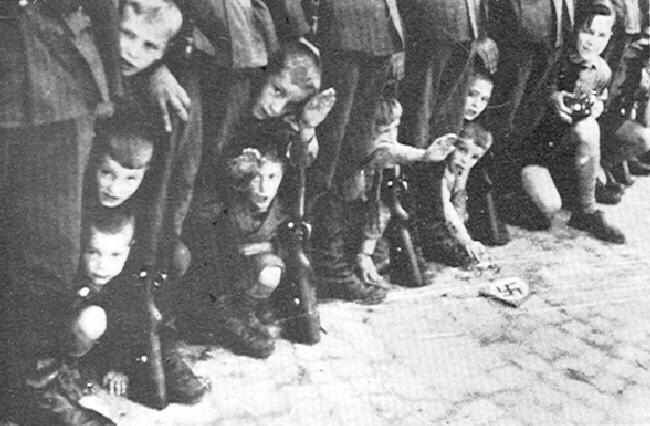
The images of the Sudeten population as the Wehrmact arrived are fascinating, esecially that of the children. Here we see a group of girls and young women that are cheering estatically for the arriving German soldiers (figure 1). The soldiers are having to hold them back. there are some interesting aspects to this photograph. First notice that allmost all of the crowd are girls or young women. Now in any candid crowd scene you would expect to find a diversity of gender and age groups. For such a homogenious group, this must have been an organized celebration. Clearly it was not when the Wehrmacht first arrived as the soldiers are there to control the crowd. This seems to be a celebration perhaps a day or so later. Perhaps Hitler or other NAZI officials are arriving. Another curious aspect of the photograph is the boy. He is not nearly as excited as the girls and gives a less enthusiastic salute. For some reason the soldiers have allowed him through. Also notice his cap. For the event, many of the children are wearing folk costumes. A second photographed can be viewed by clicking on the image above. There several boys are viewing the event through the jack-booted legs of the soldiers. Some are giving a salute. One boy is resting his swastica flag on the ground. One boy is taking a picture of the event with an expensive twin-reflex camera. We are fascinated by the fact that the children were so politicized abd fervent. This of course must reflect the views of the parents. But also note the Hitler Youth uniforms. This meant that the HJ was fully functining if undrground in the Czech Sudetenand before the arrival of the Whermacht. This also must be a factor in the joyful response of the children.
Sources
Fest, Joachim C. Hitler (Vintagfe Books, New York, 1974), 844p.
CIH -- WW II

Navigate the CIH World War II Section:
[Return to Main Munich page]
[Return to Main Sudeten history page]
[About Us]
[Biographies]
[Campaigns]
[Children]
[Countries]
[Deciding factors]
[Diplomacy]
[Geo-political crisis]
[Economics]
[Home front]
[Intelligence]
[POWs]
[Resistance]
[Race]
[Refugees]
[Technology]
[Totalitarian powers]
[Bibliographies]
[Contributions]
[FAQs]
[Images]
[Links]
[Registration]
[Tools]
[Return to Main World War II page]
[Return to Main war essay page]
[Return to CIH Home page]
Created: 1:38 AM 7/24/2004
Last updated: 1:27 PM 4/22/2015