
World War II: Soviet Civilians
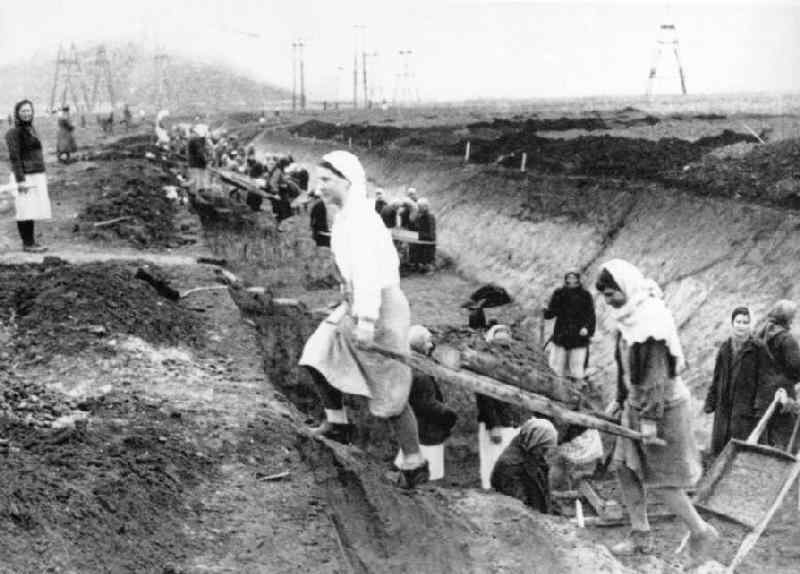
Figure 1.-- The Germans were welcomed in the Baltics and western Urkraine. The situation was different in in the Russian heartland to the north and the more Russified eastern Ukraine. Here the population remined staunchly loyal to the Soviet Union. Not so much for the sake Communism (although there were many true believers), but for Mother Russia. Civilians volunteered in large numbers and others were conscripted to build anti-tank barriers and other defensive works. Here women volunteers somewhere in the Don Blas work to build anti-tank implacements, probably after the fall of Kiev. It looks like October 1941.
|
|
Soviet citizens were stunned at the news of the NAZI invasion. The Soviet Union was a multi-national state.
Stalin as a result of the Non-Aggression Pact with Hitler has significantly expanded Soviet boundaries west. And in
these new territories the NKVD and Red Army had carried out a ruthless campaign to purge the population of anti-
Soviet elements, meaning not only people desiring an independent state, but whole classes of people who tended to
have nationalist aspirations. This was the case in the Baltics. Civilians attitudes in eastern Poland/Byelorussia
were more mixed, but in the western Ukraine the Germans were seen as liberators. Thus the first people who the Germans encountered were not at all hostile and in some cases genuinely pleased to see the Germans. And there were other peoples, especially in the Caucuses that were hostile to the Soviets. It was a different matter in the Soviet Union's Russian heartland. Here the population remained staunchly loyal, not so much for Communism, but for Mother Russia. Civilians volunteered in large numbers to build anti-tank barriers and other defensive works. Here there was sometime as it took the Germans time to reach the Russian ethnic areas of the Soviet Union. And the Russians rallied to the cause before the genocidal nature of the NAZI invaders was fully understood. This would not be known until the Red Army offensive before Moscow (December 1941) would take back villages occupied by the Germans. One interesting view of Soviet civilians are the photographs taken by German soldiers who compiled many scrapbooks of their exploits. We are not entirely sure how to interpret these images. After the disaster before Moscow, Hitler reassessed attitudes toward the Russians and allowed the Wehrmacht to organize a Russian Liberation Army. Almost all of these men, however, came from German POW camps.
The NAZIs had in the Soviet Union the possibility of being received as liberators by substantial elements of the
population. This was not just the case in the Baltics, but especially in the Ukraine. Stalin's oppressive regime had alienated large numbers of Soviet citizens. The NAZIs
in their lust for booty and hatred of the Slavs chose not to take advantage of this opportunity. A wide range of
NAZI policies turned those opposed to Stalin and and the Soviet regime against the NAZIs. Unlike in Western Europe,
Hitler did not even attempt to disguise their intentions. Some NAZI officials like Ost Minister Rosenberg as well as many military commanders wanted to at least temporarily disguise German intentions, but Hitler was adamant on the issue. The Soviet prisoners of war were horribly
mistreated. Some 3.5? million are believed to have died in NAZI captivity. These include large numbers who may
have been induced to fight with the Germans or as least used as labor in the German war economy. The mass
murder carried out by the Einsatzgrupen was focused on Jews, but was not limited to them. Much of the Einsatzgrupen killing was done openly, not behind barbed wire in camps. The administration of seized territory in the Soviet Union was in the hands of men like Alfred Rosenberg, Minister for the East, Erich Koch, Commissioner for the Ukraine. These were men who saw the East as a area to be looted and were desirous of reducing the Slav population. The Germans made no attempt to maximize the production in occupied, Eastern areas. In large measure, they seized what the retreating Soviets did not destroy and shipped it back to Germany. The civilian population was left to fend for itself. Rather than capitalizing on the disaffected Soviet population, they instead built support for Stalin and generated the War's most partisan movement
The Soviet civilian reaction to the German invaders depended somewhat on the regions involved. Stalin as a
result of the NAZI-Soviet Non-Aggression Pact (August 1939) and the resulting alliance with Hitler had pushed the
borders of the Soviet Union to the west at the expense of Poland, Finland, the Baltics and Romania. Thus much of
the territory seized by the Germans has only many Soviet for a little over a year. And brutal Soviet actions had
deeply alienated the local population. In the western Ukraine, the Soviets held the territory for much longer, but
were also very unpopular. In addition, the Germany Army had occupied the area in World War and behaved relatively
correctly. So large elements of the local population at first treated the Germans as liberators and were not full
aware of NAZI race policies. It was here that the lethality of the Holocaust was unleashed on the Jews. This was
begun by the Einsatzgruppen that followed in the wake of the combat troops. And the Wehrmacht in many actions
supported the killing. The Wehrmacht was less radicalized as regards its conduct toward non-Jews. From the
beginning, elements oi the Wehrmacht wanted to make common cause with the anti-Bolshevik nationalist groupings.
This approach was vetoed by Hitler's expressed orders. This benign attitude can be seen with the average Wehrmacht
soldier who took numerous photographs of the local children, especially during Barbarossa. Ad we see children with
the soldiers without fear, apparently attempting to ear a few coins. Many of these photographs are unidentified and
undated, but were taken and used to create photographic albums the soldiers wee compiling of their military
careers.
Stalin forcibly collectivized Soviet agriculture in the late-1920s and 30s. Peasants who resisted were forcibly
dealt with. The great resistance was in the Ukraine where there was also a strong nationalist movement. Stalin's
response was to engineer the Great Famine, a repression so severe that many Ukrainians now label it as an act of
genocide. Peasants who resisted were labeled Kulaks. Some were deported, others including whole families were
simply forced off their farms, even in the Winter. No one was allowed to assist them or offer shelter. Soviet
agriculture never recovered. The collectives which Stalin put in place is what the Germans found when they invaded
the Soviet Union. And agricultural land and production was one of the primary goals of Barbarossa. We are not
entirely sure what happened on the collective farms. The Soviets pursued scorched earth policy, but the German
advance was so rapid that many farms were captured in good shape. Here we do not yet have details. We would
welcome any information reads may have. The NAZI Commissar order involved shooting Party Commissars in the Red Army. This may have also meant the leadership of collectives. Here we are also unsure. We do not know just how the Germans administered agriculture. We do not know to what extent the collectives were involved in the resistance
movement. They held large areas of the Ukraine (1941-43) and other areas of the Baltics and Belorussia where the
collectives were less well established (1941-44). We believe that the collectives experienced more damage when the
Germans were forced to withdraw. The Germans not only destroyed the physical plant, but in some cases murdered the
collective members. Here we also do not yet have details. Large numbers of Ukrainians were deported to the Reich
for slave labor. This may have been primarily city residents, but as the Red Army approached this may have included
collective members.
The German invasion of the Soviet Union came as a great shock (June 22). Areas of the the western Soviet Union
were quickly overrun. Evacuation from these areas were impossible. But the areas overrun in the north were the areas of eastern Poland Stalin seized (September 1939). That meant there was some time to organize evacuations from
Russia proper. To the south in the Ukraine where Stalin had deployed much of the Red Army armor, a massive tank
battle was fought in the Bloody Triangle (June 1941). The Germans destroyed much of the Red Army armor, but the
battle bought time to organize evacuations away from the border regions. Priority in these evacuations ere given to
factory equipment and the skilled workers (and their families) that operated the equipment. The factories were
transported by rail to the Urals and beyond. This meant that they were not within the range of the Luftwaffe which
did not have long-range bombers. It would take some time to reestablish production, but by 1943 Soviet war
production had begun to reach pre-War levels. We also believe that Communist Party officials and their families had
priority. There was not a general evacuation. Civilians were not evacuated from Leningrad in 1941 before the
Germans cut off the city. Asa result, thousands of civilians starved in winter 1941-42. Women and children were
finally evacuated in the Spring over Lake Ladoga. Nor was Stalingrad evacuated in 1942. A Russian reader tells us
that orphanages were also given evacuation priority. And many of the evacuated orphans were Jews. He tell us that 24 percent of the evacuated children were Jews. We are not sure just when this was decided, before or after reports of Germans shooting Jews that fell into their hands. Some 0.2 million orphans were evacuated to Uzbekistan. Our
reader tells us, "Local people treated the orphans very well. A blacksmith from Tashkent (Toshkent), Shaakhmed
Shamakhamudov , with his wife Bakhree were famous for adopted and educating 16 evacuated orphans. For many of those
children Middle East became a second home even after the War. a memorial "Friendship of peoples" depicting
Shaakhmed Shamakhamudov and recognizing humanism and hospitality of Uzbek people to the evacuated children (1982)."
We notice large numbers of photographs that the German soldiers took of Soviet civilians. Most of these
photographs were taken rural areas rather than in the cities. Many of these photographs come from the Ukraine,
although they may not have been taken there. Soviet armies overran the Wehrmacht in five major offensives during
1944. This leads us to the question of how German photographs came into Soviet hands. Perhaps the personal affect
of German soldiers were obtained in these offensives. Or perhaps Soviet soldiers brought back German war albums as
personal war booty. German soldiers were not supposed to have personal cameras and take photographs. But apparently many did. I think this would have mostly been officers. We are not entirely sure of their motives. The fact that they mostly took photographs in rural areas, commonly of ragged men and children suggests that they were recording the poverty and backwardness of the society that they were destroying. These images seem to confirm many of the basic NAZI prejudices about their superiority and Soviet and Slavic backwardness. The expressions on the faces of the civilians do not seem to be one of fear. Rather the impression one gets is that the civilians had not idea what the German goals were. It should also be remembered that only near the final phase of Barbarossa did the Germans move into areas populated by ethnic Russians. One notable observation is that the Soviet rural population looked ragged, they were often dressed warmly--something that could not be said about the invading Germans.
The Russian Liberation Army (Русская Освободительная Армия--ROA) was the anti-Soviet forces that fought with the NAZIs after the German invasion of the Soviet Union (June 1941). The ROA was also known as the Vlasov Army, but Vlasov led only one part of the overall anti-Soviet groups that fought with the NAZIs. The ROA was not part of the initial NAZI planning for Barbarossa. Hitler was planning not only a military campaign in the east, but a war of extinction. Hitler's objective, however, was eventually a Holocaust for the Slavic people of the Soviet Union. Only when Red Army resistance stiffened was the idea of a ROA given any real consideration. NAZI propaganda did not focus on the racial component, but rather rather stresses a campaign against Bolshevism. After the disaster before Moscow, Hitler reassessed attitudes toward the Russians and allowed the Wehrmacht to organize a Russian Liberation Army. Almost all of these men, however, came from German POW camps. The major ROA leader was former Red Army general Andrey Vlasov. He tried to unite all anti-Soviet Russians and other nationalities in opposing Stalin. Many were volunteers recruited from the POW camps which in the case of Soviet POWs were virtual death camps. The ROA also included eastern workers (Ostarbeiters) and Russian emigrés (even including anti-communist White Army veterans of the Russian Civil War). Hitler remained suspicious about using the ROA and properly arming it.
HBC

Navigate the Boys' Historical Clothing Web Site:
[Return to Main Soviet home front page]
[Return to Main Barbarossa page]
[Return to Main Great Patriotic War page]
[Return to Main World War II country page]
[Biographies]
[Campaigns]
[Children]
[Countries]
[Deciding factors]
[Diplomacy]
[Geo-political crisis]
[Economics]
[Home front]
[Intelligence]
[POWs]
[Resistance]
[Race]
[Refugees]
[Technology]
[Bibliographies]
[Contributions]
[FAQs]
[Images]
[Links]
[Registration]
[Tools]
[Return to Main World War II page]
[Return to Main war essay page]
Created: 5:04 AM 3/4/2005
Spell checked: 7:02 PM 10/27/2013
Last updated: 7:02 PM 10/27/2013