|
America had begun expanding its military production beginning in the late-1930s. Here orders from Europe (especially Britain and France) Olayed an imprtant role. Itwas the stunning German military success that set the Arsenal of Democrcy in motion, albeit vto a still limited extent (1940). The Japanese attack on Pearl Harbor brought America into the War and this unleased the full potential of Americn ondustrial mite. The Roosevelt Administrtion organized the most expansive armaments program ever conducted in world history. An American industrialists responded. The output American factiries mot only armed the American military, but its allies as well. The quantity and quality of those arms astonished America's enemies and allies alike. Neither the NAZIs or the Japanese had any idea just how rapidly and effectibely American industril production could be converted to war production. Air Marshall Göring whose Luftwaffe terriruzed Europe for 2 years sneared. "The Americans only know how to make razor blades." Four years later, Göring said he knew that the War was lost when American P-51 Mustangs appeared over Berlin escorting endless waves of bombers. His vaunted Luftwadde within months was soon in tatters. The record of American war production is staggering and in large measure determined the outcome of the War.
It was the Japanese carrier attack on Pearl Harbor that brought America into the War. While Pearl Harbor was a stunning tactical victory, it was a strategic blunder by the Japanese of incaluable proportions. It was a stunningly successful military success, brilliantly executed by the Japanese. Eight battle ships, the heart of the American Pacific fleet were sunk. But the three carriers were not at Pearl. Despite the success of the attack, it was perhaps the greatest strtegic blunder in the history of warfare. The Japanese attack on the Pacific fleet at Pearl Harbor changed everything. A diverse and quareling nation, strongly pacifistic was instantly changed into a single united people with a burning desire to wage war. The issolationism that President Roosevelt had struggled against for over 7 years instantly disappeared. Even Lindburg asked for a commision to fight for the United States.
In the list of mostly military men that fought Wirkd War II, Donald Nelson seems somewhat out of place. He was a businessman working for Sears and Roebuck. But remember that President Roosevelt had designated America as the Aresenel of Democracy. The findamental American war strategy was to use the economy (Stalin derusiveky called in 'money') and not brute manpower to fight the War as it had done in World War I. This required a fundamental mobilization of the economy, something Hitler and the Gernmans refused to do until it was to late. As German Panzers swept across France, the President turned to Nelson (May 1940). Hos experience at Sears, marketing more than 135,000 different products led to an unparalleled knowledge of American industry. His first assignments were reltively minor, but rapidly escalated. After Pearl Harbor was addigned to oversee the War Production Board (1942-44). This was the Federal agency at the heart of the Aersenal of Democracy. Some historians have criticized his lack of decision. This is difficult to assess, but the President struck by him until the War was basically won. And American prduction achievements were phenonmenal. It is hard to sargue with success. American military panners just before Pearl Harbor argued for a 213 division army thinking primarily about Germany. Some planning estimates were even higher. Nelson maintained that this would be a mistake and damage the economy. He argued that America's greatest assett was its industry. And that a 213 division army woud adversely affect war production. This was a factor in what has been called Gen. Marshal's 90 Division Gamble. [Matloff]
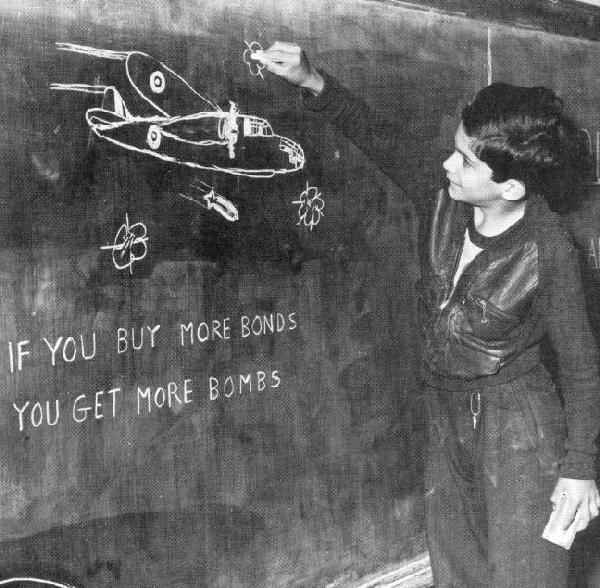
American children were not affected by World War II like children in Europe and Asia. The Atlantic and Pacicific Oceans acted as an affected barrier to the Germans and Japanese. Many American children lost their fathers, but unliked European children were not orphaned or displaced. American children, however, did particiapte in a variety of war-time activities to support the war effort. Children studied current events. Air raid drills and alerts were common. Both children and their families were involved with conservation and recycling of goods. The Scouts and other youth groups were actively involved in may home-front activities. Children often worked in sponsored rallies, parades and cultural events (such as dances) to raise money to buy war stamps and bonds to finance the war. Some children were more adversely affected by the war. Althiough not separated from their patents, Japanese Americans in Pacific coast states were interned in concentration camps. Italian and German families were also interned, but only those who parents were believed to have been involved in subversive activites.
The Government organized a major conservation and recycling effort. Cities and states were given quotas. Children and their families were involved with
conservation and recycling of goods. Many children participated scrap metal, used tire, and paper drives to collect materials iseful to the war effort. Contests were held to meet established quotas. Newspapers reported on the quantities of material collected. Some comapnies sponsored drives and offered prizes. Given the need for alumininum for aircraft production, drives were launched for old pots. As the Japanese cut off America from sources of raw rubber, drives were launched for old tires. Children would even brought their own old toys in for scrap drives. At that time toys were much more likely to be made from metal than in our plastic society today. While these activities and drives were very widely publicized, we are not sure just how useful the amterials collected actually were. We have not yet found any studies indicating the actual value of these drives.
America experienced rationing for the first time in World War II. Some products that were rationed during World War II were sugar, meat, coffee, typewriters, fuel oil, gasoline, rubber, and automobiles. Food rationing probably affected most Americans the most. Each American was issued a book of ration cupons each month. Rationed goods were assigned a price and point value. Families were not restricted to certain quantities of rationed goods. But once their cupons were
used up, they could not buy rationed goods until the next month. Families were incouraged to plant victory gardens. These gardens supplied a mjor part of the vegetable supply during the War. Rubber and gas were the most vital product rationed. Limited fuel supplies during the war affected America in many ways. Gas rationing was done differently than food rationing. Car owners had to register and were given windshield sticker based on how the car or other vehicle was used.
Pleasure driving was prohibited. We have less information about clothing at this time. I do not believe that clothes were actually rationed, but the availability of civilian clothing was very much affected. Certain fabrics like silk or synthetic fibers were not available for civilian use. Shoes were rationed in America. Stamp 17 in War Ration Book 1 was good for one pair of shoes until June 15. (Probably about every 3-4 months.) Families could pool the coupons of all members living in the same household. Even tennis shoes which had become popular in America were hard to get because that had rubber soles.
America was not militarily prepared when Hitler and Stalin launched World War II in Europe. The U.S. Army was a very small force, smaller than the armies of even some of the smaller European countries. It was better prepared, however, than when America entered World War I. Even so, only one country at the outbreak of World War II had the industrial and agricultural capacity as well as the raw material resource base to wage world war on an extended basis. And as would prove to be the case, wage world war on a global basis on two widely separated distant fronts. The United States, unlike the Axis nations and the Soviet Union, howeever, had no desire to wage another world war. The Soviet Union had substantial deposits of natural resources and had significantly expanded the country's industrial base, but significantly weakened the country's agricultural base by cusing the Ukranian famine as aay to destroy the Ukranian peasantry and collectizing agriculture. The United States' peace time economy was self sufficent or largely self sufficent in many categories of raw material production. And unlike the industry and mines of the other major World War II belgerants, America was beyond the reach of its enemies. They could not be bombed while the industry and mines as well as the transport net work of the Axis could be bombed and interdicted. And unlike the Soviet policy of murdering the peasantry, the New Deal before the War had focused on saving and revitalizing the American farmer. As a result, agricultural production could be significntly increased. As industril war production ramped up, however, America would need to import raw materials in vast quantities. The one major weakness was rubber, although uranium would also prove to be a problem. What America lacked, it had the ability to import as long as it could keep the sea lanes threatened by Germn U-boats open. The immediate problem for America once the Lend Lease commitment was made was to get raw materials and equipment to Britain and its other allies like the Soviet Union. The rubber problem was solved by launching a new synthetic rubber industry. The delivery problemn was solved by a massuive naval expansion program and the venerable Liberty Ships. Not only did the United States have the resource base to supply its own war industry, but it also was able to supply or help supply its allies as well.
Each of the Axis countries wre of course aware that the United States had a huge indistrial capacity. American industry was, however, oriented almost entirely toward the consumer economy. Even in 1941, America was churning out automobiles which used steel, chrome, copper, and rubber. Axis countries were unsure just how much Of American industry could be effectively converted to war production and how quickly. The ever optimistic Dr. Goebbels convinced himself that America's contribution would be minimal in both men amd material. He wrote in his diarry a couple months after Hitler declared war, "The Americans are so helpless that they mut fall back again and again. upon boasting about their mat�riel. Their loud mouths produce a thousand airplanes and tanks almost daily, but when they need them in eastern Asia they haven't got themand are therefore taking one beating after another. [January 24, 1942--Goebbels, pp. 41-42.] Goebbels was good at glib remarks, but his assessments are commonly completely wrong that. Even as he wrote those words, the American airmen and soldiers that would bomb the Reich into rubble and and crack the Atlantic Wall were on their way to England.
World War II was an industrial war. The NAZI's used Germany's industrial prowess to build modern weapons and the Wehrmacht was the first military to develop effective tactics for the new weapons. Germany had, however, had an industrial plant a fraction of that of the United States. This was one reason that Hitler launched the invasion of the Soviet Union when he did. He realized that he would have to defeat the SovietvUniion when before America with its industrial strength entered the War. Goebells quiped that the Americans only knew how to make razor blades. Hitler and many senior Whermacht officers knew that America posed a mortal threat to the Reich.
There was no discussion of racial supermen in America. From the beginning President Roosevelt stressed industrial production. And here America had an unparalled capacity to produce. The key to winning the War was production. The record of American war production is staggering and in large measure determined the victorty of the the Allies in the West and auded the Soviets in the East. American produced weapons and equipment in quantities that suprised not only the British, but many Amnericans as well. American productioin rose to levels neither the NAZIs and Japanese did not believe possible--both the rapidity of conversion to war production or the absolute quantities.
American factories geared up for the War effort and many new factories were opened. The unemployment so severe during the Depression was no longer a problem. In fact there was now an increasingly severe labor shortage. This was not only a matter of increasing production, but also the draft that begun in 1940 began to take men out of the work force. This was increadsingly important after Pear Harbor (December 1941), war production was increased to unprecedent levels and millions of men were drafted or enlisted in the military. The vacancies in the work force was made up with youths, women, and minorities. Sometimes older children worked part time along with their mothers to support their families. Child labor laws were suspended during the war. Millions of children between the ages of 12-17 years were employed in a wide range of jobs. Even in factories it was common to see boys of 16 and 17 years of age working. It was not just mom in the form of Rosey the Riveter that went to work during the War. Jobs were opened to minorities, especially blacks, that were formerly excluded from many jobs. Both the British and Russians adopted similar policies to mobilize the civilian population for War work. The Germans took a very different approach. Instead of women and youths, they employed slave labor to keep their factories going.
Henry Ford conceived of the first mass-produced automobiles. Ford assembly lines turned them out by th thousands. In doing so he made them so rapidly and inexpensively that almost all Americans could afford them. Before Ford, workers could hardly afford bicycles. Will Rogers was to quip when the Depression came, "America was the first country to go to the pour house in an automobile." The Government when the War came needed planes of all descriptions, immediately and in large numbers. The oinly way to produce planes in such numbers was by assembly line, but no one had every built complicated air planes by assesmbly line before. Ford engineers said that they could do it and a U.S. Government contract was awarded the Ford Motor Company to build a huge aircraft plant at Willow Run near Ypsilanti, Michigan. This was a startling development as Ford had never even thought of building air planes before, let alone build the by imovatove, untested means/ The Willow Run Airport, with six runways to test the planes to be produced was completed in 1942. Before the War ended, Willow Run had built 8,685 B-24 Liberator bombers--one of the long-range bombers used for the strategic bombing campaign in Europe. . At the height of production, one bomber came off the assembly line every 63 minutes. Never before had airplanes been mass produced. To build these planes, workers were needed. The Federal Government in 1942 the federal government built America's second freeway (now I-94) to speedilt move workers and materials to the new Willow Run plant. The Government in 1943 built a $20 million community beside the plant which became known as Willow Village. The Government built dormitories for single workers and small houses vapabl of accommodating 3,000 people. The Government added thousand trailer homes. Willow Run by the end of 1943 had more than 42,000 workers who came from all over America. Willow Village eventually accommodayted more than 15,000 people. There were 30 dormitories, 6 community buildings, rows and rows of small houses, commercial buildings, police and fire stations, and schools for the children
The Kriegsmarine and its u-boat arm was assigned the task of cutting Britain off from its Empire and the United States. Had they succeeded, Germany may well have won the War. The goal was o sink more ships than the Allies could build. Part of the American response was to increase ship construction and here the liberty ship wasthe center-piece of the American effort. American industrialist Henry Kaiser played a key role by developing a revolutionary new way of shipbuilding--assembling mass produced parts. Kaiser had never bult a ship before. The unfamiliarity of Kaiser and others with ship building was undoubtedly a factor n their succees in developing an innovative construction system. [Sawyer and Mitchell] More than 30,000 parts were mass produced by factories in 32 states. The modular construction techniques developed changed shipbuilding forever. With American shipyards working flat out to build crtically needed naval vessels, the liberty ship cargo vessels were built in what amounts to virtual shipyards all along the U.S. coast. This allowed the United States begining in 1941 to harness skills, resources, and facilities to an extrodinary degree. The output was almost unbelieveable. Not only were labor requirements to build a ship reduced by to thirds and it was done largely by workers who had never worked in shipyards--many had never even seen the sea before. The first liberty ship protype was built in 244 days. Eventually th proces was reuced to an incredible 42 days. One ship as a publicity exercise was actually built in 4 days and 15 hours. Most of the Liberty yards in 1943 began producing Victory ships, a larger and faster freighter that was to be capable of commercial use after the War. The United States, despite the u-boat offensive finished the War wih a merchant fleet larger than it had begun with. The United States expanded its shipbuilding capacity by more than 1,200 percent. American yards built over 2,700 Liberty Ships, 800 Victory Vessels, 320 T-2 Tankers, and various ships. In all, more than 5,200 ships were built.
The American economy began to surge in 1940, in part responding to war orders from Europe as well as domestic rearmamnt. The underutilization of America's economic capacity because of the Depression allowed the United States to maintain civilian consumption at a relatively high level while trememndouly increasing production to persue the War. The Government used a variety of measure to finance the war. This included deficit spending, increased taxes, and awar bond campaign. The Government's financial policy also included measures to control inflation because the increased employment increased incomes at a time when the supply of consumer goods was limited. The United States Government, even before America entered the War, initiated an ambitious advertising campaign to sell bonds. Before America actually entered the war they were called Savings Bonds. The War Advertising Council and the War Finance Committee sought to promote bond sales to finance the War and build civilian morale. The work of these World War II organizations produced "the greatest volume of
advertising and publicity ever given to any product or agency" in American history. Secretary of the Treasury Henry Morgenthau sold the first Series E U.S. Savings Bond to President Franklin D. Roosevelt on May 1, 1941. The War Finance Committees sold over $185 billion of securities. By the end of World War II, over 85 million Americans had invested in War Bonds, a number unmatched by any other country. Even American children participated in the effort.
Not only did American industry have the capacity to produce weapons and material neded by the armed forces it unbelievable quantities, there was also the potential for an enormously costly project that no one could even guarantee would work. The Manhattan Project was the most costly weapons system in the history of warefare.
Freidel, Frank. Franklin D. Roosevelt: Rendezuous with Destiny (Little Brown: Boston, 1990), 710p.
Gilbert, Matin.
Goebbels, Joseph. ed, Louis B. Lochner, The Goebbels Diaries, 1942-1943 (Doubleday: New York, 1948), p. 566.
Goodwin, Doris Kearns. No Ordinary Time (Simon &Schuster: New York, 1994), 759p.
Kimball, Warren F., ed. Churchill and Roosevelt: The Complete Correspondence 3 vols. ( Princeton University Press, 1984). This is a remarable collection of Roosevelt and Churchill's communications. Kimball has written excellent books on both Lend-Lease Act and on the Morgenthau Plan for occupied Germany. The collection came from presidential, State Department, prime-ministerial, Foreign Office files, and even German intercepts of previously unpublished transatlantic telephone conversations.
Matloff, Mauruce, "The 90 Division Gamble".
Sawyer, L.A. and W.H. Mitchell. The Liberty Ships (Lloyd's of London Press, 1985).
Schlesinger, Arthur Jr. "The Supreme Partnership," The Atlantic Monthly (October 1984).
Schama, Simon. A History of Britain.
Sherwood, Robert E. Roosevelt and Hopkins (1948).
Trapani, Carol, "Letters cemented partnership," Poughkeepsie Journal (December 8, 2001).

Navigate the CIH World War II Section:
[Return to Main Arsenal of Democracy Chronology page]
[Return to Main Arsenal of Democracy page]
[Return to Main World War II American isolation page]
[Return to Main World War II page]
[Introduction]
[Animals]
[Biographies]
[Chronology]
[Climatology]
[Clothing]
[Disease and Health]
[Economics]
[Ethnicity]
[Geography]
[History]
[Human Nature]
[Law]
[Nationalism]
[Presidents]
[Religion]
[Royalty]
[Science]
[Social Class]
[Bibliographies]
[Contributions]
[FAQs]
[Glossaries]
[Images]
[Links]
[Registration]
[Tools]
[Children in History Home]