|
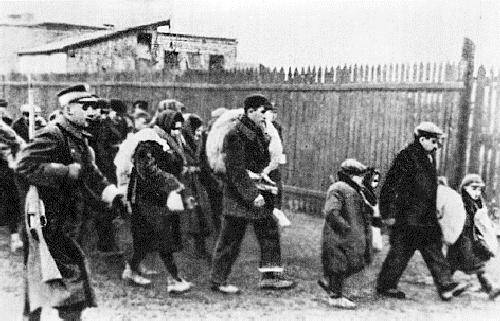
Reinhard Heydrich, head of the Security Police, ordered that all Jews in Poland and Czechoslovakia be isolated and concentrated in ghettos (Sepember 21, 1939). This did not take place immediately because of the level of organization involved. The Jews were to be concentrated in ghettos set up in in Poland's larger cities. The NAZIS used Jewish neighborhoods in the major cities for the major ghettoes (Warsaw , Lódz, Kraków, Lublin, and Lvov). Hans Frank was the leading NAZI Jurist. He was made the commander of the Government General, the area of NAZI controlled Poland not annexed by the Reich. He implemented Heydrich's orders. The ghettos were a key part of the evolving NAZI plan of dealing with Jews. From the NAZI perspective there were various advantages. 1) Once confined in ghettoes the Jews could be easily forced to work as slave labor. 2) Their consumption of food and goods could be restricted to help avoid war time shortages in Germahny. 3) As they were concentrated and separated from the general Polish popultion, future actions could be nore easily conducted. Here the NAZIs may hve originally been thinking of deportation east, but this soon turned to mass murder. The decession to establish the ghettos appears to have been taken befor the decssion to commit genocide, but once that decession was taken the concebntration made the killing opperation easier. 4) The process of stripping Jews of their property could be completed. The Jews were foirced out of their homes and required to hand over valuables as they entered the ghettoes. NAZI propaganda maintained that Jews were genetic carriers of various diseases (particularly typhus) and thus there were public health considerations. The German people were told that the Jews were natural enemies of the Reich and Aryan race and thus encarcerating the Jews was a nececessary war-time measure.
Ghetto is an Italian term originationf in Venice (16th cntury). It was the term used to describe the Jewish quarter of the city. Jews were required to live here. Here the Jews could be restricted and medieval regultions more easily applied to them. This approach gradually spread to other Italian states and eventually to central and eastern Europe. It was less common in Western Europe because Jews has been expelled from most of Westrn Euripe.
Reinhard Heydrich, head of the Security Police, ordered that all Jews in Poland and Czechoslovakia be isolated and concentrated in ghettos (Sepember 21, 1939). We do not know precisely what his ultimate goal was. He had direct access to Hitler. Killing may have been on their minds from the beginning. This we do not know. There is no record of their conversations and the orders were not given. We know that because the NAZI heierarch debated for somne time what to di with the Jews. We do know that Heydrich was a key plsyer in the Holocaust. It was Heydrich who would later convene the Wanseee Conference (January 1942). The project of killing Polish Jews was even naned cafter him--Operation Reinhard. A moderating factor here was that France was not yet defeated and this may have well kept them from taking the final decesion. At any rate, the process of gheotization proved more complicated than anticipated. As a resulkt, it did not take place immediately because of the level of organization involved. Hans Frank was the leading NAZI Jurist. He was made the commander of the Government General, the area of NAZI controlled Poland not annexed by the Reich. He implemented Heydrich's orders.
The ghettos were a key part of the evolving NAZI plan of dealing with Jews. Within the Reich, Hitler was somewhat constrained as to actions against Jews, because thdey could not be carried out descretely outside of public view. In occupied Poland there were no constraints. From the NAZI perspective there were various advantages of ghettoization. 1) Once confined to the ghettos, actions against the Jews could be taken away from public view. There was no longer a free press in Poland so even outside the ghetto, there was very little reporting reaching the international press. Within the ghetto, virtually nothing leaked out. 2) Ghetoization fcilitated the lucrative process of stripping Jews of their property. The Jews were forced out of their homes and required to hand over valuables as they entered the ghettoes. Whatever they managed to sneak in was soon expended in the need to purchase food and other items in the black market. 3) Once confined in ghettoes the Jews could be easily forced to work as slave labor. And the slave labor could be used to support the war effort. This proved very profitablr to the SS. It is the primary reason why some NAZI leaders did not want Jews under their control killed. 4) Ghetoization also enable the NAZIs to restrict consumption of food, clothing, and other consumer goods. And authorities profited by diverting some of the inadequste rations set. Low rations was in part a simple desire to punish Jews, but it had had various pratical advantages. It helped avoid war time shortages in Germany. It also affected the heath of the ghetto Jews, increasing 'nantural' mortalities. 5) As the Jews were concentrated and separated from the general Polish popultion, future actions could be nore easily conducted. There was not need to expend resources to collect and hunt down Jews. They were a captive population vulnerable to what ever the NAZIs decided. Here the NAZIs may have originally been thinking of deportation east, but we do not know precisely what Hitler's pre-War intentions were. What ever they were, very soon after the opportunity presented itself, Hitler ordered mass murder. The decession to establish the ghettos appears to have been taken before the decssion to commit genocide, but once that decession was taken the concentration made the killing opperation aelatively simple matter. easier.
Poland's Jewish population was entirely ghetoized. The Germans began this after the invasion (September 1939), but it proved more complicated than they anticipated. It was begun (late-1939), but not completed until the run-up to Barbarossa. The Germans established the first Jewish ghetto at Piotrekow (November 28, 1939). This was a small ghetto. It provide an opportunity to perfect the organizational process of establishing ghettos for larger operations. The huge Warsaw Ghetto was established (October 1940). Kiece, Crakow, and Lublin were the last major ghettoes established (March 1941). They were then closed. German authorities in Poland decreed that any Jew found outside a designated ghetto would be shot (October 15, 1941). And any non-Jewish Pole who was found aiding Jews would also be executed. It thus was very dangerous for Jews to go outside the ghettoes or for non-Jewish Poles to assist them.
Despite the deplorable conditions, the Jews managed to adjust to the situation. For one thing, they were protected from the violence which they were subjected on the streetsand their himes by NAZI zealots and anti-Semetic Poles. There was considerable organized and unorganized street violence. The NAZIs for their part were apparently surprised at the ability of Jews to adapt themselves to the terrible conditions in the ghettoes. At first the meger rations provided by the Germans wee suplements by American food deliveries through Sweden. Here the American-Jewish joint Distribution Committee (known as the JDC or 'the Joint' The United States was at first a neutral country which for diplomaric reasons the Germans had to tolerate American agencies The American-registered Joint was able to operate in German-occpied Poland with a headquarters in Warsaw. The JDC had one small advantage. Hitler and Goebbels constantly spewed out the idea that Jews hs enormous influence on Roosevelt and America. As a result, at the behest of the Foreign Ministry, they tolerated the JDC to a greater extent than they almost certainly would have. Hitler placed a high priority on keeping America neutral while he completed his conquest of Europe. Thus the JDC were able to distribute relief aid as they had done in World War I. Given the character of the NAZIs, the work was dangerous and damanding. And the JDC as a private charity did not have the capabolity to feed the entire Jewish Polish population. Yitzhak Gitterman and Emanuel Ringelblum organized and led a variety of self-help projects. The Jewish Mutual Aid Society (ZITOS) operated over one hundred soup kitchens in Warsaw. The National Society for the Care of Orphans (CENTOS) operated schools and provided food, clothing and shelter. Notable also were the informal ouse Committees which were organized virtually every apartment house and attempted to provide basic welfare, medical care and sanitation. The NAZI officials who authored the Hunger Plan thought that more Jews would die, both from the inadequate nutrition and sanitary facilities as well as from suiside out of dispair. Governor General Frank at a meeting of NAZI occupation in Krakow (the capital of the Government General) remarked "By the way, I wish to state that we have sentenced 1,200,000 Jews to death by starvation; the fact that the Jews are not dying from hunger will only serve to speed up enactment of further anti-Jewish decrees." (August 24, 1942).
NAZI propaganda used various arguments to justify the ghetoization of Jews, a revision to medieval practices. Jews in Germany were being concentrated, but there were no formal ghettoes. The NAZIs maintained that Jews were genetic carriers of various diseases (particularly typhus) and thus there were public health considerations. There was also security arguments. The German people were told that the Jews were natural enemies of the Reich and Aryan race and thus encarcerating the Jews was a nececessary war-time measure. As access to the ghettoes was tightly controlled. The NAZIs limited the information available to the public about ciondituions in the ghettos. The oublic was not told that the Jews in the ghettoes were essentially being starved.
The NAZIs established Ghettos in major Jewish population centers throughout their occupation zone (western Poland) in Poland almost immediately after invading Poland (September 1939). The largest ghetto was in Warsaw. Other important ghettos were established in Lódz, Kraków, Lublin, and Lvov. The core of each was pre-War Jewish neighborhoods. The NAZIs established some other ghettos after the Operation Barbarrosa invasion of the Soviet Union which included eastern Poland and the Baltic Republics. These ghettos were, however, much more transitory than the original ghettos in western Poland. Each of these gehettos has their own well documented and tragic story.
After family, there is little in the long history of the Jews that is more precious than educating their children. This has not always been entirely beneficial. In the meieval era, Jews tended to be better educated yjn Christians and oftemm more succesful despite a wide variety of limitations on economic activity. This added to the ever-present religious bigotry and was a factor in the countless attacks and pogroms against Jews that occurred throughout the medievl era. The NAZI began the asault on Jewish education from an early period. Jewish chldren were taunted in the schools, sometimes by the teachers. They wre attacked by other children on the way and from school. Hitler Youth members might be involved. The Nuremberg Laws stripped Jews of their citizenship and thus the right to attend state schools. Some Jes continued to attnd schools, but most were expelled from the school. Jewish parents and teachers attempted to organize their own schools, but lcal authorities gradully moved against these schools as well, often conficating the facilities. This was part of the process of seizing Jewish property as well as restricting Jewish life. After launching the war by invading Poland, Jewish education was targetted in that country as well. Older children were conscripted for firced labor. We are not yet sure about the younger. We believe Jewish chools were immeditely closed. The Germans also moved against Polish schools. We are not yet sure what measures wre taken to exclude Jews from state primary schools that continued to operate. This is a topic that we are still reearching. As the Jews were forced into ghettoes, they atempted to organize life as normally as posible. A high priority was to organize school as soon a possible. Here German policy varied from ghetto to ghetto. We are unsure to what extent the local authorities received instructions from the SS or Governor General Frank. Generally speaking, the Jews in the first ghettoes and the larger ghettoes were allowed to set up schools, at least primary schools for the youngr children.
The chools were a rare refuge where they could cone together in safety, study, and play. Sometimes the schools coul even destribute a little food. Older children either had to work or worked out of necessity to qualify for food rations. At many ghettoes schols were not permitted from the bginning. Any eduction had to be done in secret. Gradually the Germans began closing the schools and forcing children as young as 10 years to work. One historian writes, "... the educational system in almost all ghettos became victims of similar decrees [like the ones in Germany]. With one swipe of the pen, schools were outlawed and Jewish learning, specifically that of children, was forbidden under threat of death." [Eisen, p. 21.] A rare exception was Therisenstadt which was used as a show ghetto. At some ghettoes the Germans began seizing the youngr non-working children for early tranport to the death camps. Childrn thus had to study in sceret. Eventually the Therisendstadt children were lo trnsported to Auschwitz-Birkenu where they were murdered upon arrival.
Much of the photographic record of the Holocausr comes from the gettoes, most established in occupied Poland. The Germans very restricted photography in the death camps. The Jews were unavke to take photographs and the SS did not permit photographs tgo be taken, although there were a few exceptions. The ghettoes were a different matter. Both the Jews and the Germans took photographs. The Jews had to take photographs surepticiously. Even befpre ghetoization, Jews had to turn in possessions like cameras and radios. So any photography was illegal and if discovered probably would have nean that those involved would be shot or hanged. And obtaining cameras, film, and eveloping chemicals very difficult. The motivation for the Jewish photography was primarily to document what the Germans were doing to them. The Germans also took photographs. Kost of the survibing photographs were taken by thevGermans. Here there were different kind of images. Some were official photographs to be used for NAZI propaganda. Here the Germans had a varity of puroses. In somecases they wanted to show how well the Jews werebein treated. In other cases theywanted examples to show what wretched creatures the Jews were. and among the hundred of thousands of victims after beung staebed, beaten, denied medical care there were many examples of desperate persons to photograph. The ghettoes also became a kind of tourist attraction, mostly for Germn soldiers. here their motives are difficult to assess.
The ghetto Jews could not refuse to have their phoographs taken. They learned from an early point to deffy a German could mean instant death. The expressions recorded by the Germans speak volumes. Some do not understand what is happening nbd even fewer understood why the Germansa were treating them like they were.
Eisen, George. Children at Play in the Holocaust: Games Among the Shadows (Amherst: University of Massachusetts Press, 1988).
Gilbert, Martin. A History of the Twentieth Century Vol. 2 1933-54 (William Morrow and Company, Inc.: New York, 1998), 1050p.

Navigate the CIH Holocaust Section
[Return to Main Holocaust killing process page]
[Return to Main Polish Holocaust page]
[Return to Main German Blitzkrieg on Poland page]
[Main Holocaust page]
[Allies]
[Biographies]
[Children]
[Concentration camps]
[Countries]
[Decision]
[Denyers/Apologists]
[Displaced persons]
[Economics]
[Eisatzgruppen]
{German Jews]
[Ghettoes]
[Impact]
[Justice]
[Literature]
[Movies]
[NAZIs]
[Occupied Poland]
[Process]
[Propagada]
[Resistance]
[Restitution]
[Questions]
[SS]
[Special situations]
[Targets]
[Wansee Conference]
[World War II]
[Main mass killing pagel