|
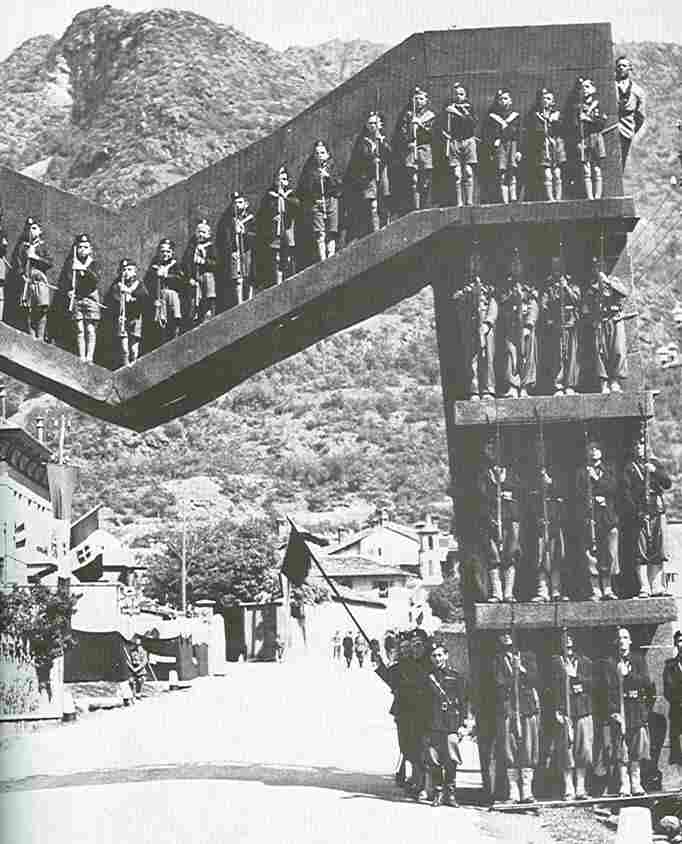
World War II was in many ways a continuation of World War I. It was also a result of the emergence of political parties, primarily Fascist parties, which idealized war. Despite the experience of World War I, the Fascists idealized war. The Fascists were willing to employ coercion in international affairs much as they employed as part of their policies domestically. This commitment to war was normally disguised in part propganda. While not as committed ideologically to war, the Communist were quite willingto employ coercion both domestically and iternationally. Fascism and Communism are often seen as opposite ends of the political spectrum. In fact there are many similarities. It was not accident that until June 1941, Hitler and Stalin were partners. Fascists and Communists groups formed throughout Europe in the 1920s and 30s. Except for Italy and Germany, however, they were only able to size power with the support of outside forces. The Germans chose a right-wing political party in occupied countries to assist in the occupation. There were also Fascit and Communist parties in democraic countries like America, Britain, Belgium, France, the Netherlands, Norway, and other countries. In the case of the occupied countries, these parties often cooperated with the NAZIs.
Benito Mussolini proclaimed in a speech at Milan's Scala theater, "Tutto nello Stato, niente al di fuori dello Stato, nulla contro lo Stato." (October 28, 1925). Meaning, "All within the State, nothing outside the State, nothing against the State." 【Mussolini, Per la medaglia ...."】 It is perhaps his most famous quote and gives us the most succinct an d powerful statement of not only Fascism, but totalitarianism in general. He later wrote, "Therefore, for the Fascist, everything is in the State, and nothing human or spiritual exists, much less has value, outside the State." 【Mussolini, Doctrine】 Mussolini proclaimed Fascist Italy as the world's first totalitarian state. But this formulation could have been applied to all of the great totalitarian states of the 20th century. This includes the Soviet Union and other Communist states as well as NAZI National Socialism and Japanese militarism. The Communists are a little uncomfortable with the term 'totalitarian' because Marx did not envision the state playing such a central role. And thus you have term 'democratic' or people's included in the mane of many Communist states, such as the Democratic People's Republic of Korea. Of course, belying the fact that the Communists are every bit as totalitarian as the Fascists, if not more so. But everywhere that Communist rose to power, Mussolini's formulation was at the heart of their program. But Mussolini's powerful formation was at the heart of all the totalitarian powers. It is somewhat perplexing in the United States and other Western countries that this formulation has been adopted by liberals, often calling themselves progressives. Liberals who once championed free speech a diversity of thought now seek to control every aspect of our lives and have created cancel culture to silence those who dare disagree with. It is astonishing that today nowhere is opposition to free speech as strong as in our great universities. And proponents of limited government are now labeled Fascists.
The 20th century was noted for the emergence of two totalitarian political systems in the aftermath of World War I and the disolution of the three great European empires (Austria-Hungary, Germany, and Russia). They were normally depicted as left and right--the two extremnes of the political spectrum While there were significan differences between the two systems. In fact there were great imilarities, most notably the absence of the rule of law and importance, militarism, and the debegration of the individual. Power in both lay in the hands of an individual or elite which dictated to the general public. The end result ws mass muder on an unbelieveable scale. A notable concomatant was a steroile society without cultural achievement. A much more reasoned way of viewing the 20th century is a struggle between the totalitarians (both left and right) and the democracies. Britain'sPrimeminister Churchill was correct when he painted the struggle as repudition of Western Civilization and the imposition of a new Dark Age.
There is a tendency in modern scholarship to view the Communist and Fascists totakitarians on the opposite ends of the political spectrum, left and right. In actuality there were great similarities between the two. And in fact there was a very strong strains of socialism among the Fascists. After all the NAZIs were national socialists. And Communist regimes have shown strong strains of nationalism. The simililarities betwen Fascists and Communists are too extensive ti be ignored. They include a rejection of basic civil rights such as free speech, freedimof rligion, and the right to assemble, democracy, and free elections. They reject an independent jusdiciary and a police force operating under legal constraints. Both Fascists and Communists created secret police forces to control the population as well as concentration camps and mass graves. State propaganda tended to teach hatred of other peoples not under their control. Leaders tled of peace, but plotted war. There were differences, but often more apparent than real. Communists regimes rejected private ownership while the Fascists did not although they were also critical of industrialists. But Fascist absolutism and control of the economy mean that that market capitalism was effectivly disabled. There were some differences such as the issue of natiinalism, but even here on close examinatiin, the differences are nitas significanr as they would appear. The ideology was often different, nut pracrucal policies a different matter. Communism was not as affected by anti-Semitism as the NAZIs, but it must be noted that at the time of his death, Stalin was planning a massive mational pogrom on Soviet Jews. The basic fact is that the Fascists and Communists are on birtially morror images, on the the same end of th political spectrum. It is liberal democracy that are on the opposite end.
World War II histories primarily focus on two Fascist parties, the Italian Fascists and the German National Socialists (NAZIS). In fact, there were two totalitarian systems, Fascism and Communism. And both the NAZIS and Soviet Communist combined forces to launch World War II. In fact there were many Fascist parties, most located in Europe as well as Communist parties. the implosion of pre-World war European empires (Austrian, German, and Russia) and the rise of nationalism there were fertile grounds for the growth of Fscist ideas. The Depression fueld the growth of extremism, both Communist and Fascist. Often missed in popular histories is the substantil similarities with Communism. Too many see Fascism and Communism as polar opposites in the political spectrum. In fact the polar of opposites of the totalitarians (both Fascist and Communist varints) was liberal democracy. And during the 1930s withthe Depression, liberal democracy lost ground to the totalitaians, especially the Fascist parties. The European Fascist parties were inflienced by the Italians and Germans, but not controlled. Only in Italy and Germany did the Fascists rise to power, but Few of these other Fascist parties gained control. Ironically, the exception was Greece which became a victim of Fascist aggression. Even so, the other achieved considerable influence during World war II after the Germabs occupied country after country. There was even a Fascist party in America. The most important was the German-Americn Bund, but membership was mostly restricted to ethnic Germans, largely relatively recent immigrants. The controling power in Japan is usually described as the Militarists. This was a Fascist variant. The military officers which seized control of Japan were essentially Fascists, it is just that the stridently xenophobic military led the way rather than a political party. While the different Fascist parties had major similarities, there were also some differences. Each country has its own destinct history and mix of contending totalitarian parties. The national communist parties were mostly under the control of the Soviet Communist Party through he KGB.
A necessary part of any totalitarian regime is a secret police force that has the authority to act outside of any legal contraints. They over see large scale killing and concentration camp systems. The various Soviet secret police forces (NKVD and KGB) and the NAZI Gestapo are the two most famous such forces, but there are quite a few other secret police forces operated by both authoritative and totalitarian regimes. In totalitarian systems, a foregihn intelligence organizatin is included within te structure of the secret police. In democraic systems there are also foreign inteligence operations, but the organization sructure is more varied. The difference between these units and those in totalitarian systems is that they are constrained by law.
Mussolini, Bento. Speech: "Per la medaglia dei benemeriti del comune di Milano". Delivered at the La Scala Opera House (1925).,
Mussolini, Nenito. "Doctrine of Fascism (1932).

Navigate the CIH World War II Page:
[Return to Main Geo-political crisis page]
[Biographies]
[Campaigns]
[Children]
[Countries]
[Deciding factors]
[Diplomacy]
[Geo-political crisis]
[Economics]
[Home front]
[Intelligence]
[POWs]
[Resistance]
[Race]
[Refugees]
[Technology]
[Totalitarian powers
[Bibliographies]
[Contributions]
[FAQs]
[Images]
[Links]
[Registration]
[Tools]
[Return to Main World War II page]
[Return to Main war essay page]