
|
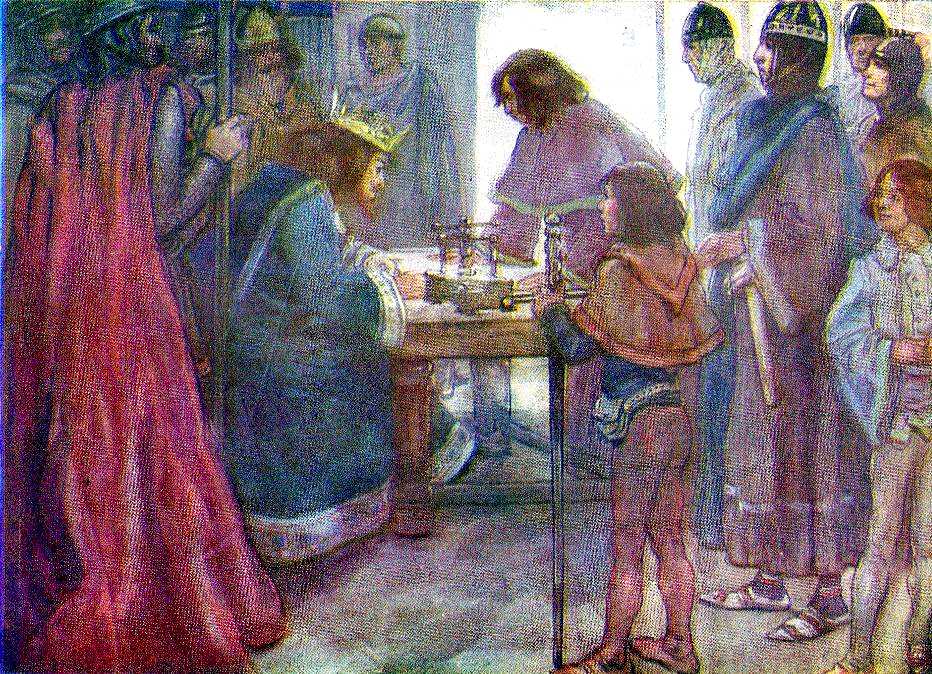
The history of law is essentially the history of civilization. Even primitive socities have law, although they are not written down. They may be largely traditions. As more sphisticated socities developed with the advent of agriculture, an actual legal code was required to resolve complicated legal questions concerning business and property. The Babylonian king Hamarabi finally made the first step toward a written code. This was a huge step as law based on a written code was less arbitrary and more fair to all concerned. One of the great gifts of Rome was that of law. Roman law played a major role in the eventual emergence of the West. The classical tradition was lost for centuries after the fall of Rome. The Islamic legal system or shria based on the Koran was in the 7th century a progressuve development. The problem with Islamic Law is that Muslims see the Koran as God's final relevation to man and beyond question. Thus with a medieval foundation that can not be questioned are amended, there is an inflexibility in Islamic law making adjustment to the modern world difficult if not impossible. . Emerging from the European Medieval era was English common law, England's great gift to America and its other colonies. English common law was a necessary comcomitant of capitalism which allowed the West to create the modern world. France had nothing like English common law. Louis XIV famously said, "I am the state". Napoleon is one of the great military geniueses of all time and committed to autocracy, but his great achievement was the Code Napoleon which for the first time presented France with a modern legal system. The importance of law is often forgotten in our modern world, but there is a strong correlation between economic prosperity and the rule of law.
As more sophisticated socities developed with the advent of agriculture, an actual legal code was required to resolve complicated questions concerning business and property. Writing had the same impetus. Records had to be kept, both by the state to assess taxes and by individual doiung business. All of this was not necessarey for hunter-gatterer peoples, but agricultural peoples developing civilization were another matter.
The Babylonian king Hammurabi was the greatest of the Babylonian kings. Babylon was the world's first great metropolis and it is no accidebnt that it was here that the world's first written law code emerged.
Of all Hammurabi's remarkable achievements, none is more important than is code of law. The actual provisions may seem extrtemely harsh to the modern reader, but te fact that they were written down and posted was a critical stepin the development of civilization. All the more so in that large numbers of peope even in the 20th and 21st centuries do not live in societies in which a written law code governs natinal life. Hammurabi's code is the earliest-known example of a ruler proclaiming an entire body of law to his people in written form. The 282 laws were written by scribes arranged in orderly groups on 12 tablets. This allowed the public to read and study the laws. They thus could understand what the state expected of them. Hammurabi had his Code carved upon a black stone pillar 8 feet high and placed in a public place. It begins and ends with pleas to the gods.
The first written law coide was a huge step in the advancement of ciilization. Law based on a written code was was a system the public could undrstand and was less arbitrary and more fair to all concerned than law depensed at the whim of individuals.
A marble bas-relief of Moses is one of 23 reliefs of great historical lawgivers in the chamber of the U.S. House of Representatives in the United States Capitol. Many Court Houses throughout the United States display the Ten Comandments, although this has come under assault as part of the secular campign against the Judeo-Christian foundations of Westrn Civilization. The Ten Commandments was an early example of codified written law. It is not enirely clear just when the Torah first appeared in either the oral or written tradition. It must have followed Hammurabi's Code, While not first, the Old Testament with the rise of Christianity helped transmit the Mosaic Code to Europe and Christendom. It influenced both codification of Roman Law and Catholic Cannon Law, both major influences on the development of European legal codes.
Emperor Ashoka was the third ruker of the powerful Indian Mauryan kingdom. He is today widely seen as one of the most just rulers of history and a great law giver--a monarch who ruled by law. A noted English author and historian writes, "Amidst the tens of thousands of names of monarchs that crowd the columns of history ... the name of Asoka shines, and shines almost alone, a star." [Wells, p. 20.] Buddhist literature recorded the legend of Ashoka. He was described as a cruel, ruthless ruler and military commander after a bloody war, converted to Buddhism and oversaw a reign of untold virtue. It was, howevrr, unclear if this was myth or history. Actual documentation was lacking. The history of the Mauryan Kingdom was largkly lost. Their language was undeciphered until the 19th century. India's Biiddhist history was unrecognized. Once progress was made in inderstanding the Mauryan script, Arceologists began to understand that a large number of stone momuments found in India, Nepal, Pakistan and Afghanistan were in facr publically proclaimed edicrs. These were carved rocks and pillars were Ashoka's edicts, proclaiming his reforms and policies and promulgatong his legal system and advice to his subjects. Our understanding of these finds is still incomplete, because the Mauryam script is still not fully decipjered. Translations thus vary widely. But what is important is that a powerful ruler sought to establish a legal code and widely deseninate that code throughout his kingsdom for all to understand. And enough of his stone edicts have been deciphered to realize that the Emperor assigned real importance to the moral and spiritual welfare of his people. Today the Indian flag has at its center blue chakra -— the Dharma Chakra known as the Wheel of the Law. The idea of a great monarch associated with turning the 'Wheel of Dharma' is a concept widely shared by Buddhism and Hinduism. And it is the Emperor Ashoka that is often associared with this. The original Congress Party flag had Ghandi's spinning wheel at the center. It symbolized Gandhi's crusade to make Indians self-reliant by spinning their own textiles with home spinning wheels sonthey could replace imported British textiles. The flag was adopted as India's national flag at indepedence (1947). Nehru and others saw the future with modern industry. Thus they substututed the similar looking blue Dharma Chakra (Wheel of the Law). The Dharma Chakra is widely associated with the Emperor Ashoka.
Trials are an important part of any modern legal system. There are two key elements to a trial, first law and second a siposedly impartial jury of some sort. They were not practical in primitive society where clan and family were the governing social unit and the wre few actual laws. Only when ivilization developed along with agriculture do we see actul law systems like Hamurabi's Code. But as a wy of administering the law you have what wre essentilly dministrative hearings by magistrates and not trials by theoretically impartial juries. The topic of truials attracts our interest for several rasons. First trials are an importnt of any legal system. Second trials often beings into question important issues of freedom, economic, political, and religious freedom. Third, children are often involved to a surprising degree. Fourth, trials are an institution primarily associated with Western civilization. A useful exercose is to assess some the great trials of history. Note the absence of trials outside the Western tradition. The modern idea of a trial, especually a trial by jury is a merger of Roman and Germanic traditions and slowly developed in England. The outcome of many of these trials are today seen as a miscarriage of justice, but as with most human nstitutions, the institution was perfected and improved over time.
One of the great gifts of Rome was that of law. Roman law played a major role in the eventual emergence of the West. Of all the great inheritances of Roman civilization, none were more important to Western Civilization that the heritage of Roman law. And today the imprint of law is one of the primary forces that mark the Western world. Roman law developed for about a milenia. The earliest Roman law was secretly administered as the law of the privileged classes. Over time it became the destinctive basis of civilized life throughout te Empire. Roman jurisprudence evolved into a legal system based on natural-law theory as the fundamental test of the reasonableness of positive law. The first major step toward a sophisticated legal system was the law of the Twelve Tables (449 BC). The cilmination of Roman lrgal development was Emperor Justinian I's Corpus Juris Civilis of (about 530 AD). Roman law, as preserved in Justinian's codes continued to be practiced in the Eastern Roman or Byzantine Empire until its fall (1453). The classical tradition was lost for centuries after the fall of Rome to the Germanic invaders and Huns. The Eastern Empire did not fall to the Barbarians. Thus it was largely through the Eastern or Byzantine Empire that Roman legal practice was passed to continental Europe during the medieval era.
With the fall of Rome in the West, many new threads appear in Europeam law. Because of the Churchg, Roman law was not lost, but secular law, such as it was was dominated by many different trends and inflkuences and different systems developed within what was once the Roman Empire. Becase of the importance of the Church, Roman law would eventully reassert itself. The medieval era is more known for lawlessness than law, but much of our modern legal systems developed out of medieval legal traditions. An exceotion was Soviet Law which was essentially state lawlessness and a factor in the demise of theoviet Union. The long arc of legal development began with Magna Carta during the medievl era was restraints on arbitrary government and the development of legal protections for the individual. Soviet Law esentially returned to the centuries old legal system of arbitary law by rulers, but with the terifying power of the modern state.
The term Sharia simply means Islamic law. Sharia is derived from the Koran and other Islamic holy works and precendents. Some Muslims view Sharia as the body of Islamic law established in the past, especially before the 19th century. How a time time can be set on law has no basic in the Koran and seems difficult to justify intelectually. As a result, other Islamic scholars view Sharia as a changing body without any set chronological limits. The essential difference between Sharia and Western secular law is that the separation of church and state in the West. Sharia developed in the Medieval caliphate where as it was a theocracy there was no destinction between religion and state, the Caliphate was an Islamic state. Sharia regulates both public and private relations and merges government, law and religion. Goverments in the West have stopped attempting to dictate religion to its citizens and thus have developed secular law. This is not the case in the Islamic world where other religions to various degrees are supressed. With the rise of Fundamentalism in the Islamic world there has come increasing pressure for the implementation of Sharia. This presents problems for non-Muslim people. And because sime Muslims believe that Sharia is now a fixed body of law based on Islamic works before the 19th century, the penalties are in some cases draconian if not barbaric. Quran 5:38 for example percribes a punishment of cutting off a thief's hand.
Emperor Ko-tsu enacted a set of laws, to be revised every two decades, laying a foundation that spread throughout East Asia (Korea and Japan) and endured into the Ming dynasty -- nearly a millenium. This made him one of the great law givers of history. The Tang legal reforms built on the Sui legal code. It has been described as the 'Confucianisation' of Chinese law. It was the culmination of a slow process of incorporating the Confucian views of society into the law codes. The result was the great Tang Code of 624. It set out what all great law codes do, a clear simple-to-understand set of laws. The code established what was permitted in Tang society and what was crininal. And it spelled out what the punishments were for violating the law. This meant that the law and judgements were not arbrtrary. The punishment was based on what you did, not who you were. The laws and punishments were codified. The Tang Code is regarded by many scholars as a model of legal precision and clarity. Three basic departments were established to create policies and laws. They were to be administered by six ministries (personnel administration, military, finance, rites, justice, and public works). The law was so clearly stated and so in coformity with Chinese thinking and values that even the dynasy that overthrough the Tang, retained their legal system. An kmprtant reason for the Tang lgal code was the novel idea that good government should include a prvision for education. The Tang unlike many rulers believed that a well-educated public was not a threat to authority, but rather, a solid foundation for a stable, prosperous society.
English common law was the basis for law in the American colonies. Each of the colonies had colonial charters. And following the English example were governed by governors appointed by the Crown and colonial legislatures basefd on the Britisjh Parliament. This was the system that developed with only limited direction fom th monarchy or parliament in sharp contrast to the panish colonial system to the south. The colonies were established at a time that Parliament and the monarchy were vying for control and thus only limited attention was given to the colonies (16th centyry). After the Ftench and Indian War (1756-63), Parliament began to rethink the relationship, primarily for fiscal reasons. They found the colonies, however, resistent to any changes. Just before the Revolution, Sir William Blackstone, published The Commentaries on the Laws of England ( Clarendon Press, Oxford, 1765-69). This was a basic compendium of English Common Law. It was divided into four volumes: 1)rights of persons, 2) the rights of things, 3) private wrongs, and 4) public wrongs. Blackstone's Commentaries became widely used in America both before and after the Revolution (1776-83). And much of the statutes enacted into law by the American states is based on English common law expressed by Blackstone. The sole exception is Louisiana which was influenced by the Napoleonic Code.
The Constitution is the first important written plan crafted to establish a new republic. Madison came to the Convention armed with a carefully developed plan which came to be called the Virginia Plan. Madison's role at the Convention has resulted in him being seen as the "father" of the Constitution. It was conceived to limit the powers of the Federal government by creating three independent braches of government, in part a reflection of American experience with what the founders considered to be King George III's unfettered executive power. Guaranteeing power to the states further limited the power of the Federal Government. There were many inperfections in the Constitution, including a failure to address slavery. There were also limits on democratic government. The fact that even in 2002, President Bush was relected with fewer votes than Vice President Gore is a reflection of these limits. The new Constitution was hotly debated throughout America after the Convention approved it. Dpite the imperfections, it was as Franklin observed, as close to perfect as could be achieved. Madison and Hamilton argued for its ratification in a brilliant series of political essays now called the Federalist Papers. The principal concern threatening ratification was fear--fear of the political unknown and dangers of both democratic rule and the political unknown. One noted scholar writes, "The Constitution was written not by hard-nosed, conservative political bosses determined to reverse the meliorist enthusiasm of the early years, but by idelaists ... who had come to recognize, reluctantly, the need to create the dangerous instruments of centralized power." [Bailyn]
Louis XIV famously said, "I am the state". Napoleon is one of the great military geniueses of all time and committed to autocracy, but his great achievement was the Code Napoleon which for the first time presented France with a modern legal system. While history focuses on his military campaigns, The Code Napoleon was surely the most important and enduring aspect of Napoleon's regiome. The legal system he inherited varied in each French province. He saw the need to replace this patch-work and inconsistent legal system with a national, standardized code for the French nation. Before addressing the legal confusion, he addressed the French fiscal system which was even more decrepit. He reformed the French taxation system and indoing so increased the imperial income by almost 700 million francs annually. The taxes included an income tax and a series of levies on goods (wine, tobacco and salt). He then capped his fiscal reforms by creating the Bank of France. Napoleon did not personally play a role formulating the new laws. Instead he appointed a commission (1801). There were 2,281 laws suggested. Napoleon did not personally revuew many before the Council of State debated them. It is an this point that Napoleon aplied his considerable administraytive skills. He proceeded to implemented a wide range of national laws which became known collectively known as the Civil Code or the Code Napoleon. The laws comprised the Codes of Civil Procedure, Commercial Law (1807), Criminal Procedure (1808), and the Penal Code (1810). The central tenet Code Napoleon was that every French citizen was equal before the law. Thus Napoleon institutionalized the central tenat of the Revolution. A Cabadiab reader tells us, "The Napoleonic code is also used to some extent here in Quebec. Most major criminal laws, however, are those of all of Canada."
A reader writes, "I remember being shocked in 7th grade in our Civics class. The discussion was about democracy. One boy got up and said the only 'true' democracy was the Soviet Union. There were gasps around the class. The civics teacher said 'Ah yes, every one has the vote, every one has to vote; one man, one vote for one man. Think about it.' There was thoughtful silence." The whole evolution of Western law was to protect the individual, both his property and his rights. Soviet or socialist law is the body of law with developed in the Soviet Union after the Bolshevik Revolution (November 1917). It was imposed upon the Soviet people by the Communist Party, based on Markist-Lenninst principles as interpreted by Soviet leaders, namely Josef Stalin in the late-1920s. It was essentially the reversal of the evolution of Western law. While the Soviet state presented itself as the complete reversal pf the Tsarist state, it was in reality similar in many ways to the Tsarist state. Just as the Tsar was an absolute ruler, Lennin and even more so Stalin became absolute rulers in their own rights without legal constraints. Rather than protecting an individuals rights and property, Soviet law was used by the state to impose its will on Soviet citizens. While the Soviet Union crafted a Constitution with seemingly liberal principles, it actially was a virtually meaningless document. There were no real limits on state power and the operations of the Secret police--the Chekka/NKVD. There was no independent judiciary. NKVD arrests always resulted in convictions. Often there were not even trials, but execultions or long commitment to the Gulag. The issue of private property became moot. Essentially individuals no longer had property. Collectivization settled the land issue by eliminating millions of peasant land owners. And without property, Soviet citizens essentially became serfs of the Soviet state.
The trial by jury is a major feature of Anglo-American jursprudence. The jury was not commomn in the ancient world. We do notice jury trials in ancient Greece. The origin of the jury trial appears to be a custom of ancient Germanic tribes. The jury system which developed in medieval Germany was supressed as the modern German states formed. Rather that citizen juries, state appointes justics decided cases. But the Anglo-Saxon tribes that invaded Britain after the departure of the Romans brought that custom to medieval England. Both the Vikings and Normans added to the tradition. These early versions were not the modern jury system, but added to its development. Trial by jury of one's piers was enshrined in the Magna Carta--at least for nobels. Only gradually was it extended to commoners. Rather trial by ordeal was common. The Church playd a major role in ending that. The jury emerged as a safeguard for the criminally accused (17th century). Blackstone described he jury as the 'strong and two-fold barrier ... between the liberties of the people and the prerogative of the crown'. He claimed that the 'the truth of every accusation ... [must] be confirmed by the unanimous suffrage of twelve of his equals and neighbors indifferently chosen and superior to all suspicion.' [Blackstine] The relative isolation of the American colonies, especially durung the English Civil War (17th century), meant that the colonists were on their own. And as there were few trained jurists and those thar di exist were not wll respected, the princiople of trial by jury became even more entrenched in American law than it was in England. Ironically one of the English soldiers involved in the Boston Masacre was exonerated by an Amneuican jury. Jurries were such an important feature of American justice that it was not only guaranteed in the constitutions of the 13 original states, was guaranteed in the body of the Federal Constitution and in the Sixth Amendment. And the constitution of every new state entering the Union thereafter in one form or another protected the right to jury trial in criminal cases.
The importance of law is often forgotten in our modern world at lest in the west, it is all too often taken for granted. It is important to note that there is a strong correlation between economic prosperity and the rule of law. nd an imprtant part of the rule of law is the importance of property rights. It is no accident that capitalism developed in the Netherlands and England and the Indurtial Revolution first occurred in England where both individual and property rights were protected by the rule of law. It is a major reason why countries with capitalist economies suceed and countries with socialist ecomomies fail, not just some, but all contries with socialiat countries have failed or are failing.
Lawbecomes an easpect of civilizatio. We see legal systems emerging in Sumeriam erliest civilzation. The fiest known formulation of law is Haurabi's code (1750 BC). The Old Testament mandates many legal precepts, many of the legal ideas prevsalent in Msopotamia, basically a reintertion of Hamurabi's code. Butwee note the firsdt sduggesdtion of juvenilke law [Deteonomy, Verse 18] The issue is nmot addressed in the New Testament. Perhaps Rome's greatest comtribution to Western Civilization is yhe vast body of law which is he foundation for Western law. As best we can determind in the ancient wotld there was no povision for age or ny kind of juvenile justice system. Under Roman law, children were the prtopery of he father who had the right to deal very hsrshly with his childrem. We suspct this was common thoughout the ancient world. With the cecline of civilization after the fall of Rome, here was a correspmding decline in law even for adults. As far ass we know Sharia (Islauc) lw does not take age into asccount. We have found no history of juvenile justice during the medieval era, either within Europe or byond Erope. The first attempt at juvenile justice we have found come from Colonial America (17th century). But basicll, chThe Maschusetts Bay colony passed the stuborn Child Act (1646). [Sutton] This my have reflected approches in Englnd becaise other colonies passed similar laws: Connecticut (1650), Rhode Island in (1688), and New Hampshire in (1679). These laes were based on Deuteronomy, but disregarded the Talmudic Commentary abrogating capital unishment. We do not see substntial chanbge primarily because for the most part children ewere seen as small-0sized adults. We finlly seem some discussion of the idea that childhood was a distincg devlopmntal stage. Only in the 19th century does juvedile justice become a matter of some comcern nd we begin to see acual chnge (mid-19th century). This included child labot laws along with chanhes om the lergal sytm. Rformotories were founded for children rather hn hiusing children in adult jails. Most of the information we have found begins with the 19th centurtry. There are some fairly detiled counts of nationl juvenile justice systems.
Law can be a doubled-edged sword. It can be used to both oppress and to seek justice. The arc of Anglo-American legal history has been to protect individual rights and property, elements that are inextrcably linked. The most conscipuous failure fr an extended period in American this prudence was race. This was an issue not touch on by English common law at the tome of the foundation of the merican colonies, but slave laws based on race were adopted in each of the American colonies and were especially important in the South where most Aficans were impted and where the aboliionist Movement made little progress after the foundation of the United States (1776). Even during the skave era, there wre some legal victories for Africans, nost notably the decesion in the Constitution to abolish the save trade (1809) and the Amistad trial (1839-40). The overwealming legal novement in the North was toward freedom and in the South toward strenthening slavery. This division led to the Fugative Save Law (1850) and perhaps the worst decision in Suprme Court history --the Dread Scott decsion (1857). Ultiately the savery issue privedc beyond the capacity of law and politics to reslobe. The only the Civil War resolved the issue. And ultimately three amendmets to the Constitution resolvd the issue. Most black Americams who at the time lived in the south were unable to fully realize the benefits of emancipation because of the Black Codes passed by Southern Lehisatures tablishing the Jim Crow system. This was confirmed by the Supreme Court in Plessy vs. Fergusson estabkishing the seoarate but equal doctrine (1898). This did not change until the Supreme Court strucj down raial segregation in the Brown vs, Topeka decision (1954). The 14th and 15th amendments were used to undo the Jim Crow system of the South. Congression passage of two civil rights (1964-65) furtheredthat process. The American jury system was a further impediment to racial justic, at least unil racila minorities achieved the right to vote in the South and thus behan to appear in the jury pool.
Blackstone, Willim. Commentaries on the Laws of England (1765).
Sutton, John R. "Stubborn children: Law and the socialization of deviance in the Puritan colonies," Family Law Quarterly Vol 15, No. 1 (1981), pp. 31-64.
Wells, H.G. The Outline of History (1920).

Navigate the Children in History Website:
[Introduction]
[Biographies]
[Chronology]
[Climatology]
[Clothing]
[Disease and Health]
[Economics]
[Geography]
[History]
[Human Nature]
[]
[Nationalism]
[Presidents]
[Religion]
[Royalty]
[Science]
[Social Class]
[Bibliographies]
[Contributions]
[FAQs]
[Glossaries]
[Images]
[Links]
[Registration]
[Tools]
[Children in History Home]