|
Queen Victoria was Britain's longest serving monarch. The generally uneventful reign of George IV 's brother, William IV (1830-37), was followed by that of Queen Victoria (1837-1901). The Princess described her childhood as 'miserable'. Only 18 years when she came to the throne, innocent, self-centered and poorly educated--few expected very much. Victoria was, however, to oversee England at the height of its overseas power as well as an extraordinary explosion of technological advances which ushered Britain into the modern age. The British Empire was established in her reign, and it reached its greatest expanse under her. Perhaps even more importantly, major social and political reforms were initiated. The one major decision she made by herself was her choice of Albert of Saxe-Coburg for her husband. Until thn she was essential a pawn of her advisers. It was the love story of the 19th century. Victoria and Albert set the moral tone of the nation and helped shape Britain's emergence as a truly democratic nation. Victoria witnessed an extraordinary development of British power and influence. She and Albert changed how Britain's looked on their monarcy. The Queen withdrew into iolationasfter her husband' death and the image of a disnterested monarch developed. She was in fact intensely involved in affairs of state. Victoria became the figurehead of Britain's military and economic world dominance. She became in many ways the grandmother of Europe, forging dynastic ties throughout the Continent, a role which could have prevebted the cataclism of World war I had it not been for her bombastic, egotistical grandson--Kaiser Wilhelm II. Dynastic ties pailed in importnce to the weight of German nationalism impressed on him by his father and Chancellor Bismarck. While Victoria failed here she did not fail in oversseing great refgorms and in strenthening ties between India and the Empire. One biolgrapher describes the story of a tells the story of aformidable monarch who transsended autocracy and became a constitutionl monarch who came to embody the aspirations of the British people. The Queen also played a major role in influencing boys clothing around the world by the garments she selected for the young princes.
Queen Victoria was the granddaughter of King George III and was the niece of
her predecessor William IV. At her birth it was not
clear that she would be a future queen. The Queen ascended to the throne in 1837
and was to become the longest reigning British monarch, having much of the 19th
century named after her. Because of her longevity and extensive family, she became
known as the Grandmother of Europe after marrying her family into every Royal House
in Europe. Victoria ruled one of the world's largest empires at the peak of its power.
She was Queen of England, but so as not to outdone by the German Kaiser
(Emperor), was made Empresses of India.
To fully understand Victoria and Albert, it is necessary to understand the world in
which they lived. One observer once commented that the world in 1819, the year of
Victoria's birth, was more like that ancient Greece than that of the modern world.
Britain's population still largely lived in rural areas and Britain largely fed itself. Most
people lived and died close to where they were born. Education was limited to the
privileged and wealthy. Power was largely based on human or animal power. The
fastest form of transportation was by horse. Marine transport was sail powered.
Travel to America could take 3 months and to Britain's Asian dominions more than
twice as long. During the life of Victoria, most of it as Queen, the world underwent the
industrial revolution which was to usher in the modern age. It was in Britain that these
forces were first unleashed and the impact on the country and its people were the most
pervasive in British history.
Victoria's father was Edward Guelph, Duke of Kent, one of 15 children of George III and Charlotte of Mecklenburg-Strelitz. Two of his older brothers became king as George IV and William IV. Edward died, however, before his brothers, leaving Victoria in line to inherit the throne.
Victoria's mother was Victoria Mary Louise Saxe-Coburg of Leiningen. The Duchess's father was Duke Francis Frederick of Saxe-Coburg-Saalfeld (1750- ). Her mother was Countess Augusta Caroline Sophia of Reuss Ebersdorf (1757- ). Victoria by all ccounts had a rough childhood growing up with her brothers and sisters. One of her brothers was Ernest I, Duke of the newky created Saxe-Coburg-Gotha, and another brother, Leopold, who married Princess Charlotte, child of George IV. She had been married before in 1803 to Prince Emich Karl of Leiningen. They had two children, Prince Charles Frederick William (1804- ) and Princess Anne Feodora Augusta (1807- ). After the death of her first husband, she married Edward Augustus, Duke of Kent and son of George III (1818) at Kew Palace. Victoria was their only child. No one at first thought Victoria would be queen, but when Willian IV died wuthout issue and George IV's daughter Charlotte died without issue, Victoria's father, the Duke of Kent was next in line. Abd when he died the young Princess under the care of the Duchess of Kent and her associate, the scheming Sir John Conroy, became the heir presumptive.
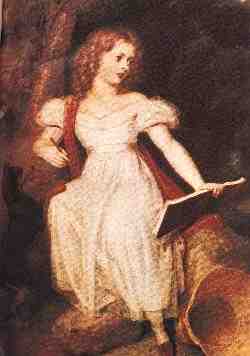
Victoria was raised in isolation. The Princess described her childhood as 'miserable'. [Wilson, Victoria.] She deply resented her mother's associte Sir John Conway who was very strictt with her and accirding to Victoria, constntly reduculing her, especilly her diminutive stature. She was not broughtup at court. And it was not initially apparent that she would be queen. Money was tight and she was not indulged as a child. There were family feuds about residence in Kensington Pallace. Her world for many years was restricted to the nursery. Little artention was given to her eduction. Her mother has been portrayed as taking little interest in her, in part because the young Queen became estanged from ger mother and stepfather. When her mother died, Victoria found that she had saved a treasure trove of childhood memorabilia--suggesting that the Duchess had taken a great interest in her daughter. [Wilson, The Victorians, p. 242.] She was closeted and guarded from the sweeping change that was affecting her nation and world. She was described as stubborn and bad tempered, but with a kind and gentle side. She was subjected to a strict moral regime, although her motherand especually her mother's secretary who became a virtual consirt was not very kind to her. She kept a behavior book where she recorded many incidents of naughtyness. She was also very spoiled, a tendency which was to endanger the relationship with her future husband. She was also very innocent, with am idealized romantic view of life.
Two of Victiria's uncles ruled as kings. As a child and teenager she had a relationship with both. She was especially fond of George IV. The failure of King George III to hold the american colonies in a hugely expensive war and then his eratic behavior had weakened the nonarchy. He was no assett duting th Napoleonic Wars, not was his son the future George IV. The personal life styles of her uncles brought the monarchy under increasingly critical public scrutiny. The scandals and rumprs suggested to many that the mobarchy was a old fashioned and a costly extravagance for a country that was becoming democratic. Her mother and Sir John Conroy did nothing tonimprove the monarchyh's sorry reputation. It would ve up to Victoria and her husband to restore the reputayion and legitamcy of the British monarchy. Many opemly wondered how an uneducated girl of 18 years could possibly suceed as soberign of the most powerful empire in the world. It is incredible givem all the sons that George III fathered that there was no male heir.
Princess Victoria's relationship with her uncle, George IV, began with her christening at Kensington Palace on June 24, 1819. The King was her godfather. Her parents asked him to
name the Princess, but he refused to reveal his choice before the actual event. He named her Alexandrina Victoria, in honor of Tsar Alexander I, who was unable to attend the service, had was the Princess' second godfather. Victoria was called Drina as a child. Her name for her uncle was suitably "Uncle King." On one celebrated occassion in 1826 the Duchess of Kent took the Princess to Windsor. Victoria was 7 years old at the time. George IV gave her a miniature doll of himself. During the visit the King directed an attendant to "pop her in" beside him in the royal carriage. Victoria later wrote, "[We] stopped at the Fishing Temple. Here there was a large barge and everyone went on board and fished, while a band played in another." Princess Victoria's always remembered George IV affectionately. She wore his diadem at her Coronation. Even so, Victoria as Queen with Prince Albert rejected the loose moral standards that George IV's reign had come to symbolize.
Princess Victoria had a correct relationship with William IV who was quite fond of her. The problem here was her mother, the Duchess of Kent, who wanted to be Regent in case of the King's death. William came to despise the Duchess. The Duchess as a widow came to rely heavily on Sir John Conroy, who she engaged as her private secretary. But he became much more than a secretary. The two became intimate, but apparently not to the point of sexual relations. Conroy it vwould latter be found embezzeled large sums from the Duchess. Conroy played a role in the deteriorating relationship between the Duchess' household and William IV. The Duchess came to regard the king as an 'over-sexed oaf'. [Farquhar, p. 152.] The Duchess and Conroy kept the young Victoria away grom the King, at least as much as they could without causing a scene. She would do things that would offend him. If not calculated to do so, done with little concern for the Kin's felings. The Duchess occupied rooms in Kensington Palace that the King had reserved for his own personal use. Both before and during William's reign, she made a point of snubbing William's illegitimate children, the FitzClarences. The estraignment finally led to row at a dinner when William, offended by the Duchess and Conroy, told them in earshot of other diners that he would live long enough to render a regency for Victoria unnecessary and William would do just that. He also criticized the influence on the heir presumptive by those around her, meaning the Duchess and Conroy. Conroy for his part begin to have high hopes for the Duchess and thus himself when the the Duchess became regent. He envisioned Victoria succeeding the throne as a minor. Following the Regency Act of 1831, the Princess' mother would be Regent. She had served in that capacity in Germany following the death of her first husband. As the personal secretary of the Duchess, Conroy would become the 'power behind the throne'--the road to great power and wealth. He miscalculated William's longevity. Unfirtunately for the Duchess and Conroy until Victoria reached her majority. Conroy had carefully cultivated her mother, gain her affection. He badly miscalculated, however with Victoria. He ignored the Princess and was often even unkind to her to the point of insulting her. He often commented on her diminuative srature. Victoria came to despise him. Her mother's failure to defend her would affect their relationship when Victoria bcame queen.
The Duke of Cumberland, Ernest Augustus, was extremely unpopular, as was his who was also his first cousin. There was not much family unity. Princess Victoria's mother and her secretary, Sir John Conroy, constantly slandered the Duke. And this carried over when Victoria became queen. The idea that only this diminuative little girl stood between him and the throne much have frustrated the Duke. Rumors spread of the 'Cumberland Plot' to remove Victoria and replace her with Cumberland's son George swirled for decades. The rumors associated with the Duke are legendary. Gossips insistedthat the Duke killed his manservant to cover up a homosexual affair he was having with his valet (1810). And that was just one of many such rumors which usually involved his many affairs. He repprtdedly had an affair with his own sister, Princess Sophia, fathering her illegitimate child. Cumberland also reportedly courtd the beautiful Lady Lyndhurst, wife of the Lord Chancellor, but she threw him out. Later, he is said to have raped her. Cumberland is said to have had an affair with the wife of one Lord Graves, which allegedly drove her husband to commit suicide. It is difficul to lnow the truth of these rumors, but it is hard to nelieve that there wa no truth in any of them. Cumberland was a arch conservative. He opposed virtually all of the major reform bills. He evebtually retuned to Hanover. British monarch had ruled there since George I. But women couldn't succeed there, meaning Victoria. Ernest Augustus as king of Hannover replaced the kingdom's liberal constitution with a conservative one. The Duke's wife was only slightly less appealing. Princess Frederica of Mecklenburg-Strelitz, was the niece of the Duke's mother, Queen Charlotte. Her first husband was Prince Louis Charles of Prussia. They had several children, but Frederica was widowed. She then became close with Cumberland's younger brother, Prince Adolphus, Duke of Cambridge. Their father George III disapproved and managed to send the relationhip. Frederica then fell for Prince Frederick William of Solms-Braunfels. A child came of the affair. They married before the baby arrived. Frederick William died (1814). Frederica had already began seeing Cumberland. Rummors wsirld that sh helped to dispatch Frederick William. This would be her most advantageous marriage to date. And a princess of proven fertility attravted her to Cumberland. They married (1815) and produced a son that would be next in line after Victoria--George. He was a possible husband for Victoria, but the two did not get on together. Cumberland's mother, Queen Charlotte, heartily disapprovd of the marriage. She refused to receive her niece/daughter-in-law at court. A trenendos slap in the face. As unpopular as the two were, Ernest Augustus and Frederica appear to have gotten on very well together.
Victoria was not close to her mother, but developed an intimate relationship with her Hanovarian-born governess--Baroness Lehzen. No great care was taken with Victoria's education, in part because in her early years it was not clear that she would be queen. The Baroness pursued a limited educational program for her charge, but in
part because of Victoria's mother lack of interest, Victoria confided in the Baroness and grew to depend upon her. Lehzen who was a spinster came to look on Victoria as a daughter. Lehzen had undermined the position of others close to Victoria, including the Duchess of Kent, Victoria's mother. Lehzen was determined not to share her royal
charge. Thus conflict with Prince Albert was inevitable. Victoria retained Lehzen as Lady Companion after becoming Queen. Prince Albert took an immediate dislike to Lehzen after the marriage and especially disliked her freely interrupting private time with his new wife and taking her off on 'state business' as well as constantly gossiping in the nursery where she had no role. Worse still, were two nearly fatal accidents. He particularly objected to her role in the nursery. Lehzen for her part was probably the source of many unkind, if not vicious, and largely untrue reports about Albert that appeared in the press. She had earlier spread harmful rumors about Victoria's mother. Albert after only two years had to demand that she be dismissed. A terrible dispute resulted, but this proved to be a turning point in the Royal relationship.
Little attention was given to Victoria's education. At first it seemed unlikely that she would become queen. But even as it became increasingling likely, no attemp was made to give her a proper education. The Duchess, Conroy, and Lehzen wereall responsible. The Duchess was no well educated herself and saw no need to eduvate her daughter. Conroy desired to rule as the power behind the Regent and thus saw no advantage to himself in educating Victoria. One might think that Lehzen would have, but she did not beyond the basics. It would be Albert in the end hat woukd play that role informally. A HBC reader suggests that Elizabeth Longworth's biography of Victoria would provide a good perspective on Victoria's temperament and education. We have not had a chance to go back to this source, but hope to do so eventually.
Her cousin Princess Charlotte had died in child birth in 1817, only 2 years before her birth. As her uncles George IV and then William IV had np surviving heirs, it gradually dawned on the British public that this young princess would be their new queen. Few help out much prospect for the young queen. Her predecessors were held in little regard. Her grandfather King George III had been described as "Mad"
and had lost the American colonies. Her Uncle George IV (Prince Regent) was universally despised by the British public. Her other uncle, William IV, was widely seen as a womanizer and drinker. Some had begun to question whether Britain still needed a monarchy. Unlike her uncles, as it became clear that she would be queen, Victoria was determined that she would o good for her people. She had no idea, however, how to go about this. Few thought that the sheltered, poorly educated young princess would be up to the job of overseeing the world's most powerful country as it entered the most wrenching period of social change in its history--the industrial revolution. One noted writer of the day phrased it succinctly when he question whether the young princess could be trusted to choose a new bonnet. Most assumed she would be overwhelmed. It is clear now that if Victoria had ruled poorly, that the monarchy may not have survived in Britain.
Victoria was not born into tranquil times. By the 1830s Britain had launched itself
on the industrial revolution. Changes were occurring elsewhere in Europe, but no
where was it as advanced as in England. For many English, the "green and pleasant
land" had given way to the Dickensian night mare of crammed, disease ridden cities
towered over by belching chimilies. A expanding class of disposed and disaffected
workers posed a threat to the established social order and the monarchy itself. The
Princess had been shielded from much of the misery and squalor, but by the time she
was queen she had seen distressing sights and was distressed by it. As a young, poorly
educated girl, however, she did not fully appreciate the problem, the danger it
presented, or how to deal with it.
Victoria coronation took place at Westminster Abbey (1838). Some 0.4 million visitors came to London for the celebrations. Victoria would be the first British first sovereign to take up residence at Buckingham House which becme known as Buckingham Palave. She inherited the revenues of the duchies of Lancaster and Cornwall. Parliament granted an annul civil list allowance of �385,000. From the onset, she provd financially prudent. She paid off her father's substantial debts. [Woodham-Smith, p. 152.]
Victoria became Queen in 1837 with the death of her Uncle William IV and was crowned in 1838 at Westminster Abbey, only a month after she came of age. For Victoria it was if she emerged from a cocoon. Her mother was no longer in charge. Think for a moment what this would mean for a modern 18-year old. Not just releaed rom an oberbearing mother but made soveign of the most powerful nation on earth. She released the country from a Regency by her unpopular mother. When the inexperienced, tempermental teenage Princess Victoria ascended to the throne in 1837. The young queen was poorly educated, without knowing it, and extremely self centered. An ready to have fun with clothes and parties. Few of her subjects expected that she would become a very successful sovereign, let alone reign until 1901 and to virtually define a critical era of the British historical experience. To no small extent, her success was made possible for two reasons. First Victoria was a Christian. While not a deep thinker, she saw herself as a benevolent country squire and believed it was her
Christian duty to look after the welfare of her subjects. Something that coul not have been further from the concept of her uncles. While she had not thoroughly assessed this belief, it was in fact a very significant departure from the ribald behavior of her predecessors. Second, she chose an enormously talented husband--a choice the young Victoria made herself despite the objections of many of her closest advisers. Again Victoria had not planned this and at first jeleously excluded Albert from state affairs, but Albert was in effect would teach her to be a queen. And once the children came, she increasingy relied on him. This process was negun by Lord Melbour before she married Albert.
Victoria at the time of her accension had just turned 18 years old. Thus there would be no regency. The government at the time was led by Whig prime-minister Lord Melbourne. He filled the role that the miscalculating Conroy had wanted but was unable to do because he had so alientated the young princess. Melbourne was very supportive and never condescending which would have been very easy to do with a tiny 18-year old, poorly educated girl who had just become soverign of the greatest world power at a time of tremendous economic and cultural change. He became a powerful influence on Victoria. The young Queen came to rely on him for advice, precisly what Conroy had wanted. [Hibbert, pp. 66�69.] Their relationship has aroused considerable historical speculation. Some believe that Victoria developed a crush on him. Others say she came to look on him as a fathrr figure. For the widowed and childless Melbourne, one diarist believes was 'passionately fond of her as he might be of his daughter if he had one'. [Greville] Melbourne was not a great prime-minister. He achieved very little despite the need for major reforms. His greatest achievemet was the first steps toward turning the ill-prepared, flighty teenager into a great queen.
Prince Albert was the born into the royal family of Prince of Saxe-Coburg-Gotha,
a small German principality. Albert was the younger son and along with his brother
strictly raised and very well educated. He and his brother Ernest came to visit their
cousin at Victoria's invitation. Behind the scenes
King Leopold had been promoting Albert behind the scenes as a suitable
husband for the young Queen. (It is no accident that Germany's invasion of Belgium in
August 1914 was the reason that Britain declared war on Germany and came to
France's defense.) Leopold as the husband of Princess Charlotte, who it was assumed
would be Queen after her father George IV, was on intimate terms with the Royal
family. Leopold had discussed the idea with Albert, but he had no idea if the Queen
would be interested. The young Queen, however, was immediately smitten with
handsome and elegantly dressed Albert upon first seeing him. It is interesting that she
chose the more serious and shy Albert rather than his more outgoing brother. It was
not Albert's mind which attracted her, but his handsome appearance--she described in
her diary the blue eyes and other physical features which immediately struck her. She
immediately began discussing marriage with her confidants without a word first to
Albert! Finally she tactfully proposed to him. As the sovereign, protocol obliged her
to male the proposal.
Four months after proposing, Victoria married Albert in February 1840. Some mocked the irony of wedding vows when Albert pledged to endow the queen with all his worldly goods. The royal couple honeymooned at Windsor. Albert's marriage to
Victoria brought him to the throne of the most powerful country of the day, a huge step for an impoverished German aristocrat. The marriage was not at the time popular with her advisers or subjects. Many objected to the Queen marring a poor noble--and a foreign one at that. Parliament refused to grant Albert a title. The young Queen was however, determined on the marriage and insisted on it. Victoria was in some ways very un-Victorian. She was deeply in love with Albert and had a passionate love affair with him. Albert's initial thoughts are less clear. They must have been influenced by the
improvement in his dynastic status, although he could hardly commit such thoughts to
paper. The union proved a most felicitous one, marked by a degree of mutual affection
rarely found in unions of state. Although Victoria believed that women had little place
outside the home, she played an active, even aggressive role in public life, especially in
foreign affairs. Albert was only to become the Prince Consort and not a co-ruler with
his wife. His untimely death was to devastate Victoria. At first Albert was given no official duties. Victoria did not want to give up any of
her royal prerogatives. He served as the Queen's secretary and at first his duty was to
blot her signature. Gradually the Queen came to increasingly rely on her advice.
Albert quickly learned English, read voraciously. The Queen's advisers came to see
him as thoughtful, and more flexible, easier to approach than Victoria. It was Victoria's
pregnancies, however, that forced Victoria to rely on Albert who gradually became a
defacto monarch without the title. Albert read the ministerial red boxes
carefully and carefully without upsetting Victoria took charge. He help to expose the
Queen to new ideas and make her aware of the social and technological developments
that were sweeping Britain. Albert was a social liberal and brought Victoria along to
his point of view. Albert's tactful advise to his poorly educated wife proved to be of great value to
England. Perhaps the most important was his success in convincing the Queen to
support of the Corn Laws. England's landed gentry imposed high tariffs to keep food
(especially grain) prices high. This meant that cheap grain could not be imported from
America. It almost meant great hardship among the urban working class, many of
whom lived on the edge of starvation. There were many other examples, the final one
was his advise that England not support the South in the American Civil War. Albert took the education of their heir, the future Edward VII very seriously. Despite the attention given to the care and education of the children, many serious
mistakes were made and a program was pursued that was not suitable for a boy of limited intelligence and volatile temperament.
Victoria and Albert had nine children, four boys and five girls. They saw themselves and in many ways were suitably enough the ideal Victorian family. The marriages and offspring of these children are truly remarkable. Victoria in more than name was the grandmother of Europe. Ties were forged with Denmark, Prussia and other German states, Russia, and Spain. Notably France was exempted from Victoria's dynastic web, even before becoming a republic.
Photograph was invented (1839) at avout the same time that Victoria became queen (1837). This there are no photographic images of Princess Victoria, There is an exhaustive photographic record of Queen Victoria and Prince Albert, their children, and grandchildren. There was nothing like it ever before. And it was very important as the Queen and Prince pursued the image as an ideal Victorian family. The Royal Family did not turn away from artists. And thus we have many important painted works. Both the Quuen and Prince had ideas about art. Several artists were given commissions, including W.P. Frith, Edwin Landseer, David Roberts, Thomas Sully, Robert Thornburn, Franz Xavier Winterhalter and other artists of the day. In addition to all of this, the Queen herself loved to sketch the childre, leaving us with amateur, but charming images.
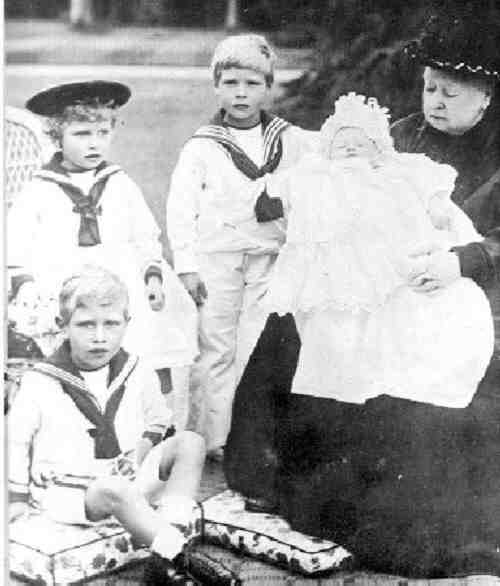
The way Victoria and Albert's children were dressed had an enormous impact on children's fashions for generations. I'm not sure who decided on these fashions. Perhaps it was Victoria. But the use of the kilt made good political sense for the monarch, just the astute step that Albert was likely to have suggested to Victoria.
HBC has no details yet, however, on just how the children's clothes were selected and the role of Queen Victoria Prince Albert, or others. We also do not know to what extent the children's clothes were made in the nursery by staff of the royal household or
ordered from outside seamstresses and garment shops. HBRC was somewhat surprises that at least some of the children's clothes were made in the nursery, but it is known that Prince Albert obtained a sewing machine for the nursery.
After the dalliances of their predecessors, Victoria and Albert sought to set the standard for rectitude. Although historians vary somewhat the young family seems to nave been very happy. The children were not relegated to a nursery and rarely visited
by their parents. Albert delighted in playing with the children. He not only joined in their games, but invented many for them. [Bennett, p. 128.] I'm less sure about Victoria's role. It is clear that the family participated in many activities together. The
engaged in family theatricals. Albert taught them games. They enjoyed producing tableaux vivants. Albert would read from books they could all enjoy like Dumas' The Count of Monte Cristo. They also traveled together, taking may trips on the royal yacht, Victoria and Albert together. The children grew up thinking that papa knew how to do everything and Victoria her self with her limited outlook and education also came to look to her husband for guidance. In family maters after the Lehzen matter was resolved, Albert was the undisputed head of household.
Victoria gradually turned to Albert on matters of state. In this regard, Albert very tactfully gained her confidence. There were little tiffs from time between Victoria and Albert, but they appear to have been a wonderfully happy family. Most of the disputes resolved around Victoria's frustration. She wanted him to be successful and admired, but as he rose in stature there were more demands on his time. This took him away
from her which she did not want. The standards set by the royal couple with the children and their family life was to set a standard that many of their descendants found difficult to meet. Edward in fact made no effort to do so and was a notorious philanderer.
The official London residences of the royal family became Buckingham Palace and Windsor Castle. Victoria was the first British monarch to designate Buckingham Palace as a royal residence. The royal family needed, however, somewhere to go to be away from the lime light. There two favored retreats were Balmoral Castle in Scotland and Osbourne House on the Isle of Wright. Both were designed and built under Albert's supervision. He did his best to avoid official duties at Osbourne and devote himself to the Queen and children. Several interesting group photos were taken at Osbourne, but fewer images seem to exist from the other residences--perhaps an indicator that more family time was spent at Osbourne.
Prince Albert died in 1861, 4 years after being given the title of Prince Consort. He was only 42. Albert passed away on December 14, 1861, officially of typhoid fever. There were, however, many complications that do not correspond to typhoid. Incredibly, Bertie saw him just before he took to bed and had no idea his father was not feeling well. A good example of how clueless the Prince of Wales was at this time. His father had traveled all the way to Cambridge on November 22 to see him about his behavior. The two strolled in the country lanes around Cambridge and Bertie managed to get them lost. Albert did not need to be outside after dark in his condition. [Bennett, p. 368] Victoria was later to
actually blame Bertie for Albert's death and would constantly throw it up at him when ever the two quarreled. Even Victoria, however, had no idea that Albert was so sick. It was a great shock when the doctors told him how sick he was. Despite his position, the prince got incredibly poor medical care. His was a long, protracted decline, yet the royal doctors, Clark and Jenner, repeatedly gave hopeful prognoses, encouraging Albert to leave his sick bed and walk around Windsor Castle. Oddly
enough, neither doctor was able to recognize Albert's symptoms as typhoid, even though William Jenner was a noted pathologist who had recently distinguished the germs of typhus and typhoid. [Longford, p. 290] While the doctors kept issuing cheerful bulletins of the Prince Consort's health, Albert kept walking the cold stone halls of the castle like a pale ghost. According to Lady Elizabeth Longford, "After wandering about the passages, occasionally rattling at a door handle, he at last decided to settle in the
Blue Room--the King's Room where both George IV and William IV died." Albert passed away there as well. He died on December 14, the Queen holding his hand and the children gathered around his bed. The loss of Albert devastated Victoria. The Albert Memorial in Kensington Gardens, designed by Sir George Scott, was erected in his memory in 1871.
Prince Albert's death was followed by Bertie's marriage to the Danish Princess Alexandra. The beautiful and lively young princess let in a ray of sun light into gloom of a family still grieving over the loss of their husband and father. The Queen and Princess
were immediate friends. Over the years, the Queens meddling posed many problems for Alix. Luckily unlike her son Prince George, Alix's home at Sandringham was located at some distance from the Queen's residences. Alix insistence on a separate life for her family frustrated the Queen who made some some hurtful comments,
especially in her letters. In person, Alix was almost always able to charm the Queen. The bonds between the two were never broken and the Queen came to rely on Alix more than any of her daughters. Certainly few could have tolerated and handled Bertie better than Alix, the Queen must have realized this.
Historians have tried to interpret Queen Victoria's dreams. It would seem that the dreamer has given away her childhood to a very strict, yet maternal authority figure (Queen Victoria). The dream is telling the dreamer that she has either already started the task of finding the lost masculine aspect of herself (the baby's father). This dream is a description of the path that the dreamer has already taken in life to bring back together aspects of the dreamer's fragmented selves. The barbershop signifies a giving away of personal strength through a rigid social network of youth. The dance hall signifies the dreamer's enjoyment in life (dancing), but this enjoyment is curtailed again by the rigid social youth network. When it comes to expressing one's own self, the dreamer feels bound up by the social expectations of the youth network. Victoria's attitude to her working-class subjects was a mixture of contempt, fear, and romantic idealization. She gloried in her elevation to the title of Empress of India, but the Indian people were either unrealistically idealized for their spirituality or furiously vilified as the fiendish murderers of white women and children during the 1857 Mutiny. Victoria's narrow view of the world had important political consequences that Erickson ignores, notably in the case of Ireland. By her stubborn opposition to political rights for the Irish, Victoria helped to block the far-sighted attempt by her prime minister, William Gladstone, to grant them greater autonomy. The consequences of that failure have been tragic.
One of the interesting aspects of Victoria's life was the relationship with her servant, John Brown. Their relationship scandalized 1860s England, divided the royal family and provided the Tory government's enemies -- and its leader, Prime Minister Benjamin Disraeli -- with a stack of political cannonballs. Still, the actual nature of what transpired between the queen and the commoner remains a mystery. All that is known for certain is that Brown exerted control over the Queen and her activities, allowing and denying access with impunity--astonishingly even to her eldest son the Prince of Wales who detested him.
|
Victria's reign is the longest in English history. Victoria was pre-eminent among English sovereigns in terms of her personal character. Her personal rectiude was expanded by Albert's tutelage into a progressive monarch that helped aid Britain;s tranition from monarchial authority to cobstitutionl monarchy. She for many years exerted an almost unbounded moral control over the larger policies of the British Empire. She was industrious and methodical, patient and tactful, with a memory that was a great storehouse of knowledge of things past and present. The nature of the British crown changed during her reign as Britain emerged as a democratic country with monarch playing an increasingly ceremonial role, one of which was a symbol of Imperial unity. Along with this, she and Alnert oversaw monentous reforms. She also helped ease the the extraordinary development of Imperial Britain as shown in the growth and political organization of the Dominions--Canadian, Australian, New Zealand, and less sucessfully South africa, Sge also played an impotyant role of strengrthening toes between India and the Empire. [Wilson. Victoria] Democratic India today owes Victoria a debt of graditude that few Indians recognize. Perhaps the great failure of her reign was the acceptance of the Government's virtually genocidal policies during the Irish Potato Famine In all fairness, this occurred while she was still a very young queen and with a youthful Albert at her side.
The Queen's descendants suffered from a then strange delusional illness. George
III was the best example and passed the disease on to his granddaughter, Victoria. Certainly Victoria exhibited the monarch's traditional antipathy toward the Prince of Wales. According to Morris, She had never in fact entirely forgiven Bertie for what she
thought to be his part in Albert's death. The Prince Consort had caught a cold while scolding Bertie in the rain. Furthermore, Victoria found her first son to be "shiftless and irresponsible, and quite naturally, the Prince and his young wife, like all
Hanovarian heirs, formed their own court and society.
Victoria and Albert had a large family. When their marriages and children are added we have a very substantial number of people, making it difficult of keeping track of who is who. A complete tally shows why Queen Victoria became known as the grandmother of Europe.
Queen Victoria took a great interest in her grandchildren, especially the children of the Prince and Princess of Wales. She did not, however, lose track of the others. Of course the Queen could exert special cconcern and attempt tp control the grandchildren close at hime. Here she was especially concerned with the children of tthe Pribce and Princess of Wales. They were in fact the major cause of the disagreements between the Queen and Princess of Wales who did her best to be tactful. The Queen each year raised objections to Alix taking the children to visit their Danish grandparents. She had no objections to her daughter Victoria bringing the grandchildren even from an early age from Prussia to see her, but did object to Alix taking the younger grandchildren to Denmark. She expressed concern over their health, but we suspect that this was not her major concern. The grandchildren often did not enjoy vists to their grandmother. Queen Victoria tended to be stricter and more formal than their parents.
Queen Victoria had ana amazing number of great grandchildren. The mourning and isolation, not to mention silence, with which Victoria surrounded herself even years after Albert's death must have made visiting "Gangan" an ordeal for the great grandchildren, especially as younger children.
News from South Africa improved in 1900 as British forces began to gain the
upperhand over the Boers, but the Queen suffered personal losses. Her son Prince
Alfred who had become Duke of Saxe-Coburg-Gotha died in July. Her eldest
daughter Victoria was near death in Germany. Her grandson Prince Christian Victor,
son of her daughter Helena, died in South Africa. The Queen's health waned. At the
end on January 20, 1901, surrounded by her family. Notably it was Princes of Wales
Alexandra rather than one of her daughters that was kneeling by her bed holding her
hand. [Battiscombe, p. 213.] The Princess and Queen had had their differences, but
through the years their common bonds had grown very close. One could not have
asked for a more loving daughter-in-law..
The British royal family was related to each of the 20 ruling families in Europe. At
the time of Prince Albert's death, he was related to each of these families by birth or his
marriage to Victoria. There large family meant that dynastic links with many of these
families were strengthened. Queen Victoria was referred to as the Grandmother of
Europe for good reason. The most important of course was the marriage of The
Princess Victoria with the Prussian Crown Prince Friderich, a future German kaiser.
The British royal family was also directly linked to Russian Tsar and the kings of
Belgium, Bulgaria, Portugal, Romania, and Spain. When Bertie married Alexandria,
there were further links with the royal families of Denmark and Greece. The german
relations were almost to numerous to mention, but were especially strong with Prussia,
W�rttemburg, Hanover, Saxe-Coburg-Gotha, Hesse-Darnstadt, Mecklenburg-Strekitz
and Battenberg. Victoria called them "the royal mob".
The HBRC pages concerning Prince Albert, Queen Victoria, their children, court
staff, and other related individuals such as Government officials and European royals is
quite involved. It is sometimes difficult to follow this extensive suite of pages without
knowing who the different individuals are. We have thus created an alphabetized
biography page provide a thumbnail sketch explaining who the various individuals are.
Please let us know if we have omitted anyone who should be included are if you think
some note should be made on these pages about these individuals.
Battiscombe, Georgina. Queen Alexandra (Houghton Mifflin, Boston, 1969).
Bennett, Daphne. King Without a Crown: Albert Prince Consort of England, 1819-1861 (New York: J.B. Lippincott, 1977).
Bradford, Sarah. The Reluctant King: The Life and Reign of George VI, 1995-1952 (New York: St. Marin's Press, 1989), 506p.
Farquhar, Michael. A Treasure of Royal Scandals (Penguin Books: New York,2001).
Greville, Charles.
Hibbert, Christopher. Ed. Queen Victoria in Her Letters and Journals (London: John Murray, 1984).
Longworth, Elizabeth.
Wilson, A.N. Victoria: A life (2014).
Wilson, A.N. The Victorians (W.W. Norton: New York, 2003).
Woodham-Smith, Cecil. Queen Victoria: Her Life and Times (1972).

Navigate the Boys' Historical Clothing Web Site royal pages:
[Return to the main Main English royalty page]
[Belgium]
[Bulgaria]
[Denmark]
[France]
[Germany]
[German states]
[Italy]
[Japan]
[Jordon]
[Luxemburg]
[Monaco]
[Monaco]
[Netherlands]
[Norway]
[Romania]
[Russia]
[Scotland]
[Spain]
[Sweden]
[Yugoslavia]