Austrian Royalty: Karl I's Children


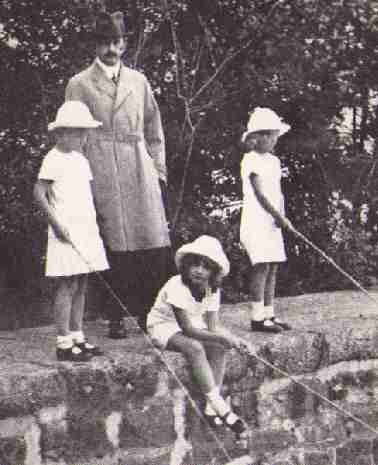
Figure 1.--The three oldest children are shown here fishing with their father. From left to right they are Adelherd, Otto, and Robert. The picture was taken during 1920 in Switzerland where the family fled after the War. The boys appear to be wearing shorts. Otto still has his long hair.

Charles I or Karl I (Charles IV of Hungary) (1887-1922) was another of Francis Joseph's nephews (figure 1). He was only sixth in line to inherit the throne, but the more senior family members invalidated their claims bu marrying commoners or were not suitabl. Charles I had many children, the eldest were two boys (Otto and Robert) and a girl (Adelheid) (figure 3). The eldest was Prince Otto (named after his grandfather) who was born in 1912. Grand Duchness Adelheid was born a year later in 1913, and Robert the second son was born in 1915. Charles and Zita's children came about one a year.

The Children

Karl and Zita had eight children. The oldest and crown prince was Otto. Except for Otto, we know little about the children. The children were born about 1 year apart untill Karl died (1922). This testifies to the close relationship between the Empror and Emperess.

Otto (1912- )

Otto was to be the heir to the Hapburg throne. His full name was Franz Josef Otto. The children were very smartly dressed in many formal and informal photographs. Otto is pictured in a variety of outfits. As a small boy he wore dresses. A family portrait taken when he was about 3 years old shows him wearing a dress. He also wore a dress for the emperor's funeral in 1916 when he was about 4 years old. By about 5 years of age, probably in 1917, Otto began to wear short pants, usually with white ankel socks. Despite beginning to wear knee pants, his mother did not have his curly hair cut until much later. In one photograph he wears a white suit with short pants and a very long blouse with a fancy ruffled collar, white socks and shoes and a straw hat with a ribbon band. I don't believe American or British boy wore such long blouses. Their blouses either tucked into or buttoned on to the pants.

Adelheid (1913- )

Grand Duchness Adelheid was born a year after Otto in 1913. We know very little about her. As the two were very close in age, they were very close to each other as children. There outfits at times seem to have been coordinated. Quite a few photographs We do not yet have details on her adult life.

Robert (1915- )

Robert the second son was born in 1915. Robert's son Lorenz was born after World War II in 1955. His sons Prince Amadeus of Belgium was born in 1986 and Prince Joachim of Belgium in 1991.

Felix (1916--)

Emoress Zita brought the family to America although I am not sure when. We do know that in 1943 Felix, Carl Ludwig, and Rudolf were training as privares in a Free Austria Brigade. Earlier there had been considerable enthusiasm for a Free Greece Brigade. There were, however, few volunteers for the Free Austria Brigade so the Army began assigning soldiers of Austrian ancestry the Brigade. Through a misunderstanding this include non-Austrian descendents of the old Austrian-Hungarian Empire as well as Jews. Many of these people were unhappy about being in A Free Austria Brigade. In the meantime Emperess Zita was promoting the idea that hercsons in a Free Austria Brigade would march into Vienna andcreinstall their brother Otto on the throne. In the end the Army dropped the idea and reassihned the men. Felix, Carl, and Rudolf were allowed to apply for discharge. It was aid at the time that they were going to inlist in the Canadian Army. I do not know if they did this. [Jacobs]

Carl Ludwig (1918- )

We do not have much information on Carl Ludwig. As he and Rudolph were born about the same time, they were very close. They were often dressed similarly and had their hair styled the same. The Austrian monarchy was abolished in 1918 and an attempt to established a Hungarian monmarchy failed. Thus Carl Ludwig and Rudolph necer experienced life as aince in an illustrious ruling family. They lived with their family as royal refugees in Switzerland and other countries. We have one impage of Karl Ludwig with his brother in Spain. Carl Ludwig was like his brothers briefly associated with the U.S. Army Free Austria Brigade in 1943.

Rudolph (1919- )

Rudolf like his brothers briefly associated with the U.S. Army Free Austria Brigade in 1943.

Charlotte (1921)


Elizabeth (1922)


Figure 2.--This photograph taken in 1927 shows Emperess Zita and her children. Otto wears a knicker suit. Notice how differently his brothers are dressed than hewas dressed.

The Children's Clothes

Royal era (1912-18)

Empress Zita as might be expected for the empress of Austria was a very stylish induvidual. Young Prince Otto appears to have been one of the most stylishly dressed boys in Europe. Prince Otto wore frilly white dresses and long hair. Even after breeching he wore frilly short pants outfits and is long flowing locks were not cut.

Early exile (1918-20)

Even after the fall of the monarcy the children were dressed very stylishly. None of the other boys, however, were dressed in the extremely fancy outfits that Otto wore as a young boy before the royal family was forced to abdicate. She appears to have liked dressing the children in similar outfits, with Otto in short pants and his sister wearing a skirt. Otto and Adelheid appear in a 1919-20 photograph dressed in blue sailor suits (figure 6). Otto still has his long curls. A photograph taken in Switzerland shows the children fishing with their father in Switzerland during 1920. They wear similar casual outfits. Adelherd wears a white skirt and the boys white short pants. All three children wear strap shoes and white ankel socks. Otto still has his long hair. The available photogrphs that Otto even at 8 years old in 1920 was wearing his hair quite long (figure 7). In fact Otto appears to be wearing is hair longer than his younger brother and even his sister. I'm not sure just whose idea this was. It seems unlikely that his mother would insist that her older son wear his hair longer than is younge brother and sister, but this aooears to have been the case. Otto seems to have been quite special to his mother. One contributor tells me that Otto wore his hair long until he was about 12 years old.

Exile (1920-30s)

Gradually in the 1920s the Austrian princes began to wear less fancy clothes anf shorter hair. In part is a reflection of how significantly boys clothing changed after World War I (1914-18). A photograph taken in 1927, for example, shows the boys dressing as in wealthy European family might dress. Prince Otto who would have been about 15 years old wears a mature-looking knicker suit.

Sources

Jacobs, Tevie. "When The Grand Dukes Drilled In Indiana," The Indianapolis Star Sunday Magazine, August 15, 1971.


HBRC



Navigate the Boys' Historical Clothing Web Site royal pages:
[Main Emperor Karl I pages]
[Main Emperess Zita pages]
[Main Austria pages]
[Belgium] [France] [Germany] [Italy] [Italy]
[Monaco] [Netherlands] [Norway] [Romania] [Russia] [Spain] [United Kingdom]


Created: February 26, 1999
Last updated: 7:31 AM 1/1/2005