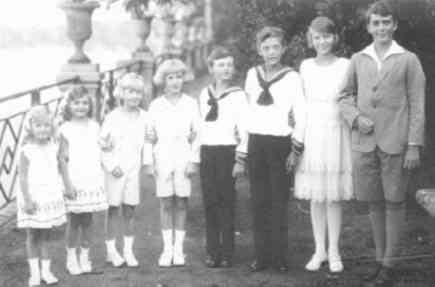
European and American Children's fashions, especially in the 19th and early 20th centuries were strongly influenced by the way royal families dressed their children. Queen Victoria was especially influential as so many of her children and grandchildren maired into royal familes throught Europe. Kaiser Wilhelm II, for example, was the Queen's grandson. While the British House of Windsor was the most influential in this regard, other royal families also had great influence, at least in their own countries.
|
The geneology of European royalty is a huge under taking, given the large number of countries and principalities. Major changes have ocurred over time with countries created, dismantleted, and reappearing. Some royal lines extend more than a millenium, others only a few generations. Royal lines can be looked up on the internet with a convenient search engine.
The following information is available on the royal houses in various countries around the world. Our research has primarily focused on Europe, but we have some information on other areas as well.
African royalty is a poorly understood topic. All but the Egyptian monarchy in the extreme northeast were pre-literate societies. As aresult, we know very little about theroyalty of sub-Saharan Africa. There were quite a number og\g great empires encompasing areas of West and Central Africa as well the Ethiopian and Kushite empires. By the time the Europeans arrived, most of the continnt was divided into small chiefdoms. One of the few exceptions were the Zulus expanding their territory in South Africa, only ended by the Zulu War (1870s). Many of the chiefdoms have disappeared during the colonial era or with independence. There are, howver, still some 165 monarchies in Africa. They include self-governing states, territories, or nations where power resides with an individual chief or king. Most are associated with a tribal grouping. All have similarities, especially with the sovereign inherits his or her office and usually keeps it until death or abdication.
Today the chiefdoms are influential, but not soverign. Only five are actually sovereign ruling national positions. Most are are sub-national monarchies and of these four are constitutional monarchies, wherein the sovereign is bound by laws of the new independent states in the exercise of his or her powers. Only one is an absolute monarchy, wherein the sovereign rules without constitutional bounds. Three of these monarchies are independent states, while the remaining two are dependencies of European monarchies.
Asia like Europe was governed by monarchies. We know less about them because they have not been well covered by Western historians. Of course Asian history has been dominated by China and the Chinese emperors and their dynadsties. In fact when Chinese emperors were strong they impacted Western history as well because they drove the war-like tribes of Central Asia west. The Chinese monarchy proved to be an impediment to modnization in contrast to Japan where it led the modernization of the country. The longest surviving modern monarchy is that of Japan. The Japanese monarchy used Shinto and emperor worship to launch the disaterous Pacific War, but the emperor survived. Indian monarchs have also played important roles, although here due the sub-Continents political fragmentation, the historical accont is more complicated.
The history of Europe until the 20th century was largely the history of monarchy. Of course there were the Greek city state democracies and the Roman Republic as well as various other republics over time. Ad of course there was the French Republic resulting from the Revolution. With these exceptions, however, y Europe until the 20th century was largely governed by moarchies. These monarchies played a role in the gradual development of democracy--usually opposing it. There were a variety of limitations on royal power in Europe which varied from country to country. Many monarchs sought to expanded their power, cilminating in Louis XIV's famous statement, "I am the state." The most asolute royal house was the Romanovs in Tsarist Russia. A small group of other dynasties dominated Europe, the Bourbons, Hapsburgs, and evetually the Hohenzollerns. The English royal family was also important, but here there were several different dynasties. In additin to these major royal dynasties there were a substabtial number of other royal lines that ukled the various European countries. Here the story becomes very complicated because of the large number of principalities in addition to the major countries. German and Italy in particular were divided into many small principalities.
The major pre-Colombian civilizations had royal dynasties and historians have developed some information on them. The best known civilizations were the Aztecs in Mexico and the Inca in Peru. A good deal is known about both Montezuma and Altalapa who were in power at the time of the Conquest of Mexico and Peru. There were also two short-lived monarchies during the 19th century. Most of the Latin American countries after their wars of independences established republics. Europe at the time was dominated by monarchies and it was far from clear that republics were a practical way of governing. Two monarchies were established
in Latin America during the19th century. The Brazil monarchy (Pedro I and II) was a domestic one. Santa Anta in Mexico wanted to set up a kingdom, but was unable to do so. France imposed a monarchy (Maximillian) on Mexico. Maximillian was a Austrian royal, but robavly father by Napoleon II which in part explains why Napolen chose him. His reign proved short lived. After Napoleon withdrew French support, he was executed by a Mexican firing squad.
Middle Eastern royalty is somewhat complicated. Most of the Middle East was absorbed into the Ottoman Empire (16th century). The Ottoman emperor was the Sultan. He exercized both temporal religious authority. Even while local rulers ererted their indeoendence or European powers seied control, the Ottomn Sultan still retained religious authority. Some of the local rulers also styled themselves sultan, influenced by the Ottoman precedent. After world war I, the new Aeab states adopted the title king using the European precent. The new kings, however, did not carry the religious authority of the sultans. The same process occured when Middle eastern countriws began to become independent after World war II. Some Arab countries rejected monarchy, but the rulers of new republix generally ruled like monarchs and some have ven provided for dynastic sucesssion.
Europe since the fall of the 500-year old Roman Republic in the first century B.C. was ruled by various monarchial systems, ranging from tribal chiefs to the absolutism of Louis XIV, France's famed Sun King. The Christian monarchs which emerged in first Western and then Eastern Europe and Russia claimed that they were anointed by God, the divine right monarchy which dominated Europe for a millenium. Some monarch were able to exert absolute control, symbolized the French bourbons which inherited a weak monarchial system and built a system of absolute control. Elsewhere in Europe, limited monarchies developed out of the struggle between monarchs and the nobility. In some countries, such as Poland, a strong monarchy never developed, in the end leading to the disappearance of Poland from the European map in the 18th century. In other countries this lead to the emergence of modern constitutional monarchies, such as in Britain (the United Kingdom). Democratic institutions appeared in many countries, including Imperial Germany. Led by able advisors like the Count von Bismark, the German Kaiser was able to dominate still weak democratic institutions. In other countries, such as Russia and and Austria-Hungary, the monarch still reigned with virtual absolute power at the turn of the century.
The 20th century was not kind to the great royal houses of Europe. The turn of the 20th century saw a Europe still largely dominated by monarchial government. The only important republic was the France. All other European states, with only minor exceptions, were ruled by hereditary monarchs. This vast monarchial system was virtually swept away in a few years by the malestorm of the First Word War. More than half of the monarchs were forced to abdicate. The Romanovs were shot. Most of the monarchs steped down peacefully in the face of poopular outrage over the war. At the time it was seen as a progressive democratic step, but the nationalistic passions unleased play a major role in the horrors of the Second World War. Monarchies in Austria, Italy, Germany, and Russia were replaced or eclipsed by totalitarian regimes of the left and right that were to challenge the very principle of democratic ruke. And as seen still today in the Balkans, where the First World War erupted, the ultr-nationalist excesses that were once constrained by European mnarchies have still not yet fully played out.
The fall of the European monarchies left a large numbers of prentenders to vanished thrones. Details on these individuals are included in each of the national pages above.
European royals had placed an often excessive emphasis on outward forms. This often expressed itself in an almost obsessive concern with clothing, military uniforms, medals, and other decorations. This varied over time, but through World War I when many royal reigns ended, it tended to be the case. It of course varied from monarch to monarch and there were great differences between kindoms. It was not always the more important monarchs that dressed the most formally, although they could of course best afford it. Such diverse personalities as Britain's Edward VII and Germany's Kaisser Wilhelm II were greatly concerned with proper dress. In some cases monarchs even designed their queens' dresses--although usually with little success. In most cases it was the queens who selected the children's clothes, especially when they were younger. Some kings also took an interest here. Britain's George V, for examole thought the only suitable children's attire were sailor suits and kilts.
One interesting question about the royal children picture in these pages is who selected their clothes. One would imagine that the quuen rather than the king had more to do with the boys' clothing. Some queens may have done it mostly themselves. at least one king took an nterest in the children's clothes--Grorge V. In other cases the palace staff may have been involved. The authors have no information on this, but hopefully will eventually find some pertinent sources. The choices could be complicated. More was involved than just what the queen though stylish. There were political considerations. Queen Victoria by having the young princes wear kilts presumably improved the popularity of the monarchu in Scotland. The Dauphin when he wore a long pants skeleton suit was making an important political statrement in 18th century France. Monarchs who wore ruled multi-ethnic populations might adopt ehtnic influenced attire for the princes and princesses. Many monarchs had to be careful not to allow the children to appear in outfits that might be considered foreign.
One does not normally consider the political conotations of boys wear, but in fact the way some boys were dressed had definite political conotations. The ones that most prominently come to mind are the ways that royal youngsters were dressed. Their parents commonly used the children, especially the boys, to help improve the image of the ruling houses. There may be some non-royals as well, but none occur to HBC at this time.
When we now think about kings of kings we generally think about Europe before the 20th century. European history from the fall of Rome to the 20th century is often viewed, rightly or wrongly, trough the study of the rise and fall of royal dynasties. The royals, of course, have not disappeared even in the 21st century. The modern royals, however, have very different life styles from their precessors who kept themselves and their children apart from their subjects.
These pages will focus primarily on the chilhood of the royals in an effort to describe their clothes and life style. Some basic background is also provided to show their accomplishments and impact on the following generation. Greater details are available on many interest sites. There are some excellent search engine for biographical information on the royals. Readers who know of other useful sites are encouraged to let us know so we can add links here.
HBRC has consulted a variety of books on the lives of individual monarchs. These works are noted on the individual pages where the information was used. There are, however, many books with general information about European monarchs as boys.
Van der Kiste, John. Childhood at Court (Sutton Publishing, 1995).
HBC has acquired a number of images of European royalty, but can not identify all of them. If you know who the individuals in these images are or can add any other information, HBC would be most interested in your insights.
We hope you will find our HBRC wesite of interest. Because of the substantial hosting fees, we need to ask your support to maintain our site. The images in particular require considerable bandwith. We have had to limit access to the images to those readers who help support HBRC. We are also very interested in any information that readers may be offer to help expand tghe information about royals we have already began to work on or additional royals we have not yet covered.