|
After the NAZIs seized power in 1933, totalitarian principles were applied to all aspects of education. Private
schools were taken over or closed. Great emphasis was attached on racial "science" in NAZI education and this was
quickly introduced into the curriculum. NAZI ideology and physical-military training became other important aspects of
the school program. Many teachers embraced the new Germany, but others were fired or left teaching. It is difficult to
assess the relative importance of the two groups. It is known that many teachers were fired or replaced with political
hacks during 1933-35, but HBC has no details on the numbers. Some of the best educators fled abroad. The quality of
German education, once the leading system in Europe, declined. Again, however, it is difficult to assess this in
quantitative terms.
The basis German school system continued unchanged by the NAZIs. The NAZIs did make substantial changes in the
Education system, but the basic school system inherited from Imperial Germany and Wiemar was left unchanged. Children
began school t about age 6-7 in a primary school which was called a Volksschule (peoples' school). All children
attended the Volksschule for the first four years. classes were separated by gender, except in small village schools
which were not large enough to have separate classes. Many students whose parents who could not afford to support their children or who were not interested in education attended primary school for 8 years. They then would find a position as an apprentice to learn a trade or work as laborers. Students with more affluent parents or some academic talent could take a test in the fourth year of Volksschule. This varied somewhat by gender. Girls took a test to earn entrance to the middle / secondary school (6-year program). There was also a "school for higher daughters" which required a tuition fee. Boys took tests to earn a place at a secondary school, similar to a British grammar school. These schools were called Gymnasium and it was an 8-year program. With the advent of the War, boys could leave school a year early to join the military and were awarded a Notabitur. After the War, German universities did not recognize these diplomas. [Mostowski]
The school day began in the classroom with a "Heil Hitler" salute. Which was expected at the beginning of each
lesson in secondary school. When the teacher entered the classroom, the students all stood up and saluted. Children
encountering their teacher on the street were expected to give this salute. With the War many male teachers were
drafted, first the younger ones and then the middle-aged ones as the War continued. A shortage of teachers meant that
more women were brought in as well as older men. Class sizes got increasingly large. By 1944 classes of 50 or more
children were not uncommon. The average was in the 40s. Children did not normally wear their HJ and BDM uniforms, but
wearing uniforms was expected on special days like Hitler's birthday (April 20) and the commemoration of the Beer Hall
Putsch (November 9). classrooms were very basic, even stark. Many had benches rather than desks and were often crammed full of children. Every classroom had a portrait of the F�hrer at the front, Many classes had a large map which was used to mark the progress of the War. The children would mark the front lines with pins. This was a first exciting for the children, but became frightening when in 1943 the War turned against Germany. Many children living in cities with war industries had their schooling disrupted by the Allied bombing which by 1943 had become severe. Even if their homes and schools were not hit by the bombing, children who spent the night in cellars or shelters arrived at school only half awake. Schools would allow children to arrive an hour late if there had been night raids, but of course this did not make a lot of difference. As the War went against Germany and food became hard to get, school children were given vitamin lozenges. [Mostowski]
German schools during the Third Reich (NAZI era) did not normally require boys to wear school uniforms. Boys were
allowed to wear the clothes parents selected for them. Despite the considerable interest of Germans in uniforms, there
does not seem to have been a great interest in adopting a school uniform. Boys did on certain days wear their Hitler
Youth uniforms. The NAZI also had some special Party schools where the boys wore their Hitler Youth uniforms. We have
noted images where some boys are wearing their Hitler Youth uniforms to school, but are not entirely sure about how common thus was or the the circumstances involved. We wonder if wearing the uniform told us anything about the boys or
their families.
The German attitudes toward school uniforms did not change during the NAZI era. While it is understandable why there
was no interest in school uniforms during the post-War Wiemar period, it is less understandable why the NAZIs did not
institute uniforms for school children. In the Nazi Germany there were uniforms for almost everybody and anyone without
some kind of swastika emblazoned uniform must have felt left out. So it is curious that uniforms were not instituted
for school children. Of course all the Aryan children had their Hitler Youth uniforms and on occasion wore them to
school. It is likely that the NAZI leadership understood that the German people as a whole did not want another war and
that instituting school uniforms would not have proved popular.But this is just speculation on my part and would be
interested in any actual historical insights visitors to this web site might have.
After the NAZIs seized power in 1933, totalitarian principles were applied to all aspects of education. Private
schools were taken over or closed. Great emphasis was attached on racial "science", often termed "racial hygiene", in
NAZI education and this was quickly introduced into the curriculum. NAZI ideology and physical-military training became
other important aspects of the school program. Many teachers embraced the new Germany, but others were fired or left
teaching. It is difficult to assess the relative importance of the two groups. It is known that many teachers were fired
or replaced with political hacks during 1933-35, but HBC has no details on the numbers. Some of the best educators fled
abroad. The quality of German education, once the leading system in Europe, declined. Again, however, it is difficult to
assess this in quantatative tterms.
The NAZIs did not significantly change the structure of German education during their 12-years of power in Germany.
The educational system remained basically unchanged from that of Imperial Germany and the Wiemar Republic. There were
of course changes. The NAZIs expelled Jewish children from pubic schools (1935). The staff of the schools was changed.
Jewish Teachers were immediately dismissed. Teachers critical of the NAZIs were replaced with NAZI supporters.
Political reliability rather than competency became important. This of course affected educational standards. But these are changes that do not show up in period photographs. The photographs do show the changing fashion trends during the period, both at the primary and secondary level. Only during World War II, especially the later part of the War do we begin to see some major changes because city children were being evacuated as a result of the Allied bombing. There were no school uniforms at most German schools. The boys wore their own clothes. I believe that boys mostly wore short
pants and knee socks. The younger boys may have worn long stockings. Older boys wore shorts, knickers, and long pants. Many parents let the boys wear long pants during the winter. We see some children wearing their HJ uniforms at some
schools.
Within only a few months after the NAZI seizure of power, Franz von Papen and Hermann G�ring went to Rome and met
with Pope Pius XI (April 1933). The NAZIs negotiated a Concordat with the papacy (summer 1933). Papal official Eugenio
Maria Giuseppe Giovanni Pacelli (the future Pope Pius XII was a major factor in the negotiations). Cardinal Faulhaber
congratulated Hitler after the signing of the Reich Concordat. The Catholic Center Party fell in with other parties to
support the regime and was then along with other political parties disbanded. Pacelli and other papal officials hoped
that the Concordat would serve as a shield for the church. This was of course based on the assumption that Hitler would
adhere to agreements he signed. As one historian writes, "the agreement lent Hitler international credibility,
criminalized Catholic political activity, and demoralized bishops and priests who opposed Nazi rule." [Loconte] The
Reich Concordat conceded to Pacelli the right to impose the new Code of Canon Law on German Catholics and promised
several actions to safeguard Catholic education, including possible new schools. Pacelli and the papacy in return
assented to the withdrawal of Catholics from political and social activity. [Cornwell] The NAZIs subsequently launched
the Currency and Immorality trials which reached a highpoint in 1935 and 1936 led to the fining and imprisonment of
hundreds of clergy. The NAZIs desired to de-Chritianize Germany, but did not want to openly attack churches. They began by attacking the reputation of Catholic clerics, especially those working in primary and secondary schools. The NAZIs by the onset of World War II had managed to closed down or take over confessional schools as well as private schools, both day schools and boarding schools. This essentially ended the diversity in education that had existed before the NAZI take over.
HBC notes that most of the available images of Geman school children taken during the NAZI era show the children wearing their ordinary civilian clothes. We notice a few images suggesting that some children wore their Hitler Youth (HJ) to school. One report indicates that this was not common, but we have only limited information at this time. Unlike Scouts or even more so the Communust Young Pioneers, schools did not sponsor the HJ abd the asctivities were not school based. There were, however, some connections. Children desiring to enter secondary schools and universities needed certification that they were in the HJ abd had a good record of service. In addition, an ibncreasing number of pro-NAZI teachers were appointed as the NAZI era continued who would have encouraged the HJ children. They may have even encouraged the children to wear their uniforms to school. And those youth rising to positions of authority were given favorable treatement and were difficult to discipline. School children in NAZI Germany did not wear school uniforms. This is interesting, because just about everone else in the country had a uniform. We are not sure why the NAZIs did not adopt school uniforms, perhaps they did not want to give parents, who remembered World War I, the idea that they were militarizing the schools. The children did have their Hitler Jugend (HJ) uniforms which they sometimes wore to school. One reader tells us that this was uncommon, although he remembers older boys wearing their HJ uniforms to school on occasions when there was some special event. Some boys did wear their black DJ/HJ short pants to school as they were a utilitarian garment with many pockets. [Wellershaus] Of course all the insignias and badges were on the brown shirt. There does not seem to have been a day when periodically children wear their uniforms to school as was the case for Scouts in America.
A German reader tells us that in 1933 the Nazis tried to establish a
uniform Schult�te. I am not sure what official and at what level this
effort was made. We notice one boy in 1933 with a Hakenkreuzschult�ten--a gift cone with a swastika. This would have
been done in September 1933. The NAZIs at that time had been in power only a few months. The idea apparently was not
very popular. Almost all the cones we note have animals and characters on them that apparently were more appealing to 6
-year old children. Notice all the various different designs on the gift cones archived in HBC. The NAZIs seem to have
dropped the idea as even when the Party was in firm control of Germany we do not
notice Hakenkreuzschult�ten. A German reader tells us they remained a rare choice for these gift cones. We rarely see
such photographs. Some care, however, needs to be take in assessing popularity by the modern number of surviving images.
We believe that following the German surrender in World War II (May 1945)
that many German families destroyed photographs and artifacts that had the swastika on them.
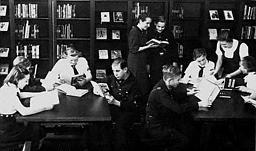
HBC has little information about school life during the NAZI era and what classrooms look like. One HBC reader
tells us, "I am looking for some pictures of German students during World War II or the pre-War Nazi era. I'm looking
for pictures of them doing their equivalent to our pledge of allegiance. A picture of them saluting a flag or something
like that. do you have any or know a good place where I can find one." In fact, HBC
knows of no German school sites. Wile the HBU site has considerable information on Hitler
Youth, we have only limited information and few images of school life.
With the outset of the War, German schools were not at first significantly affected, except that many younger teachetrs were called up for milyary srtvice. And this process only increased as the War continued longer than Hitler anticipated. His short summer campaign in the East turned into a arolonges abd titanic life and death struggle. More male teachers were called up for military service. They were replsced with older teachers brouyht out of retirement and wounded military veterans. The NAZis put a limitation on this. They did not want children seeing terriblt managled veterans.
Then as the Allied strategic bombing campaign began to have some impavt, the NAZIs began evacuating children from the cities, although the program was very differen than the British evacuation program. The German Kinderlandverschickung (Child Land Dispatch -- KLV) functioned during World War II (1939-1945). The children had to go to rural areas on "holiday" but really they should be out of the cities and towns that had difficulties feeding them and were being bombed by the Allies. I believe that both schools and the Hitler Jugend were involved in organizing the KLV. One reader reports that the HJ was especially important in the KLV organization beginning in 1940. About 2.5 million children were sent to 9,000 camps until end of World War II. I believe in many cases their teachers accompanied them. The camps were, however, run by Hitler Youth leaders. They were not very happy places. Strangely, unlike the extensive discussion of the British evacuation of children (1940-41), the German KLA evacuation and camps are little discussed.
As the War continued, schoolanfd school children were more and more affected and not just because male teachers wer concripted. The biggest impact beca,e the allied strategic bombing campaign. Yje British did not at first have the planes needed for strattegic bombing. This changed with the arrival of the Lancaster abd aew connander for Bomber Comman--Air Matshal Arthur Harris (1942). The British could only bombed ar night when the schools were rempty. This changed when the Ameicansjoined he strategic bombing campaign and around-the-clock bombing campign (1943). This meant the npmbs began flling while school was in session. The Luftwaffe was ble to control the skies over the Reich until the Allies infroduced long-rangeescorts (1944). The destruction of the Luftwaffe mean that the allies coulkd destroy German cities at will, including the schools in those citie. .
A reader sent us this blurb about his mother's secondary school. Girls went to Oberlyceums and boys to Gymnasiums. Here she learned fencing, gymnastics and was on the rowing team. The walk to and from school became a terrifying challenge as war reduced much of the city to rubble. By 1943, many schools had to go on split sessions as 'Volkschule' children had to be shifted to several "big kids" schools from 8 to 12, and reduced hours for teens from 12 to 4. ... the school board felt getting kids home in daylight, and teens by dusk in winter time in a city of total darkness provided the greatest chance, and parent's relief of getting home alive. A favorite memory was of a biology field trip to learn about edible mushrooms. The teacher said some are poisonous, some are not. Nibble on a corner, if it makes you sick, it probably IS poisonous, spit it out." Then as the situation becane increaigly worse, schools were closed and unified. Many went on two shift schules. By the end of the war the school system had ceased to exist.
Mostowski, Marianne. "The school system", Bund Deutscher M�del, internet site accessed May 30, 2006.

Related Chronolgy Pages in the Boys' Historical Web Site
[Main Chronology Page]
[The 1910s]
[The 1920s]
[The 1930s]
[The 1940s]
Navigate the German school pages
[Return to the Main German school page]
[Return to the Main school national page]
[Reyurn to the Main school page]
[Imperial Germany]
[Weimar Republic]
[[]
[Post-war Years]
[Modern Germany]
Navigate the Boys' Historical Clothing School Uniform Pages
[Main School Uniform Page]
[Australia]
[England]
[France]
[Germany]
[Italy]
[Japan]
[New Zealand]
[Scotland]
[United States]
Navigate the HBC School Section
[About Us]
[Activities]
[Chronology]
[Clothing styles]
[Countries]
[Debate]
[Economics]
[Garment]
[Gender]
[Hair]
[History]
[Home trends]
[Literary characters]
[School types]
[Significance]
[Transport and travel
[Uniform regulations]
[Year level]
[Other topics]
[Images]
[Links]
[Registration]
[Tools]
[Return to the Historic Boys' School Home]
Navigate the CIH Holocaust Section
[Return to the Main NAZI education page]
[About Us]
[Allies]
[Biographies]
[Children]
[Concentration camps]
[Countries]
[Decision]
[Denyers/Apologists]
[Displaced persons]
[Economics]
[Eisatzgruppen]
[Eugenics]
[German Jews]
[Ghettoes]
[Impact]
[Justice]
[Literature]
[Movies]
[NAZIs]
[Occupied Poland]
[Process]
[Propagada]
[Resistance]
[Restitution]
[Questions]
[SA]
[SS]
[Special situations]
[Targets]
[Wansee Conference]
[Return to the World War II]
[Return to Main Holocaust page]
[Return to the Main mass killing page]
[Return to CIH Home page]