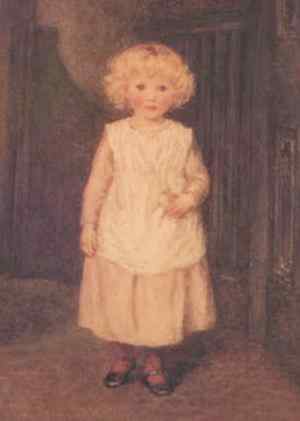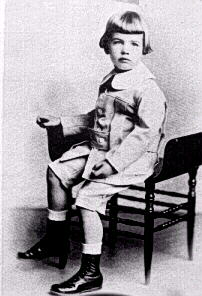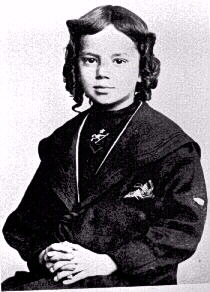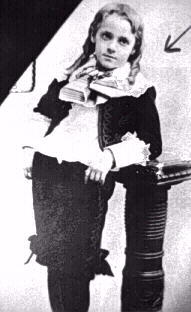
Figure 1.--Note the long sausage curls on this older boy which his mother has lovingly laid on his lace collar so they would be clearly visible. The picture was taken in the early 1890s. |

|
Styling boys hair in curls is a relatively recent phenomenon. It was not tought of any thing special in the 17th and 18th Centuries as their fathers commonly curled their hair or so as to avoid the process wore
wigs with curled hair. As short hair became more common for men in the early 19th Century, many mothers adopted the practice of keeping their boys hair long and only cutting it as he got older, before or after
breeching. I am not sure when they began to curl the boy's hair. Some boys of course had naturaly curly hair. Practices were different in various countries, in part because the prevcalence of curly hair varies
from country to country. French mothers, for example, like to keep their sons' hair long, but were less likely to curl it. The popularity of curling a boy's hair reeached a peak in the 1880s and 1890s with the
Fauntleroy craze. Since the popularity of curls have varied. Short hair had become almost universal by the 1950s, but the Beattles and Mrs. Kennedy in the 1960s with her son John created renwed interest in longer hair for boys. By the 1970s some boys were wearing long shoulder-length hair. There was no revival, however, in the style of curling boys' hair.
There are two basic types of curls. The first is natural curls. Curl hair is a naturally occuying hair type. We now know that the shape of the follicle determines both the curvature of a strand of ghair and the angle in which it grows. When a hair follicle is symmetrical, the strand that grows from it grows round and straight. If the hair follicle is asymmetrical, the hair strabs tends to curl. Research has shown that curly hair is the alsoncaused by an uneven distribution of a type of keratin that tends to accumulates beneath the curve, actually on inside edge of a curled strand. And genetics determines these haracteristics. The gene for curly hair is said to have incomplete dominance over that for straight, so an individual inheriting one straight and one curly gene may have a mix of the two, resulting in wavy hair.
The other type of curl is styled curls. This requires differentbforms od curling techniques. The best known style is ringlet curls, but ringlets were done in different ways. In addition to ringlets that hung down at the sides and and back were dufferent styles of top curls.
Hair comes in all type from straight to natuarlly curly. When the style of keeping younger boys hair long increased in popularity, some mothers found that the boys' hair was natuarally curly. Some mothers were particularly enamored with this look and begun to curl their sons hair to produce the desired effect. Often boys with this style would wear their hair over their ears, but not down to shoulder level as with ringlet curls. This style appears to have been worn throughout the 19th Century and during the early 20th Century. I believe that most of the curls worn by these boys were their natuaral curls, but I know little about this style and I could be wrong about that. Boys wearing natural curls are usually seen wearing a variety of juvenile styles, including dresses, pinafores, smocks, tunics, sailor suits, Buster Brown suits and other outfits. Interestingly this hair style was rare with the classic Fauntleroy suit worn before the turn of the 20th Century, but somewaht more common after in the 1900s.
|
The other major type of curls was styled curves. Doting Victorian and Edwardian mothers kept their treasured sons in dresses and long curls. As the 19th century passed boys were less frequently kept in dresses and their hair was cut earlier. Some mothers, however, kept to the traditional practices well into the 20th century. Even after graduating to kilts or boyish suits such as sailor suits and other outfits such as little Lord Fauntleroy suits, a boy might be kept in long-flowing curls. Some mothers might wait until a boy was 10 or even 11 before allowing him to have his long curls cutting. Romantically inclined mothers, influenced by English-American authoress Francis Hobson Bennett, kept their sons in curls, a fashinoable statement when wearing Little Lord Fauntleroy suits or other fancy clothes such as kilts. Many mothers had delayed cutting their sons hair before the publication of Mrs. Bennett's instantly popular, a least among mothers, Little Lord Fauntleroy in 1886. After publication, however, it not only became more popular to delay cutting a boy's hair, it became fashionabe to curl it. Boys' in long fashionable curls, sometimes boys as old as 10 or 11 could be seen. Many reports exist of boys kept in curls well into their boyhood. Franklin Rooseveltin the 1880s who was raised at home wore dresses, kilts, and Fautleroy suits crowed with carefully maintained curls.
|
Hair types and textures was primarily an issue with girls' hair styling. Boys for the most part just combed their hair or in the case of naturally curly hair just hd it cut when necessary. Girls were much more interested in hair styling and often let their hair grow long. And thus had many styling options. There were some exceptions here. One was some relatively brief periods when long hair becamne popular for boys. One was the Fauntleroy era during the late-19th century. Then textured hair became an issue which boys, or more correctly, their mothers had to deal with. For boys with textured hair, styling had to be based on the unique curl patterns of the boy's hair. There is a wide variety of wavy, curly and coily hair which affect hair styling. This was a special issue when mothers wanted to curl the hair, espcially attempting to do ringlets. Thus mothers choosing Fauntleroy styling had to use their imaginztion. A good example here is Indiana boy Edwin Carter.
These boys had to endure having their hair done up in papers at night to make curls just like their sisters. It was at the time a long drawn out process which presumably must have been
irritating for an active boy with surely many more pressing ideas of how he could spend his time. In fact some accounts from the era note the boys complained more about having their hair done up in curlers each night more than the Fauntleroy suit they had to wear. The amount of work involved suggest an element of social class was involved. Only mothers with small families or with hired help to assist with the children. This probably restricted long hair and especially ringlet curls to weathty families or at least affluent
middle class families. There are also examples of middle class families who had fallen on hard times, but the mother insisted on curls as part of her effort to keep up appearances. American author Thomas Wolfe describes just such a boyhood experience.
Some authors have wondered about
the impact of wearing curls on the boy's psyche. Some have wondered which was more objectionable the curls or the elaborate outfits like Little Lord Fauntleroy suits or kilts. It was not just boys in kilts and Fauntleroy suits that were kept in long hair and curls. Some mothers refused to cut their son's curls long
after they had passed into sailor suits and other boyish styles.
Some addoring mothers not only kept their sons' hair long, but added
the additional indignity of hair bows. Hair bows had become very fashionable
for girls by the late 19th century. Some girls, even older girls,
sported massive, often white, hair bows. Bows for boys hair were less
common. As far as I can tell, it was not common in Britain or America.
The fashion of hair bows for boys appears,
however, to have been more common for French boys still
in dresses and long hair.
It was always a major rite of passage for a boy to finally have his curls cut and allowed to wear more closely cropped hair. While long hair for boys in the 1960s became very fashionable, it was certainly never curled. In previous years, however, long hair, even uncurrled long hair, was generally perceived as girlish. As a result many a boy looked forward with great relish to have his locks trimmed. For many a doting mother, however, it was often a trying experience bringing forth gushing tears and the site of her darling sons flowing curls falling to the floor. Many mothers would save the clipped curls as keepsakes. Franklin Roosevelt's mother, for example, kept her son's curls in a trunk with his baby dresses and other keepsakes as long as she lived.
|
Curls for boys continued into the 20th Century, but became increasingly uncommon. While unusual,
many boys well into the 1900s were kept in curls. Dressed for boys passed from fashion by the 1920s. Little boys instead wore rompers,
smocks, or short pants. A.A. Milne the author
of the Winnie the Poo books) says in his autobiography says that he
was 9 or 10 years old (in 1910) before he was permitted to have his long sausage curls cut. The American author, Thomas Wolfe, describe his long sausage
curls which he had to wear until he was 9/10 years old. The Wolfe family was not even an affluent one and Thomas even sold papers as a boy. His curls did not endear him to his fellow paper boys. As it became increasingly rare for boys to be educated at home, mothers found it more and more difficult to dress boys in fanciful styles.
Hair lengths for boys grew longer in the 1960s and could be shoulder length in the 1970s. Shorter hair has returned in the 1990s, but there is much more dIversity than ever with no one hair style dominating.
Long hair for boys became fashionable again in the late 1960s. The hair style Jacki chose for
John John helped to popularize bangs, although she was critcised in many quarters for her son's hair cut and she eventually had it trimmed. Eventually of course the Beatles helped to popularize longer hair among boys themselves.
Bangs have not gone completely out of style in the 1990s. Small boys often wear bangs. In addition the bowl cut which appeared in the early
1990s, often involved bangs. The cut had long hair on top and cut at more or less a circular bowl lenhth at the sides with the hair around the ears
and neck cut very short.
Young boys before their first hair cuts often have natural curls. A reader writes, "I was always fascinated by a photograph of my brother taken about 1963 showing him at the age of 4 or 5 in shoulder length naturally curly hair wearing boys shorts. Apparently, my mother could not stand to cut his hair because it was quite beautiful." It is no longer common, however, to style curls for boys. After long hair began to become popular for boys in the lste 960s, many of the old hsair comvrntions were weakened if not disappeated. In the 2000s sgort hir is becoming increasingly standard for boys. We still, however, note young boys with curls.
Assessing hair trends is difficult until the invention of photography. Once photogrphy was invented we begin to have sufficient images to make a substantial country assessment. We so not yet have many country curl pages. A factor here is that most boys in other countries had their curls cut at a fairly young age. This was especially true by the time they began school. In fact on the Continent it was very common to closely crop a boy's hair. But this varied from country to counry and over time. There are chronological factors at play here. We have very limited information on the early-19th century. Until the apperance of the CDV in numbers, we have very little information on Europe. We especially note boys with long hair and curls in England and France, not as commonly as in America, but we still have found a number of images. It was in America that the fashion of long curled hair for boys beyond the todler stage became most pronounced. We have found a substantial number of American boys with long hair, often styled in ringlet curls during the late 19th and early 20th century. This was a small part of the photographic record, but still notable and much more common than other countries, especially after Mrs. Burnett published Little Lord Fauntleroy (1885).

Navigate the Boys' Historical Clothing Hair pages:
[Return to the Main hair page]
[Ringlet curls]
[Bangs]
[Hair bows]
[Long hair]
[Curls general]
Navigate the Boys' Historical Clothing Web Site:
[Introduction]
[Activities]
[Biographies]
[Chronology]
[Cloth and textiles]
[Clothing styles]
[Countries]
[Topics]
[Bibliographies]
[Contributions]
[FAQs]
[Glossaries]
[Images]
[Links]
[Registration]
[Tools]
[Boys' Clothing Home]