|
The headwear for a sailor suit, mostly hats or caps, was once a very necessary part of a sailor suit. Several different styles of hats were worn, determined by the style of suit chosen and the whims of the mother. In fact mostly every type of headwear has been worn with sailor suits. Some were sailior styled, but often they were just popular headwar styles at the time. Some of the most common in the 19th Century were broad brimmed sailor hats caps worn with nationl naval uniforms. English boys also wore the flat topped cap cloth cap worn by more modern British sailors, also with a ribbon dangling at the back. French and German boys wore the caps worn by the sailors in their navy. The French cap was clearly destinguishable from the others at it had a red pom pom on the top. Some sailor suits have matching headwear, meaning headwear done in the same color and material as the suit. This would normally be caps. This was not vet common, but e do see examples. Sailor hats rarely matched the suit, in part becaise they were often done in straw. The caps on the other hand did sometimes match as theu were done in fabric like the suits. eOften the caps like the caps were purchased separately and this might be said to be coordinated with the suit, but not matching. Of course boys did not always wear headwear with sailor suits, but many did, especially in the 19th century.
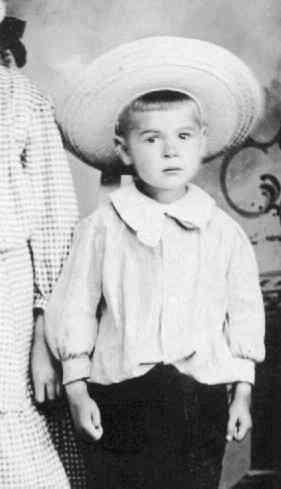
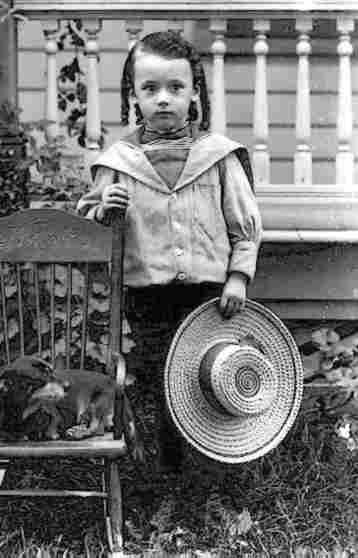
The original sailor hats were based on the hat worn by English sailors in the early 19th Century. The hats had broad brims and rounded crowns. This style for boys' sailor hats continued into the 20th Century, long after it had disappeared as part of the English sailor's uniform. Many other versions of the sailor hat appeared for boys with smaller brims and even flat crowns. These were fashion creations and never worn by actual sailors. Boys in the late 19th Century also began wearing sailor caps which were based on actual uniform caps.
The sailor hat was an integral part of the sailor suit. Hats were
much more commonly worn in the 19th Century. Thus any suit purchased
for aboy would be worn with requisite headgear to complement it.
Eventually sailor hats, less commonly the caps, would be worn with other styles of suits. Only sailor hats or caps would be worn with sailor suits. The wide brimmed sailor hat with long treemers and elastic chin strap became by the 1880s the primary dress hat worn by childre, both boys and girls. Sailor suits were worn with both hats or caps
The first boys' sailor suits were worn with the broad brimmed sailor hats British seamen were wearing. The sailor suits popularized by Queen Victoria's sons in the 1840s were worn with straw sailor hats. A hat differs from a cap in that it has full brim all around the crown. Gradually the hats for boys and girls began to appear with much wider brims that actual seaman ever wore. Sailor hats were an important part of a boys' sailor suit outfit. The sailor suit outfit selected by Victoria and Albert for their sons included the straw broad-brimmed sailor hat actually worn by British sailors at the time. .At the time the broad brim was fairly modest. While caps were subsequently adopted by Royal Navy and other navies of the world, it was the sailor hat that was the principal headgear for dressy boys' outfits. The broad-brimmed sailor hat was a formmal style, not only worn with sailor suits, but also with dressy outfits such as Little Lord Fauuntleroy Suits. Sailor caps becamr popular beginning in the 1870s, but for dressy occasions boys most commonly wore the broad-brimmed sailor hat. Gradually sailor caps began to appear, reflecting styles worn bu sailors. Latter various styles of caps, headgear without full brims, were also worn with sailor suits. Caps were less formal headgear to be worn with sailor suits. They differed from sailor hats in that they did not have a full brim. Caps also came in many more different styles than hats. This is partly because after the mid-19th century, most of the world's navies introduced caps of different styles rather than hats.
Girls by the 1870s were also wearing sailor suits, but not sailor caps. The original wide-brimmed hat eventually became associated with a style for girls and small boys--especially for formal occasions. The girls' style was usually the sailor hat. Girls never commonly wore the various styles of sailor caps that boys began wearing in the 1870s. Eventually wide-brimmed sailor hats were worn mostly by girls and younger boys. Older boys would wear sailor caps.
|
The sailor suit for boys burst out on the fashion scene at about the same time that commercoial photogrphy appeared. We thus have a very photographic extenive record to study styles and trends. We have archived large numbers of images, especially for the major countries. We do not see many sailor caps and hts in the early photigraphic formts, but we do beginning with the CDV (860s). Over the century or so that sailor suits and headwear were popular, we notice a range of developments in countris around the world. We have country pages on major countries like America, Canada, England, France, Germany, Italy, and Russia. We also have information on many other countries. In all these countries, sailor headwear was worn with both salolor suits and regular outfits. While the sailor suit began in England, this was not where sailor styles were the most popular. For reasons we do not fully inderstad, ghis was France and Germany. There were similarites among many countries, primarily because the British Royal Navy set the standard for navies around the world and most navies wore uniforms with headwear very similsr to the Royal Navy. There were also a range of differences. Most navies had some destibctive uniform elements and boys' sailor suits did not always replicate actual naval
uniforms. There were sailor suits that dis, but mny which differed widely. This caried from country to country.
Many mothers so liked the sailor suit style that they would outfit
their sons in sailor outfits before breeching. Many styes of sailor
dresses or middy blouses to be worn with kilts/skirts were available.
Boys in dresses or breeched boys still in curls would usually wear
broad-brimmed sailor hats instead of the various styles of sailor
caps.
We note a variety of decorative items used with sailor headwer. The three most important are: chinstraps, streamers, and tallies. They are used with other headwear, but seem vthe most popular with sailor headwear. In part because they were derived from the headwear actually worn by sailors. We note chinstraps with both sailor caps and sailor hats.

Navigate the Boys' Historical Clothing Web Site:
[Return to the Main boys' headwear page]
[Return to the Main sailor suit component page]
[Return to the Main sailor suit page]
[Introduction]
[Activities]
[Biographies]
[Chronology]
[Cloth and textiles]
[Garments]
[Countries]
[Topics]
[Bibliographies]
[Contributions]
[FAQs]
[Glossaries]
[Images]
[Links]
[Registration]
[Tools]
[Boys' Clothing Home]