|
We are not sure when double breasted styling first appeared or who designed them. Almost certainly they were inspired by military uniforms. The most influential uniforms were those of Hussars. The origind of the Hussars was Hungary. Hussars were used in the calvary of the Polish king who releaved Vienna from a Turkish seige in the 17th Century. Their uniforms insluded feathered wings and leopard skins. The name Hussars may have come from the sound these wings made when the horses were at full gallop. Double-breasted garments were wirn in many countries. We do not yet, howeever, have much information on the foreign language terms for double-breasted styling. We believe that the French term is 'veston crois�'. Parallel rows of buttons appeared on many other types of clothing. Double breasted styling has been used since the early 19th Century on a wide variety of garments. Generally it was two rows of parallel buttons,
but some clothes had three rows. While roughly parallel, the rows often widened near the top of the garment around the collar. Double-breasted as regards children's clothing is best known for styling on boys' jackets. The double-breasted style was not limited to boys' jackets. Parallel rowsof buttons appeared on many other types of clothing. Even dresses for little boys and girls appeared in the double breasted style. In comparison tothe skeleton suits and mid-19th Century suits with large numbers of buttons,some of the double breasted dresses had only four buttons. Parallel rows of buttons, however, appeared on many other types of clothing. Even dresses for little boys and girls appeared in the double breasted style.
We are not sure when double breasted styling first appeared or who designed them. Almost certainly they were inspired by military uniforms. The most influential uniforms were those of Hussars. The origind of the Hussars was Hungary. Hussars were used in the calvary of the Polish king who releaved Vienna from a Turkish seige in the 17th Century. Their uniforms insluded feathered wings and leopard skins. The name Hussars may have come from the sound these wings made when the horses were at full gallop. We are not sure if the double breasted style was part of their uniform at the time. Their illustrious record, however, was honored by other European armies who in the 18th Century created Hussar units in their calvary and by the turn of the 19th Century their uniforms did sport elaborate double breasted jackets. The double breasted styling used in children's clothes was clearly a reflection of the military uniforms worn in the early 19th Century during the Napoleonic Wars. Elaborate uniforms for units liked the Hussars had elaborate double breasted styling. The double breasted uniform jackets were particularly popular duting the Napoleonic Wars of the late 18th and early 19th Centuries. They were also enormously expensive. An Hussar officer's uniform night cost a year's salary and he might go through four a year. This explains why officers in many countries, like England, were gentlemen who had wealth in their own right. They were worn by Austrian, English, French, Prussian, and other soldiers. Double breasted styles were used in military uniforms well into the 20th Century. Thus boys being boys and impressed by uniforms, it is understandable that elements of these uniforms would appear in boys' clothing. We do not yet have any historical information. I am collecting available images which hopefully will provide some insights on the development of this important style.
Double-breasted garments were wirn in many countries. We do not yet, howeever, have much information on the foreign language terms for double-breasted styling. We believe that the French term is 'veston crois�'. A 'veston crois�' (crossed jacket) is a jacket where the sides of the jacket with the buttoning cross over each other by about 20 centimeters. HBC believes that this means "double breasted". By the same token, 'veston droit droit' (straight jacket) would button one end just over the other. HBC believes that this means 'single breasted'. We would appreciate our world-wide raeders providing the term for double-breasted in their language.
Parallel rows of buttons appeared on many other types of clothing. Double breasted styling has been used since the early 19th Century on a wide variety of garments. Generally it was two rows of parallel buttons, but some clothes had three rows. While roughly parallel, the rows often widened near the top of the garment around the collar.
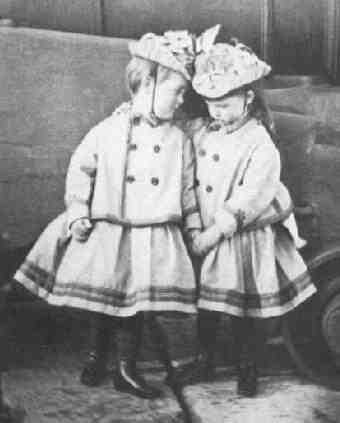
Double-breasted as regards children's clothing is best known for styling on boys' jackets. The double-breasted style was not limited to boys' jackets. Parallel rowsof buttons appeared on many other types of clothing. Even dresses for little boys and girls appeared in the double breasted style. In comparison tothe skeleton suits and mid-19th Century suits with large numbers of buttons,some of the double breasted dresses had only four buttons. Parallel rows of buttons, however, appeared on many other types of clothing. Even dresses for little boys and girls appeared in the double breasted style.
|
[Note: Sorry this page has been lost in the move from Fortune City, we are now looking for it.] Dresses for both boys and girls have been made with double-breasted styling. I'm not sure when this styling was first used in dresses, but I have seen such dressing as early as the 1860s. The double breasted
dresses, however, have none of the military embelshment commonly used for boys' jackets through the 1850s. In comparison to the skeleton suits and mid-19th Century suits with large numbers of buttons, some of the double breasted dresses had as little as four parallel buttons.
[Note: Sorry this page has been lost in the move from Fortune City, we are now looking for it.] Some kilt outfits came with double-breasted jackets. However, this style was not common. I havce seen double-breasted kilts as early as the 1870s, but they may have appeared early.
Some rarly and mid-19th Century tunics had varing elements of double breasted styling. This was not true of the tunic suits that were worn at the turn of the 20th Century.
The first usage I have seen of double-breasted styling for boys' clothing was in skeleton suits. One of the classic characteristics of a skeleton suit was parallel rows of buttons stretching from above the waist all the way to the shoulders. Not all skeleton suits were made in this double-breasted style, but many were. The inspiration is clearly the double-breasted style of early 19th Century military uniforms. hese early suits have the look of military style jackets witha rows of large numbers of buttons--often brass buttons. Some of the suits had 30 or more buttons on them. Some were purely ornamental, but some of the suits had to be buttoned.
We note that bouble-breasted styling is sometimes used in Oliver Twist suiuts. This of course means the use of buttons, niot the lapels. Thebuttons was a major eklemnts in Oliver Twist outfits. A good examle is a Kiddy Togs double-breasted short pants suit. This was astyle popuklar un the 1910s and 20s.
[Note: Sorry this page has been lost in the move from Fortune City, we are now looking for it.] One of the most important style for boys ever conceived was the
sailor suit. Few styles have been more widely worn. Most sailor suits were worn with middy blouses that was pulled over the head. Some of the blouses buttoned up and dounle-breasted styling was used on many of these blouses.
One of the most enduring double breasted sailor garments was the reefer jacket. The double-breasted reefer style was widely used for boys coats and jackets in the late 19th Century. They were called reefer jackets
because they were worn by sailors taking in the sails, which is referred to as reefing. Short coats were needed that would not be cumpersome while the sailors were working in the rigging.
Sailor suits
Reefer jackets
|
Boys suits in the
1850s. These early suits have the look of military style jackets with
a rows of large numbers of buttons--often brass buttons. Some of the suits had 30 or more buttons on them. Some were purely ornamental, but some of the suits had to be buttoned. After the 1850s, the double breasted jackets lost their military look. I have noted double breasted
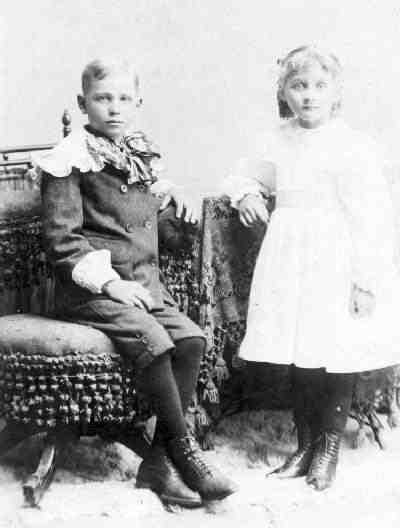
suits with a modern look as early as the 1880s, although they might have appeard earlier. At this time, the earliest image I have of a double breasted boys' suitdates to the 1890s. It is an Americium image is a boys' knee pants suit.I believe the double breasted style was used primarily for older boys'styles. I do not recall any double breasted Fauntleroy suits. Mothers beingmothers, however, some double breasted jackets were embellished with ruffledcollars, bows, and wrist ruffles. Boys' suits have been most commonly been single breasted, but the double breasted has never disappeared. Its popularity,
however, has fluctuated widely from decade to decade.
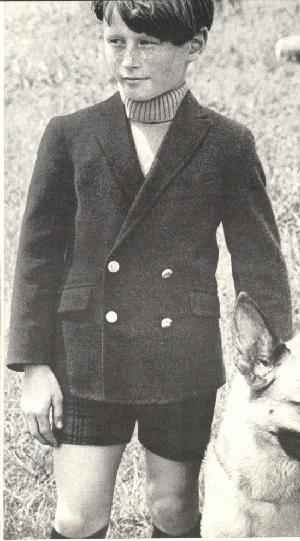
Since blazers were introduced in the late 1880s at British schools, boys have generally wore single breasted jackets. When modern suit styles developed
after the First World war, single breasted blazers were generally chosen for boys. American boys generally wore their suits with knickers while British boys wore shorts. Double breasted jackets, however, were relatively rare, even during the 1930s and 40s when
double breasted suits were popular for adults.