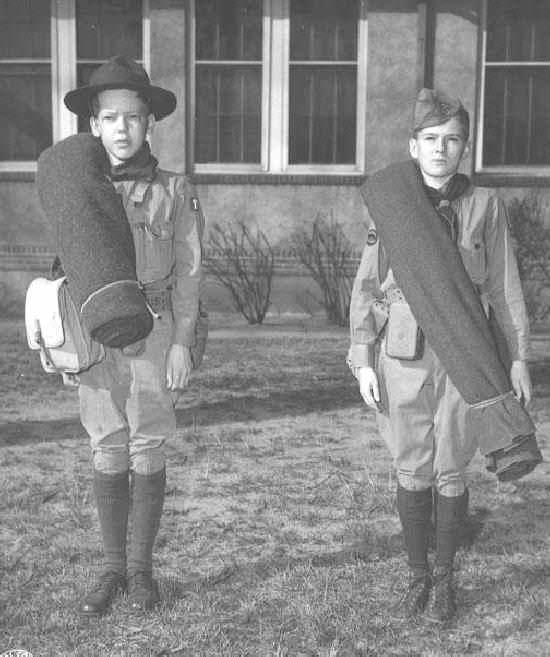
Figure 1.--These boys are preaparing for a camping trip about 1942. At the time the American Scout unoform was being changed. A new cap had been adopted and knickers were about to be phased out. Note that sleeping bags were not yet in wide use. |

|
Scouting in the principal American youth group in America. The American SCouting movement was stongly influenced by Baden Powell's Enbglish Scouts, but there were several Scout-like groups which formed in Americam before the Enlish Scouting movement was formed. After Scouting became the dominate movement in the 1900s. One of the most important was Camp Fire. Religious groups, objecting to the secular, non denominational constraints of Scoting formed the royal rangers. Right and left wing groups also formed uouth groups of some importance, primarily in the 1930s.
Awana is an international, Bible-centered youth ministry providing local churches with weekly clubs and programs for pre-schoolers through high schoolers. Awana is non-denominational, but mostly Protestant. Their goal is to reach boys and girls, and their families, with the gospel of Christ and train them to serve Him. The acronym Awana comes from the first letters of the phrase "approved workmen are not ashamed" (2 Timothy 2:15).
Awana has a leader and clubber uniform. Clubber uniform options include a standard gray uniform shirt, green T-shirt, or green polo shirt. The grey shirt can be worn with a red or other colored tie or neckerchief. Leader uniform options: sandard gray uniform shirt or green polo shirt with the Truth and Training Club (T&T) embroidered logo and "Awana" woven into the cuffs.
The Scouting movement was founded by Lord Baden-Powell in England. Americans and boys' organizations played a major role in the movement. The Scouting movement was simply accepted in many countries. American played a major role in the program that was finally conceived by Baden-Powell. When American Scouting was founded, existing organizations were incoroprated into it. Despite this role in the Scouting movement, American Scouts dd not follow the unifiorm conceived by Baden-Powell and adopted by virtually every other country. American Scouts insisted on wearing knickers rather than short pants. American Scouting can trace its history to both domestic and English influences. Some important steps leading to the founding of the American Boy Scouys were layed before the turn of the century. An important book in the development of scouting was published in 1882, the American Boys Handybook written by Daniel Carter Beard. Some early Scout groups were founded in America even before, the famed unknown English Scout introduced Willam D. Boyce to Scouting. Woodcraft Indians were founded by Ernest Thompson Seton in 1902. Sons of Daniel Boone started by Daniel Carter Beard in 1905. Boy's Clubs were founded in 1906. The first American Boy Scout camp was held at Silver Bay, Lake George, N.Y. in 1910. The Boy Scouts of America (BSA) were incorporated in 1910. The first local councils chartered in 1913. The BSA issued 57 merit badge books in 1915, the first such detailed instructions issued for this important phase of Scouting. The U.S. Congress granted a Federal Charter in 1916 and in that same year the BSA constitution and by-laws were adopted. American Cubbing was introduced in 1930 so that younger boys could participate. Scouting grew to be the major youth group in America with a substantial proportion of American boys particiapting in Cubs or Scouts. Modern boys have many more options and demands on their time, but Scouting continues to be a major activity for many American boys.
The Boys' Brigade was organized in America during 1887. Sir William Smith helped bring the Boys Brigade to America. Units were founded in several different cities. Given the strength of Christianity in America, one might have thought that the BB would have become a very important organization. President Theodore Roosevelt comnmended Smith for his service to boys. We are not sure why the BB was so sucessful in Britain and had such limited success in America. We note a few BB groups in America, but going on the photographic record, there were not very many. The Brigade never experienced great success in America. The exclusive church-based approach was one factor limiting its growth--even among the many religious families. The more diverse American Christian community was surely a facgtor. The Brigade was a Protestant movement and did not appeal to Cathlolics. And there were even problems with various Protestant denominations. The association with Britain probably was not an advantage in America. And eventually the groups that were formed were rapidly engulfed by the more secular Boy Scout movement. Today few American boys have even heard of the Boys' Brigade.
The Boys Club is a largely American group, although there are clubs in some other countries. The Boys' Club is the oldest American youth organization and possibly the oldest in the world.
The Boys and Girls Club Movement began in the United States just before the outbreak of the the Civil War.
The first Boys Club was founded in Harford, Connecticut during 1860--the Dashaway Club. Interestingly, it was the women of Harford whjo were responsoble. They were concerned about the boys who were roaming the streets without any constructive activities. Apparently the girls were not roaming and already had constructive activities to occuopy them--probably helping mom with the cooking and cleaning. The women thoughtb that the boys should have a positive alternative. They organized the first Boys' Club. Soon Clubs were opening in large cities throughout the United States. The idea spread to other areas of the country and more Clubs were formed. The first Club to use �Boys Club� in its official title was the Boys Club of New York in 1876. At this time, the Clubs served only boys. By the turn of the 20th century, there were about 50 such clubs. Representatices of 53 clubs formed a national organization (1906). Girls Clubs were also formedm but as a separate organization. They evolved into Girls, Inc. which organizes actibities for girls a serves as an advocacy group for girls. In response to a need for a girls program, the Boys Clubs began to also serve girls. The national organization officially changed its name to Boys and Girls Clubs of America (1900). There are over 4,000 Clubs in the United States serving over 4 million members. There are similar organizations in Germany, Australia, Canada, and many other countries around the world, but thev program is much smaller outside the United States.
Camp Fire, Inc., formerly known as the Camp Fire Girls, is the outgrowth of a unique summer camping program developed by Dr. and Mrs. Luther Halsey Gulick. In large, full bloomers, white middies and blue ties, a group of girls spent two summers at Lake Sebago, Maine, in a program of fire building, cooking, sewing, bedmaking, singing, Indian lore, and folk dancing. The success of the program and the need for an ongoing year-round activity for girls attracted a group of unusual men and women who were destined to begin the first national, non-sectarian organization for girls in the United States. The name, Camp Fire Girls, was chosen from among hundreds suggested. The word "Camp" symbolizes the outdoor spirit of the organization. "Fire" symbolizes the home, the place of comfort and cheer, and keeping the fire burning, whether in camp or in a home, was a necessary task. As early as 1913, small groups of girls in Oklahoma City were meeting together as Camp Fire Girls. Each group formulated its own program, based upon scanty information they received explaining the general purpose of Camp Fire Girls and the philosophy upon which it was built.
The 4-H is not a uniformed youth group. It is, however a youth group of considerable importance. 4-H was a major youth movement in rural America. Although rural America has significantly declined in importance, there still are about 6 million young people involved in 4-H youth programs. Educators accross America began to organize programs for rural youth well before an actual national 4-H program was established. Progressive thinkers in America saw the need to better educate farmers and introduce increasingly sophisticated scientific findings into farm practices. This process began with the Morrill Act during the Civil War (1862). This established Federal Government support for Land Grant Unversities. Later in the 19th century educators saw the importance to promote nature study for students before the university level. This was considered to be an increasingly important part of a agricultural education. Education and community leaders began founding boys and girls clubs and leagues, commonly in schools and churches. Farmers Institutes began working with with school dictricts by sponsoring various contests, soil tests, and plant identification contests to build interest among young people. Young people were encouraged to take on projects, rather like science fair projects. These clubs and leagues after the turn of the 20th century began exhibited their projects. This "hands on" approach for 4-H was notble the the early origins of the movement. The "learning by doing" was persued from the onset. State organizations for these clubds began to appear. Parents commonly acted as volunteer leaders. County Extension agents provided materials and technicak advise. Parents began to see real practical benefits from these clubs and support began to grow. The use of the term "4-H Club" did not begin until several state organizations had appeared. The term "4-H" first appeared in a Federal Government bulletin written by Gertrude L. Warren in 1918. Clubs all over America took to the name and by 1925 it was in common use. The original objective of the 4-H program was to form boys and girls clubs across the United States in order to promote agricultural education. Over time 4-H has changed. It is no longer exclusively devoted to agriculture, but this remains an important focus. The overall objective has remained constant: "the development of youth as individuals and as responsible and productive citizens".
As in Britain, as soon as the Boy Scouts of America were founded (1909) girls were also found to be interested in joining a scouting-type youth group. In Britain the girls group was called guides to reasure parents that were skeptical about a rough scouting type organization for their daughters. Americans were haopy to retain the scouting name for a girl's youth organization. Juliette Low would be the the main force behind organizing girls' scouting in America. Juliette was an adventuresome girl, but lost most of her hearing in chilhood. She married the wealthy William Mackay Low (1886). Theu lived in both America (Georgia) and Britain. hile in Britain she watched the grouth of both boy scouting and girl guiding. Shemet with Robert Baden-Powell, the founder of Scouting (1911). She proceeded to found the Girl Scouts of merica (1912). Unlike the Voy Scouts, gierl scouts groups had not begun to organjize before the nationsl organization was founded. One element from the bginning that the BSA was slow to adopt was to make room for children with disabilities in the organization. She saw the GSUSA as a way to empower girls at a time that women did not yet the right to vote in many states. Girl Scouts offered a program to prepares girls to empower themselves and promotes compassion, courage, confidence, character, leadership, entrepreneurship, and active citizenship through activities involving camping, community service, and learning first aid. Like the BSA, an important part of the program was earning merit badges by learing practical skills. Girl Scouts' achievements are recognized with various special awards, including the Girl Scout Gold, Silver, and Bronze Awards. Girl Scouts are age groups with activities designed for each level. GSUSA is a member of the World Association of Girl Guides and Girl Scouts (WAGGGS) and accepts girls of all backgrounds. The BSA in the late-20 century showed itself interested uin merging with the Girl Scouts. The GSUSA has, however, adanently insisted onm mntaining separate identity. The BSA in recent years has increasigly become a church sponsored organization. GSUSA has not shifted to the same extent as the BSA.
A HBU reader writes, "As a boy age 11 in 1950 i was involved with a group called the Junior Nautical Birgade. We were meeting at a high school in Ozone Park, New Yor. We always me on Fiday night. This is not a group HBU is familiar with. We would be interested in any information HBU readers may have.
American boys fought in the Civil War (1860s). This was the last time that American children played a major combat role. The Red Cross points to six children who put on a play that raised $50 which they donated to the then 3-year-old American Red Cross othanization (1884). Clara Barton who had founded the Red Cross used the money to aid a family affected by severe Midwestern floods. American children first became involved in war-time humanitarian efforts during The Spanish American War (1898). Children helped provide medical support and comfort to American soldiers and their families during and after the War. This was done in various privateand church efforts. This changed wih World War I.
The Red Cross organized an official youth auxilery--The American Junior Red Cross (JRC). The JRC was one of several youth groups to assist with the er effort. The children knitted scarves, rolled bandages and built furniture for hospitals and convalescent homes. They prepared and sent Friendship Boxes containing school and personal items to school children overseas adversely affected bythe War. They grew vegetables in Victory Gardens that vadded to the country's food supply -- making it possible for American to send mopre food abroad for relief efforts. The JRC also helped raised funds. The JRC raised some $3.7 millioan for the Red Cross during the War--a considerablec in the 1910s. After the Armistice, the JRC continued their work. Withe Douhnoys coming home, the focus was on the children affected by the War, especially the European children, but American children as well. The National Children's Fund was establishhed to aid war victims and refugees throughout Europe. And then the JRC helped fight against the influenza pandemic which devestated both Europe and America. Funds were raised to aid the victims of fires, floods, and tornados. There was an effiort to aid Native American schools in the American Southwest. The Great Depression had a huge imoact on America. JRC members distributed Government surplus wheat and cotton. They also helped organize clothing and food driubes, collcting canned fruits and vegetables. The JRC reachged its peak, crowing to 20 milliomn members 20 million during World War II. Effoots included the production of clothing, toys, furniture and art works to entertainment and recreational programs at military camps and hospitals. After the War, the JRC ontinued traditional programs, such as assistance to war veterans and their families, disaster relief, and public health. It also intriduced new programs such as an International Student Work-Study Program, started a High School Chest Program which sent school supplies to students who had lost them in natural disasters and set up Leadership Development Centers for junior and senior high school and college students.
A variety of nationlist groups have been formed in America. Some early Scout-like organizations formed at the turn of the 20th century. While these grops had a very nationalistic focus, they were ecentually joined with the Boy Scouts of America. There were limitations with American nationlist groups because of the great diversity of the United States. Nationalist groups thrived where there was a common ethnic idenity. This of course did not exist in America. Thus what was occurred was the organization of ethnic groups. The strongest such group was German Americans, a small group of whom was inspired by Hitler's NAZI New Order. Various groups were formed which by 1936 had become the German-American Bund. The Bund organized a youth section and ran summer camps during the 1930s and early 40s. Hitler wanted a strong NAZI orienterd German group to organize in America, but he wanted it to be done quietly. He did not want to stir America from isolationism. The Bund led by Fritz Kuhn did all it could to make headlines, even holding a mass rally in New York' Madison Square Garden. The Bund's activities frightened many Americans and inspired a series of Congressional investigations. The Bund was disbanded when Hitler declared war on America after the Japanese attack on Pearl Harbor. Contemporary right-wing groups such as the Klu-Klux-Klan, Aryan Nation, and others often involve children, but not as a separate, uniformed youth group.
Many religious groups sponsor Scout troops. There is a minimal religious component to American Scouting and in a few cekebrated cases, boys who were athiests have been excluded. Some religious groups want more control over the Scouting program and who belongs. They have formed their own Scout units, but the Boy Scout Association has a legal lock on the
word "Scouting" in the United States. Only the Girl Scouts have been given permission to use the word. It is trademarked, which is why one religious group which has its own program calls them "Royal Rangers"--they can't use the word "Scout".
American Daniel Carter Beard founded the Sons of Daniel Boone in 1905. The name for this organization was obvious. More than any other man, Daniel Boone was responsible for the exploration and settlement of Kentucky--the western frontier of 18th century America. The Sons of Daniel Boone was in the 1900s, the larfest boys organization in America. Beard was an advocate of Scouting and eventually his organization joined the Scouting movement.
The American author and illustrator, Ernest Thompson Seton, created the Woodcraft Indians in 1902. It was designed for boys aged 12 to 15 years and was based on North American Indian lore and outdoor life. In 1906 he added the Little Lodge of Woodcraft Indians for younger boys and girls, which in many ways was the fore runner of Cubbing, even though it took the Boy Scots many years to establish Cubbing--well after most other countries had established the program. Seton visited London in 1906 and met with Baden Powell to exchange ideas. Baden Powell eventually incorporated some of Seton's ideas and later credited Seton with being one
of the fathers of Boy and Cub Scouting. His many volumes of Scoutcraft became an integral part of Scouting, and his
intelligence and enthusiasm helped turn an idea into reality.
Young Judea is the oldest Americam Jewish youth movement. It was established in 1909 by the Zionist Organization of America. Young Judea promotes the Zionist idea, encourages Jewish youth in their spiritual and physical development. It also promotes Jewish culture and identity. The movement operates through the many Hebrew schools located throughout America. It was for many years the largest youth movement among American Jews. Members during World War I joined Jewish regiments. Beginning in 1924, Young Judaea developed a cooperative relationship with the Scouts organization in Palestine. Hadassah, the Women's Zionist Organization of America began sponsoring the group in 1967.
The YMCA expanded in countless American communities. Often YMCA were organized around specific groups such as universities, railway workers, military services, industrial as well as urban areas, and blacks in both northern and southern cities. The YMCA which began as an exercise program in poorly designed gynasiums developed into sophisticated programs of health and physical education that proved so popular that they came to symbolize the "Y" in the popular mind. The "Y"s work provide the foundation for modern physical education programs in the public schools. Part time and evening classes prved extrodinarily helpful to young men of modest means. Many "Y"s organized low cost summer camp programs for urban youth. The Y played a major in popularizing the summer camp program for American boys--making the experience available to boys from families of modest means. When the BSA was founded in 1910, 400 local YMCA summer camps were already serving 15,000 boys. The Y in America also played an important role in the fledgling Boy Scout movement. YMCA Executive Edgar M. Robinson, in fact, played a major role in the early Scout movement.
There were also Young Pioneers in America. Some Americans with leftist leanings during the 1920s desired that their children participate in a more ideplogically oriented program than the Boy Scouts. Interest increased in the 1930s after the onset of the Depression. Unlike comparable right-wing groups like the German American Bund, the American Pioneers did not have uniforms. Summer camps were set up so that the children's political education could be pursued during their summer vacation.
The idea of uniformed youth groups appears to have appealed to American boys and adult ssault leaders in the late-19th century. News of European groups like the Boys' Brigade and Wandervogel may have raised interest in America. Or the idea may have occurred indepdentenly to Americans at the local level and the individuals involved made no attempt to form national organizations. we are sure about spnsors, but schools and churches may ave been involved. We have found some images which suggest community orgnizations, but without any detailed information associated with the photograph. at this pont we can only make inferences bsed on what we see in the available photograhic record. Once the Boy Scouts were organized we no longer see these local, at least until the late-20 century when participating began to have differences of opinion about BSA policies.

Navigate the Historic Boys' Uniform Web Site:
[Return to the Main Countries page]
[Activities]
[Biographies]
[Chronologies]
[Countries]
[Essays]
[Garments]
[Organizations]
[Religion]
[Other]
[Introduction]
[Bibliographies]
[Contributions]
[FAQs]
[Questions]
[Unknown images]
[Boys' Uniform Home]