United States Boy Scouts: Uniform Chronologies


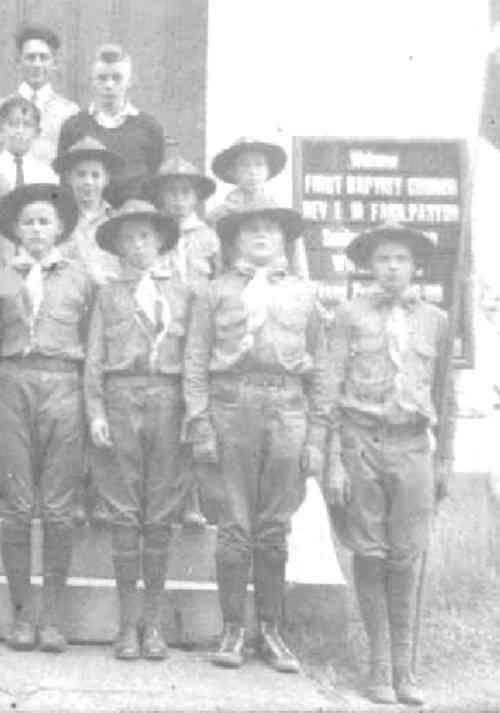
Figure 1.--This Scout troop was sponsored by a Baptist church. The boys wear the standard knickers uniform. They were probably photographed in the mid-1920s. We know that it was at least 1922 because the boys wear the new style uniforms, but note that many boys seem to be wearing long stockings rather than kneesocks. This suggests about 1925 because by the late 1920s virtually all Scouts wore kneesocks. Click on the image for an enlargement.

The first American Scout uniforms were based on U.S. Army uniforms. There since have been only three major changes in the uniform (1922, 1943?, and 1981). For long periods boys have worn the same styles with only minimal changes. The uniforms have always been various changes of khaki, green, and tan. It is possible, however to date them with some degree of accuarcy by analizing the uniforms that the boys are wearing. We have compiled information on both Scout and Cub uniforms over time, beginning with the establishment of the American Boy Scouts in 1910.

Uniform Types

American Scouts have worn four different uniforms. A variety of minor changes were made in these uniforms annually, but there have been only four basic uniforms. The first American Scout uniforms were based on U.S. Army uniforms and included a rather long jacket with pockets rather than a shirt and knickers with a Smoket the Bear hat. American Scouts were the only ones to wear knickers rather than shorts. Many early Scouts did not wear kerchiefs. The second American Scout uniform was adopted in 1922 and had a shirt rather than a jacket. Kerchiefs were almost always worn with this uniform which continued to include knickers and the Smokey the Bear hat. Boys sometimes wore shorts rather than knickers at camps and jamborees. The third uniform was adopted in 1943? A new campaign cap was adopted and knickers were dropped. Boys could wear short or long pants. The fourth and current uniform was styled by Oscar de Lorent and adopted in 1981. The campaign cap was replaced woth a baseball cap. It was a two tone uniform with a light tan shirt and brown pants. Boys could wear eoth short or long pants. The kneesocks were changed to althetic socks and were green with red tops.

Progression by Decade

Many old Scouting pictures are not dates. It is possible, however to date them with some degree of accuarcy by analizing the uniforms that the boys are wearing. Specific details on the evolution of U.S. Scout uniforms organized by decade are as follows:

The 1900s

The American Boy Scout movement generally dates itself from 1910 because this is when the Boy Scout Associatiion was founded and took the title from William D. Boyce. There were, however, some pre-BSA Scouts in the Uninted States. The uniforms worn by these boys, however, was not standardized.

The 1910s

The earliest American scout uniforms were military-style khaki uniforms similar to U.S. army uniforms. The first U.S. Scout uniform was an actually a rather impractical copy of the U.S. Army uniform of 1910, which disregarded the far more practical English uniform designed by Baden-Powell. The early uniform had no neckerchief, and Scouts generally wore knickers with leggings. Most American Scouts wore knickers rather than the short pants worn by British and European Scouts. Scouts also wore a button-down coat with metal insignia. Scouts and adults both wore their rank insignia on their hats (adults at first were allowed to earn merit badges and ranks right along with the Scouts).

The 1920s

The American Scout uniformns in the early 1920s continued to be the khaki Army-style uniform after World War I (1914-18). The BSA modernized its uniforms in 1922 to the style we would recognize today. The boys wore the Smokey Bear type hats were retained. Coats and leggings were dropped, and neckerchiefs were added. Scouts could wear shorts and knee socks in the summer, knickers and knee socks in the winter Unlike England, however, short pants were not commonly worn, instead scouts generally wore knickers with knee socks.


Figure 2.--This Boy Scout in the 1930s wears the knickers uniform which was the most commonly worn Scout uniform worn by American boys.

The 1930s

American Scouts in the 1930s still wore the olive green military style uniform with the smokey bear style hats. Knickers were most commonly worn, reflecting what most American boys were wearing. Some some Scouts wore short pants and knee socks like scouts in most other countries. This was primarily the Scouts participating in camps and jamborees. Scouts attending weekly meetings and engaging in activities around the neighborhood mostly wore knickers. There were sime exceptions to this. Boys in wealthy neighborhoods were more likely to wear short pants as were boys in the South. Cubbing was introduced in 1930s after years of debate within the BSA. American Cubs Scouts wore a blue and gold knickers uniform. They wore the peaked cap (rather like a British school cap) introduced for British Cubs, but in the blue and gold American colors. The kneesocks worn with knickers had gold stripes--unlike the Scout kneesocks wghich were plain. Cubs did not participate in camping like the Scouts and were thus even more likely to wear the knickers uniform. Again there were exceptions and some boys did wear shorts, but I think this was a relatively small number.


Figure 3.--Norman Rockwell used neigbors to model his paintings. Here is a Cub and Scout he painted in 1949. Note that the Cub is wearing the knickers uniform. Click on the image for a view of the final painting.

The 1940s

Knickers continued to be worn at the beginning of the 1940s by both Scouts and Cubs, but were going out of fashion. They were generally replaced by the late 1940s. Scouts wore mostly long pants, except for camping and the periodic National Jamboree. Again some boys wore the short pants uniform, but longs were much more commonly worn. Cubs continued to wear the same blue and gold uniform worn in the 1930s. The uniform was worn knickers at the beginning of the decade, but had mostly shifted to long pants by the end of the decade. Some of the most beloved images of American Scouting are those painted by Norman Rockwell. He painted a nice image of a Scout and Cub ("A FRIEND IN NEED") for the 1949 Boy Scout calendar image, 1949)." What Norman Rockwell did as he created his paintings was to pose the models (most of which were local neighbors of his), and photograph them in various positions and clothing, so he wouldn't have to keep them posing for long periods of time. I had seen the final painting before, but this was the first time I had seen a preliminary. Until 1948, all Scouts wore campaign ("Smokey the Bear") hats. At that time, the field (overseas) cap (popularized by World War II soldiers) was added.


Figure 4.--This magazine cover was published in 1960, it shows the Cub uniform worn in the 1950s and 60s and the uniform Den Mothers wore. The term Akela was not used in American cvubbing.

The 1950s

A Cub Scout in the early 1950s tells that he and his fellow Cubs all wore long pants even during the summer. Each Thursday was Scout day at his elementary school and the boy all dressed up in their uniforms--with considerable pride. One former Boy Scout reports that, "When I was in Scouts, back in the mid 50's and early 60's, our troop's official uniform was the summer uniform with the short pants and knee socks. We were expected to wear the full uniform to each weekly meeting, and special scouting events. The only exception, naturally, were cold weather outdoor events like camping. Once a year, there was something called a "Red Star Inspection," where each troop from the district (there were about twenty or so troops) gathered at a local National Guard armory for a competition on scouting skills, and uniform presentation. The uniform inspection was the first item, because the following events might mess things up. Even though our troop was the only one who adopted short pants and knee socks as the official uniform, I don't think the issue of feeling out of place ever came up, even though we were the only group of boys with bare knees. Before the final presentation of our troop, we did, however, have the extra check by our leaders to make sure our knee socks were straight and evenly pulled up. Obviously, the other troops didn't have that final step. I do remember our troop winnning the inspection more than once, so I suspect the fact that we stood out as unique and attracted the attention of the judges."


Figure 5.--American scouts wore this green uniforms from the 1950s through the 1980s. Shorts were not commonly worn except at jamborees during the 1950s, but had become common by the 1980s.

The 1960s

Most American boys in thr 1960s wore the long pants Scout uniform. This varied somewhat by region. Shorts were worn more in California. It was beginning to become more common to wear the short pants ubiform during the summer. One HBU contributor tells me that he was an Eagle Scout in the 1960s. "Yes, I remember wearing the shorts and knee socks and all, at least during the Summer months. The shorts didn't seem any more "sissy" than the regular long-pants uniform, but you didn't dare wear either of them to school past about the 6th grade--unless you wanted to get teased by the other boys." There were no major changes in the Scout uniform during the 1960s.

The 1970s

major changes occurred in U.S. boys' fashions during the 1970s. For the first time, American boys began wearing short pants. They weren't worn for dress, but became very common for leisure wear and play. This carried over into Scouting and more American Scouts wore the short pants uniform. A U.S. Scouter tells us, "When I was in Scouting during the 1970s, there were several uniforms:
Formal or dress: Long sleeved shirt, long pants, medals, neckerchief (Scouts), necktie (adults), Loafer or Oxford shoes.
Summer Dress: Short sleeved shirt (neckerchief for Scouts, open collar for adults). Long pants. Square knots or medals, at the ????????? of the unit, but the unit must be uniform - they all wear medals, or they all wear square knots. Loafer or Oxford shoes.
Summer: Short sleeved shirts, shorts, knee socks (w/garter & tab) Knots/medals optional. Open collar for all, except if a collarless shirt is worn, then a neckerchief is worn. Shoes or boots.


Figure 6.--American Scouts by the 1980s commonly wore the short pants uniform with green kneesocks.

Summer Camp: Scout at summer camp almost always wore short pants, usually with camp or Scout T-shorts during the day for activities. Knee socks w/tabs and garters were optional. Camp shoes or boots were worn. The Scout shirt and kerchief was worn for church call and special events.
Other; Other uniforms included the "Fall or Spring Camp" uniform, with long pants, long sleeved shirt, Knots optional, boots or shoes suitable for the conditions and terrain.

Each uniform has a different purpose. Courts of Honor usually require a full dress uniform, especially an Eagle court, or one where an award from the local or National Council is being presented. A camping trip over a weekend, while also necessitating long pants and a long sleeved shirt, would not take all the medals, knots, service stars, etc., of the dress uniform.

The 1980s

The American cub and scout uniforms were changed in 198?. The distincrtive cub peaked cap was changed to a blue and yellow base ball cap. The uniform was left blue shirt and pants. Most cubs only but the shirt and wear it with jeans, although shorts were becoming somewhat more common. The blue kneesocks were changed to blue athletic socks with yellow turn over tops. The boy scouts changed the green uniform they had worn for years to a light-brown shirt and dark olive long pants or shorts. Both long and shorts have large cargo pockets which have proven popular with the boys. It had become common for scouts to wear shorts during the summer. Base ball caps replaced capaign-style caps. The solid green knee socks were replace with green athletic socks with red turn-over tops. Scouts tend to wear the full uniform more than the Cubs, but many Scouts also wear jeans with the Scout shirt. Not all Cubs and Scouts buy both the long and short pants, but many more did so then in the past.


Figure 8.--The American scout uniform was changed to this so-called designer uniform in the 1980s. Shorts had become more common, but in the mid-1990s, long baggy ones had become common.

Interestingly as American Scouts more commonly wore the short pants uniform, Scouts in other countries increasingly moved to long pants or no uniform at all. American Scouts tend ti give more attention to the uniform than virtually any other country. American Scouts through the 1950s and 60s usually wore long pants except for camp outings. During the 1980s, however, it became very common for Scouts to wear the short pants uniform. At the U.S. Jamboree and the World Jamboree, American Scouts are part of a growing minority of Scouts wearing short pants and kneesocks.


Figure 9.--The American scout uniform was changed to this so-called designer uniform in the 1980s. Shorts had become more common, but in the mid-1990s, long baggy ones had become common.

The 1990s

American boy scouts wore the uniform redesigned in the 1980s. In the 1990s more commonly wore shorts with the uniform than ever before. The shorts worn by the boys became long and baggy by the mid-1990s. It became less common to wear kerchiefs with the new uniform as the tan Scout and blue Cub shirts came with standard collars. Kerchiefs are becoming increasingly worn only for formal occasions.

The 2000s

We have liirle information on the 2000s yet. The most notable observation is that unlike Scouts in many other countries, American Scouts still commonly wear uniforms--often full uniforms. If anything American Scouts are wearing the full uniform more than in the 1970s and 80s, although this is only a preliminary assessment. Very little change has been made in the uniform in the the 2000s. The principal change appears to be in the short pants. They are the same style but now generally worn at knee-length or below and often quite baggy. Kneesocks are no longer worn. There are now short socks, but with the same red tops.


HBC


Navigate the Historic Boys' Uniform Chronology Pages:
[Return to the Main chronologies page]
[Return to the Main Scout chronologies page]
[The 1900s] [The 1910s] [The 1920s] [The 1930s] [The 1940s] [The 1950s] [The 1960s] [The 1970s] [The 1980s] [The 1990s] [The 2000s]


Navigate the Historic Boys' Uniform Web Site:
[Activities] [Biographies] [Chronologies] [Countries] [Essays] [Garments] [Organizations] [Religion] [Other]
[Introduction] [Bibliographies] [Contributions] [FAQs] [Questions] [Unknown images]
[Boys' Uniform Home]


Navigate the Historic Boys' Uniform Web organizatiion pages:
[Return to the Main U.S. Scout page]
[Return to the National Scout page]
[Boys' Brigade] [Camp Fire] [Hitler Youth] [National] [Pioneers] [Royal Rangers] [Scout]


Created: November 15, 1998
Last updated: April 29, 2002