|
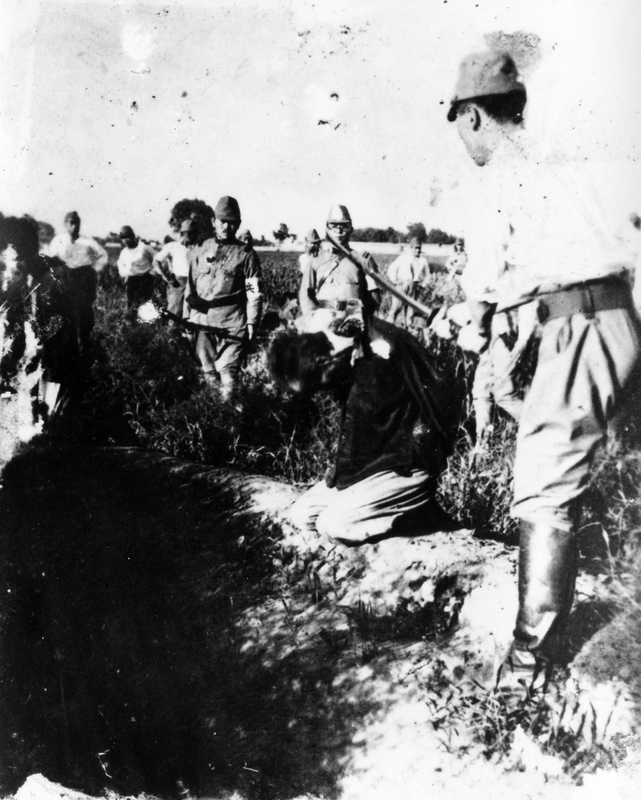
The Japanese in China after occupying large areas of the country, but failing to decisesly defeat the Chinese Army, adopted the "Three Alls" ( 三光作戦, Sankō Sakusensankô sakusen) policy to subjugate the country. The Japanese policy was most aggressively implemented in northeastern China. Details on the Japanese effort only emerged after the War as a result of a book published by a Japanese POW. The effort was initiated by Ryûkichi Tanaka (1940). The fullest implementation was in north China by Yasuji Okamura. He divided occupied northern China into pacified, semi-pacified and pacified areas. The Imperial Army Headquarters issued order number 575 (December 2, 1941). Okamura as part of the strategy burned villages, confiscating grain to deny food to insurgents, and used Chinese peasants as a slave work force to construct concentration hamlets. Other projects included trench lines, containment walls, moats, watchtowers and roads. These construction projects were conducted on a vast scale. The brutal treatment of these Chinese workers resulted in deaths on a vast scale.
The Japanese Three Alls Policy was in Japanese ": 三光作戦, Sankō SakusenSankō Sakusen" and in Chinese "Sānguāng Zhèngcè".
The Chinese characters mean "three lights policy". Chinese language specialists, however, report a more accurate translation in this context is "The Three Alls Policy". The three alls here are: "Kill All", "Burn All" and "Loot All". The Japanese originally referred to the policy as "The Burn to Ash Strategy".
The term "Sankō Sakusen" based on the Chinese characters term, was first made known to historians by a Japanese war criminal who was released from the Fushun war crime internment center (1957). After his release he wrote a book Sankō, Nihonjin no Chūgoku ni okeru senso hanzai no kokuhaku (The three all, Japanese confessions of war crimes in China) (new edition : Kanki Haruo, 1979). The book included virtual confessions by Japanese veterans of war crimes they committed under the command of General Yasuji Okamura. The book created a sensation when it appeared in Japan. Unlike the situation in Germany where the post-War Government admitted the war crimes committed by the NAZIs, the post-War government in Japan attempted to down play Japanese war crimes. The publishers of the book had to stop publication. Unrepentant militarists and shôwa fanatics were outraged and death threats were sent to the publisher.
The Japanese invaded China proper (1937). The Imperial Army in engagement after engagement defeat the Chinese Army and occupy first Shanghai and Beijing and then Nanking. The occupation of Nanking was one of the most publicized of the Japanese World War II atrocities. The Japanese did not, however, succeeded in decisively destroying the Chinese Army. As a result, what the Japanese expected to be a brief campaign turned into a war that went on and on with no end in sight. China occupied large areas of the country, including the coastal areas. The Chinese Army withdrew into remote areas of western China where the Japanese had difficulty pursuing the Chinese. The Chinese were driven inland and no longer able to import war supplies through their ports. Some supplies were, however, delivered over the Burma Road. The Japanese attack on Pearl Harbor launching the Pacific War was in part a belief that his would help them complete the conquest of China. Which of course led the to invaded other territories. While the bulk of Japanese atrocities and murders were in China. Where ever the Japanese military went, we see the same brutality and record of atrocities followed them the. The action here occurred in the Philippines which was occupied (1942-44)
The main resistance to the Japanese was China. Even during the Pacific War (1941-45), most of the Japanese Army was deployed in China because of the resistance there. THE KMT realized that they did not have the military capability to fight the Japanese. So even after Japan seized northern China (Manchuria), the KMT avoided War (1931). War finally came when the Japanese invaded China proper (1937). As with Manchuria, the action was launched by local military commanders, not the Tokyo national government. After the initial battles, it became obvious that China had to retreat into the interior where China's primitive infrastructure made it impossible for Japan to get to the KMT. Japan's primary tactic became mindless terror. The more brutal and extensive, the better to overcome Chinese resistance, The most terrifying example was the rape of Nanking, the provisional capital (December 1937 and January 1938). The primary force resisting the Japanese was the KMT Army, but there was also a small Communist force. With the Pacific War, Japanese brutality extended to many other territories. This was different than in Europe, because of he territories were European colonies, not independent countries. Some perceived the Japanese as liberators rather than invaders--part of Japanese propaganda. Japan set up the Greater Eat Asia Co-Prosperity Sphere. Most soon learned that Japan's concept of colonialism, was very different than that of the Europeans. Japanese brutality was intensified if the occupied population resisted in any way. But eve territories tht did not resist were not spared brutal incidents and lawless exploitation.
The Three Alls policy was a scorched earth policy Japan pursued in areas of China they occupied during World War II. The Japanese in China after occupying large areas of the country, but failed to decisively defeat the Chinese Army which withdrew into remote areas of the country. Even more frustrating to the Japanese, they continued to be attacked even in areas they had occupied by resistabce forces. In response they adopted the "Three Alls" (sankô sakusen) policy to subgegate the country.
Ryûkichi Tanaka initiated the Three Alls policy (1940). The most brutal and full scale implementation of the policy occurred in northern China. Imperial Army Headquarters approved the use of the brutal strategy in Army order number 575 (December 3, 1941). Historians report that the Three Alls Policy was personally sanctioned by Emperor Hirohito. 【Bix】 Japanese commander Yasuji Okamura to implement the policy divided occupied northern China into pacified, semi-pacified and unracified areas. Civilians in the unpacified areas were targeted as they were assumed to be supporting partisans. Few Japanese soldiers spoke openly of their actions after the War. A few have. Hakudo Nagatomi described how he carried out orders. He reports that the slogan -- "the Three Alls: 'Burn all, steal all, kill all" was in use. He explains that it meant, "... if there were people, kill them. If there was a house, burn it. If there were cows or sheep, slaughter them. ... I rounded up the women and children in the villages, shut them into buildings, piled up fire wood, and burnt them. I did many terrible things." 【WGNH and BBC】 Okamura as part of the strategy burned villages, confiscating grain to deny food to insurgents, and used Chinese peasants as a slave work force to construct concentration hamlets. Other projects included trench lines, containment walls, moats, watchtowers and roads. These construction projects were conducted on a vast scale. The brutal treatment of these Chinese workers resulted in deaths on a vast scale. The Japanese shôwa army forcibly conscripted more than 10 millions Chinese civilians were mobilized by the shôwa army for slave work in north China and Manchukuo. They were under the supervision of the Kôa-in. 【Himeta, Kubo, Peattie and Ju】 There are no precise figures, but historians believe that some 2.7 million Chinese civilians were killed as a result of the policy. 【Bix】
The historical work on the Three Alls Policy is controversial in Japan where ultra-nationalists object to any admission of war guilt or atrocities committed by the Japanese military. The critics have picked up on the fact that the popular name for this strategy is Chinese and charge that the policy is a fiction of Chinese propaganda. Normally the Japanese critics focus on the semantics here and ignore Japanese World War II military documents showing that the policy existed and was in force. A more valid point the critics make is that the Chinese themselves pursued a
a scorched-earth policy which the Japanese referred to as the "The Clean Field Strategy" (Seiya Sakusen). This it is often difficult to differentiate between Chinese and Japanese actions.
Curiously the Japanese company Fujian Industry Co Ltd (Fujian Chanye Zhushihuishe) submitted a request to patent the term in China (2006). The term is well known in China. It is unclear why the Japanese company did this. It presumably is an example of Japanese insensitivity, but we have no details at this time. It is extremely unlikely that the Chinese Government would ever approve such a request, especially to a Japanese company. A Chinese journalist explains, "The Trademark Law of the PRC states any item implying discrimination towards the nation or is harmful to social morality must not be registered as a trademark. Under this law, Ma says, the 'Three Alls' trademark is illegal." 【Qian】
Bix, Herbert P. Hirohito and the Making of Modern Japan (Harper Collins, 2000). Bix relies heavily on the work of Mitsuyoshi Himeta and Akira Fujiwara.
Fujiwara, Akira. The Three Alls Policy and the Northern Chinese Regional Army (Kikan sensô sekinin kenkyû 20, 1998).
Himeta, Mitsuyoshi. Concerning the Three Alls Strategy/Three Alls Policy By the Japanese Forces (Iwanami Bukkuretto, 1996).
Mitsuyoshi Himeta, Toru Kubo, Mark Peattie and Zhifen Ju, "Japan's atrocities of conscripting and abusing north China draftees after the outbreak of the Pacific war" (Joint study of the Sino-Japanese war, 2002).
Qian. Li. "Three-alls' to be trademarked by Japanese firm," Chinadaily.com.cn, August 10, 2006.
WGNH and BBC. "People's Century: Total War".

Navigate the CIH World War II Section:
[Return to Main Japanese World War II war crimes and attrocities page]
[About Us]
[Biographies]
[Campaigns]
[Children]
[Countries]
[Deciding factors]
[Diplomacy]
[Geo-political crisis]
[Economics]
[Home front]
[Intelligence]
[POWs]
[Resistance]
[Race]
[Refugees]
[Technology]
[Totalitarian powers]
[Bibliographies]
[Contributions]
[FAQs]
[Images]
[Links]
[Registration]
[Tools]
[Return to Main World War II page]
[Return to Main war essay page]
[Return to CIH Home page]