
World War II: Japanese War Crimes and Attrocities (1931-45)
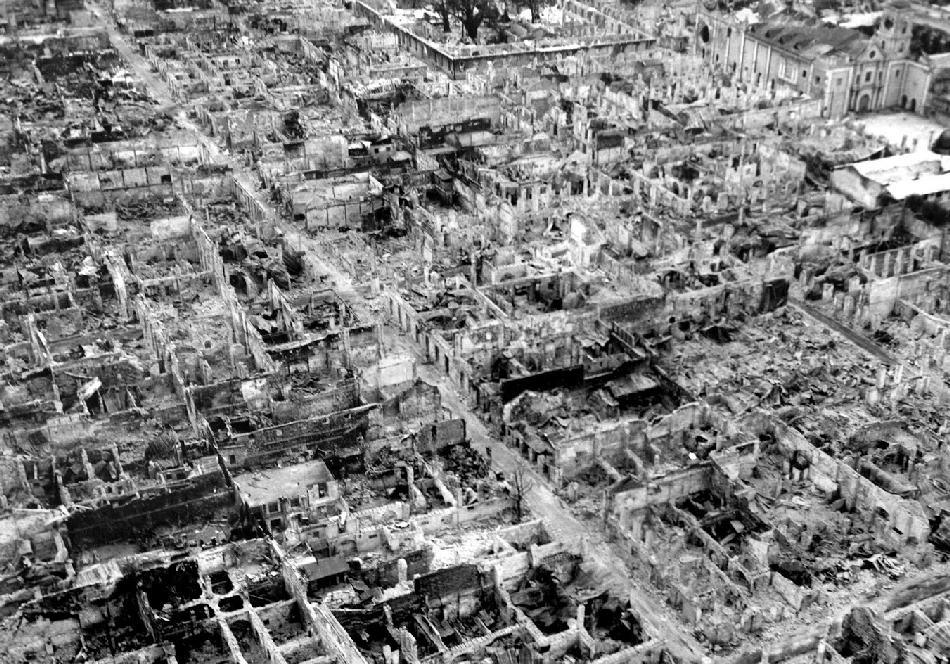
Figure 1.--Most Japanese believe that the atomic bomb attacks were the great attrocity of World War II and places the United States on the same level as Japan in terms attrocities and war crimes. Seeing the image here, except for the church, one might think it is Hiroshima or Nagasaki. Actually it was whast the Japnese did to Manila (February 1945). They not only destroyed the city, but all the men, women, and children they got their hands on. This was what was left of central Manila (the Walled City).
|
|
The attrocities committed by Japanese soldiers defy the cognitive abilities of the human mind. It is difficult to believe that any nation could have carried out the barbarities perpetrated, mostly on innocent civilians. Japanese war crimes were not only unimaginably brutal and widespread, but they are without prescedent even in Japanese history. Some of the attrocities were official Japanese war policy. Many others were ordered by local commasndrs or committed by individual soldiers. NAZI war crimes and depravity are better known, but the Japanese in some ways were even more barbaric thasn the NAZIs if that can be imgained. Despite 8 years of War, there were no Chinese POWs to liberate--they had all been murdered. Japan in sharp contrast to Germany did not and does not today admit the full extent of its responsibility for launching World War II and the brutality of their soldiers during the War. Many Japanese attempt to hide the extent of their country's war crimes. Some claim that the decision to go to war was forced upon Japan. For the most part the Japanese prefer to view their country as a victim of the War. Japanese school childtren are largely tought briefly about the War with text books and school ceremonies that focus on the atomic bombs. The treatment by Japanese text books approved by the Ministry of Education has been a recurring issue affecting relations with China, Korea, and other countries occupied by the Japanese during the War. Virtually unknown to the Jaspanese people are the war crimes perpetrated aginstg their own people. The list of Japanese atrocities and war crimes is very long, involving the deaths of millions, mostly innocent civilians. The list in its entirity is too long to list here, but we need to mention some of the most grevious atrocities committed by the Imperial armed forces.
Aggressive War
The primary war crime is the launching of aggerssive war first against China (1937) and then the United States, Britain, and the Netherlands (1941). This was one of the primary charhes at the Tokyo IMT trials. The decisin for Agressive War was taken by the Japanese Government influence or totally controlled by the Japanese military.
Japan decided in 1939 to intensify its naval armaments program with a 6-year naval building plan. New battleships were ordered. Still unproven were the air craft carriers. The Imperial Navy by 1941 Japan had 13 carriers, three times as many as the American Navy. Japanese carrier pilots were superbly trained and flew the Mitsubishi Zero, superior to any fighter available to the United States and Britain.
The Japanese today focus on the American strategic bombing raids culminating on the dropping of the two atomic bombs on Hiroshima and Nagasaki. This is most of what school children are taught about the War. Largely unknown to the Japanese is that their country's military routinely engaged in the terror bombing of civilian populations, mostly undefended Chinese cities such as Shanghai and Chunking. The first major Japanese terror bombing raid visited on Shanghai (1937). Raids escalated as Japan expanded its air force amd military assault on China. The Japanese began an expanded effort crush Chinese resistance by sustained bombing of every major city in Natioanlist hands. The strategy of air warfare was not yet worked out. Many air commanders, including the Japanese, believed that terror raids in civilians would force suurender. One estimate indicated that about 20,000 civilians were killed in the first 9 months of 1939 alone. [Gilbert, p. 239.] The Japanese bombing was at first virtually unopposed. The Chinese asked for American assistance and President Roosevelt approved plans for the American Volunteer Group (AVG) -- the famed Flying Tigers. The Flying Tigers reached Burma and China in 1941, a few months before Pearl Harbor.
Killing of Chinese civilians was routine. Often they occurred after taking a city or as reprisals for gureilla activity. Japanese soldiers as a reward for taking a cHinese town were normally given 3 days to do as they please, including rape and pillage. The most notorious incident was the Rape of Nanking (1937-38). Another major incident was wide-scale killings after the Doolittle Raid (1942). There is a long list of other terrible incidents. The Tokyo War Crimes Tribunal and Chinese war historians estimate that the Japanese killed outright or were indirectly responsible for 10-30 million deaths in China--mostly innocent civilians. Some even belive the total was higher. These deaths resulted from massacre by the Jpanese army, bombing of civilian populations, mistreatment of slave labor, starvation and germ and chemical warfare. The single most horendous incident was the Rape of Nanking where close to 0.3 million Chinese were killed. [Chang] Many other Chinese cities suffered greviously.
The Japanese in China after occupying large areas of the country, but failing to decisesly defeat the Chinese Army, adopted the "Three Alls" (sankô sakusen) policy to subgegate the country. The Japanese policy was most agressively implemented in northeastern China. Details on the Japanese effort only emerged after the War as a result of a book published by a Japanese POW. The effort was initiated by Ryûkichi Tanaka (1940). The fullest implementation was in north China by Yasuji Okamura. He divided occupied northern China into pacified, semi-pacified and unpacified areas. The Imperial Army Headquarters issued order number 575 (December 2, 1941). Okamura as part of the strategy burned villages, confiscating grain to deny food to insurgents, and used Chinese peasants as alave work force to construct concentration hamlets. Other projects included trench lines, containment walls, moats, watchtowers and roads. These construction projects were conducted on a vast scale. The brutal treament of these Chinese workers resulted in deaths on a vast scale.
Starvation Famine Policies
While other Japanese war crimes have attracted more attention, it was Japanese food policies that accounted for the largest number of deaths in Asia during the Second Sino-Japanee War (1937-45) and the Pacific War (1941-45). The death resulted from both planned Japanese actions as well as incredible mismanagement of the occupied areas. The Japanese efforts to manage food production and distribution roved incredably mismanaged. It was the people in occupied areas that died in the largest numbers. The Japanese seized food in the occupied areas both to feed the militry and to ship back home to the Home Islands. This would have been bad ebough, but occupation policies also affected harvests, including the harvests in some of the richest agriculturl areas of Asia such as the Mekong Delta. Japanese policies were for every area to become self sufficient. As a result coastal vessels that usually carried rice from the Mekong Delta in the south to the heavily populated Red River Delta in thevnorth could no longer do so. They also attempted to control prices, causing farmers to reduce produc=tion. The result were terrible famines. Other famines ourred in China, the Dutch East Indies, and northern Burma. In addition to the local population, internees both civilian and POWs died from starvation. Less well reported are the number of Japanese soldiers who died from statvation as a result of military policies. And by the end of the War, the Japanese people themselves were nearing starvation. And if the occupied islands were populated, the Japanese, they died in large numbers after the Japnese seized the available food. The Andaman Islands are just one of the islands where the Japanese starved island populations. If th Emperor had not demanded that the military surrendr (August 1945), millions of Japanese civilians would have also died from starvation.
Japanese medical units in Manchuria experimented with biological warfare. More than 400 villagers died of bubonic plague in China's eastern Zhejiang province during September 1942. Japanese planes with bombs prepared by medical Unit 731 dropped germ
bombs. Unit 731 was stationed on the outskirts of Harbin--the capital of the rich agricultural and coal region of Hailongjiang Province in what was known as Manchuria. The unit was active until August 1945 when the Soviet Union entered the war by invading Japanese-occupied Manchuria. The unit is known to have introduced typhus into the water supply flowing into Manchuria.
Mistreatment and/or Murder of Allied POWs and Civilians
The Japanese more than 10 years before launching the Pacific War were engaged in military operations in China. First inbading Mnchuria (1931). And than launching an outright invasion of China proper (1937). And along with military operations, Japan conducted massive operaions brutalizing and killing the Chinese people i unpesedented numbers. The initial targes of the Japanese militarists were the Chinese people. At first in China and evntually Chinese communities in Southeast Asia and Oceania. Western journalists reported on the carnage, but noting prepared the world for the Rape of Nanking (1937-38). And Japnse barbarism toward civilians in Nanking was not unique. The Japanese of all the World War II belligerants were the most brutal toward POWs. They killed all the Chinese prisoners they took as well as many Western prisoners. The POWs not killed were brutalized, starved and worked to death in fetid camps throughout Asia and the Pacific. Large numbers of POWs died in these camps. Allied civilians were interned in camps. Some ware killed ouright such as the Australian nurses. They were not brutalized to the same extent of the POWs. But there treatmentment was also barabaric, denied adequate food and medical care. Large numbers perished in these camps. Not only was the death toll in Japanese POW and internment camps astronomical, but many those who survived had serios health problems. Some took years to fully recover. Some neer did fully recover, Many had premature deaths because of the lingering impact of their treatment by the Japanese.
The Imprial Japanese Army (IJA) was responsible for the murder of millions of civilians in the areas Japan occupied. The Navy also engagd in such atrocities, but because it was primarily at sea not on the same scale as the IJA. The best known IJA atrocity is the six week Rape of Nanking (1937-38). It was an incredible incident of mass murder and rape committed by IJA troops on the residents of Nanjing (Nanking), at the time the capital of China. It was not just chaotic violence on the part of soldiers, but actually overseen and to an extent orhanized by IJA commanders. No one knows how many civilians and disarmed POWs he IJA murdered, but estimates range between 40,000-300,000 victims murdered and countless rapes. But Nanking was hardly unique. This kind of horror took place throughout the areas of China occupied by the Japanese. The acale of the the barbaism appears to have been large even by Japanese standards. The reasin we know more about the Rape of Nanking is that because it was the capital, European diolomats were present to witness the behaior of he IJA. And even larger killing spree, but not confined to a single cuty was the less well documnted massacres conducting in eastern coatal privinces China in reprisal for the Doolittle raids. [Scott] In addition to civilans killed outright, the IJA unleased Unit 731 bacterological agents on the area. Four months of terror gave the Japanese time to kill some 500.000-750,000 Chinese civilians (May-August 1942). Missionaty accounts gradually filtered back to th United States recording the barbarity, but American historians did put together the scale of the retribution untill years after the war. Japanese savagery was not limited to China. The IJA Sook Ching (肃清) killing action meaning "purge through cleansing") was the systematic purge of those the Japanese perceived hostile elements among the Chinese in Singapore (February 1942). The death tool is believed to have reacged 70,000 victims. The Japanese conducted another horific killing action in the Ohilippine--the Rape of Manila (February 1945). In this case it was Japanese Marines that did much of the killing, some 100,000 victims. And they did it in plain view of the U.S. Army that was liberating the city.
The mistreatment and massacres of Allied POWs are too numerous to list. Here we are not referring to incidents committed by individual soldiers and field commanders. The Pacific War was fought with unprecedented savegery. There arenumerous incidents. One example is the nine naval airmen shot down in the fighting around Iwo Jima. One was rescued (George H.W. Bush). The other eight were tortured horribly, beheaded, and devoured by the Japanese. [Bradely] There were incidents of barbarity by the Americans as well. American submarines machine gunning survivors or GIs pulling gold teeth out of living Japanese. More important is how POWs were treated once in the hands of competent authorities. The Batan Death March is the best known incident involving Americans and Philippinos. The building of the Eastern Railroad is the best known incident involving English and Commonwealth troops. I am not sure how the Japanese handeled Chinese POWs. Chinese POWs were normally killed outright were killed outright, but this needs to be confirmed. There is a huge body of evidence from the reports of Allied POWs. An estimated 40 percent of Allied POWs died in the Japanese camps. This compared to the 2 percent of American and British POWs who died in German camps. It also campares to the American POW camps where POWs lived under the same conditions as American service men. While the treatment od Allied POWs by the Japanese was demonstrably horrendous, less clear is the responsibility for these condiions. Individual camp commanders were clearly responsible, but the conditions in the Japanese camps were uniformely brutal, there must have been guidelines issued by higher authorities. Here we have only limited evidence. One important piece of evidence that surfaced at the War Crimes Trial of the major Japanese officials in Tokyo. The Japanese Vice Minister of War ordered camp commanders to execute POWs if a camp was about to fall into Allied hands [document 2015]. While this document was entered into the officil reord, it was never discussed by the Allied procecutors. Some historians speculate that this was bdecause MacArthur feared that the paper trail might extend to Emperor Hirohito.
With the occupation of the Philippines, Hong Kong, Shanghai, Singapore, Mayasia, Borneo,and the Dutch East Indies, large number of civilians from combatant nations were interned by the Japanese. Conditions gradually deteriorated and the internees were forced to endure horific conditions. The internees were not as abused as the POWs, but the living conditions were still terrible. Medical supplies ran out. Food ws the major problem. The Japanese rations were inadequate and after a while the internees were not allowed tonobtain food outside the camps. The Allies tried to send Rd Cros packages, but few got through to the internees. The death rates were apauling, especially among the children. Theclargest group of civilins were Dutch. There were about 70,000 Dutch women and children interened by the Japanese in early 1942. One Dutch girl remembers at age 10 reporting to the church in Bogor where the Japanese processed them for different camps. She was in five different camps before being liberated. Her father had already been taken by the Japanese to a mens' camp. Only the younger boys stayed with the women. Her mother had a terrible choice. Should she hold on to Rob the youngest boy or let him go with Will hoping that together they would have a better change of surviving. She finally decided to let him go and agonized about it afterwards. When the British got to her camp after the war, her foot was rotting off. Somehow they all survived, but were forever changed. [Halewijn Brown] There were Americans, Australians, British, Dutch, and others among the internees. Most of the Americans were in the Philippines. One British boy whose family was in Hong Kong later described his experiences in The Empire of the Sun which was made into a movie. Japanese Army authorities in Tokyo ordered camp authorities to kill the internees at the end of the War to destroy evidence of how the civilians and POWs had been mistreated. As the Americans finally broken the Japanese Army codes (1943), some of this traffic was probably picked up, but we do not yet know the details.
Mistreatment of forced labor
The Japanese routinely rounded up civilians in occupied areas for forced labor. Asfar as we know there was no real organiation behind this. The Germans also did this in the East, but in the West commonly had coscriotion systems or rcruitmenr effors. The Japanese Army just seem to have ronded up people. And we notice that they seized whole populations, including men, women, and children. Conditions were commonly genocidal. A good example is the use of Javanese on Noemfoor Island off western New Guinea.
Not only was he death toll in Japanese POW and internment camps astronomical, but many those who managed to survive had serious health problems. The first POWs and internes in any number were in the Philippines. The liberation of the Philippines began with Leyte (October 1944). Most of the camps, however, were on Luzon. Thus the advancing american troops got to the POWs and internees (January-February 1945). As a result, they had a better chance of surviving than POWs and internees held deeper in the Japanese Empire, most of whom would not be liberated until after the Japanese urrendered (August 14-September 2). The camps were located in many different locations in Japanese held territory across the Pacific and East Asia. The logistics of getting to them was daunting. In some cases there were air food drops to provide food and medical supplies before Allied forces could reach them. Not only did they need food, but also emergency medical aid. That first month of liberation was the most deadly. They were in such poor condition after several years of abuse and starvation that even when food and medical care became available, many died. In some cases there were no available quarters so the POWs and internees had to stay in the camps until transport home was arranged. For many it was months before they got home. Many required extensive medical care even when they returned home. Some took years to fully recover. Some neer did fully recover and had permanent disabilities. Many had premature deaths because of the lingering impact of their treatment by the Japanese.
The Japanese military committed a long list of horendous atrocities that were without precent in modern times. Terrible atrocities begn in Mnchria and quickly escalated. The atrocities reached a fever pitch in Chima. The Rape of Nanking is the most widely known atrocity, largely because Nanking was the capitl of Nationlist China and there there were Western embassies there. This meant that there were many Western observers including many members of the international press. Thus unlike many other terrible atrocities it was observed and reported on in detail. And the Japanese were not particularly shy about taking photographs. The Japanese soldier at the time did not have the slighest idea that they could be defeated. They thought it was their right to sestroy any one who stood in their way or even civilins who were meerly in the city. It was rape, pillage, and sestruction such as was common in acncient times. Similar atrocities would be committed throughout China, Southeast aia, nd the Pacfic. Toward the end of the War, the idea of victory had long evaporated, but the Japanese behaved similarly in Manila. The Japanese victims included military and civilian including men and women, children and the elderly. Many of these murders were committed up close and personal, not only with guns, but often with swords and bayonets. Rape was commonly involved with cvilians, often followed by murder.
Slave Labor
Rape
One striking difference between the Japanese and Germans was rape. The Germans behave barbasrically, especially in the East, but rape was no widespread. A factor here was race. The NAZIs did not want race 'pollution'. This was not the case with the Japanese. Much of the dicussiomn of Japanese rape deals with the Comfort Women, but the rape issue goes far beyonf the comfortt women. The Rape of Nanking received that name because of the Japanese Army proceeded to rape the women anf girls of Nanking with abandon. And if tghat in itself was not bad enough, the women sfter the soldietrs were thriugh with them were often beaten, mutilasted, and killed. And this sort of scti=vuty, alneit on a more limited scale occurred in cities and villages througjhout China. While Japane militaty incidents of rape orimarily occurred in China because of the length of the war and Japanese racial attitudes toward the Chinese, rapes in large numbers occurred where ever the Japanese army went. As far as we know there were no military procecutions for rape. One of the major incidents of rape outside China was Manila (February 1945). And almost all the women raped were killed asfter the soldies nd mrines were done with them.
Comfort women
The Japnese Army conscripted civilian women to serve as prostitutes for Japanese soldiers. Women from Korea, the Philippines and other countries were used. The Army sourced many of these women in Korea, Japan's second important colony. Korean women were not the only victims. The Japanee Army also used women in the areas they occupied. This included Dutch, Eurasian, and Indonesian women beginning in 1943. Many of the Dutch women were nuns, often working as nurses. Dutch military authorities strenously procecuted the cases involving Dutch women, but cases involving the other women were laregly ignored. [Tanaka. Japan's Comfort Women] Amazingly many Japanese people were unaware of the Comfort Women. It only became known in Japan when the surviving women in the 2000s began pressuring their givernments for ction and this was reported in the Japanese press. Today fior the most part the crimes are largely ignored in Japan. Some Japanese authors even claim these women volunteered for this work. The lack of knowledge of this and other war crimes has left the Japanese mistified when people in China, Korea, and other countries protest against the Japanese. Not all Allied nurses taken prisoner were used as comfort women. The Japanese took 78 American Army and Navy nurses prisoner on Correigdor after the fall of the Philippines (1942), but they were not molested. They were allowed to help care for the POWs in and around Manila. The nurses became known as the Angels of Bataan. Army cimmanders ordered the Australian nurses to be machine gunned after the fall of Singapore (1942). [Van Harl]
Canabalism
There are numerous reports of canabilism practiced by Japanese soldiers during World War II in the Pacific and the CBI theater. We are not sure about China proper. Perhaps most shocking of all it was not an attrocity practiced by just a few starving soldiers on isolated Pacific islands garrisons. It appears to have been a fairly common practice practiced by units that were not starving and carried out or condoned by unit commanders. And the Japanese targeted many natiuinalities in their canabilistic rites. One Indian source reporyts, " For the 10,000-odd soldiers of the Indian Army who endured extreme torture at the hands of their Japanese captors, cannibalism was the culmination. Evidence suggests the practice was not the result of dwindling supplies, but worse, it was conducted under supervision and perceived as a power projection tool. The Japanese Lieutenant Hisata Tomiyasu who was eventually found guilty of the murder of 14 Indian soldiers and of cannibalism at Wewak (New Guinea) in 1944 was sentenced to death by hanging." [Jayalakshmi K.]
Crimes Against Japanese Citizens
The Japanese military was not only brutal toward the people they conquered or attempted to conquer. They also committed terrible crimes aganst their own people. This included civilians. The first Japanse vivilians encountered in any number by the Americans were the Japanese colonists on the Marinanass. When it became clear that the Americans could not be defeated, the Japanese military encouraged the civilins to commit suiside and when they hesitated in many vases simply killedthe civilians. The same ccurred on Okinawa. Finally the military was prepared to do the same on th Home islands untilafter the two atmic bombs ad the siviet declarun of war, the Emperor intervened nd decided to surrender.
Japanese World War II attrocities are generally see as heinous acts targeting the people imvading an occuied. Less well covered are the attrocities targetting the Japanese people. This began as far as civilans are concerned in the Marianas, mst promonently on Saipan whivh had the largest population f Japanese settlers. Japan acquired the Marianas durin World War II and had two decades to settle a sizeable number of civilians on the islands, displacing many Chamoros on Saipan. The Japanese were well prepared for the American invasion. The American Central Pacific campaign had made considerable progress. After the Gilberts, Marshalls, and actions in the Carolines, it was obvious that the Marianas were next. The Japanese knew about the B-29 and that the Home Islands could be attacked from bases in the Marianas. Thus the Japanese authorities in the Marianas had pleny of time to bried civilians that the Americans were coming and what they could expect. We know what they were told, although it is not entirely clear who ordered it. We do not know if authorities in Tokyo ordered how civilians should be briefed. As far as we know at this time, local authorities just followed the Japanese propaganda line that the Americans were beasts and would torture and kill civians and rape the women. We are not entirely sure how this message was conveyd. We are not sure it was Tokyo based propaganda. Cetainly Tokyo demonized the Americans at every turn, but it was slow to admit that the Americans were having success in the war, esecially occupying areas with Japanese populations. The Japanese propaganda message at the tome ws that Japan was winning the War, so message about American behavior in occupied areas would seem to have been off message, but perhaps readers who know more about Japanese propaganda can tell us more. The message seems to hve been delivered locally, in many cases informally. We are not sure that higher ranking officers really believed this. There was no actual information to sunstantuate it. But this is what civilians were told and most seemed to have believed what they were told. Once the Americn invaded, the civilians hid in the many caves, odrering sheltr from the air raids and fighting. This was done in desperation. The Japanese pre-positiond food and water for soldiers, but not for civilians. And cuvilins do not seem to have done this on their own. Unlike Okinawa where the Americans also encountted Japanese civilians. Japanese soldiers on the Marianasa do not seem to have forced civilans to commit suicide or even just killed them. After establishing their beachead, American marines and soldiers advanced inland through valleys of sugar cane fields, swamps, and finally reaching jungle-covered mountains. his was the most difficult terrain feature on Saipan for the Americans. Hundres of natural caves honeycombing the island. These caves could conceal Japanese snipers, artillery, or terrified civilians seeking to survive the fierce fighting. It was the first time Americans encountered any substantial numbers of Japanese civilians in the Pacific War. In addition to misinforming their civilians, the Japanese soldiers actually used their own cibvilians as bait for ambushes or as human shields. his of course suggests that at least the officers knew that what they were tellng the civilians were lies. What ever the case, it was effective. Civilins continued to hise in caves evcen when starving. And finally as the Americans soldiers drove th Japanese to the northern corner of the island, womn started commiting suisud, jumping fom high cliffs into the sea, many with their babies in their arms. They ignored pleas by Japanese speakking Americns to surrender. The smesenario unfolded on Guam and Tinian, albeit with smallr numbers of Japanese civilins. [Shimazu]
In addition to the Japanese troops on the island, there were some 450,000 civilians. This was much larger than the small Japanese population ncounteed on Saipan. Okinawa included n ethnically diverse group of people. Many Okinawans had multi-ethnic origins in contrast to the Japanese. Okinawa was a relstively recent addition to Japan. Japan seized the islands at an early point after the Mejii Resoration (1875). They immediately began a process of 'Japanization'. Becaise of their mixed sncestry, the Japanese looked don on the Okinawans and treated themn as second-class citizens. One historian writes, "With their greater racial 'deviance' than Koreans, Okinawans were made to suffer even more grievously for their failure to be pure Japanese, that most valued national quality." The Japanese had evacuated sime civilians, but most were still on Okinawa when the Americans landed. From the beginning, civilins were caught ijn the crossfire. Trapped Japanese soldiers commonly urged or even forced civilians to commit suicide with them. Civilians were often ordered to commit mass suicide, although Japanese sources, especilly the Ministry of Education, seek to deny this. Okinawan sources want the truth told. In the final phase of the battle, what was left of the Japanese 32nd Army abandoned the Shuri Line south to Mabuni where they planned to make a final stand. Some civilians terified of the advancing merivans becaus of the storie told them by the Japanese militry, followed the Japanese solders south. The tiny corner of the island became a chaotic mass of Japanese soldiers, American soldiers, and civilians caught in a deadly crossfire. Not only were the two armies fighting, but there was also intense air and sea nbommbardment. The civilians tht fled with the Japsnse not only had the deadly fire to contend with, but were let without food, water, or shelter. Horific tales emerged. One journalist writes, "Clutching a hand grenade issued by the Japanese Imperial Army and driven by tales of what U.S. soldiers would do with a pretty young woman, Sumie Oshiro recalled,she fled into the forests of Okinawa during the World War II battle known here as the 'typhoon of steel'. No one knows precisely, but some historians estimate that some 100,000 to 150,000 Okinawan men, woman, and children perished in the 3 months campign for Okinawa. It is probably a template for what would have happened on the Home Islands had the United States been forced to invade.
Crimes aginst the Japanese people
World war II historians almost exclusively discuss the crimes committed by the Japanese military against POWS and civilians in other countries. Rarely do they discuss the crimes Japanese soldiers committed against their own people and even less against their own soldiers. Western historians generally ignore this topic and Japanese historians, perhaps for perceived patriotic reasons, almost uniformily refuse to discuss it. Japanese military authorities in areas where there were Japanese civilians (primarily the Marianas and Okinawa) spread information that the American soldiers were monsterous barbarians who would rape, plunder, torture, and kill. Civilians were incouraged to commit suiside rather than be captured. The Japanese military code forbid soldiers to surrender, but there was no such code for civilains. Even so civilians were incouraged not to do so. U.S. Marines on Saipan were confronted with the horrifying spectacle of civilians hurling themselves off rocky cliffs, including mothers with children in their arms (May 1944). The same thing occurred on Okinawa, only the Okinawans were often ordered to commit suiside and in some cases actually hearded into caves and killed by the soldiers (June 1945). For the Oknawan people (etnically destinct from the Japanese), Imperial soldiers proved more dangerous than the American invaders. The same was being prepared on the Main Islands to ward off the anticipated Amnerican invaasion, although here the Japanese military took it one step further, civilians were not only being told to commit suiside, but first to actively resist the invasion force, an effort called Ketsugo. We are not entirely sure to what extent the idea of incourging civilians to commit suiside or killing their own civilians was a policy ordered by local commanders or directed by higher authorities in Tokyo. Ketsugo we know was approved by the High Command. This is something on which we hope to obtain further information. Not only did the Japanese military commit these crimes against civilians, but they also were responsible for the deaths of hundreds of thosands of their own soldiers. The Japanese military from the very beginning of the War given the limited food resources on the Home Islnds planned to provision its troops with supplies sized from the enemy. This worked in Malaya, Singapore, and Burma where the Japanese seized large quantities of British supplied. Elsewhere it proved an unmitigated disater. In the failed Japanese invasion of Assam, India (1944), much of the attacking army fied of starvation and starvation-related illnesses. This may be attributed to military incompetence, but what occurred in the Pacific was a clear war crime committed against the counties own soldiers. The Japanese on Guadalcanal, New Guinea, and countless Pacufic islands after the Battle of Midway and the steady losses in its already inadequate Maru fleet ordered isolated garisons to adopt a policy of 'self sufficency'. [Collingham, p. 290.] The Japanese High Command knew very well this was nonsence. Large garrisons on small islands could not possibly feed themselves. They needed supplies to be deliverd. And because of the growing power of the U.S. Pacific Fleet, this was impossible. Self sufficiency was in effect an order to starve to death and commanders it Tokyo knew it. And this is exactly what hindreds of thosands of Japanese soldiers in the Pacific did, and estimated 15 percent of Japanese miliary deaths. The death toll would have been much higher if Japan had not surrendered (August 1945). One historian writes, "Whatevere the scale of their war crimes against foreign nationals, the Japanese chiefs of staff should havev been condemedv by their own peoplefor crimes against their own soldiers, but this was unthinkable in such a conforist society." [Beevor, p. 619.] And starvation in the Pacific led to another rarely discussed war crime--canibalism. This was not ordered by higher authorities, but Japanese soldiers in the Pacific not only ate foreign civilians and POWs (called 'white pigs'), but in many cases their fellow soldiers as well. [Beevor, p. 619.] This practice was much more widespread than is commonly reported. Some authors describe it as ceremonial, but in most cases it was the response of starving troops to hunger and starvation. While not ordered, it did not take much thought to realize that this was inevitable. There were also an increasingly desperate food situation on the Home Islands. And the Japanese High Command was prepared at the end of the war to commit the ulimte crime against their own people, allowing millions to die in a mass famine during winter 1945-46.
Coutry Trends
Dutch-East Indies/Indonesia
The Japanese in a proaganda gesture offered independence to the Indonesia people. Indonesia had been the Dutch East Indies colony . The Japanese released Indonesian politicians that had been jailed by the Dutch. In fact they turned no real power to the Indonesians. The Japanese occupation while timulted he independence movemnt was a disaster for the Indonesian people. Large numbers were conscripted for forced labor and because of the brutal treatment and poor conditions, many died. Even worse, the Japanese seized food supplies and their attempts to regulation food production and distribution disrupted farming, causing a terrible famine. In all some 2.5 - 4.0 million Indonesians died due to starvatio during the Japanese occupation.
Nauru
Nauru is a small island located between New Britain and Tarawa. It was at the time of World War II an Australin Trust Territory. The island has one important resource--phosphate, mined by the British Phosphate Commission (BPC). BPC took over the rights to phosphate mining and started exporting phosphates to Australia and New Zealand to be used for producing munitions and as fertilizer. The Japanese passed over tge island in its initual offebsive, byt seized it (Seotejnber 1942). They operared the mine for a while, but as the American Cntral and Southrn Pacific campaigns began, they garrioned a subtantial firce on the island. Whn the Americans began bombing, the Japanese executed the five Australians in the island, beheading some. Bombing infuriated the Japanese throughout the Pavific. The Japanese ekentlssly bombed unprotected Chinee cities for several years. However when the american began bombing Japanese targts, they were furious. Apparently many Japanese believed that bombing was something Japanese did o others, not whatv was done to them. Because food was inadequate and labor was neded elsewhre, many Naurans were coinsrioted for slave labor on other islands. Many perished there, dying from srarvation. These losses were paicukarly grevious given the island's very small population. The Japanese also murdered the lepers on the iusland.
The Japanese committed terrible war crimes in the Philippines from the very onset of the War, most notably the Baatan Death March (March 1942). The treatment of Ameriacn POWs and Filipino soldiers as well as American civilian internees has been widely reported. The American internees were the largest number of American civilains held by any Axis power. There were reports of unbelievavle crulity and near the end of the War, the Japamese killed a group of Americamn POWs on Palawan by burning them to death. The primary problem was food. As the War went against the Japanese, food became a major problem both on the Home Islands and Japanese field armies. Japanese Army regulations mandated that the Imperial soldies had the first priority for available food stocks, then the local population, and finally the POWs and civilain internees. If the Japanese had managed the situation reasonably, there should have been sufficent food throughout Southeast Asia. Unfortunately they did not manage the food situation reasonably and terrible famines occurred in the Dutch East Indies (Indonesia), Vietnam, and other areas. These were food exporting areas before the War. The situation was not as bad in the Philippines, but by 1944 the POWs and internees were beginning to starve. And unlike the Germans, the Japanese did not allow Red Cross parcels through to the POWs and internees. Filipino civilians had better access to food, but were targets of the most savage atrocities imaginable. The situation escalated when President Roosevelt acceeded to General MacArthur's demand that after the Marianas, the next target would be the Philippines and not Formosa (Taiwan) (July 1944). Formosa actually made more strategic sense. The decession saved the lives of many POWs and internees hovering near death by starvation, but it put the Filipino people in a war zone and the Japanese turned very vindicative knowing that most Filipinos were strongly pro-American. The Filipinps no doubt were delighted when the Americans began landing on Leyte (October 1944), but few Filipinos or Americans for that matter understood the barbarity that the Japanese would unleash on the Filipino people. Japanese propaganda had little impact on the Filipinos. Unlike Dutch, the Amerivans were in the process of granting independence when the Jpanese invaded. And Japanese behavior during the occupation only futher alienated the Filippino people. This was especially the case of the people of Manila where the Imperial Marines and others in the Manila garison refused to surender and decided to take every civilian in their grasp with them, often after raping the women.
Indo-China
The Japanese largely through mismanagement and a total lack of concern for the local population caused one of the most horific famine of the War in Indo China. Millins died in the Red River Valley (North Vietnam). Before the War, the needs of the population in the North was met by ship,entd fropm the Mekong Delta (Souith Vietnam). Tghe Japanese, however fecrteed that each region should become self sufficemt. And in the south, Japanese occupation policies resulted in abnormally low harvests. All through the deadly famine in the Morth, Japanese warehpuises were full of food seized from the starving peasantry, which could not be shipped due to the American naval blockade.
Thw question arose after the War of Emperor Hirohito's knowledge and support for Japanese attrocities and war crimes. The Japanese were able to destroy emense amounts of domunentation before the American occuption forces arrived. Also the generals refused to give evidence against him. There is no doubt that the mperor was fully complicit in Hapann's planning and execurion of aggressive war. It is not known that the E,peror gavehi approval for all majorgovernmental actions. It may be true that out of fear for his persona;l safety and the imperil system that until the atomic bombs were dropped, he hesitated to challenge the military That said, it was his responsibility as emperor to rue and act in the vest interest of the Japanese people. The next question is how much he knew about Japanese attrocities and war crimes and to what extent he authorized such actions. This is impossible to answer becuse if the destruction of documentation and the refusal of Japanese generals, including convicted war criminals, to give evidence against the Emperor. We do not know the extent of the Emperor's knowlege of attrocitis and war crimes, but we do know that he had sone detailed informtion. We know this because his brother, Prince Mikasa, provided him extensive information including personal observations from his service in China as well as film's concerning the infamous Unit 731. [Bix]
Sources
Halewijn Brown, Emilie. "The Agonies of internment," The Washington Post (May 29, 2005), p. W11.
Scott, James M. Target Tokyo: Jimmy Doolittle and the Raid that Avenged Pearl Harbor (2015).
CIH -- WW II

Navigate the CIH World War II Section:
[Return to Main Japanese World War II war crimes and attrocities page]
[Return to Main World War II war crimes and attrocities page]
[Return to Main IMT Trials page]
[About Us]
[Biographies]
[Campaigns]
[Children]
[Countries]
[Deciding factors]
[Diplomacy]
[Geo-political crisis]
[Economics]
[Home front]
[Intelligence]
[POWs]
[Resistance]
[Race]
[Refugees]
[Technology]
[Totalitarian powers]
[Bibliographies]
[Contributions]
[FAQs]
[Images]
[Links]
[Registration]
[Tools]
[Return to Main World War II page]
[Return to Main war essay page]
[Return to CIH Home page]
Created: 11:53 AM 10/6/2015
Last updated: 8:56 PM 9/29/2017