
World War II: Victory Celebrations--VE Day (May 1945)
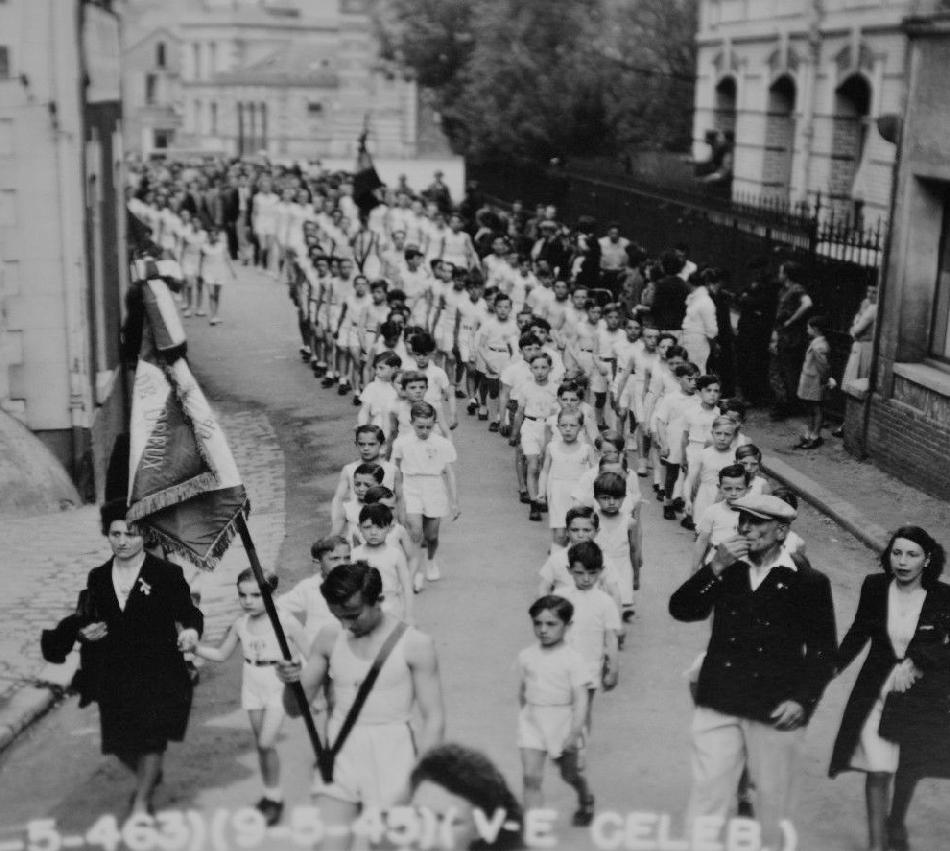
Figure 1.--VE Day was celebrted in most European countries as wll as America and Canada. In Europe the celebrations were mostly in the West and Moscow. Eastern Europeans had less to celbrate. Here French school children are marching in an organized VE Day celebration. The children appear to be from Dreux (we see that on the flag) which is a commune in northern France. The marchers go all aronf the street and here pass a printers shop. The photograph is dated May 9, 1945. Photographer American Cpt. Joseph Krynicki.
|
|
Europe and America rejoiced with end if the war that had devestated Europe. Celebrations erupted in national capitals as well as small towns in villages. Important clebrations occurred from Moscow to Los Angeles. Perhaps the most heart-felt celebration occurred in London, a city which only a few weeks earlier was still being pounded by V-2 atacks. More than one million people poured out into the streets to mark the NAZI surrender and the end of the War. Londoners massed in Trafalgar Square and up the Mall to Buckingham Palace. Here King George VI and Queen Elizabeth, accompanied by Prime Minister Winston Churchill, appeared on the balcony of the palace before the cheering crowds. The victory was that of the British people, but most understood what a critical role that Churchill played. Princess Elizabeth and her sister Princess Margaret were not there. They wanted to take part in the celebrations so they were allowed to disappear incognito into the crowd. President Truman's in America dedicated the victory to the memory of his predecessor, Franklin D. Roosevelt, who suffered a cerebral hemorrhage less than a month earlier. It is sad that the President was not able to travel to Britain to celebrate the grat victory with Prineminister Churchill. Flags in America remained at half-mast. President Truman in his remarks said that he wished "Franklin D. Roosevelt had lived to witness this day." Massive celebrations also took place in Chicago, Los Angeles, Miami and especially in New York's Times Square, but there were smaller celebrtions throughout the country. Celebrations in Paris did not rival the tumault of liberation a year earlier. VE Day unlike the liberation of Paris came as no great surprise. Allied and Soviet armies had met, Berlin had fallen, and Hitler was dead. It was obvious that it was just a matter of days before NAZI Germany surrendered. Celebrations did not take place throughout Europe. In Eastern Europe occupied by the soviet Red Army, there was a felling that they had simply exchange in totalitarian oppresor for another.
America
President Truman's in America dedicated the victory to the memory of his predecessor, Franklin D. Roosevelt, who suffered a cerebral hemorrhage less than a month earlier. It is sad that the President was not able to travel to Britain to celebrate the grat victory with Prineminister Churchill. Flags in America remained at half-mast. President Truman in his remarks said that he wished "Franklin D. Roosevelt had lived to witness this day." Massive celebrations also took place in Chicago, Los Angeles, Miami and especially in New York's Times Square, but there were smaller celebrtions throughout the country.
Britain was one of the four countries (including, Germany, Poland, and France) that was involved in the War from the very beinning. The British people did everything possible to avoid war, including appeasement Hitler to the point of near national destruction. For a time it looked to many around the world that Britain was lost. It took a great national effort, essentially drafting the whole nation for the military or war work, tearing children away from thrir familis, converting nearly the entire economy for war work, rationing on an unpecedented level, and acquiring a vast nation debt. Virtully everything people wanted was rationed--even the amount of water in the bath rub. Thus V-E Day was perhaps the greatest celebration in British hitory. Perhaps the most heart-felt celebration occurred in London, a city which only a few weeks earlier was still being pounded by V-2 atacks and in which large areas of rubble, devestated homes and other buildings, could still be fond. More than one million people poured out into the streets to mark the NAZI surrender and the end of the War. The celebrations began even before the official day of celebration on May 8. Londoners massed in Trafalgar Square and up the Mall to Buckingham Palace. Here King George VI and Queen Elizabeth, accompanied by Prime Minister Winston Churchill, appeared on the balcony of the palace before the cheering crowds. In fact they appeared eight times to make sure that everyone in the flowing crowd could see them. Churchill later gave an impromptu speech on the balcony of the Ministry of Health, telling the crowds, 'This is your victory!'
There were celebrations large and small, includiung neigborhood celbrations as well as family celebrtions.
All over the country people held fancy dress parades for children, got drunk, made a din, sang and danced in the streets, and went to church to give thanks to God for victory. The victory was that of the British people, but most understood what a critical role that Churchill has played. he King and Queen along with Churchill appeared on Buckingham Palace. Princess Elizabeth and her sister Princess Margaret were not there. They wanted to take part in the celebrations so they were allowed to disappear incognito into the crowd. One of the tragedies of the War is that President Roosevelt did not survive the War and could not make an appearance aftrwards on that balcony with Churchill nd the King and Queen.
France
Celebrations in Paris did not rival the tumault of liberation a year earlier. VE Day unlike the liberation of Paris came as no great surprise. Allied and Soviet armies had met, Berlin had fallen, and Hitler was dead. It was obvious that it was just a matter of days before NAZI Germany surrendered. Here we se the celebrtion in one French town (figure 1).
(The) Netherlnds
Formany countries, liberation came before VE-Day. For some it cane after. The Netherlands was divided at the time of VE-Day. The Allies had liberated the country south of the Rhine (September-October 1944). With the dailure of Operation Market Garden, however, the Dutch north of the Rhine was left in he NAZI grip. And Hitler decided to starve them for siding with the allies, leading to the yerrible Hunger Winter. Thus VE Day was different in these two areas. For the starving Dutch in the north it meant food and litterally life. A Dutch reader, a boy at the time writes, "What I remember about VE Day is especially the German troups marching towards their Heimat (Homeland), from where they came 5 years before as conquerers to occupy the Netherlands. Their mood was totally different now. This time they heard insults and they were here and there physically shoved or urged to hurry up by Dutch civilians. But, amazingly, some of them also received handshakes from the on-lookers, who of course were very happy that the nightmare was over. I also witnessed the chaotic departure of the Dutch Nazis to Germany --'Dolle Dinsdag' (Crazy Tuesday). And I recall the Allied (mostly Canadian) troups one year later." [Stueck]
Soviet Union
Sources
Stueck, Rudi. E-mail (November 18, 2015).
CIH

Navigate the CIH World War II Pages:
[Return to Main Victory celebration page]
[Return to Main Liberation, Surrender, and Victory page]
[Return to Main World War II aftermath page]
[Return to Main mass killing page]
[Biographies]
[Campaigns]
[Children]
[Countries]
[Deciding factors]
[Diplomacy]
[Geo-political crisis]
[Economics]
[Home front]
[Intelligence]
[POWs]
[Resistance]
[Race]
[Refugees]
[Technology]
[Totalitarian powers]
[Bibliographies]
[Contributions]
[FAQs]
[Images]
[Links]
[Registration]
[Tools]
[Return to Main World War II page]
[Return to Main war essay page]
[Return to CIH Home page]
Created: 2:26 AM 11/18/2015
Last updated: 6:23 PM 11/18/2015