***
war and social upheaval: World War II United States Army Air Corrp planning
World War II National Air Forces: U.S. Army Air Corps--Planning
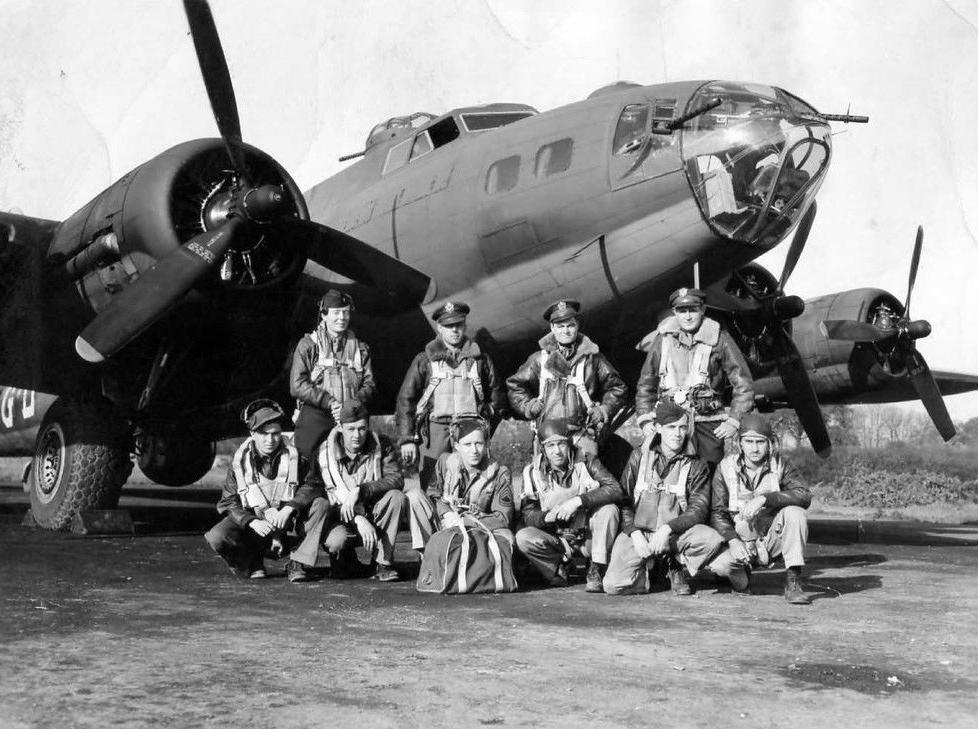
Figure 1.--The Boeing B-17 was first flown in 1935 and became operational in 1938 just as Hitler was threatening Europe with his Luftwaffe. It was perhaps the most iconic American airplane of the War. It was bristing with defensive armament--fixed and moveable guns. The press when they saw it, christened the plane 'The Flying Fortress'. (Note the front facing machine guns. This was not part of the B-17s orgininal armament, but gerrt-eigged by the crews when the Gernan fighter pilots figured out that the safest direction to attack a B-17 was head on.) The B-17 became the centerpiece of the Army Air Corps war planning. American Air Commanders who became known as the 'Bomber Boys' were sure that it could fight its way into enemy airspace during the day without fighter escorts and hit targets with percission accuracy. This is a B-17 with the 8th Air Force's 381st Bomb Group at Ridgewell Airfield, in Essex. The AAC's pre-War assessment would prove wildly optimistic, but the B-17 would be the primary platform that would tear the heart out of industrial Germany and level Berlin and the other cities of the Reich. Thankfully for American bomber crews, the United States had the industrial capacity to also build the fighter escorts that would be need for the bombers and well as by the Army for close air support.
President Roosevelt saw the importance of air power from an early point and this was only strenhthened by the Munich debacle. "Air planes -- now -- and lots of them!" is how America's air commnder summarized the President's take on Munich. "The Presient came straight out for air power. .... [Expanded Amerrican ground forces] would not scare Hitler one blankety-blank-blank bit! What he wanted was air power."
-- Gen. Henry H. 'Hap' Arnold, Commander U.S. Air Forces
World War I ended before planned strategic bombing campaigns could begin. Military strategists in the inter-War period debated the use of air power. More than any other country the United States decided to fight the next war with a massive air force. Funding was limited in the 1920s and even early-1930s when Hitler began to devote massive fund to the new Luftwaffe. President Roosevelt is known for his affinity with ships and the Navy. Less well known is his commitment toward building a massive air force, despite a bad experience with the Army Air Corps early in his administration.
Military spending was cut to the bone (1920s). And little changed after the NAZIs sized power in Europe (1933). Japanese aggressiveness resulted in increased naval spending. The Munich debacle resulted in increased air spending. President Roosevelt's priorities were the Navy and Air Corps, The President after Munich asked Congress for a special appropriation if $300 million for aircraft construction (January 1939). 【Kennedy, p.4.】
About 25 percent of American war spending was devoted to the air war. The British devoted an even higher percentage. Hitler was able to cow the Allies and gain stunning victories with a relatively small air force. Even by the time of the Battle of Britain, however, the British were already out producing the Germans in aircraft (July 1940) and American production was ramping up. American and British air commanders optimistically believed that the war could be won by air power alone. This would prove wrong, but they would make a major contribution to the War, both by strategic bombing and by by building a tactical, close ground support capability as well. Unlike the Germans, the Allies thanks to American industrial might had the capability of doing both. Ironically this was not the Army Air Corps' (AAC) intention. The AAC was dominated by Gen. Hap Arnold and the other Bomber Boys. They developed the iconic B-17 heavy bomber during the mid-1930s and they were convinced that squadron of B-17s could fight their way into the Reich during the day and destroy targets with pin-point accuracy. The rare individual who questioned the bomber thesis like Claire Chennault had his career ruined. The British were skeptical for good reason. They pursued their bombing attacks at night. The American Bomber Boys would get their chace to test out their theories after President Roosevelt and Prime-Minister Churchill announced the around the clock bombing of Germany at the Casablanca Conference (January 1943). It soon became obvious that fighter escorts were needed. So much emphasis had been placed on bombing that the AAC gave little attention to tactical close air support. The Bomber Boys disliked the very sound of the phrase, especially the idea of 'support'. They wanted to win the War. American entered the war with no tactical air doctrine. They were developing superb planes, but not doctrine or training. had superb planes, This would be developed in the field with very limited support from the Bomber Boys who dominated the AAC, but considerable support from Gen. Eisenhower and Bradley. The key figure would be Gen. Pete Quesada in the 9th Air Force who literally wrote the book on tactical air doctrine in the 4 moths before D-Day. America also had the capability of building a massive transport capability. The Axis powers had primarily tactical air forces. The Germans unlike their adversaries had developed close air support even before launching the War. It was a critical aspect of their great victories. Both Germany and Japan began bombing enemy cities from the very beginning. It proved an incredible mistake because they did not have the industrial capacity to build a strategic air force. The British and Americans did and by the end of the war, German and Japanese cities would be vast piles of rubble and ash.
Sources
Kennedy, David M. The American People in World War II: Freedom from Fear Part II (Oxford University Press: 1999), 480p.