|
" The Zero was a superior fighter. The Hellcat was a supeior weapon system. We never understood the differencve until too late. We bought swords to a gun fight and wondered why we lost."
-- Commander Saburo Sakai, Japanese Zero Ace, U.S. Navy Symposium on Pacific War Aviation, 1962
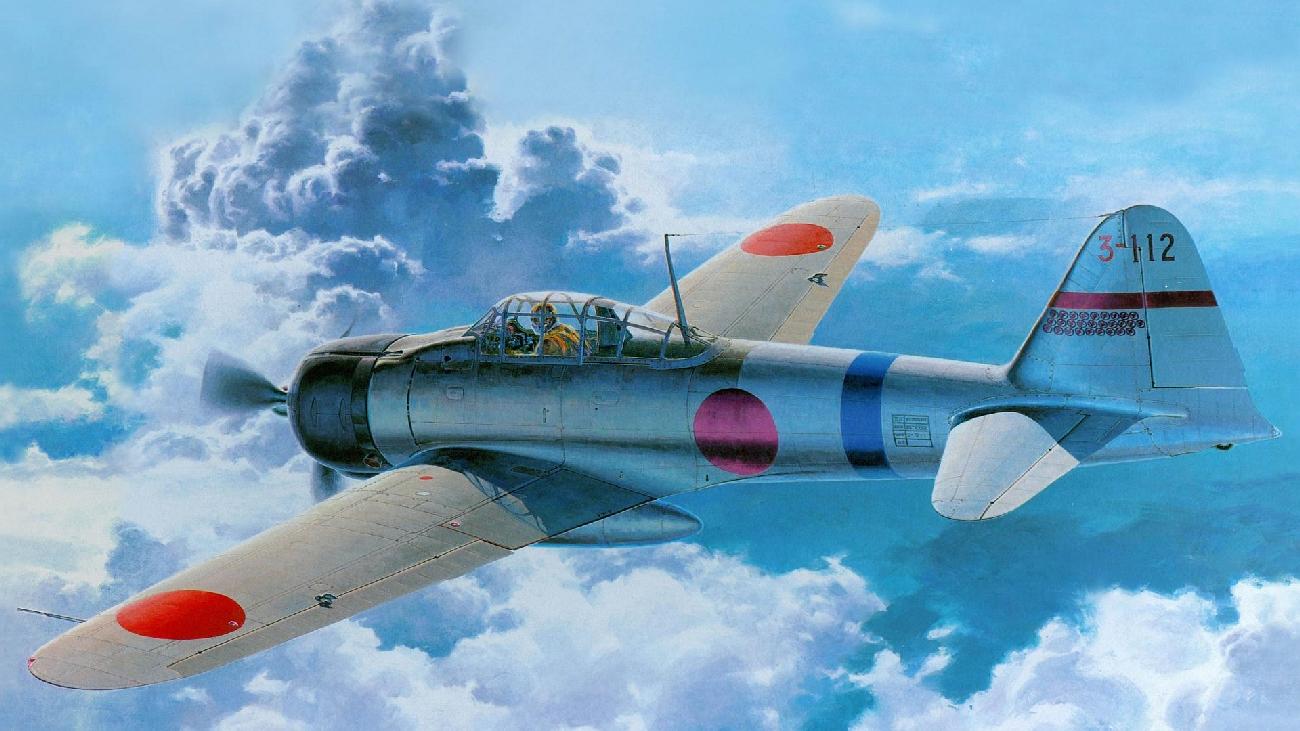
The Zero was one of Japan's secret wepons at the onset of the Pacific War. The Zero was introduced in China. Western military sources were, however, unaware of the Zero's capabilities. The Americans and British were stunned. They did not think the Japanese was capable of making a world-class fighter, let alone one which out-flew their fighters. The Japanese Mitsubishi A6M Zero was vitrtually made for the huge distances of the Pacific War. And the Zero was a major element in the first year of the Pacific War, but the phenomenal range of the Zero was effective primarily because it had no armor protection for the pilot. The light-weight gave the Zero its speed, maneuverability, and range. Japan unlike the United States did not have the industrial capacity to build the larger engines to drive the heavily armored planes which the Americans built in huge numbers. The lack of armor was not the only secret to the Zero. Its highly innovative single-piece constuction helped to reduce weight. While the Zero cut a blazing path across the Pacific, by the end of the first year of war when improved American fighters began to arrive, many of Japan's experienced pilots had been lost. The Zero was in many ways self-defeating. The Zero was not Japan;s only secreat eapon, another was marvlously trained pilots. And the lack of armor showed Japan's total failure to recognize or inability to protect this invaluable resource. The American pilots gradually worked out tactics to defeat the Zero with slower, less manuerable planes. Clare Chanaullt first worked out the tactics at the very onset of the War. American Army and Air Force commanders still did not believe the Zero was a threat. The Zero was still largely a mystery to U.S. Navy pilots when the encounteted it in the Coral Sea (May 7, 1942). Navy pilots were not sure what the Zero was. It was not until the Solomon's campaign that American pilots encounteted the Zero in numbers and began to report about it. Flyers in the Solomons also worked out the needed tactics. Another factor was the discovery of an intact Zero in the Aleutin Islands. As part of the Midway Plan, Japanese aircraft attacked Dutch Harbor in the Aleutian Islands. One Zero fighter was damaged. It was flown by 19-year-old Flight Petty Officer Tadayoshi Koga from the carrier Ryujo. He had to crash land on Akutan. The A6M2 Model 21 was one of the most up-to-date models. It was later discoverd virtually intact and studied. American flight evaluations of the restored aircraft were conductted (September-October 1942). The Americans North Island Naval Air Station in San Diego were able to learn the performance capabilities and limitations of the Zero. The Navy test pilots found that the Zero had superior maneuverability only at the generally lower speeds used in dogfighting. At low speeds the Zero could indeed make tight turns and had excellent aileron control. As the plane accelerate beyond 200 knots, the ailerons woukd freeze. Rolling maneuvers at low speeds were thus slow and required substantial force on the control stick. The Zero rolled to the left much easier than to the right. In addition its engine tended to cut out under negative acceleration, such as nosing into a dive, as as a result of the float-type carburetor. Army pilots als test flew the Xero. This information proved invaluable to the new air groups being formed to do battle with the Japanese in the Pacific. Suggested flight tactics were worked out for each major fighter in the American inventory. 【Rearden】
Rearden, Jim. "Koga's Zero Fighter".

Navigate the CIH World War II Section:
[Return to Main World War II fighter page]
[Return to Main World War II air weapns fixed-wing types page]
[Return to Main World War II air weapon types page]
[Return to Main World War II air weapons page]
[Return to Main World War II air technology/tactics page]
[Return to Main World War II technology/tactics page]
[Biographies]
[Campaigns]
[Children]
[Countries]
[Deciding factors]
[Diplomacy]
[Geo-political crisis]
[Economics]
[Home front]
[Intelligence]
[Resistance]
[Race]
[Refugees]
[Technology]
[Bibliographies]
[Contributions]
[FAQs]
[Images]
[Links]
[Registration]
[Tools]
[Return to Main World War II page]
[Return to Main war essay page]