|
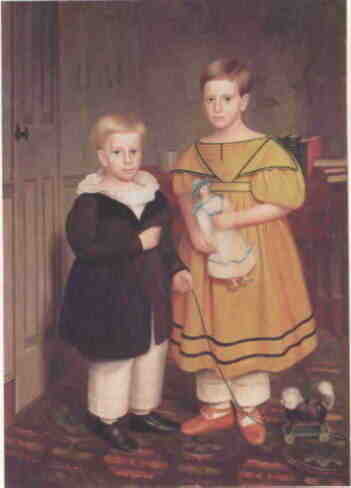
Many fascinating American primitives exist providing a wealth of information about children's fashions. While the artist is not known, in some cases the children depicted and the approximate date of the paintings are known. These portraits are some of the few sources of information as to what American boys were actually wearing in the early 19th century before the advent of photography. Thes artists are particularly important as unlike the work of the more accomplished artists, these primative/naive artists painted the children of more ordinary less wealthy families--giving a helpful glimse of popular fashion Here we have some infirmation collected on anonamous artists we have found. We will discuss what little information exists about these artists including what can be inferred from the portraits.
A portrait by an unknown artist shows two children with the younger boy's black nurse. All we know about the artist is that he worked in Virginia. American artists at the time generally worked in generally restricted areas, so this is useful in attempting to identify artists as is the date of the work. We have been able to find little information about the individuals depicted. The Virginia Museum of Fine Arts, Richmond identified the children as the "grandchildren of Virginia's Governor Spotswood", but the children are not named. The Museum dates the painting to the 1790s. Alexander Spotswood was a Lt. Governor (1714�1722), but because the governor was an absentee official, he acted more like the govenor. He played an important role in Virginia colonial history and is especially remembered for ending the rapacious attacks of the notorious pirate, Blackbeard (1718). He had four children. Given the children's age, they are mostly likely the childten of Anne Catherine Spotswood (1728-c1802) and Col. Bernard Moore, Esq., of Chelsea, King William Co., Virginia. He was related to Sir Thomas More, of Chelsea, England, the author of Utopia and executed by King Henry VIII. Descendents include Genetral Robert E. Lee and Helen Keller. Ann Catherines siblings became involved with George Washington and Patrick Henry. The term 'nurse' for the young women seems to describe the young woman's assignment, but not her status. In Virginia at the time she almost certainly would have been a slave. She is barefoot, but better dressed than most slaves would have been at the time, presumably because she was a household slave. The older boy is coming from hunting with a bow and arrow. Note he is wearing a suit even though he was hunting. As was still common at the time the suit has knee breeches. The little boy is wearing only a shirt or perhaps a night shirt. The sky suggests that it is morning or evening. The portrait is in the collection of the Virginia Museum of Fine Arts, Richmond.
|
A HBC readers tells us that at the Art Institute of Chicago there is a large family portrait entiteld "Mrs. Noah Smith and Family", dating from 1798; the artist is unknown, but the portrait is known to be of an American family. Among the Smith children are two boys, aged something like 7 and 10, in clothes of a type I don't believe I've seen on your site. They wear nearly identical suits, save that one is green and the other is red. Each suit consists of a coat with a fancy white ruffled collar, rather low-cut, not unlike a modern sports coat in proportions; and a pair of pants of the same material, rather plain. Both boys wear white stockings and low black slipper-like shoes.
This unidentified American primitive shows the pantalettes worn by young children with tunics and dresses (figure 1). Some like these were plain, others were much more fancy. Wehave no information on the artist , but we would guess it was painted in the 1820s, presumably in one of the northeastern cities.
American settlers began moving into the Ohio River Valley even before the Revolutionary War (1770s). This was at first mistly Kenticky and Pennsylvaia. After the War, migration oncreased and the settlementbid Ohio began. A major factor was the building of the Erie Canal (1817-25). This American boy may have been painted in the Ohio Valley (figure 2). He is holding a flute, suggesting it was important to either him or his mother. Note the collar and hair style.
|
The Cogdon brothers were painted by an anonymous American primitive artist about 1830 (figure 3). They were from East Greenwich, Rhode Island. The painting shows that the skeleton suit and large ruffled collars were still being worn in the early 1830s. The style, however, went out of fashion in the 1830s.

Navigate the Boys' Historical Clothing Artist pages:
[Return to the Main primitive artist page]
[Return to the Main American art page]
[Return to the Main style page]
[Blake][Johnson][Stock][Waters][]
[Chronology][Countries][Individuals]
Navigate the Boys' Historical Clothing Web Site:
[Return to the Main dress page]
[Return to the Main pantalettes page]
[Introduction][Activities][Biographies][Chronology][Clothing styles][Countries]
[Bibliographies][Contributions][FAQs][Glossaries][Images][Links][Registration][Tools]
[Boys' Clothing Home]