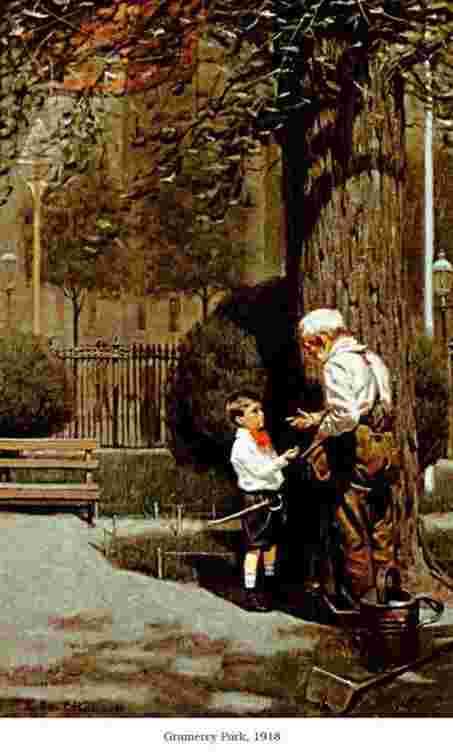
Figure 1.--Rockwell is best known for his "Saturday Evening Post" covers, but he drew book illustrations, calendars, advertisements and much more. |

|
One of the most well-known an beloved illustrators is Norman Rockwell. He portrayed America as we would all like to remember America. Perhaps America never quite lived up to the Rockwell's idealized drawings, but there are few Americans for which he does not hold an instant appeal. He was increadably prolific, over 2,500 magazine covers, advertisements, calendars, and various other published works. Rockwell's early illustrations were done for St. Nicholas magazine, the same magazine which first published Little Lord Fauntleroy. He also worked for other juvenille publications. He sold his first cover painting to the Saturday Evening Post in 1916 and ended up doing over 300 more. Presidents Eisenhower, Kennedy, and Johnson sat for him for portraits, and he painted other world figures, including Nassar of Egypt and Nehru of India. In his later years he addressed social issues like the Civil Rights movement. He is perhaps best known by many for his Scout drawings. In an era of abstract expressionism, Rockwell never achieved the stature of contemporaries like Jackson Pollock in his lifetime. But, as the film reveals, his familiar images have found a permanent place in the American psyche.
The pictures of Norman Rockwell are recognized and loved by almost everybody in
America. The cover of The Saturday Evening Post was his showcase for over forty years, giving him an audience larger than that of any other artist in history. Over the years he depicted there a unique collection of Americana, a series of vignettes of remarkable warmth and humor. In addition, he painted a great number of pictures for story illustrations, advertising campaigns, posters, calendars (especially Scout calendars), and books.
Norman was born in New York City (1894). His parents were Jarvis Waring Rockwell and Anne Mary "Nancy" (born Hill) Rockwell. His earliest American ancestor was John Rockwell (1588–1662), from Somerset, England, who immigrated to America probably in 1635 aboard the ship Hopewell. He was one of the earlest settlers of Windsor, Connecticut. He had one brother, Jarvis Waring Rockwell, Jr. a year and half older. Norman had a comfortable childhood. His father was the manager of the New York office of a Philadelphia textile firm, George Wood, Sons & Company. The elder Rockwell spent his entire working career with the company, beginning as an office boy. Both parents were very religious. Norman and his brother sang in the church choir. Norman was a slight, rather skinny boy. He was not good at sports. He lived in a rather rough neighbourhood on the Upper West Side and came to fear the tougher boys. His mother bragged about her English heritage and artistic amvestors. She tended to coddel Norman. He was, however, not close to his mother who often complained of largely imaginary illnesses. He also later complained of her periodic frenzies of religious fervor. Much of these childhood experiemces can be seen in his work. We also see the styles children wore in the 1900s and 10s dominating many of his earkly drawings. Norman from a very early Age knew that he wanted to be an artist. Here his father was undoubtesky an influence. He was an amateur artist and would spend time with Norman copying illustrations out of magazines. His father also read to the family. Charles Dickens' work was aarticular favorite. While his father read, Norman would draw the characters in the novels. One art critic sopeculates, "His strong sense of narrative and his eye for the telling detail were byproducts of those long, nurturing evenings in his father's company." The family would spend summers at farms in the country to get away from the heat of the city and enjoy the fresh air and greenery. He seems to have enjoyed these excursions. "I have no bad memories of my summers in the country." He thinks that these summers in the country 'had a lot to do with what I painted later on'. [Rockwell] The family could afford books and magazines. Norman was thus exposed to the Golden den Age of American illustration. He was particularly taken with the work of Charles Dana Gibson, Harrison Fisher, Howard Pyle, and Newell Convers Wyeth. The family as the senior Rockwell prospered moved out of New York City to leafy Mamaroneck (1907). This was a small suburban settlement on Long Island Sound.
The move to Mamaroneck disrupted his schooling. At first Rockwell went to the local high school where he entered as afreshman. He was, however, more interested in art. He began at the age of 14 years studying part time at the the New York School of Art (1908). This was an institution run by the artist, William Merritt Chase. As aesult it was at first called the Chase School. This required, however, a 25 mile trip back to Manhatten. During his Freshman year in high school he gradually began devoting more time to his art lessons. The next year after beginning his sophmore year, he left high school to attend classes at the National Academy of Design (1910). Rockwell found the teaching at the academy very conventional. He quickly transferred to The Art Students League. There he was such aerious studehnt that he becane jkniwn as the 'Deacon'. He studied under Thomas Fogarty and George Bridgman. It was Fogarty’s instruction in illustration in particular that prepared Rockwell for his early commercial commissions. Bridgman helped with Rockwell's technical skills.
Rockewell worked not only from a number of live child models but from fotos. He had a fotographer working with a large format camera take many of the stage shots from which he would later work. Many of the models were boys and girls living in the small New Hampshire town where he worked. He painted some especially poignet works about a young girl as she was growing up. Most of the Scouts drawings after he moved to Stockbridge, VMassachusetts were from the neighborhood boys.
Rockwell's work is enormously both prolific and diverse. As so many of his illustrations dealt with children, they charmingly chronicle chaning fashions through much of the 20th century, from the 1910s-70s. He is best known for his magazine illustrations, especially those for the Saturday Evening Post. He created illustrations for many other mediums as well. We have dealt information on many of the major areas in which he worked.
One especially notable aspect of Rockwell's work is the meticulous detail in his drawings. As a result his body of work represents a woinderful albeit idealized view of American families and life style. His work also provides a rich archive of clothing styles over time. Because he drew with such fine detail, his drawings are a rich source of information on the clothing worn during the decades in which Rockwell was active. Many illustrators produced charming although often not accurate images. This was decidedly not the case of Rockwell. His illustrations are not only charming and detailed but very accurate as well.
Although his vast body of work has often been dismissed or stereotyped by art historians. Even so, Rockwell remains one of 20th-century America's most enduring and popular artists. Now, 100 years after his birth, he is achieving a new level of recognition and respect around the world. Others have begun calling Rockwell as "the most American artist of them all". Throughout his long career, Norman Rockwell always considered himself a commercial illustrator, privately harboring deep insecurities about his ability and value as a bonafide artist. Despite the ongoing debate over his artistic merit among certain critics, one thing is clear as we approach the end of the century: As a powerful visual storyteller, Rockwell helped define the ideal and, ultimately, the reality of America in the 20th century. Rockwell's prolific career, streaches from the days of horse-drawn carriages to that momentous leap that landed mankind on the moon. While history was in the making all around him, Rockwell chose to fill his canvases with the small details and nuances of ordinary people in everyday life. Taken together, his many paintings capture something much more elusive and transcendent -- the essence of America's collective spirit. "I paint life as I would like it to be," Rockwell once said. His own words, incorporated into the narration of the film and culled from archival interviews, reveal a great deal about the man and his work. Mythical, idealistic, innocent, his paintings evoke nostalgia for a time and place that existed only in the rarefied realm of his rich imagination and in the hopes and aspirations of the nation. According to filmmaker Steven Spielberg, "Rockwell painted the American dream--better than anyone." Spielberg, describing Rockwell's influence on his own work, is among many prominent people interviewed in the film. Others include painter Jamie Wyeth, art critics Robert Hughes and Arthur Danto, art historian Robert Rosenblum, authors Richard Reeves, Karal Ann Marling, and Thomas Buechner, and advertising executive Jerry Della Femina. Rockwell's son, Peter, and models and photographers who worked with the painter offer a more personal perspective on his life.
In 1957 the United States Chamber of Commerce in Washington cited him as a Great Living American, saying that..."Through the magic of your talent, the folks next door - their gentle sorrows, their modest joys--have enriched our own lives and given us new insight into our countrymen."
Rockwell, Norman. Autobiography.

Navigate the Boys' Historical Clothing Artist pages:
[Return to the Main illustrator page]
[Return to the Main artist page]
[Chronology]
[Countries]
[Individuals]
[Styles]
Navigate the Boys' Historical Clothing Web Site:
[Introduction]
[Activities]
[Biographies]
[Chronology]
[Clothing styles]
[Countries]
[Bibliographies]
[Contributions]
[FAQs]
[Glossary]
[Images]
[Links]
[Registration]
[Tools]
[Boys' Clothing Home]