
Biographical Details on Boys' Clothing Styles: Ordinary People Alphabetical Page (B)


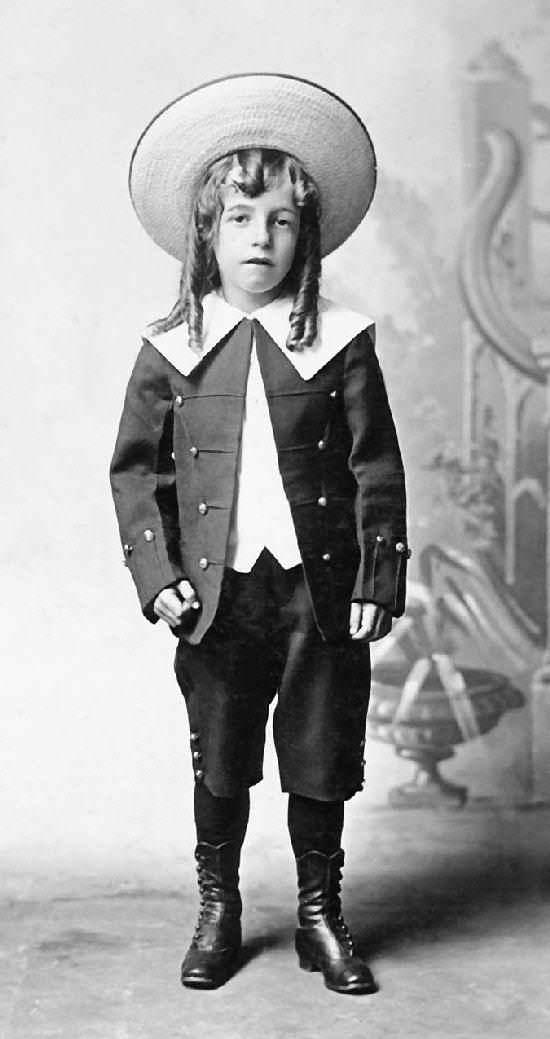
Figure 1.--Henry Reginald Bacon was photographed at 7 years of age wearing a natty military-styled kneepants suit and ringlet curls. His wide-brimmed sailor hat covers much of his head, making it difficult to see all of the hair style.

The HBC biography section is for people or families that have achieved some degree of notariety or fame. HBC readers in many cases have submitted family portraits. HBC has until now not added them to the biography section. We believe now that this is a mistake. Many of the HBC readers contributing family portraits can also provide details about the boy and him family. This background information help us to assess social trends and put the fashions involved in perspective. This is just why the biographical section is an important part of HBC. As a result, HBC has decided to create pages for these relatively unknown people, when some basic family data is available. Incidentally if you find a relative here, please do tell us somehing about him. Here we are listing these biographies alpahabetically to facilitate looking up individual names. The alphabdetical list is the primary data base in this section. While we have not persued geneolgical resreach on these individual, having the names and in many cases the loaction provide the potential to acquire more back ground information in the future which may provide additonal insights into the fashion and life style trends.

B,, H.F. (United States, probably 1880s)

The boy here wears stylish knee pants suit. Unfortunately all we have is his initials--HFB. We do know that he was 11 years old. The portrait is a cabinent card. We would guess that it was taken aout 1890. It looks to as a portrait taken in the late-1880s, but the early-90s is quite possible. The boys suit has vertecle vents and he wears an Eton collar with a destinctive checkered floppy bow. The setting is interesting with the boy leaning on an ornately carved elephant table. The back of card states that this is "From The New Mammouth Portrait and Photographic Parlors of Walter E. Chickering. The cabinent card mount is black with gold/gilt lettering. There was also gilt beveled edge.Chickering had studios at 476 & 627 Washington St., Boston., near Jordan Marsh & CO. and Globe and Park Theatres.

Bacon, Henry Reginald (England, 1903)

Henry Reginald Bacon had his photograph his photograph taken in Brightlingsea, Essex during July 1903. He wears a wide-brimmed sailor cap and long ringlet curls. He was 7 years old. He has a kneepants suit with military styling worn with an enormous Eton-style collar. Henry has long ringlet curls which have been carefully layed on his shoulders. Four ringlets can be seen. Because of the hat, it is difficult to make out how the hair on his forehead was done. It looks like rather than bangs, his hair at the front was done in short curls.

Bailey, Frank (United States, about 1915)

Here is a full-length studio portrait of Frank Bailey. Frank is an American boy born in 1900. He looks as though he were about 15 or 16 in this posed portrat. This surely is a school portrait because he is wearing what a school cap with piping, resumably in the school colors. This suggests he attended a private school. Frank wears a formal three-piece knicker suit with long black stockings and hightop shoes with metal hooks for lacing. Often American private schools did not have an actual uniform, but required the boys to wear suits. Frank also wears a formal watch chain with fob on his waistcoat (vest). Notice the stiff detachable white colar, worn with collar pins to keep it in place. He has got something in his jacket pocket that makes the coat hang a bit awkwardly. The photo would have been taken in about 1917. We do not know the location.

Bailey, Robert Nelson (Canada, 1907)

Robert Nelson Bailey had his photograph taken on September 16 1907. He was 3 years old at the time. He wears a sailor tunic with matching large soft cap. The tunc suit was fairly standard, the material rather unusual. It is notable because it was made in polka dot material. Presumably his mother bought the material and made it from the pattern. We believe that the boy was from New Brunswick, probably southern New Brunswick.

Baird, Tom (United States, 1860s)

Here we have a Civil War era CDV of a boy who looks to be about 10 years old. He is from Montgomery, Alabama which is interesting because Civil war images of northern boys are much more common than southern boys. The photographer was J. H. Lakin. The portrait is undated. It was provably taken during the War, but if not was surely taken soon after. The boy wears a cut-away jacket with voluminous long pants. Also noticed his narrow-brim hat. The portrait was fiund in a copy of the rare Confederate Imprint History of the Fourteenth Regiment Alabama Vols. by M. B. Hurst (Richmond, Virginia: 1863). The boy's name is inked at the bottom. Unfortunaletly the writing is not very clear. It looks like Tom Baine, Baisch or Baird (it's definitely "Tom Bai__" (and I think Baird is the most likely choice). Possibly he had some connection with the 14th Alabama. He looks too young, however, to be a drummer boy,

Balfour A. (Canada, 1898)

Here we have a portrait (taken at a professional studio in Montreal on December 2, 1898) showing Master A. Balfour in a big-collar Faunterloy blouse. The boy seems to be about 10 years old. The photograph gives us an excellent view of the blouse with its complicated full sleeves and ruffled cuffs. It seems to have a large collar with lace or ruffled trim and matching white or pastel bow. The boy wears form-fitting, light colored knee pants (probably beige or tan) but apparently without the usual ornamental buttons at the knee--although we do not have a side view.

Banthrop, Charles (United States, about 1890)

This boy is Charles Banthrop. He is identified on the front as "Chas Banthrop". He was 6 years old. The photographer and thus the location is is not indicated. The boy could be British, bur we think he is provably American, the floppy bow and long stockings in particular point to this. The boy's jacket is not clearly shown. It might even be a tunic. He wears a large starched collar with scalloped edges. The coolar may have been detachable or a pin on collar rather than part of a blouse, but this is difficult to determine. He also has a moderate-sized plaid floppy bow. Charles wears knee pants and long stockungs. The long stockings are dark, but may not be black.

Barad Twins (United States, 1931)

These twins had their portrait taken in 1931. They look like fraternal twins. Unfortunately the hand writing on back of the portrait is very poor. It looks like it could be Barad, but we are not sure. Another possibility is Braud, but we think Barad is more likely. HBC readers may have a better idea. We do know their Christian names. The boys are Charles Stuart and Robert Gerald. The portrait was taken on their 5th birth day during February. The Winter date explains why the boys are wearing long stockings. The boys wear stripped shirts with sports collars, self-belted wool short pants, long stockings, and high-top shoes. The boys hold a stuffed doll and a black doll. I suspect that these are studio props. We do not know where the portrait was taken.

Barnes, Jasper (United States, about 1910)

Jasper Barnes looks to be about 4 years old. His portrait was taken by Alpha Lomax in Atlanta, Georgia. He has short above the shoulder ringlet curls and wears a dark, traditionally styles sailor suit. The portrait is undated. The fact that is not an albumen print and the type of paper fram suggest to us that it was not taken at the turn-of-the 20th century, but in the late 1900s or early 1910s. The shot ringlets here are another factor. Ringlets were becoming less common in the 1900s. We still see long ringlets in the early 1900s, but much less so in the late 1900s. Ringlets did not disappear compleletly. We we still see younger boys wearing short ringlets in the 1910s, especially before World War I.

Bartle Brothers (Canada, 1895-1910?)

Here we have a portrait of the three Bartle brothers from Ontario, Canada . The portrait is undated. The reader who sent it to us estimates that it was probably taken some time between 1895-1910. We mught guess that it was taken after the turn-of-th-20th century, but during the 1900s. One reason that it is difficult to date the image is that the boys wear old well worn clothes. The lack od fashionable styles makes it difficult to come up with an estimated date. The portrait is somewhat unusual in that it seems to be a professionally done portrait. Most professional portraits have children done up by their parents in their best clothes. Here there was no attempt to dress up the children and is thus of interest as it shows how working-class children might have dressed at the time.

Bartram, Harold and Rolland (United States, late-1890s)

This cabinent portrait shows two brithers, Harold and Rolland Bartram. The portrait is undated, but looks to have been taken in the 1890s. The perforated edges of the mmount along with the whicker furniture suggests to us that the portrait was taken about 1895-1900. The studio was the National Art Company's Railroad Palace Photograph studio. The boys look to be about 3-6 years old. The youngervboy wears a Fauntleroy kilt suit. He has a smll cut-away jacket amd a kilt skirt. His older brother wears a double-breasted knee pants suit. Both boys wear long stckings. They also look to be wearing similar square-collar blouses and large floppy bows. The floppy bows look to have the sme candy-strip pattern. The little boy has long hair, but it does not looked curled.

Baslian, Erich (Germany, 1907)

We note a German boy photographed in Darmstadt during March 1907. We do not bknow how old he was, but would guess about 6 years old. He has long, but not shoulder-length hair. German boys at the time commonly had short even, shaved heads. This portrait shows that some German boys had long hair, although it was much more common in other countries such as France. Erich wears a kneepants white sailor suit with three-quarter length dark socks. He was photographed with a hoop, a popular play item at the time.

Bätcher, Max and Georg (Germany, 1860s)

Here we have the Bätcher family. All we know about the family is that they are German and that the boys are Max and Georg. They look about 8 and 11 years old. The portrait is undated, but looks to have been taken in the 1860s. We do not know where in Germany the family lived. Of course in the 1860s Germany as a united country did not yet exist. The family looks to have been a prosperous middle-class family. The adults look rather old, they may have been the grand parents. The boys are dressed identically in what look like velvet jackets. The jackets are done with large buttons, but have no collars. The boys wear long pants. Kneepants were not yet commonly worn.

Bate, Harold (England, 1870)

A watercolor painting from 1870 shows Harlod Bate wearing intricately done ringlet curls. Unfortunately we have no provinance on the painting, except that on the back it indicates that he was 2 1/2 years old at the time and wears a blue dress or smock with a small neck frill. The fact that he had a reasonably high-quality watercolor portrait done of him suggests that he came from an affluent family. We note that he has a large top curl in addition to his ringlets. This is a style we have also noted in America, at the time. It seems to have been a destinctively boyish hair fashion. At least we have not yet noted it on girls.

Bayly, Vere Talbot (England, 1910-11)

Vere Talbot Bayly and his friend Roy (last name unknown) were photographed together, proably outside Roy's home in Bath. The photograph was undated, but probably taken about 1910. As with so many of the photographs taken at this time, there is a sad aspect to this image. According to The Commonwealth War Graves Commision, a 2nd Lieutenant Vere Talbot Bayly was killed on the May 8, 1916. He was only 19 years old. He was serving with the 7th Battalion of the Dorsetshire Regiment. Lieutenant Bayly was the only son of Isabel H. J. Bayly, of "Oaklands," Lansdown, Bath, and the late Langton G. Bayly. At first I assumed that these boys were brothers but from the above I now think that Vere was a friend of Roy. I would guess him to be about 12 or 13 when the photo was taken, dating it to around 1910-11. An interesting aspect is that these boys were photographed at about the same time William D. Boyce encountered the famed unknown Scout in London, an encountered which launched the American Scout movement.

Beasley Family (United States, 1890)

We note a portrait of the Beasley family in 1890. The portrait was taken in Tennesse, but we are unsure just where. It looks to be a farm fmily or at least a family in a rural area. Presumably the portrit was taken by an itinerate photographer as the photograph was taken outside the family home. There are four sons and and three daughters. One of the daughters may be an aunt. The boys all wear suits. The jackets have what look like men styling, but with differently cut lapels. The younger boys wear kneepants and are barefoot. Notice all but the oldest boy has close cropped hair.

Beckett, M. E. (Canada, 1899)

Here is a professionally taken photograph in Montreal. This one is of Master M.E. Beckett, taken in a Montreal studio on December 6, 1899. I would assume that young Master Beckett, a boy of about 16 or 17, hailed from a prominent Anglophone family in the city. He is very elegantly dressed in the style of a young adult except for the teenage knee pants and ribbed long stockings (black of course, as would have been standard). The suit is quite beautifully tailored and may have been bespoke (that is, made to order by one of the several Montreal tailoring establishments). It is in the Norfolk style with a belted front and additional strips of cloth down the front (and probably the back as well).

Benedict, Warren and Carolyn (United States, 1929)

Warren and Carolyn Benedict had their portrait taken during 1929 in Crawsfordsville, Indiana. Carolyn was about 8 years old and her little brother Warren about 6. Carolyn wears a plaid dress with dark collar and cuffs, hightop shoes and unusually patterned long stockings which come to just above her knees. Her brother Warren wears a one-piece belted short pants suit with matching white collar and cuffs, long beige stockings of conventional length, and hightop shoes. The children appear to be wearing typical school-age clothes of the late 1920s and early 1930s, although the girl's patterned stockings look a bit anomalous.

Benjamin, Horace (United States, 1890s)

Here we have a portrait taken at the M. J. Brady, eisert's block, Petersburg, Ind. It is undated, but we would guess it was taken in the 1890s, although I am not sure about that. The boys name was Horace Benjamin. Along the right hand edge was written "etta Boy". I'm not sure what that means. Horace looks to be about 5 yeatrs old. He wears a collar buttoning jacket, perhaps with a little Norfolk styling, with a wide white collar, but no bow. What is interesting about the portrait is Horace's toy drum. We susperct that this is in part a reflection of the legendary status of Civil War drummer boys. Perhaps his grandfather was a Civil War soldier, or even a drummer boy.

Benton, Ralph (Germny/United States, 1896)

Ralph Benton was born in Germany on August 2, 1884. All we know is that he was born in Munich. We are not sure, however, that he was a German boy. Benton does not seem like a very German name. I'm not sure, but it seems more English. It is possible that he was the son of an American family living in Germany. Well to do Americans did travel to Germany and many studied there because of the prestige of German universities at the time. But he may have well been the member of a German immigrant family. Based on the way he is outfitted, the family seems to have been a rather affluent one. And some German immigrants had their names Americanized. We see Ralph in September 1896 having just turned 12 years old. Hos portrait was taken at Clinedinst, 1207 F Street, NW., Washington, D.C. This was the major shopping street in Washington. Ralph wears a traditional knee pants sailor suit with long stockings. His hair in done in ringlet curls. This was rather unusual both for German boys and 12 year old American boys. It means the family must have been affluent enough to have Ralph tutored at home.

Bickle, Penn (England, 18??)

Here we have a photograph of Pinn Bickle. All we know about him was that he was convicted of a crime in England. We do not have any details about his crime or his sentence. Our information on how children were treated in the English criminal justice system is incompledte. We are unsure when facilities like borstals, sprecizalized facilities for children first zappeared. Many boys this age were deported to Australia or other colonies. More than likely it would have been something like theft. He looks about 12 or 13 years old. We are not sure when the photograph was taken, but would guess it was the late 19th century.

Bisthos, Hans (United States, 1925- )

Hans was from a German immigrant family. The name Hans suggests that the family were recent immigrants. We know little about or his family. We do know that the family enrolled Hans in the youth dibision of the Friends of the New Germany, the NAZI front organization in the United States. We see here him on a camping trip during 1934.

Blanchenburg, Ervin Emile (United States, 1905-10)

This portrait is undated, but was probably taken about 1905-10. The boy is Ervin Emile Blanchenburg. He wears a white lawn sailor tunic and has long ringlet curls. These tunic suits were very popular at the time, although ringlets for boys were beginning to become less common. He looks to be about 6-7 years old. Yhe studio was Terikelson & Henry, San Francisco.

Blandings, William (United States, 1934)

William blandings came from a wealthy Rhode Island family. We note several photographs of him and his older sister in 1934. The two seem close. They were about the same age and photographed together. He was known as "Billy". We know little about the family, but the fact the family had a chauffeur of course means that they were wealthy, We see Billy dressed both formally and for play. He wears a Eton short pants suit with beret. For play he has a swabie sailor cap.

Blasque, V.A. (United States, about 1870)

This New York City boy had ha CDV portrait taken at the Rockwood studio on Broadway. The name written on the back looks like V.A. Blasque, although the writing is a little difficult to read. The only other information I have on the origin of this CDV Photo is that It was with other photos from the mid- to late-19th century from photographic studios in Michigan, Washington D.C., and Colorado, with the surnames of Bailey, Stoddard, Mabons, and Thompson. The boy looks to be about 12-13 years old. We are not entirely sure when this portrait was taken. The military looking collar buttoning jacket was a popular style in the 1850s and 60s. And the CDV was a popular portrait format in the 1860s. The studio set, however looks more like the 1870s. Thus we would guess the portrait here was taken sometime around 1870. It could have been taken any time dyring the late-1860s or early-70s.

Blatt, Willie (United States, 1870s)

This cabinet card portrait shows a boy from Reading, Pennsylvania. The portrait by the New Tork Gallery is undated, but we would guess it was taken in the 1870s. The boy is identified as Willie Blatt. He wears a very plain long black dress. The only decoration is a long vertical column of buttons and a very small ruffled collar. The boy looks to be about 3-4 years old. It is a long dress with a hem down to the boy's calves.

Blewitt, Molly and Betty (England, 1920)

This is a photo postcard from an English studio. The only identification is the children's names--Molly and Betty Blewitt. The portrait is undated, but the HBC reader who contributed this believes that it was taken about 1920. Our reader writes, "Here are some toughts which are not so far from truth. The portrait was taken by an English professional photographer. It was taken without those landscape backgrounds which jam any attention from the subject. We are looking at two girls , probably twins, wearing sailor dresses which were so popular from in the early 20th century. The short lenght of the coats is characteristic of clothing in the 20s for women and also boys and girls. These coats were also worn by boys and the only difference telling the gender were the buttons overlapping at right instead of left for girls. The material is a heavy wool fabrics which suggests that the portrait was taken in winter but inside the studio.

Boardman, Kenneth (United States, about 1905)

This portrait of two American children looksto have been taken about 1905, based on the clothes and mount. We can't make out the photographers information, but looks to be something like Mattod, Illinois. We at first thought the children were two sisters, bur they are a boy anf girl, presumably cousins. Their names are written on the back of the portrait: "Aldeau Larkin and Kenneth Boardman, Aunt Lizzies children". They both wear white dresses and have white hair bows. They look to be 2 and 4-5 years old.

Bowles Family (United States, 1860s)

An unidentified painter did a beutifully detailed portrait of a young boy from the Bolles family of New London, Connecticut. The portrait is undated but looks to be from the the 1860s. He wears a grey suit with oversized weid sleerves and the kneepnats that were beconming fashionable in the 1860s. Early kneepants like these temded to be quite long.

Boyden, C. Olin (United States, 1852)

This is a sixth plate daguerreotype portrait of a little boy in a high chair. The tablecloth has been beautifully hand tinted, a common practice in dags. This is aarticularly valuable dag because it is dates and the boy identified. Most dags are not identified. The pad opposite the image identifies the boy as "C. Olin Boyden, Aged 2 years & 8 months, August 2d, 1852, Columbus, Ga". The dag is housed in a full case (split spine) with a floral design. The oval metal frame is very plain.

Bracke, Emil (Germany, 1899)

This German school boy was photographed in the sailor suit that he wore to school. He wears a sailor hait that looks rather like an English boater hat. His dark sailor suit buttons at the front and the "V" collar seems to have three emroidered dark stripes. The suit has kneepants which he wears with lighter colored long stockings. The boy has an elaborately emroidered white dickey, but I can't make out what the design is. I'm not sure how his hair was cit, but it looks rather close cropped. His name was Emil Brack. We do not know a great deal about Emil, except where the portrait was taken. He looks to be well outfitted for school so we assumed his family lived in comfortable circumstannces. Emil looks like a younger primary school boy, but it probably was not his first day of school.

Brakey, Robert J. (United States, 1900s)

This cabinent card shows Eobert J. Brakey and presumably his little sister, C. E. Brakey. We do not know where in the States they were from. The style of the cabinent card suggests that the portrait was taken in the very early 1900s. The classic Fauntleroy suit was still worn in the early 1900s, but rapdly goping out of style after mid-decade. Rober wears a classic cut-away jacket Fauntleroy with a large ruffled collar. Robert looks to be about 5 years old.

Brewers, Sammie Tate (United States, about 1905)

Here we see Sammie Tate Brewers. He was 5 years old when his portrait was taken in Kisse, Texas. I'm not sure just what kind of cap he was wearing. It is undated but was probably taken about 1905. Sammie wears a kneepants sailor suit. I'm not sure what the color of the suit would have been. The most interesting aspect of the portrait is that his mother has added a very large white ruffled collar.

de Broglie, Princess Marguerite and her Cousin Robert (France, 1890)

This portrait is of Princess Marguerite de Broglie and her cousin Robert. It was painted in 1890. The artist is Carolus Duran (1837-1917). Marguerite was the daughter of Albert de Broglie, who was a prime minister. I do not have much information on the prestigious Broglie family, but the genealogical tree including marshals, writers, a 'President du Conseil' (Prime Minister) and a Nobel prize-winning scientist. We're not sure about Robert's last name. The children are clearly European. An American boy would have never worn three-quarter socks like this, but always long stockings.

Brown Family (Canada, 1897)

One of the most common English names is Brown, which means it is also a common name in America and Canada. Here is another professional protrait taken in Montreal (December 18, 1897). The white porch railing and potted plant are obviously part of a professional photographer's set and give the appearance of a spring or summer scene even though the picture was actually taken during a wintry Montreal December. The boy and girl are brother and sister. Unfortunately we don't know their Christian names, but the name Brown obviously places them among the Anglophone and probably affluent ruling elite of the city.

Brown, Dan (United States, early 1870s)

Dan Brown had his CDV portrait taken, but we are not sure where in A,erica he was from. His propername was probanly Daniel. All that we know for sure is his name and the fact he was 8 years old. There is no printing on the front or back. That helps to date it, because blank cards were most common in the 1860s and early 70s. The clothes suggest the 1870s to us. Dan really was concntrating for the portrait, his eyes are fixed on the family. He has an Eton collae with a soft point whoch he wears with what looks like a stock tied with a a kind of cross bow. His hair is a little shorter than was common in the 60s. He has a suit with a loud check. The javket has matching pants. He hold a hat with a wide brim, but we can't make it out very well.

Brown, G. (England, 1880s)

Here we see a cabinet card portrait of four boys, almost certainly brothers. They are all dressed in matching sailor suits, posing on what looks to be a mockup of the deck of a ship. They are standard solid color suits, presumably blue. They have white collars and dickies. They were apparently worn with boater hats. Each boy has a lanyard and whistel. The boys look to be about 5-10 years old. The portrait was taken by G. Brown and Son studio in Deal and Ramsgate, England. There is writing on the back which I can't make out, but it is signed "G. Brown". Could this possibly be Brown's son? It is most unusual for a photographer to sign one of his cabinent cards.

Brown, Percy Whiting (United States, 1891)

This cabinent card portrait of Percy Whiting Brown (sp?) was taken in 1891. It was taken at the Emerson studio in Lowell. We assume that is Massachusetts. It is unusual for an American cabinet card not to indicate the state. There is an inscription on the back in ink script "Percy Whiting (Brown?) and dated 1891 with the notation "My first pants!". We do not know how Percy was dressed before he was breeched. He wears a tam and knee pants sailot suit with a light-colored scarfe. There is a pocket in the middy blouse with a hanfkerchief. He has his hands in his pocket, unusual in these portraits. This shows us how the pants were constructed in period knee pants. The cabinent card was black with gild script. This appears to have been a popular style in the 1890s. Also bote the stand to hold Percy steady. We seen these in earlier cabinent cards, but they were less common in the 1890s.

Brown, T.K. (United States, probably 1880s)

We have noted a portrait from the T.K. Brown family, probably taken in the 1880s. The Brown boy is posed in the studio wearing a pleated checked longsleeve dress topped by a white linen pinafore. This is interesting as generally for portraits children were no posed in their pinafores which were protective garments. He is looking off camera and a string leads from his hands to the pull toy horse on wheels. All details can be seen clearly. His hair is cut short. The photographic studio was: P.E.Chillman, 914 Arch St., Philadelphia, Pennsylvania. Handwritten in pencil on the back in old script is: "I think of the T K Brown family ?".

Bruzga, V. (United States, 1880?- )

A portrait of Valom? Bruzga was taken in Boston aboy 1886-90 by the photographer H. H. Sahakian, 384 W. Broadway, So. Boston, Mass. The boy is dressed in an elegant Little Lord Fauntleroy suit and long curled hair, although they are not done in ringlets. We are not sure about the name, but believe thtbit may be Lithuanian. The suit and hair style suggest that the boy came from an affluent family.

Bryan brothers (United States, 1860s)

We notice several boys in the Bryan family. Unfortunately we do not how the boys are related. We suspect, however, that the boys are brothers. The portraits are not dates, but all look to have been taken in the 1860s ot 70s. We do not know anything about the Bryan family, except that they came from Chicago and had a great deal of money.

Bryce, W.C. (England, about 1905)

W.C.Bryce was a student at Britain's famed Eton school. He looks to be a new boy or at least a junior student. Heis dressed in an early 19th century naval unioform, dating from the Napoleonic War era. Apparently there was some kind of celebration at Eton on June 4 when th boys dressed up in these uniforms. I would have guessed that the portrait was taken in the 1890s, but our British contributor tells us that it was in collection of Eton phitographs taken from 1901-10.

Burn, H. Douglas (England, 1875)

The salor style in the 1870s was being used for boys even before breaching. This is H.Douglas Burn photographed at Sandown on the Isle of Wight on July 13, 1872. He is 2 years and 7 months old. Note the hat, suit styling, and stipped socks.

Burnell, Marion (United States, 1923)

Here we have a wonderful portrait of Marion Burnell in his brand new Boy Scout uniform. Note that he does not have a kerchief. It is a detaled photograph of the Scout uniform. Marion looks very proud of himself in his uniform. And we know he is 12 years old, although he will be 13 in a few days. We know this because his mom explained it to Grandmother Mills. Marion lived in Sound Bend, Washington. We know the photograph was taken in 1923 because the letter is dated. A second photograph was included in the envelope which we assume is Marion a few years earlier.

Bykes, Raymond (United States, 1900?-??)

Raymond Bykes worked as a Western Union messenger. He was photographed , getting on his bike in Norfolk, Virginia. The photograph was taken by Hine in June, 1911. Hine worked as an investigative photographer for the National Child Labor Committee (NCLC), documenting working and living conditions of children in the United States during 1908-21.


HBC


Navigate the Boys' Historical Clothing Web Site:
[Return to the Main ordinary biography alphabetical page]
[Introduction] [Activities] [Biographies] [Chronology] [Clothing styles] [Countries] [Girls] [Topics]
[Bibliographies] [Contributions] [Essays] [FAQs] [Glossaries] [Images] [Links] [Registration] [Tools]
[Boys' Clothing Home]


Created: November 4, 2002
Last updated: 4:54 AM 10/9/2008