|
The HBC biography section is for people or families that have achieved some degree of notariety or fame. HBC readers in many cases have submitted family portraits. HBC has until now not added them to the biography section. We believe now that this is a mistake. Many of the HBC readers contributing family portraits can also provide details about the boy and him family. This background information help us to assess social trends and put the fashions involved in perspective. This is just why the biographical section is an important part of HBC. As a result, HBC has decided to create pages for these relatively unknown people, when some basic family data is available. Incidentally if you find a relative here, please do tell us somehing about him. Here we are listing these biographies alpahabetically to facilitate looking up individual names. The alphabdetical list is the primary data base in this section. While we have not persued geneolgical resreach on these individual, having the names and in many cases the loaction provide the potential to acquire more back ground information in the future which may provide additonal insights into the fashion and life style trends.
William Hackney and big brother Robert had their portrait taken in 1914. Robert is the older boy standing. We have no ibnformation about the family. The boys look to be about 2 and 5 years old. Both boys are dressed in white. William wears a simple tunic-style dress with white socks and ankle strap shoes. Robert wears a white short pants sailor suit without any detailing with black long stockings and high-top shoes.
This is a snapshot of Peter Hadjuk at the age of about 8 years in his first communion outfit-- a dark suit with short trousers worn with a white open-collared shirt and black long stockings worn with a bodice and supporters (what the Germans called a Streumpfhalterhemd, a sleeveless unshirt with reinforcing straps over the shoulders and four elastic garters). We are not sure where in Poland the Hadjuk family lived, but they seem to have been a prosperous middle-class Catholic clan, probably of the merchant class. Peter had a sister named Ingrid for whom there is also a first communion portrait. This was just after World War II and conditions in Poland as a result of the War and NAZI occupation were terrible at the time. And the Soviet NKVD were helping Polish Communists create a police state that would launch a Soviet-style athiest campign. Inlime most other countries the Ples and theur Catholic faith woukd prve a tought nut to crack.
This CDV portrait shows Ferdinand Hahnzhog in his school clothes. He wears a tm with what looks like a short tunic. We think his mother would have called in a tunic rather than a smocks. He also wears baggy bloomer knickers and probably long stockings. The book satchel tells us that it is Ferdinand'school outfit. The portrait was taken around 1900-05. CDVs were popular in Germany longer thn in America. The studio was A. Breuning in Hanau aM (au Main) Germany The town's name is derived from 'Hagenowe' which is a composition from 'Haag' (wood) and 'Aue' (open land at the side of a river). historic core of Hanau was sited within a semi-circle of the River Kinzig which flows into the River Main just to the west. Today the town has reched the Main after a vast expansion during the 19th and 20th centuries.
All five boys Haight boys wore dresses and long hair until about 8 years of age. At about 5 years of age under their dresses appeared baggy pantalettes. Gradually the boys began to wear suits. Another page shows two of the boys. One in a suit and another wearing a dress. A reader writes, "This costume appeared to be unique to this family. Well I found a match on ebay. The boy appears to be 7 or 8 years old. He wears a dress very similar to the Haight boys and has long hair. The only difference is that his is done up in ringlets."
The dealer here could not determine the format of this cased portrait. It looks rather like a clor tinted ambrotype to us. The portrait shoes a boy about 6 years old. It is enclosed in a small leather bound 2.5" X 3", single latch case with a velvet interior. The case contains a handwritten note identifying the boy as "Johnnie Haily, Grandma Winklers brother, who died of lockjaw at age 8". It is a little difficult to make out details of the boy's outfit, but he has ahite collar. He hasd long hair down to his ears. The portrait is undated, but looks like the 1850s to us.
This is a cabinet portrair of the Hale children in 1886. The children are Henry M. (age 8), Elzada? (age 10), and Willie C. (age 12). The portrait was taken in Hudson, Michigan on November 9, 1886. Elzada is a strange name, the writing is a little indistinct. The studio looks to be C. O. Nye, also in Hudson. Both boys wears suits. Henry wears a collar buttoning knee pants suit with rather unusual long stockings. Henry's plain suit is interesting. Suits for younger boys could be quite fancy in the 1880s, especially among affluent families. Clothing preferemnces could vary a great deal from family to family. Clearly not every mother was enamored by the fancy fashions. We would guess from Elzada's dress that the family was affluent. Willie wears a single breasted suit with a vest and long trousers. His collar is small, but difficult to make out. He seems to be wearing a stock that looks somewhat like a bowtie. Elzada has rather short hair. She wears what looks like a jacketed dress with a rounded lace collar and small bow. Note that even young girls wore long dresses.
This 19th century portrait shows Duncan Halkett in a Highland Kilt. The CDV is British and given his name and outfit, we believe it was taken in Scotland. Duncn wears a classic Highland kilt outfit, including a Glengary cap and a sporan. Curiously he does not wear Argyl knee socks which were very common with such outfits The CDV is undated, but looks to have been taken in the 1870s. Duncan looks to be about 13-14 years old. Outfitslike this wold have been worn by boys from affluent families.
Here we see John Hall with his son Anthony in the 1940s. Anthony was born in 1936. They are walking down a commercial street in Pretoria, presumably going shopping. The photograph is undated, but as Anthony looks to be about 10-11 years old, it was probably taken just adter Wotld War II, about 1946-47. The name suggests they were an English family. Anthony's father is dressed dapperly in a double-breasted suit. He is presumably a businessman. Anthony wears a long-sleeved shirt and matching short psnts. Notice the patches on the shirt. We are not sure what they represent. We thought the outfit might be Anthony's school uniform, but we are not sure about that. Anthony is barefoot. While not common in England, it was and continues to be common for children to go bsarefoot, even to school.
Charles Hall was photographed in Lewiston, Maine wearing long ringlets curls and a kiltsuit with some sailor stylistic elements. The portrait is undated, but it looks like the early 1880s to HBC. He looks to be about 5-6 years old.
We see a family portrair=r, sent as a Christmas greeting. This was a popular traditiion at the time. We see the Hallmark children with mother Ruth. The four children are not named. The children look to be about 3-11 years old. The Cub uniforms hlp to dte the boys. The yiounger boy look to be sbout 5-6 years old, too young to be a Cub. They could not be older because the oldest boy woud have been a Scout. The two older boys wear their Cub scout uniforms. The younger boy even wears his cap. Scouting was very widespread at the time in America. They lived in San Jose, California. The photographer was the Woodland Studio.
Here we see how the name cabinet card was acquired. The cards were proped up on cabinets and other pieces of furniture like pianos. (Stand up paper frames had not yet been invented.) Charley Halsey is sitting in front of of the family a Victor Chicago pump organ during the early 1900s, probably about 1910. Notice all the cabinet cards. They look to be the new style of cabinet cards that appeared after the turn-of-the 20th century. This and Charley's knicker suits help to date the image. We do not know where Charly lived. We know his name because someone has written his name across the score that rests on the organ's music stand. Charley looks about 7-8 years old. Charley is all dressed up in his best church clothes in a dark double-breasted knickers suit with white shirt and tie, long black stockings and hightop shoes nicely polished.
Robert Mason Hamilton had his portrait taken during 1897. Presunably he was from Chicago. Photo was taken in Chicago. There is writting on the back that reads, ROBERT MASON HAMILTON, "MY HUSBAND", 6 YRS. 18 Sep. AUG 29 - 97". I think that means that Robert's birthday was September 18 and that the portrait was taken August 29, 1897. Robert has long ringlet curls that come down over his shoulders. His front fringe is curly. He has a knee pants Fauntleroy suit, The jacket is worn open, but is rather long. It seems to have a divided sailor "V" collar and back flap. Note the heavy stockings even though it is August. His Fautleroy blouse has a large white collar. I am not sure if it is lace, but there is a fancy front and wrist cuff extensions.
This cabinet card portrait shows Illinois boy Roy Hammond wearing what looks like a light-colored summer kilt suit dress in 1881. The dres is detiled with buttons and stripes. It could be a kilt suit, but looks more like a dress with kilt suit styling to us. The kilt suit was a very popular style for younger boys at the time. Monther may have thought tht Roy was too young for a kilt suit which was a kind of transition garmnt between dresses and breeching with pants. Also motice the stripped long stockings, a very popular style in the 1870s and also commonly worn in the early 80s. There is a printed date of 1881 on the back of the card. Roy looks to be about 3 years, perhaps 4 years old. The studio looks like S.M. Adams in Elgin, Illinois.
We believe that the name of this Hitler Youth boy is Rudolf Hanig, although we are not positive. We believe that he was from central Germany. While we are not positive about his name, he has left us a record of HJ experiences in a photographic album he prepared. It is not a complete record of his HJ experiences, but rather focuses on the trips that he and his HJ unit took. The photographs are largely undated, but look to us to have been taken before World War II, about 1936-38. The album contains 56 original photographs. We assume he took them and thus is not in many of the photograhs. The quality of the photographs suggest that he is an older teenager and a rather talented photographer. The albumn shows that HJ got the opportunity to take many different trips as well as biking and skiing trips. We note visits to: Berlin, Brandenburg, Hamburg, Kiel, Laboe, Turingen, Timmendorf, and other places. Most of the photograph have interesting captions in old German script. For some reason the album wound up in Italy some time after the War. Given that he was an older HJ boy, he almost certainly would have been involved in the War. We have no information on his War experiences.
Harvey Eldriidge Hannaford, Jr. was born in 1892. The portrait here was taken in 1901. He would have been 9 years old. He is sitting in a rather elegant Art Nouveau chair for the portrait. The portrait was taken by W. N. Brenner in Cincinatti, Ohio. He wears a white shirt without a jacket because it is August. WE can't make out his collar, but he is wearing a bow-tie. He wears knee pants with long black stockings and lace-up high-top shoes. We do not have any details on his adult life, but he lived until 1975. His hair is done in bangs.
This CDV portrait is of John Montagu Hapford. He was 10 years old. The portrait was taken in March 1871. As it is still winter, John is wearing a coat. John for some reason has kept his coat on for the portrait. I'm not sure why mother did not have him take it off for the portrait. We do not know what kind of suit jacket he wore, but he wears bloomer knickers and tan or other light shade of long stockings. Also note the Glengary Scottish cap. The studio was Maull of London. Note the small dog. We assume that was the family dog.
Thomas is named on the reverse of the wonderful silhouette as Thomas Hardwick (the brother of Mrs Fanny Upton). Thomas is an American boy, although we do not know where in America he is from. He looks to be wearing a dress with with a cape and large white collar. He was probably about 5 years old when the
silhouette was made which would date it to about 1840-41. It seems poor Thomas died at school in Roundhay, Leeds in 1850 when he was just 14 years old.
This portrait shows an American boy wearing a button-on sailor suit. The buttons are quite large as would be common with a younger boy's outfit. The outfit looks like a play suit and Jackie is holding a ball. I'm not sure about the color, but it would presumably be white with blue trim. The boy is identified on the back as Jackie Hardy. The photograph is undated, but was probably taken about 1940. Play suits like this were worn in the 1930s and early to mid-1940s.
Here we see twin boys wearing plaid suits and holding straw hats which look like boaters, They are posed standing arm in arm. The portrait was taken at the Lyon Studio, Saginaw Michigan. Written neatly on the back is "Neil & Dennis Harge (?), Saginaw". I'm not sure how to spell the last name.
This cabinet card portrait shows the four Harper boys (Charles, Joseph, Frank, and Fred). The boys look to be about 5-15 years old. All but the older teenage boy wear Eton-style collars with bows. Two of the boys wear unusual print, rarther than white collars. We can't make out much detail about their jackets, but the younger boys are wearing knee pants and long stockings. The studio was Phillips Photos of Kirkwood, Missouri. The portrait is undated, but we would guess the 1880s, probably the early 80s.
These boys are not at all sure that they want their portrait taken. This undated image shows three American boys (David, Ross, and Gordon Harper) poseing barefoot for their portait. They look to be about 3-7 years of age. We do not know where in America this portrait was takem , but they are definitekly American boys. They boys have been dressedup somewhat for their portrait, the youngest boy wears a tunic suit with lace trim. These tunic suits were one of the most popular styles for younger boys in the early 20th ventury. Notice that the belt on the tunic has no real function. Some were plain, others could be quite fancy. His older brothers wear identical stripped blouses with large Peter Pan collars.
This CDV shows a three-piece knee pants suit with an Eton collar. Notice his hat to the left. The knee pants were cut very full. The boy looks like he is about 13 years old, but apprently was 15-years old. We think his name may be John George Alexander Harris and he or someone else sent the CDV to cousin Susan, but the writing on the back is confusing. (Click on the image and see if you can figure it out.) Then we have the date, 13th April, perhaps the date the portrait was taken. The studio was W.H. Midwinter in Bristol. This could have been his school uniform. Schools in Bristol include Clifton College and the Bristol Grammar School. Interestingly, the studio had their card mounts printed in Paris.
This is a really cabinet card potrtrait of the Harrison boys. The older and seated brother has his feet resting on a pillow. The younger beruffled boy with shoulder length curls rests his hand on his brother's arm. The photographer was Sympson in Carthage, Illinois. They were the sons of George Harrison. I can't make out the middle initial written on the back of the card. There is a different town written on the back, but I can't make it out. The boys look to be about 5 and 11 years old. The younger boy has ringlet curls and wears a light colored Fauntleroy suit with alarge lace-trimed collar and floppy bow. His older brother wears a cdark collar buttoning knee pants suit, also with a lace-trimed collar and floppy bow. Both boys wear black long stockings.
We note a CDV of American boy Mark O. Harris. He looks to be about 4-5 years old. We do not know where he was from. He wears a kilt suit with unusual bloomer-like pantalettes/drawers covering his legs. This was quite unusual. We rarely see pantalettes worn with kilt suits.
This is CDV portrait shows a a boy holding a hat. Notice that it is slightly conical with a nearly flat-top hat. I make out his neckwear. He has a suit with a long-cut jacket and long pants. Notice how he uses only one of the buttons to close his jacket. This seems influenced by the cut-away jacket he probably wore as a younger boy. He does not seem to have a belt or if he does it is very narrow. The boy is identified on the back as, Clifton Harrison, age 12. The portrait was was taken by Tousley in Keesville, New York. There is an orange 2 cent bankcheck tax stamp on the back ink cancelled with the date July 26, 1866. There were no special stamps for photographs so whatever revenue stamps available were used.
This is a cabinet card portrait of Mr. Hartmann and his family of five children. They a all are very young, anout 3-10 , amazing for a group of 5 children. The younger boys are dressed in what looks like simple jerseys (sweaters). The older boys wear sailor suits with lanyards. The boys have white Eton collars, incluing the biys wearing sailor suits. Notice that the boys also including the sailor suit boys wear boaters. Their little sister wears a plain dress with kace trim. Unfortunately the portarit is not dated. We would guess that it dates to the 1880s, but we are not at all sure. The only other information we have about the Hartmann portrait was that the studio was W. Perry in Sandgate, Lent. Sandgate is a seaside village located at the Dover Narroes. The studio was located on The Broadway (High Street). A rail line was opened giving access to London and other vacationers (1874).
This American image is a matted 'studio' photograph from Montpelier, Vermont. The photograph is undated, but appears to be from the early 1900s, perhaps about 1905. Written beneath the photo are the words "Uncle Robert Harvey and Maurice". Embossed upon the matting beneath the photograph are the words "Ayers Art Studio, Montpelier, VT." Maurice wears a dark sailor tunic with his Dutch boy or Buster Brown bangs. I'm not sure how old Maurice was, pergaps 5-6 years old.
Here we have a formal studio portrait of a brother and sister, Charles and Anne Hatch. They look o be about 13-16 years of age,It is aost-card back portrait. The card stock is the KLtd brand which appeared 1918-36, but the clothes suggest to us that it was taken during the mid pahase of that range, probably about 1925. The high-cut shoes here are a factor. We would say that they came from a well-to do family. They could be wearing school clothes, perhaps just such garmnts. Charles wears a sungle breasted vested wuit with short pants. The Eton collar was going out of style for boys, but still worn at some schools. Note the boys's Eton here does not have pointed tips. He is wearing school socks. The girl wears a plain dark dress with long stockings. They were not longer very common by 1930, but still worn some conservative schools. The studio was Seaman in Southport.
These two American children were photographed about 1910. These are Clara Metcalf and Robert Hathaway. I am not sure what their relationship is. The back of the photograph indicates that they Clara was 7 years old. Notice that it is the boy sitting on the horse. Both children are dressed in white. Clara wears a lacey dress with a hair bow and white stockings. Robert looks younger, about 4 years old. He wears a drssy white tunic with lace trim. The tunic has a wide white belt which was worn only for decoration. It had no real purpose. With his tunic he wears bloomer knickers and white stickings. Notice that the girl wears a dress and the boy wears a tunic. The children's hair is done differently, but both have white hairbows.
Cabinet cards rapidly replaced CDVs as the primary format American studios produced. The CDV did not, hoever, disappear. They seemed to have remained popular especially in New England. Here we see an example. This CDV was dated July 5, 1881. It seems to have gold edging. The boy depicted is identified as Henry Gates Hayes who was 6 Yearsold. The studio was Bingham in Dover, New Hapshore. We don't see much of Henry suit. It had a muted pattern. It looks like a collar-buttoning jacket with a double-breasted look. His outfit is dominated by a large pin-on lace collar with a small straight bow joining the two sides of the collar. This is interesting because it shows some a style that would become much more popular after Mrs. Burnett published Little Lord Fauntleroy a few yeatrs later (1885).
we note five framed and matted photographs of American boy John Hauerwaas, Jr. He was son of Lucy and John Hauerwaas. His father at the time the portraits were taken was President of the U.S. Steel Corporation, one of the most important industrial corporations in the United States. John looks to be about 8 years old. He wears a military uniform with what looks like a sailor cap. The uniform is not one I have seen American boys wearing. I has rather the look of a German cadet to it. Hauewaas does seem to be a German name. The cap looks to have a German emblem on it. John assumes various military poses for the different portrait. I can't make out the photographer, something like Fritz. He was located in Los Angeles, California. The portrait is undated, but would have had to have been taken before World War I.
The dealer defines this portraot as a CDV because oif its small size, about 3 3/4" X 2 1/2". We would call it a small cabinet card. At the turn of the century we suddenly begin seeing new sabinet card mounts in many different styles and sizes. This isone of tose cards which also helpste the portrait to the early-20th century. We would guess about 1900-05. We see a boy wearing weaing a a fancy ruffled Fauntleroy vlouse with a back flap. The blouse is done in polka dots. Mother has added a coloful floppy bow. He had an open jacket to show off his blouse. The most notable aspect about the portrait is Albert's righlet curls. There are no long ringlets, they are well off his shoulders. Instead he has two top ringlets. Top curls were less commonn thann side and back ringlets. We do see a number of top curls, but they are mostly one large top curl. And the ones we have found tend to be before the turn-of-the century. The boy is Albert Hawley. No photographer or location is indicated as is often the case in these new style portrait mounts.
This outdoors snapshot shows James Arthur Picard and Jack Heal. Presumably they are friends or cousins. For some reason Jack's name is written as "Little Jack Heal". Both boys wear fancy blouses with knee pants, and long black stockings. One boy has a Fauntleroy cut-away jacket. Both boys have long ringlets, but done differently. One boy has an added hair bow. They look about 4-5 years old. The snap shot is undated, but the boys wear styles popular in the 1890s and early 1900s. Because it is an outdoors snapshot rather than a studio cabinent card, it was probably taken about 1900-05. The studio was Emil J. Kraemer, Frederick St., Auburn, New York. I think that means that they orocessed the film rather than took the portrait.
This one is tricky. The boy has written his name on the back of the cabinet card portrait, only we can't read it. Roger is written clearly enough. The last name is something like Heebid. Readers may have a better idea about deciphering the hand writing. Roger looks to be about 3 years old. He has long hair, but it has not been done in ringlets which by the 1900s was declining in popularity. He wears a very plain knee pants sailor suit without any of the standard sailor stripe decoration. Earlier he probably woud have worn some kind of skirted garments. The portrait is not dated, but the mount style and the boy's laceup shoes suggest the 1900s as does the white whicker furniture. The studio was T.A. Hinson in San Marcos, Texas.
Here we see Karl Heinz on his first day of school with his goodie cone that he seems very pleased with. His sailor hap has a tally enccribed with "Deutschland". On the backside is written "Ostern 1927". We (eastern) and the name of the boy (Karl-Heinz). It doesn;t look like he is wearing a sailor suit under what looks like a pea-jacket. Buut he is wearing knee pants and long stockings with high-top shoes.
A HBC reader has provided us a remarkable series of photographs showing how Herbert and Kurt Hender were dressed at different ages in the 1920s. Their mother clealy liked sailor suits, although they were not always dressed in them. We do not know much about the family except that they were from Dusseldorf and were a very affluent family. The boys were dressed very smartly and they even had a nurse to take care of them.
This is a CDV portrait an 11-year old boy. He is identified on the back as: Frank Mortimer Hene (or Wene). Mortimer is one of thoses names that essentially disappered in the 20th century. The portrait was taken by Morse in Hallowell, Maine. The dealer estimates that the portrait was taken 1877-83. Our experience is that most American CDVs were talen in the 1860s or 70s. The early 80s is possible, but we think the 70s is more likely. Frank wears a cut-away jacket with a vest. Note that this cut-away jacket has a lapel, but styled differently than the lapels on a sack suit. There appears to be some piping on the jacket. I'm not sure how to describe the neckwear, but it looks similarv to a bowtie. We can make out the collar.
This cabinet card portrait shows two brothers who look to be about 5-8 years old. Theya are the Hepperle boys, Bruno and Herbert. The boys are both wearing Little Lord Fauntleroy suits with large ruffled collars. The portrait is undated, but because North Dakota became a state in November 1889 it would have probably been some time in the 1890s. The very early 1900s decade is possible. The older boy';s small flopy bow suggesrts thevlate-1890s or early-1900s decade. The location is interesting. Boys wearing fashionable outfits like this in the Dakota means that the Fauntleroy Craze did not just affect the fashionable northeastern cities. The style , but even the most remote regions of the country such as the Dakotas. The boys are not dressed exactly alike. The younger brother (perhaos Herberrt wears the classic velvet Fauntleroy cut-away jacket, but without a floppy bow. His older brother wears a double-breasted jacket. It looks like his brother's cut-waay jacket only because it was left unbuttoned. The portrait was taken at the Fallman Studio in Eureka, South Dakota.
We know very little about Leo Herbert, except the one phothograph we have of him. It is undated, but we estimate that it was taken about 1910. We know it was taken in Trinton, Mossuri. The photograph suggests that his mother had him study the piano. The most interesting aspect of the portrait is the justaposition of the rightlet curls and hair bow with the informal overalls. The images rather leads one to speculate about how Leo was dressed when not wearing his overalls. We assume that the overalls were used as play clothes around the home.
We note a potrait of Mrs. F.L Herreshoff and her unidentified son. He looks to be about 9 years old. He wears an Eton collar with a light-colored summer Norfolk suit with knickers. He also has whuite three-quarter socks with dress dance pumps. High-top shoes were still standard for regular wear. The portrait is not dated, but we would guess was taken in the 1910s, probably the late-1910s. The very early-20s is possibkle. Except for the shoes ad perhaps Eton collar, the boy does not seem very formally dressed. His beautiful socialite mother, however, is very formally done up. Her low-cut gown even has a train. We are not sure just who she was. The portrait suggestrs a well to do family. We note the Herreshoff family of Rhode Island and Herreshoff Manufacturing Company which was involved with boat building and the Anmerica's Cup.
This cabinet card portrait shows brothers Paul and Earl Hewett, but no additional information. The bous look to be abou 8-11 years old. They wear identifical double-breasted suit jackets with knee pants and long stockings. We can't tell much about the collars. The neckwear looks to be bow ties. We are not sure about the date, but looks like the 1890s to us, probably the late-1890s. This was during the Funtleroy Craze, but there is not a touch of Fauntleroy styling involved here. Boys this age commonly
had large collars or floppy bows even in the late-19th century. The studio was Wineland in Centerburg, Ohio. Centerburg was a very small town in a rural areas. A studio in sych a small town shows how wide spread photographic studios were. The name comes from the location in the center of the state.
This is a postcard back portrait of a British cadet during World War I. Written on the reverse is "Cadet Barnard Castle School Cadet Corps, taken while visiting 3 D.L.I. South Shields trg. Recruits as re-inforcements for active overseas service. Lived S. Shields. 3 D.L.I. at S.S. WWI." It is also signed "J. Hewey, 13/5/15". We think J. Hewey was the boy's name. We do know that 3DLI means 3rd Durham Light Infantry. Many British schools at the time had cadet programs. We know nothing about Cadet Hewey, not even his first name. He looks to be about 13 years old.
I do not know when this photo was taken or precisely where. It is of two brothers, one in his Boy Scout uniform and he is proudly holding his hat. The boys are standing on a hill overlooking some sort of factory. I was told that it looked like the tannery factory in Hartland, Maine but I do not know. It was clearly taken in a northern state and as the item was being sold in Maine, that is tghe most likely location. On the back it has "For grammie Cat" Dwight Hill or and Stewart Hill. On the back of the photo there is the word VELOX printed right in to paper. This may help date it.
HBC has no information about this American boy, Robert Hode. Some information, however, can be deduced about the boy and his outfit from the photograph. All that we know for sure about Robert is that he is American. He looks to be about 10 years old. Robert is rather elegantly dressed in what looks like a sailor tunic suit with a very large lace collar. Given his hair style, it would seem likely that he was being tutored at home and probably came from an affluent family.
Here we see two boys dressed very similarly. The boys are identified as Charles Shumaker and John Henry Hodges. John was called J.H. Both boys wear similar, but not identical Norfolk suits with similar flat caps. Notice how the brims are worn differently. The similarity of the outfits suggest tht the boys were brothers, but as we know their names, this was not the case. They could be cousins being raised together, but we suspect that they were just good friends, probably neighbors wearing what at the time were very popular styles. They also wear the same darl long stockings. We are not sure about the color. They could be faded black or perhaps brown. One of the boys had a bike. Notice trhe well used waggon at the side. Also notioce the porch, a very popular fixture in small towns and the growing sunburbs. The home suggest a middle-class family living in modest, but confortable circumstances. The snap shot is undated, but looks like the 1920s. We do not know where in America the snapshot was taken.
Martin Hodgkinson, the 11-year old son of Mr. and Mrs. Lemuel Hodgkinson. A photograph shows him with his parents wearing short pants and knee socks (the standard dress for an Australian schoolboy). He already towers overs his parents at the abnormal height of 7 feet. There appears to have some glandular abnormality in the case of this boy's extraordinary height. Nevertheless, his parents dress him just like other 11-year old schoolboys, in short pants and knee socks. He wears a knit jumper with long sleeves and a colar. His parents have taught him good manners, and he holds his tea cup properly as would an adult. This photograph apparently appeared in an Australian magazine, although we don't know the source--probably a news story calling attention to the boy's abnormal tallness. I haven't been able to find out anything additional about the Hodgkinson family. The source tentatively dates the photo 1951. It is said to be Australian, but we don't know where in that large country. This photo is relevant to HBC's discussion of age-grading, because even though Martin is only 11 years old, his height makes him look more like 17 or 18, an age at which he would undoubtedly have graduated to long trousers.
Here is a cabinent card oirtrait of a boy orator striking a pose. He is Roy Chapin Hodgson. Note the medals on his lapel, no doubt awarded for his speaking skills. Children at the time were encouraged to develop speaking skills. Recitations and speeches were common activities promoted at school. The portraitvis undated, but was probably taken in the 1890s. The photographer was F.C. Flint of Syracuse, New York. Roy wears a kind of velvet tuxedo suit with a white vest and lace collar and wrist ruffles. I haven't seen a suit quite like this before.
This snapshot shows Harry Hoffman and his son James, posing with their cat on a chair. The snapshot is an AZO postcard. It is not postally used, but we would guess was taken about 1905. Note the father's long frock coat. James wears a blouse with what looks like a detchable collar and a small bowtie. We think he is wearing knee pants rather than knickers, but it is a little difficult to tell.
This large-format new style cabinet card looks like a graduation portrait of siblings G. Ward Hogan and his sister Juanita Hogan taken June 12, 1907. At the time as is still the case, the school year ends in June. A given the diploma scrolls they are holding and the boy's ribbon, it is certainly a graduation portrait. Although the teens are different ages, they seem to be in th same grade. At the time, many primary schools went to the 8th grade. Many children ended their education at this point. These teens look to be a comfortable middle class family and my have gone on to the 9th grade in a senior high school. We believe that this is an 8th grade gradution. They are 13 and 14 years olds. The boy is about to turn 14. Juanita's birthday is January 27. G. Ward's birthday is August 6. Juanita wears a forml, flouncy white dress with two large white hair bows. G. Ward wears a single breasted suit with a contrasting white vest--a fashion flare that was not all that common at the time. It is a knee pants suit. This is intereting because it was just before we begin to see American boys shifting from knee pants to knickers (1908-09). Both wear black long stockings and high-top shoes. For some reason, 'Milton and Opal' is also written on the back, this could be the parents. As is the case of many of these new style card, there is no indication where the portrait was taken.
This little German boy, Heinz Höhne was photographed with his goodie cone on his first day of school. Heinz would have been 6 years old. He really made out well. His cone is enormous. He would have had to lug in all the way to school. Surely he must have been the envy of the class. No one would have had a larger cone. But he couldn't get into the cone until after school. That must have been really a trial for the children. Heinz wears a military-styled school cap and a knee pants suit. Notice the shirt with a Schiller collar. He also wears long stockings and brand new high-top shoes. We can't see his book satchell, but the small case in front is for his lunch.
Here we have a little boy with a sheepish smile named Ellis Gray Holden. The portrait was taken in October 1908 and mother even noted Ellis' weight--42 pounds. He was 3 years 4 months old. The portrait is interesting because it shows Ellis wearing a flouncy cap which completes his sailor tunic. Boys commonly worer sailor tunics, but often we do not see matching headear in the photographic record. Some tunic suits came with the caps, especilly the sailor tunics, but many did not. The boys probably only wore the caps for more mormal occassions.
A HBC reader has provided us a photograph of a friend and his broyher, Daniel and Richard Holland. He indicates, "The portrait shows a college friend of mine, Richard Holland, and his older brother Daniel, with their mother in Boston. The photograph was taken in 1936. Richard, the younger boy, is 5 and a half years old; Daniel is about 7 or 8. The picture was taken in Boston during the Winter (February, 1936) and shows how respectable middle-class boys were dressed at that time for a posed photograph. Both boys wear V-necked sweaters with a stripe at the neck and wrists, white shirts the large collars of which extend over their sweaters, and neatly tied neckties. Both boys wear short trousers and very long tan stockings held up by hose supporters, although you can't see the shorts and stockings of Daniel, the older boy."
Here we see a CDV portait of Francis Holliday. He wears a sailor suit mafe up of a cap with abnchor pin, middy blouse and trousers. The cap had a cap tally with a ship name--MS Dun????. He was 6 years, 5 months old. We know nothing about Francis and his family. The portrait is undated, but we would guess was taken in the 1880s. The studio was Wayland of Blackheath.
Jesse and Mary Mary Louise Hook participated in the Congressional children broadcast. This was a NBC radio sponsored event in which the children of Congressmen ans Senators apparenty got radio time (April 16, 1938). . This may have been a one time event. We have few details at this time. We are not entirely sure what they did with their time. We see some children playing musical instruments. Another child sang while a lady played the piano. Most of the children are just standing or sitting and talking into the michraphone. Here we have Jessie wearing a white short pants suit, reflecting the fact that it was spring time in Washington. Mary Louise weas a formal long dress. They look to be about 8-10 yearas old. Given that their parents are in Congress, we would assume that they came from a really affluent family. Notice the white ankle socks with bands. White socks became standard casual/athletic wear in America, but this was not yet the case in the 1930s. We do not notice them very commonly in the 1930s. We note another NBC program with children from the embassies, including the German Embassy.
Here we see a portrait of brother and sister Lotti and Willie Horn, taken in Hamburg during 1915. They look to be about 8 and 0years of age. It is a sweet image of both children dressed all in white. One would not imagine that a terrible war was waging in Europe at the time. Lotti is dressed all in white except for a light-colored hair bow. Willie wears a white sailor syit with blue detailing. The children's white socks have multiple colored bands.
This one-sixth plate Ambrotype is of John S. Van Horn. He was born in 1856 and looks about 4-5 years old, meaning this portrait was taken about 1859-60, just before the Civul War. He was from Syracuse, New York. The Van in his name suggests that he was of Dutch ancestry. His hair almost covers his ears. He has a white collar which he wears with a neckwear item that does not bow out. His suit has an open jacket with black trim and matchong knee pants that alomst reach his ankles. He also wears white stockings and high-top button shoes. We know little about John's adult life, but he lived until 1931.
Here we have a delightful photograph of William Cornelius Covenhoven Van Horne (age 3) on the grounds of his grandfather's mansion near Montreal. The boy's grandfather was the famous railway baron, Sir William Van Horne (1843-1915). Sir William was born in Will County, Illinois, the son of a struggling farmer-lawyer. He started life as a telegraph operator with the Illinois Central, the Michigan Central, and the Chicago and Alton railroads. He rose to become a great magnate of railroads in Canada and lived in Montreal as a Canadian citizen and president of the Canadian Pacific Railway.
This is a cabinet card portrait of Walter M. Hoskin. He was 5 years 8 months old when the portrait was taken September 2, 1890, perhaps he was preparing for school. The portrait was 'for Dm & Roisa' (writing indestinct), presumably relativeS or family friendS. Walter wears a collar buttoning jacket which has been after the top button been left unbuttoned, giving the appearance of a cut-away jacket. The jacket has vericle vents, part of Norfolk styling. It is unclear what kind of shirt he is wearing, perhps a shirt waist. There are no Fauntleroy elements, either neckwear or fancy collar despite the fact that the portrait was taken during the Fauntlroy craze and many boys his age wore Funtleroy suits or decorarive trim. It is a knee pants suit which he wears with dark, perhaps matching long stockings and high-top button shoes. At his feet is classic straw rounded-crown hat with wide band. There does not appear to be a streamer. This was the last decade these hats which have persisted for decades were worn. The studio was M.A. Loomis in Jefferson, Ohio.
Here we see a studio portrait of Philip and Maurice House. The boys wear sailor outfits and are photographed in mock sailor rigging. The younger boys wears a sailor dress. We are guessing thatvthe portrait was taken in the 1880s, but we are not sure about that. We also think the children are English. These rigging portraits are more commonnin England than America. The card logo seems to say G. West & Son. The studio was apparently located in Gosport and Pareham. I thinl that is in England. (American cards usually indicate the state.)
This portrait looks like a large size cabinet card that has been cut down, but we can't be sure. ASnd wev are also are not entirely sure about the date, but believe it was probably the late-1890s. The early-1900s decade is possible, but we think less likely. Kilt suits rapidly went out of style after the turn-of-the 20th century. It is a studio portrait with a boy posed on a large tricycle. The boy is weang a classic kilt suit, cut very long. We are not sure if this was a stylistic decision or if mother expected him to wear it for some time and griw into it. He has an Eton collar and a military-styled peaked cap. We are not sure what the proper name for this cap was. We see this cap being worn with various outfits, including kilt suits and Fauntleroy suits, but it was not one of the more common types. The boy looks to be about 5 year old, but all we know for sure was his name -- Harry Preston Houston. Also written on the back is Jamestown, New York, a town in northern New York state. The portrait suggests he was playing in his suit. It should be remenbered that is a studio set meant to suuggest he lived on an impressive estate, not an actual play scene. The trike bvelongs to the styudio. A middle-class family is more likely and he may or may not have even had a trike. They were a fairly expensive item at the time. And we suspect he would have been dressed more casually for play.
Here we have a cabinet card photo of a young boy wearing clothing typical of the Victorian era including a very delicate lace collar covering the boy's shoulders. The card has gilt edges and a plain back. The photographer for this photo is unknown. The boy, however, is identified on the back as Ralph Howard, born March 1884.
Here we have a cabinet card portrait of a little boy in a white dress with ringlet curls and hair bows. This was a common outfit for boys from affluent families in the 19th century. We would guess that he was 3-4 years old. In many cases we have guess with images like this. In this case the boy's name is written on the back of the card. His name was George Dewey Howell. We wonder if he was named after the war hero, Admiral Dewey who became a national ero after his victory at Manilla Bay (1898). The photographer was Huff in Newark, New Jersey. Presumably that was where George was from. The portrait is undatedm but we would guess was taken in the 1890s.
This Civil War period albumen portrait shows two brothers, John and Charles Howell. The portrait is undated, but we would guess was taken in the late-1860s. Most albumen prints were CDVs or cabinet cards, but they could be done in large formats like this one. The boys are about 5-10 years of age. John wears a collar-buttoning blue jacket. This was a popular military inspired style during the 1840s-60s. Charles wears a checked blouse black and white blouse with blue pants and a militart-styled peak cap. The print has been expertly hand colored. The boys seem to be weaking mostly navy blue. We are never sure about the accuracy i\of these colorized portrairs, but we suspect that they are generally reasonbly true. Charles' short seejms to be a black znd white check. The inscription on the back reads "This came from Rays Family. I think that these two boys are John Howell (Ray's grandfather) and his younger brother Charles. DDR. Rays grandfather smoked and drank and lived to be 95. Uncle Charlie never married was abstemious? and lived to the same age." The photo opening on back measures about 8 by 10 inches. Overall, the frame measures about 14 by 12 inches.
We have found some portraits of an Ameican boy, Harold Howes, in the 1900s. Harold was from Atlanta, Illinois. Some of the portraits were taken at the Elite studio. We have found several studio portraits. The portraits show Harold at different ages and in different outfits. Harold wore dresses, tunic suits and sailor suits. He also had different hair cuts. As a younger boy Harld had curls. Breeching and cutting hair varied from family to family. The portraits show several different views of his hair cuts. He seems to have been breeched at about age 4 and had his hair cut at about age 6 years.
This is one of those difficult images, I am not sure if they children are boys or girls, but in this case some of the names are on the back of the portrait. I had trouble, however reading the writing of one of the names. Ada and Charles Hoyt had four children. I think that they are from Fredericton, New Brunswick. A HBC reader notes that he bought the portrait from a local dealer situated between Fredericton and my hometown of Saint John. The portrait is not dated, but looks to us like the late 1890s.
This is a portrait of four American boys from Urbanna, Illinois. The boys are Robert, Linus, Ralph, and Harlry, I think from left to right. The portrait is undated, but the mount suggests to us the earlly or mid-1900s, perhaps about 1905. This would match the clothes, except it seems a little early for sandals so we are not entirely sure about the date. All three younger boys wer sailor outfits. They are different styles, but all with bloomer knickers and long stockings. Two of the boys wear double-strap sandals, but not the youngest boy. The older boy wears a striped shirt and necktie. The boys look to be about 4-11 years old.
This are cabinet card portrait shows the three Hudkins boys (Walter, Ernest, ancd James Jr.). Th boys looks to be about 3-9 years old. They are all dressed like in elaborate Fauntleroy blouses, knee pants, long stockings, and high-top button shoes. The older brothers have very elborte striped Fauntleroy blouses. The younge boy has a whit blouse, probnly as elaborate as his older brother, but it is difficult to tell because it is so white. They also have floppy bows, but they are rather small given 1890s styles. The conventions of the time were to wear suit jackts, but younger boys at the time could wear just blouses as we see here during the summer. We might have guessed the potrait was taken atvthe tutn of the 20th centyry in the early-1900s decade, but the dealer tells us that the photograher was only active 1878-97. Which means thzat the portrait was probably taken in the mid-1890s. The studfio was Lockhart in Bryan, Ohio. It was called The Halls. The phtographer was apparently a well-known Ohio photographer. The mount is theclasic styl that was most commonm before the turn-ofg-the century, but we see some after the-turn-of-the century whixch id why the dates for the photograoher are so importnt. It is a white mount done in gold print.
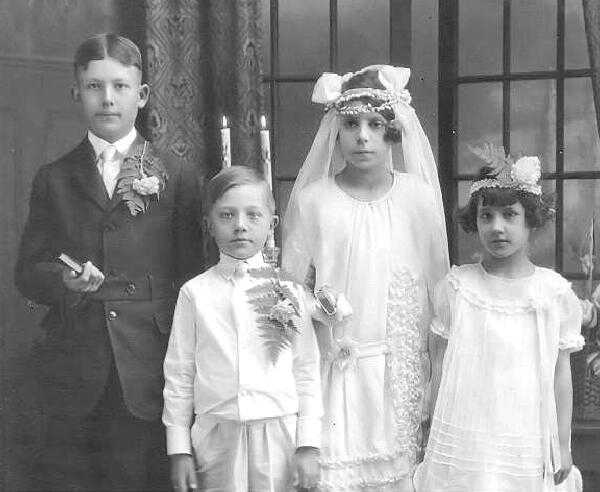
Here we have another First Communion portrait, or at least we think it is a First Communion portrait. There are four children in the portrait. We think it is the older children having their First Communions. The older boy is Cletus Hullen. He wears a dark suit. The younger boy is Henry Oelschlagen. He wears a white shirt and white kneeopants with white long stockings. The girls are Margatet and Jeneviene Budina. I'm not sure what the younger children are doing with the older children. The portrait is undated and do not know where in America the portrait was taken.
The studio cabinet card studio portrait here shows Waldo Hunt Hurst holding a palette and painting a picture. This not a studio prop we ordinarily see so perhaps Waldo had artisttic talents and he brought his art materials with him to the studioso he could pose with them. We are not sure about this. While waldo is idenifed on the back, the portrait is no dated. We would guess it was taken at the turn-of-the 20th century, either the late-1890s or the early-1900s. Waldo looks to be about 10-11 years old. He wears a dark knee pants sailor suit with a 'V' white collar and back flap. The white dickie has an embroidered crest, but we can not make it out. The suit is prrobably dark blue. He wears the standard black long stockings and high-top shoes. His hair is carefuly parted near, but not at the center. He has longish hair, but not shoulder-length ringlets.

Navigate the Boys' Historical Clothing Web Site:
[Return to the Main ordinary biography alphabetical page]
[Introduction]
[Activities]
[Biographies]
[Chronology]
[Clothing styles]
[Countries]
[Girls]
[Topics]
[Bibliographies]
[Contributions]
[Essays]
[FAQs]
[Glossaries]
[Images]
[Links]
[Registration]
[Tools]
[Boys' Clothing Home]