|
The climate in Canada has of course affected the clothing to a substantial extent warm coats and sweaters have been worn for much of the year. Canada like America for many years was largely influenced by Europea, mostlyBritish fashions. Canada's colonial status and smll popultion mean that foreign styles were important. Canadian boys, howvever, wore the garments worn in England and France during the 19th century. After World War I, American fashions became increasingly common. We have little information on headwear, but suspect that cold weather hats were especially important. Suit in particular were primarily Bristish styles. Knickers were very common in the 1920s and 30s, but by the 1940s long pants became inceasingly important. Boys that wore short pants commonly wore them with knee socks or even long stockings. Modern Canadian fashions are today little different than American fashions, although the summer clothes are somewhat less common because of the climate.
We have some limited information on headwear worn by Canadian boys. Cold weather caps seem especially important and were similar to styles worn in northern states like Maine and Minnesota. We suspect that the styles were very similar to those worn by American boys. Boys from affluent families may have worn British styles as well. We have noted boys wearing British-style peaked school caps. These were also worn in America. Much more common were various styles of flat caps. We note a lot of Canadian boys wearing flat caps in the early-20th century just as innAmerica. We do not know if French Candian boys wore different styles. We have noted some boys wearing berets which we think are mostly French-Canadian boys. Boys as in America and France commonly wore sailor caps and hats. Canada is second after the United States in the popularity of baseball. Most Canadian boys by the late-20th century wear baseball caps similar to their American counterparts. [Alcock]
We notice Canadian boys wearing a variety of Skirted garments. This was a common convention in both Europe and the United States. dting back centuries. It was prevlnt in Canada in the 19th century and even into the early-20th century. Mny children wore skirted garments until they were breched, most as pre-school boys. The age of breeching varied from family to family. Here social class differences were important, affecting somewhat the age of breeching. Much of it was up to the fashion proclivities of the mother. Skirted garments include dresses, skirts, kilts, pinafores, smocks, and tunics. Canadian boys like boys in America and Europe wore dresses when they were young during the 19th and early 20th century. We have few specific details on this convention in Canada, but beliece it was little different than the practice in America and Britain. As far as we know the chronology, styles, and ages as well as social class conventions were comparable. We do not know if there were any differences among the French community. There is a substantial Scottish influence in Canada. The Maritime Provinces, especially Nova Scotia have the most obvious Scottish influence, but even French Montreal has significnt Scottish influence. One report indivates that at least some boys in Nova Scotia wore kilts during the 19th century. This appears to have been the case for sone boys whose fathers were soldiers in St. Johns. HBC does not know, however, how common this was, either for soldiers' families or for the population in general. We note stores at the turn of the 20th century were offering essentially the same styles as Ametican stores, including kilt suits, fancy blouses, and Fauntleroy suits. We note Canadian boys wearing tunic suits in the early 20th century. They seem rather similar to the suits worn in America, commonly with belts. The tunic seemed less popular in Britain at the time. We notice Canadian boys wearing tunic suits done in the sailor style. HBC has wondered just how influential French fashions were in Canada, especially amomg French Canadians. As far as HBC can determine, French Canadian boys never wore smocks at home or at school as was common for French boys.
|
Geography makes inclement weathger garments especially important. Canada along with the United tates (Alaska) Scandinavian countries and Russia are located in the most northerly reaches of the North American continent. Russia and Canada dominate the Arctic Ocean. As a result, winter meaning cold weather is a longer part of the year than anywhere else in the world. As in the othern morthely countries, the population is primarily in the south, which makes it cimparable to northern Europoe. But the population is located inland, giving it more of an vintinental climate which is colder than climate modifie by coastal influences. Winter is freezing cold throughout Cnada. The most moderate area is the British Colombia coast in the west. Not far fromthe coast, howevr, in the Rockies there is hevy snow fall.
Winter in the Rockies is long and cold. The snow stays around in the higher altitudes well into Spring. The warm Chinook winds help to defrost the Continent. Eastern Canada, including the large cities of Toronto and Montreal, has a shorter, less fierce winter, but it is still cold with lots of snow. Here Canadians experiene mostly sub-zero temps and -20°C (-4°F) not uncommon. At least one or two snow storms falls of eight inches or more commonly fall (during January and February). As a result, inclement weather clothing is vital. As so much precipation falls as snow, this has to be taken in account. Warm coats are vital. There are of course many other cold weather garments. We see knitwear (including scarves abd sweaters), leggings, long stockings, and snowboots. We see similar garmets in the northrn United States. There is a great deal of similarity, although the time line is often different. We notice knickers being worn longer in Canada than America.
We notice a range of outfits worn by younger boys, both pre-school boys and boys in the early primary years. Youngr mostly pre-school boys of course wore a range of skirted garments discussed above. Here we are talking about non-skirted juvenile outfits. Perhaps the best known are Fauntleroy suits and sailor suits, but there were a range of other outfits.
We notice Canadia boys wearing Fauntleroy velvet suits in the late 19th century. As far as we can tell the stles and chronology as well as the conventions involved were very similar to those in the United States. The original inspiration for fancy suits for younger boys was France where Mrs. Burnett lived for a few years. We are unsure if there were differences among the English and French community concerning the styles and wearing of Fauntleroy suits.
Canadian boys as in America and Europe also wore sailor suits. We have little information about this fashion specifically related to Canada, largely because our Cnadian archive is still relatively limited. As far as we can tell, Canadian boys wore the same style of sailor suits as worn in the United States. There may have been more of a British influence in the mid 19th century, but by the turn of the 20th century they seem to be wearing rather American style sailor headwear and suits. An example is a family portrait taken by an itinerate photographer, probably on New Brunswick. The two boys in the family wear matching white sailor suits with floppy tam-like headwear. A Canadian reader has provided us a photograph of an English Canadian boy wearing a traditionally styled sailor suit in 1928. The suit is quite a bit different than those worn by American boys. Perhaps it is based on an English style. The cap is a type we have not noted being commonly worn in the 1920s, either in America or England. We are insure to what extent it was a popular boy's style in Canada. We also notice Canadian boys wearing tunic suits done in the sailor style.
We have very limited information on rompers. We have noted them being worn in America, England, France, Italy and other coutries. The conventions and time lines for rompers vary in those countries. Rompers in America were a children's garment common in the early 20th century, but evolved into a girls' style. Rompers in France were primarily a boys' garment. We have less information on Canada. We are not sure when they were worn or how common they were.
Canadian boys wore English style suits in the 19th century. I'm not sure to what extent French-style suits were worn. Well to do boys, especially from English families, might wear Eton suits and collars. After World War I, American-styled suits have become more common. HBC has noted Norfolk suits in the early 20th century. By the 1930s modern looking single breasted and double breasted suits. I'm not sure how common kneepants suits were in the late 19th century, but Canadian boys do seem to have commonly worn knicker suits through the 1930s. Despite the climate, short pants suits appear to have been more common than in America. Canadian suits ere stongly influenced by British styles. American styles wre alo influential. One factor here were the American mail order catalogs thay circulated widely throughout Canada.
We do not yet have much information about shirts and blouses worn by Canadian boys. We would guess that trends were similar to Britain and America. We do have some information on Eton collars. They seem particlarly popular during the late-19th and early-20th centuries. We see quite a number of boys wearing lace and ruffled collars during the Fauntleroy Craze. We would guess that given the climate than flannel shirts were especially popular in Canada. We hope to develop this topic as our Canadian archive grows.
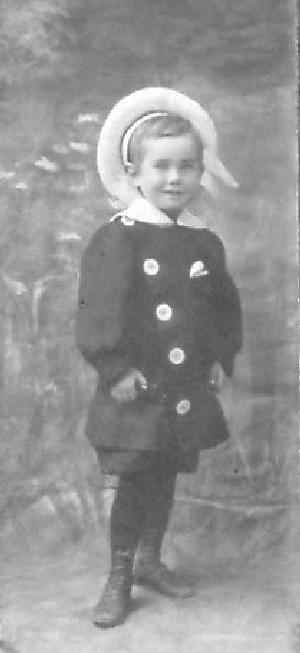
We have very limited information on Canadian boys' neckwear, but have begun to collect some information. As far as we can tell it looks quite similar to American trends. There were differences between American and British neckwear styles. In particular, floppy bows were never as popular in Britain as they were in America. We see quite a few portraits of Canadian boys wearing them. We do not yet have sufficent images to assess chronolgical trends or differenes among English and French speaking Canadians. A HBC reader writes, "This portrait photo of a Canadian boy was taken March 1902. I believe it may be in New Brunswick, as I got bought it from a dealer there. It is a very long and narrow card, measuring: 7 1/8" X 3 5/8" overall." He wears what at the time would have been a modest sized floppy bows. Floppy bows declined in popularity after World War I (1914-18), although some boys woire then for a few more years. Since World War I as far as we can tell, Canadian and American neckwear styles had been very similar.
We note many Canadian boys wearing knepants in the late-19th century. Knickers were very common in the 1920s and 30s, but by the 1940s long pants became inceasingly important. Her American styles seem more inflential than British styles with many Canadians. He climate may have been an important factor. Knickers were very common in the 1920s and 30s, but by the 1940s long pants became inceasingly important. Pre-teen boys from affluent families often wore short pants. I'm less sure about French-Canadian boys who often came from low-income families. Boys that wore short pants commonly wore them with kneesocks or even long stockings. Modern Canadian fashions are today little different than American fashions, although the summer clothesm especially short pants, are somewhat less common because of the climate.
Canadian children wore underwear very similar to American children. Here the underwear seems much more similar to American than English or French styles. This seems in part because of the importance of American clothing styles as well as American mailorder catalogs and publications. The underwars styles offered in Eatons and other Canadian catalogs seems vurtually identical to American catalogs, perhaps with a somewhat heavier emphasis on warm Winter underwear
Long stockings were commonly worn in the late 19th century and persisted somewhat longer in Canada than America. They were worn with both short pants and knickers, although kneesocks had become more common by the 1930s. During the winter long stockings and kneesocks were also worn with long pants. Long stockings appear to have been worn with short pants as a dressy outfit more commonly than in America. Boys that wore short pants commonly wore them with kneesocks or even long stockings. Modern Canadian fashions are today little different than American fashions, although the summer clothes are somewhat less common because of the climate.
Canadian pyjamas, which have been required by law to be fireproof since 1987. Cotton flannellette PJ's are most popular with Canadian boys, usually with a hockey print.
A Canadian reader informs us, "Even though Canada has a harsh cold winter, it also gets a very hot summer and Canadian boys always go barefoot during the summer months, particularly July and August when school is out. During the 1970s, it was most common to see Canadian boys wearing T-shirts, cut-off jeans with frayed edges just above the knee, with bare feet. They would walk everywhere, play with friends and go around the neighbourhood in bare feet. It is also very popular in Canada for boys to ride their bikes in bare feet. Canadian boys,in the the early 2000s during the summer wear long shorts, which can also be used for swimming, and go barefoot all summer. It is still quite popular for walking around and riding a bike in bare feet during a Canadian summer." [Alcock] The same source also tells us, "Black and red rubber boots have also been extremely popular among Canadian boys, and remain so today. Every Canadian boy has worn a pair of rubber boots, like his British counterpart. They are called Wellington boots.
High-top shoes were common in the late-19th century, but as in England we see low-cut shoes as well. A good examole is a Montreal boy.
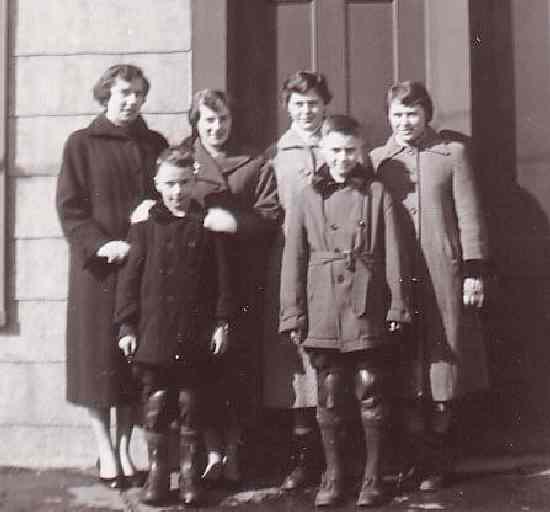
During the 1950s and 1960s, it was considered tough and cool to fold the tops down. The lower they were folded, the more cool a boy was. Rubber boots in the early 2000s remain popular in Canada, more so than in the U.S., however, it is now more common for Canadian boys to wear their rubber boots up at full length. Canadian boys wear rubber boots in the mud and water in the spring, at camps in the summer and generally on rainy days. They also wear lined winter boots during the harsh cold winters. Canadians usually have a blend of the British and American influence, this is evident with the boots and the popularity of going barefoot in the summer." [Alcock] Sandals do not appear to have been very popular. Trends seem similar yo America. We do, however, see a few boys wearing sandals. An example is a Quebec boy in 1959. Canadian boys in the 2000s wear the same popular shoe styles worn in America--running shoes and sport sandals.
We do not know a great deal about Canadian costumes yet. We believe that trends were largely influenced by Britain until the turn of the 20th century. Costumes before the 20th century were primarily dressup outfits for portraits or formal parties rather than play outfits. As in America this probably changed after World War I. We then begin to see some American influences about the turn-of the 20th century. We think American mail order catalogs may have been a factor here. We do not at this time have any information on destincly Canadian costumes. We suspect that some boys wanted to dress as Mounties. We also have no information on trends in the French-Canadian community. Hopefully Canadian readers will provide some insights.
Alcock, James. E-mail, July 24, 2002 and August 6, 2003.

Visit HBC Canadian Pages:
[Return to the Main Canadian country page]
[Canadian choirs]
[Canadian Scouts]
[Canadian long stockings]
[Canadian First Communions]
Navigate the Boys' Historical Clothing Web Site:
[Return to the Main country page]
[Introduction]
[Activities]
[Biographies]
[Chronology]
[Clothing styles]
[Countries]
[Bibliographies]
[Contributions]
[FAQs]
[Glossaries]
[Images]
[Links]
[Registration]
[Tools]
[Boys' Clothing Home]