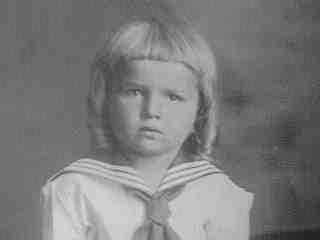
Figure 1.--This boy photographed in the 1840s or early 1850s shows a large ruffled collars. Smaller plain collars were more in style at the time. |

|
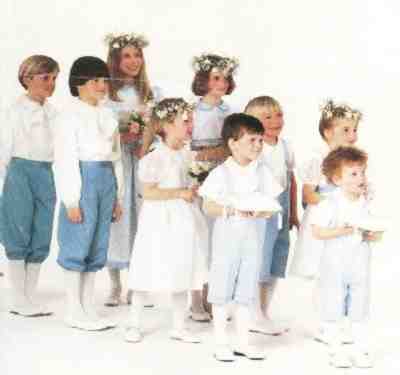
Clothes send all kinds of obvious and some more subtle signials as we have disussed in the image essay. Changing fashion trends showcase changing social views of childhood. Indeed the emergence of specialized children's clothes in the late 18th century coinside with the emergence of the modern western view of childhood. The modern concept of childhood is very different than the way children were viewed in the 17th century. It was in the Victorian age that modern concepts of childhood and family began to be adopted by increasing numbers of children. This is when the expanding middle-class began to adopt the new destinctive styles for children. This was not the case for working-class children. They had little or no childhood in the modern sence and there clothing tended to be the same style as their parents. In fact their clothes were often their parents old clothes, cut down to fit them. Only grdually did working-class children begin to experience a modern childhood. This shift can be observed to some extent in the clothes that the children wore.
The Western view of childhood changed radically in the 19th century, one of the many profound changes occurring during the Victorian era. The modern concept of childhood is a very recent and novel concept in the human experience. Few modern people would really like to go back in time. Until our modern age, people lived short lives because of the lack of medical knowledge and often apauling sanitary conditions. For those who survived life was hard and work might be 12 hours or more daily. Diets were often inadequate. Childhood virtually did not exist. Infant mortality was extremely high. Children began working at an extremely early age. Children did not enjoy any of the salient features of modern childhood meaning the early period of an individual's life when he or she is allow to play and learn and which innocent ideleness and amusement is permitted. [Wilson, p. 160.] Indeed the very idea of childhood innosence was new. Most in the 18th century still saw a child as an esentially evil being that had to be civilized, often with severe physical discipline. And you see realistic depictions in art. New concepts of childhood and education were conceptualized and promoted by Rosseau and began to be increasingly accepted by the 19th century. Here economic developments were critical. The Industrial Revolution was creating the kind of wealth that created a sizeable middle class that could afford to support a modern childhhood.
Modern concepts of childhood first appeared in the 18th century. Englightenmnt thinkers began to explore the topic of the nature of childhood. Europeans until the enligtenment saw children as simply small-sized adults. Enlkigtenment thinkers began to see childhood as a special an importnt phase of human development. And we begin to see the new concepts expressed in art work. Webegin to see idealized imges of childhood. The appearance of specialized clothing for children appeared at essentially the same time. Not only did the chronology coinside, but the clothing also reflected the individual children were experiencing childood. Throughout the 19th children, children who had to work rather than ply and attend school still commonly wore adult clothes. Often working-class children wore the same styles heir parents wore. In fact their clothes were commonly their parents worn out, patched up clothes cut down to fit them. Only grdually did working-class children begin to experience a modern childhood. This shift can be observed to some extent in the clothes that the children wore.
Some famous quotations about boys provide some interestings insights into boys and childhood over the years. We will list some of our favorite quotations. Do let us know if you have a favorite quotation. We will archive them by author.
Adults have varied children very differently through time. Often this is reflected in children's fashions as mothers sought to dress their children in the ways that they saw them. Of course other factors affected this. Clothes especially for the less affluent had to be utilirarian. Cost was another fator, again especially for the less affluent. Even so the images that all mothers had of childhood was reflected in the popular fashions of the day. Assessing historical and modern images can provide insights on the attitudes in spcific countries or eras toward childhood. Some authors have even projected future images, giving an insite on how they view the future.
The sentimentalization of childhood was a Victorian notion. The concept owed much to the writings Jean Jacques Rosseau. He did not believe in formal education before age 6. Rather he advocated outdoor play and physical activity. The best plan is to keep children in frocks for as long as possible, and then to provide them with loose clothing, without trying to define the shape, which is only anotother form of a dress. Before the 19th century Victorian era, the intelectual and social demands on children were not greatly different than those for adults. This was reflected in children's clothes, essentially scaled down versions of their parent's clothes. Rosseau led the convention for the specialized children's clothes that had begun to appear after the mid-18th century. Rosseau wrote in his educational classic:
The limbs of the growing child should be free to move easily; there should be nothing tight, nothing fitting closely to the body, no belts of any kind. The French style of dress, uncomfortable and unhealthy for a man, is especially bad for children, her way of deforming it. The defects of body and mind may be traced to the same source, the desire to make men of them before their time. [Rosseau, Emile, 1762]
The evolving concept of childhood was visible in the pages of European and even American fashion magazines. These magazines like La Mode Ilustree illustrated popular pastimes in which familiar relationships were often showcased. The visibility of children by the mid-19th century had increased measurably. One writer in Godey's Lady Book, an American fashion magazine, similar to La Mode Ilustree, indicated "almost every parent commits the blunder of making too much of his children in the presence of visitors,. The emphasis on children produced a number of diversions and activities encouraged by doting parents which required fashionable garments appropriate to various activites. Children, "God's last best gift to women," were fast becoming examples of what Thorstein Veblen was to describe "vicarious consumption," costumed to reflect their parent's financial success and social status.
One very significant change has been the development of modern adolescene. The adolescents of the late 19th century are a very destinct group, courted by modern mass marketing companies. The concept of adolescents did not really exist a century ago. Today adolescents in America and Europe may be the most often discussed population group.
In the late 20th cetury there have been a withering of "boundaries"
that once defined the lives of children and adolescents. One has to be struck by the declining boundaries or constraints regulating the livers of today's adolescents. The boundaries built by respect and trust--between teachers and students, between parents and children--seem much weaker.
This has taken place in many institutions as well as popular thought:
School: One journalist who covered the Colombine tragedy was struck by the absence of boundaries in the lives of the killers as well as their classmates. (At Columbine High, students are free to leave during free periods to bake themselves in tanning salons or assemble arsenals of weapons. They no longer are confined by the walls of the school.
Home: There has been a definite relasation of parental supervision in recent years. Research psychologists now say that lack of parental supervision is directly linked to a shift in the age at which violent behavior first shows itself. In the past, they say, it cropped up in high school. Now it shows up in middle school (because that's when parents now allow children to be on their own after school). In other words, there's no authority figure, which means another kind of boundary is gone.
Psychological boundaries: Modern adolescents are also less confined by psychological boundaries that once kept kids from thinking of themselves as killers, no matter how angry they got, no matter how accessible parents' guns were).
The internet: The Internet is another obliterator of boundaries (not only can kids cross state and national boundaries, they can get information once off-limits to them and, when it comes to navigating all this, they've become the wise ones and their
parents the innocents).
Financial: The limits once established by money have been much weakened. Once boys had little access to money. Poor boys had to work, but few middle class boys and girls did. They were totally dependent on their parents for money. This mean of course that the parents chose therir clothes. As kids have more of their own money (and infinitely more businesses catering to them) and in some cases can become rich on their own (particularly those with internet skills, who, according to an article in the New York Times, have created a trend of hiring their parents!)
Popular culture: Another boundary that is fast disappearing is in popular culture. More and more, adults mimic the styles of kids (rather than vice versa), listen to the
same music, play with the same toys (technology).
These trends are clearly observable in America. They are also true in European countries, although trends vary from country to country as in many countries barriers or restrictions placed by cluture and tradition have remained stronger than in more mobile America. The trends, however, are present in Europe. They also are observable in Japan, although to a much lesser degree.
|
HBC visitors as they move through the various pages, should ask a variety of questions. Here are some interesting ones. Perhaps you can suggest other important questions that should be addressed.
--How are children presented?
--How did the mother view childhood?
--Do you think the boy and his mother had similar concepts of childhood?
--Are differing concepts of childhood apparent in various countries?
--What false images are presented?
--What messages is the mother, reporter, artist, advertiser, editor, school or institution offical conveying?
--How do the times compare?
--How have concepts of childhood varied overtime?
--How have boys' concepts of fashions changed?
These are the kinds of questions we will address in HBC and summarize here. I'd be very interested in your thoughts as you view the various images. I'll post thoughts on these questions here. If they become lengthy, I'll create a new page.
For the great majority of British and Americam boys at the middle of the 20th Century, the whole concept of "boys' fashions" would have been whollyalien and indeed quite laughable. In stark contrast to young people now, we thought it "cissy"--"wimpy" in today's terminology--to care (or at least to appear to care) what one wore, or indeed what anyone elsewore. Presumably some boys' mothers gave thought to these matters but certainly not the boys themselves.There has been a profound, and to me astonishing, cultural revolution on this issue, and now boys pretty welleverywhere in the developed world seem to be every bit as obsessed with their appearance as girls.
|
There has appeared in the 1990s a developing field of scholarship on childhood. This has been a generally neglected field of study. Scholars in America, Europe, and other countries have rapidly been filling the void in available studies. This material is providing some insights explaining fashion trends. As fashion is one of the most visible reflection of changing social trends, fashion trends can be useful in charting larger social trends.
Wilson, A.N. The Victorians (W.W. Norton: New York, 2003), 724p.

Navigate the Historic Boys' Clothing Web Site:
[Return to the Main essay page]
[About Us]
[Introduction]
[Activities]
[Biographies]
[Chronologies]
[Countries]
[Style Index]
[Bibliographies]
[Contributions]
[FAQs]
[Glossaries]
[Images]
[Links]
[Registration]
[Tools]
[Tools]
[Boys' Clothing Home]
Navigate the Historic Boys' Chronology pages:
[Return to the Main chronolgy page]
[Late 18th Century]
[The 1800s]
[The 1810s]
[The 1820s]
[The 1830s]
[The 1840s]
[The 1850s]
[The 1860s]
[The 1870s]
[The 1880s]
[The 1890s]
Navigate the Historic Boys' Clothing Web style pages:
[Short pants suits]
[Blazers]
[Lace collars
[Fauntleroy suits]
[Sailor suits]
[Ring bearer/page costumes]
[First Communion suits]