
The American Civil War: The Gettsburgh Address (November 19, 1863)
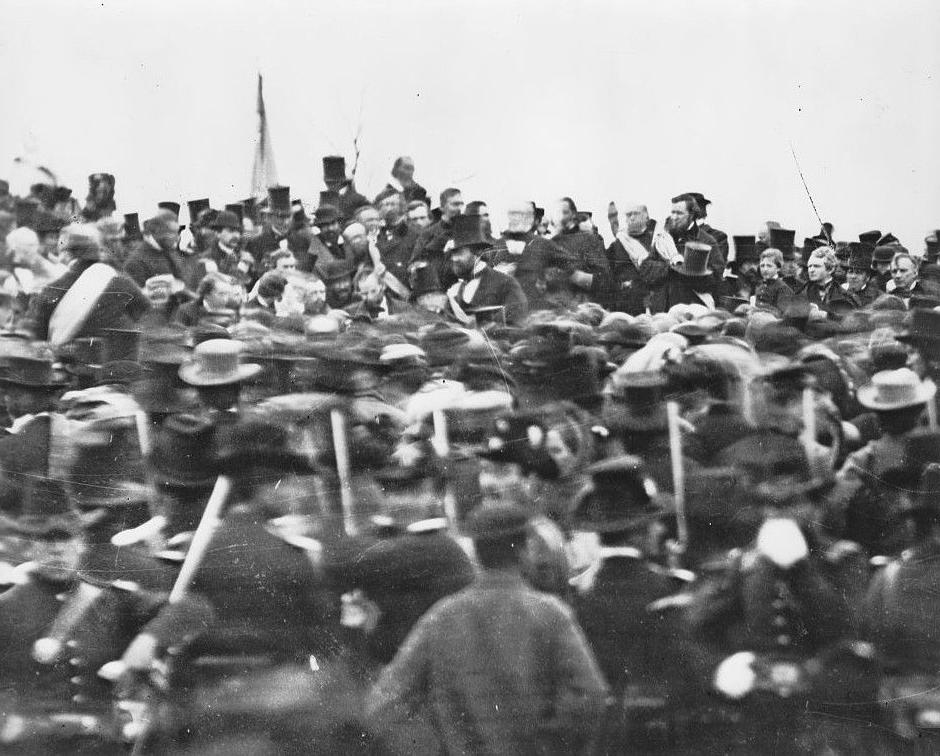
Figure 1.-- Several months after the battle of Gettysburgh Lincoln traveled to Gettyburg (November 1863) to dedicate the cementary being built to honor the thousands of men who lost their lives there. Gettyburgh was the largest battle ever fought in North America. And it was already preceived as the most important bttle of the War and the high-water mark of the Confederacy, especilly as at the same time, Gen. Grant in the West had taken Vicksburg spliting the Confederacy in two. To honor the fallen, President Lincoln and many other dignataries had been invited. The principal speaker was to Edward Everett, a highly respected statesman, pastor, academic, and perhaps the greates orator of his day. Lincoln at the time was still seen as a controversial political figure, not the great president we honor today. In the era before movies, rafio, and television, oratory was an important event and popular diversion. And impassioned speakers could go on for ever, even hours. The President had been invited to speak more of a courtesy, the assembled dignaties were waiting to hear Everett. The official program listed Everett as the Oration speaker and Lincoln as the giver of Dedicatory Remarks. The photographer was expecting a length speech. The President, however, spoke very briefly. Some at first saw this as a discourtesy. As a result Lincoln had finished his remarks and sat down by the time the photographer, Alexander Gardner, took the cap off his lens. As a result, this image is all we have of argubly the most powerful and consequential speech in the English language. He is, however, clearly vissible on the speakers platform without his stovepipe hat. We are not yet sure who was on the plastform with Everett and Lincon. Thomas H. Stockton who had served as Cha;ain to the House of Representatives gave the opening prayer. We notice a boy with the dignties, but hve not yet been ale to identify him.
|
|
A few months after the feroious battle at Gettsburgh, Lincoln traveled to that small Peenstlvania town to participate in the ceremonies there to dedicate a military cemetary. His speech, little regarded at the time, eloquentedly stated the Federal cause. It is ceratinly the nost famous presidential speech ever delivered. Many consider it to be the greatest speech ever delivered in the English language. It was not at the time generally considered to be an important speech at the time. One of the few was Edward Everett, the renoouned orator who gave the major orration dedicating the cemetary. "... Mr. Lincoln perhaps said more to the purpose in his brief speech than I in my long one". [MacVeagh] What Lincoln did was to eloquently make the case for democratic government. This of course it taken for granted today. But at the time American was the only republic of any consequence. Britain was becoming more democratic, but was still ruled by a poweful monarch. The rest of the world, however, was goverened by kings, emperors, and tsars, many of whom ruled with absolute or near absolute authority. The world was watching while the sole republic tore itself apart in civil war. Lincoln's address was a rising endorsement of democracy ending with the soaring acclamation that "... governments of the people, by the people, and for the people, shall not perish from the earth." Implicit in this statement was the preservation of the Union.
The Ceremony
Federal and Confederate armies on July 1-3, 1863 fought the largest battle of the Civil War at Gettsburgh, Pennsylvania. Over 50,000 Federal and Confederate soldiers were killed, missing, or seriously wounded. Following the Federal victory at Vicksburgh, this represented the turning point in the War. The Battle of Gettysburg had effectively put an end to any chance that the South could prevail militarily. Still unanswered was whether the North had the determination to persue victory despite the apaulng cost in blood. Four months after the feroious battle at Gettsburgh, Lincoln traveled to that small Peenstlvania town to participate in ceremonies to dedicate a military cemetary for the men who fell there. Lincoln used the occassion to also dedicate the nation to persuing the cause for which the Federal soldiers burried at Gettsburgh had sacrificed their lives.
The Speech
The presidential address was a very short one, lasting only about two minutes, an astounding decissions on Lincoln's part in an age when men not uncommonly gave speeched of 1-2 hours.
There is of course no recording of the speech. There are five drafts written by Lioncoln, all with minor differences. This is the most widely accepted version, based on a trascript of a reporter:
Four score and seven years ago our fathers brought forth upon this continent a new nation
conceived in Liberty, and dedicated to the proposition that all men are created equal.
Now we are engaged in a great civil war, testing whether that nation or any nation so conceived and so dedicated can long endure. We are met on a great battlefield of that war. We are met to dedicate a portion of it as the final resting place of those who here gave their lives that that nation might live. It is altogether fitting and proper that we should do this.
But in a larger sense we cannot dedicate-we cannot consecrate-we cannot hallow this ground. The brave men living and dead who struggled here have consecrated it far above our poor power to add or detract The world will little note nor long remember what we say here, but it can never forget what they did here. It is for us, the living, rather to be dedicated here to the unfinished work that they have thus far so nobly carried on. It is rather for us to be here dedicated to the great task remaining before us-that from these honored dead we take Increased devotion to that cause for which they here gave the last full measure of devotion-that we here highly resolve that the dead shall not have died in vain-that the nation shall, under God, have a new birth of freedom-and that governments of the people, by the people, and for the people, shall not perish from the earth.
Reaction
Lincoln's speech was little regarded at the time. Even Lincoln was concerned that there was no aplause when he sat down. As many speakers regard audience replause as a barometer of their effectiness, Lincoln was concerned that his words had failed. The address was not at the time generally considered to be an important speech. Many newspapers even criticised Lincoln for his lack of substance. One of the few was Edward Everett, the renouned orator who gave the major orration dedicating the cemetary. "... Mr. Lincoln perhaps said more to the purpose in his brief speech than I in my long one". [MacVeagh] It may be that the audience's apparent lack of response was not due a dimissal of President Lincolm's address. Some historians believe it was a lack of awareness on the prt of the audience. Others believe that Lioncoln's address was so short that it was over before the audience expected. One observer believes that the audience's apparent lack of reaction was not because they were not moved, but precisly because they had been deeply touched and their greatesttribute wa silence. [Forbes]
Modern Assessment
Lincoln eloquentedly stated the Federal cause. It is ceratinly the nost famous presidential speech ever delivered. Many consider it to be the greatest speech ever delivered in the English language.
Construction
Lincoln's Gettysburgh address is a beaitifully crafted speech. One that should be studied in every soeech class. Many of the devices used in speechcraft are present here, inclusing contast, rhyme, rythhm, echo, alliteration and methaphor.
Lincoln wanted to begin on a tone that was both stately and also familair to the audience. A speech expert explains that the now famous opening "Fore score and seven years ago" would have been instantly recognized by 19th century Americans, large numbers of ho seriously studied the Bible. Lincoln's phrase echoed the Biblical passage "three score and 10" which was man's alloted time on earth. This set the stage for his discussion on the survival of democrativ governent. Like wise when he described the creatiin of America, exclaimed "Our fathers brought forth on this continent" he used the language of both Matthew and Luke in describing Jesus' birth. Thus he was asserting that the founding of America was an almost holy event. Other words such as "concecrate" further emphasize this point. This was a very effective device in 19th century America, appealng to both the imagination and emotion "because even the unlettered in his audience in those days wnt to church and head the bible read. Their ears were cinditioned to those phrases and those rhythms." [Humes]
Meaning
What Lincoln did was to eloquently make the case for democratic government. This of course it taken for granted today. But at the time American was the only republic of any consequence. Britain was becoming more democratic, but was still ruled by a poweful monarch. The rest of the world, however, was goverened by kings, emperors, and tsars, many of whom ruled with absolute or near absolute authority. The world was watching while the sole republic tore itself apart in civil war. Lincoln's address was a rising endoesement of democracy ending with the soaring acclamation that "... governments of the people, by the people, and for the people, shall not perish from the earth. " Implicit in this statement was the preservation of the Union.
Modern Relevance
It might be though that Lincoln's words were meaningful to a 19th century world, but no longer of any significance in our modern 21st century. Nothing could be further from the truth. Linclon was talking about the struggle betwtween monarchies and democracy. For the most part the the monsrchies are gone and those which have survived are constitutional monrchies playing largely ceremonial roles in democratic states. But there today are many threats to democrcy and the rule of law. The most serious threats were the great totalirarian powers of the 20th century (Fascist and Communist) and they were defeated by America and its Allies, the Fascists in Wotrld war II and the Communists in the Cold War. Two new threats have emerged in the wake of the Cold War. The Communist Soviet Union and China have morphed into new authoritarian states. Russia underPutin and his KGB associates has become a kleptocracy. China has become Communist in name only, adopting free market econominic reforms. What they have in common is a distrust of their own people. Both states rule with the idea that a small cabal of politucally adroit leaders can more effectively govern than a democrtically elected leadership. It is certainly true that there is a greater degree of freedom than in the Communist era, but neither country has either democracy or the rule of law. The new authoritarians commonly use control of the media to arounce hyper-nationlist sentiment and create foreign threats that do not exist to justify their rulle. The long term prospects are unclear. Putin's kelptocracy has destroyed the Russian economy and the country is now precariously depebdent on falling oil prices. The Chinese leadersgip has proven much more effective, adopting free mrket reforms and building a real economy. There has been an advance of democravcy in the Third World, but all to many countries there are governed by authoritarian leaders using their position to enrich themselves and remain in power. The other major development since the end of the Cold war has been the rise of fundamntalist Islam and theoractic states--rule by the mullahs and other Islamuc clerics. This has proven possible because of the discovery of oil in many Muslim nations. Essentially Islamic states have been able to appease their population through programs supported by the oil wealth. And money from the oil states have supported rasical groups in the non-oil states. The fall in oil prices if it is sustained may radically affect the ability of Islamic clerics to resist social chnge and modernization. Here there is a danger in tht the Arab Spring while seemingluy aspiring to democracy often means exposing minorities to majority rule without a tradition of the rule of light and the protection of basic civil liberties.
Sources
Forbes, Malcomb F. "Thoughts," Rorbes, April 28, 2003, p. 128.
Humes, James C. Speak Like Churchill, Stand Like Lincoln (2002).
MacVeagh, Issac Wayne. "Lincoln a Gettysburg," The Century Magazine, November 1909. MacVeagh was the Chairman of the Republican State Committe in Pennsylvania.
Wills, Gary. Lincoln at Gettyburg: The words That Remade America.
CIH

Navigate the CIH Civil War Section:
[Return to Main Gettysburg battle page]
[Return to Main Civil War campaign page]
[Biographies]
[Campaign]
[Causes]
[Emancipation]
[Families and youth]
[Fiscal policy]
[Formations and units]
[Law]
[Railroads]
[Reconstruction]
[Slavery]
[Soldiers]
[Uniforms]
[Weaponry]
[Return to the Main Civil War page]
[Lost Cause]
[Civil Rights movement]
[Return to CIH Home page]
6:59 PM 12/8/2014
Created: March 13, 2003
Last updated: 7:01 PM 12/8/2014``