**
World War I First World War : prisoners of war POWS
World War I: Prisoners of War (POWs)
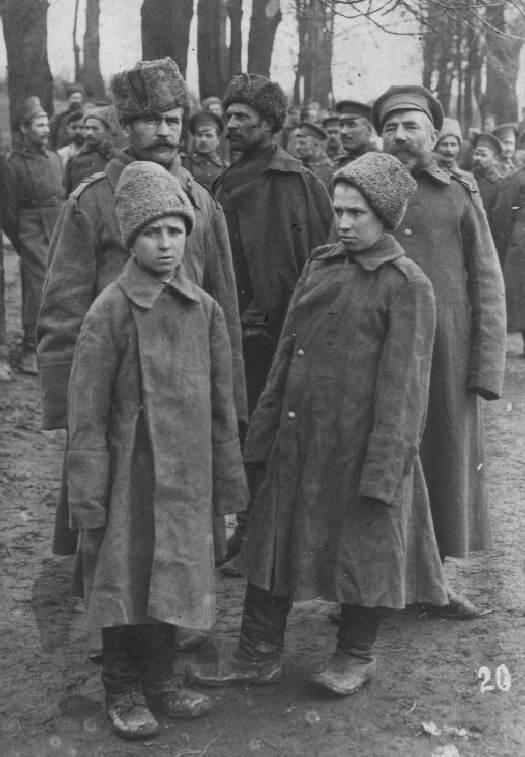
Figure 1.-Here we see Russian POWs being held by the Austrians in 1915. The potograph was taken in Terezin in what is now the Czech Republic. The backside of the postcard is a message written in Czech. It says that in Terezin city there are a lot of soldiers and Russian POWs. The card was mailed November 18, 1915. Notice the boys among the grizzeled veterans. Put your cursor on the image to see the message on the back.
World War I histories tend to give less attention to Prisoners of War than is the case of World War II. This is in part because the major beligereant countrirs generally treated POWs correctly following the Geneva Convention to the extent possible given war time conditions. Here the major exception was the Ottoman Turks. The Austrians and Germans also tended to treat the Serbs harshly. There was, however, nothing of the barbarity exhibted by the Germans, Russians, and Japanese during World War II. Quite large numbers were involved. Offical statistics tend to combine POWs and missing in action. The two countries with the largest numbers of POWs were the Russians with 2.5 million (mostly taken by the Germans) and thecAustro-Hungarians with 2.2 million (mostly taken by the Russians. There were also 1.2 million Germans (mostly taken by the Western Allies). Other countries with relatively large numbers were: Italy (0.6 million), France (0.5 million), Ottoman Empire (0.3 million), Britain (0.2 million), and Sebia (0.2 million). Only 4,000 Americans were POWs or missing. Given the recruitment policies of the beligerant nations, there were many children and teenagers among the POWs. The Red Cross played a major role with POWs during World War I. This was a category of war victims that had not previously been protected by the Geneva Conventions. The International Prisoner of War Agency in Geneva compiled a an index of seven million file cards. They documented 2 million prisoners held in the POW camps of the 38 belligerents nations.
Geneva Convention
Historical Attention
World War I histories tend to give less attention to Prisoners of War than is the case of World War II. This is in part because the major beligereant countrirs generally treated POWs correctly following the Geneva Convention to the extent possible given war time conditions.
Taking Prisoners
Most POWs came from unit surenders. Individual surrenders were not very common as a proprtion of the overall POW populatiopn. Usually a commanding offiver in an untenable situuation surrendered all of the men in his unit. This usually was units who were cut off and surrounded. There were several large surrenders. The Russian surrendered 92,000 men at Tannenberg (1914). There were 20,000 Russians who surrendered in the he besieged garrison at Kaunas (1915). Surendering individually was dangeros. Surrendering soldiers were sometimes sjhow by vengeful ememy doldiers. This rarely occurred pnce a POW was processed.
An estimated 8 million men were held as POWs in camps during World War. As a result of the Geneva Convention (Hague Rules), the princiles as to how POWs should be treated were well established and agreed to by the combatant countries. Each country generally attempted to do so. The survival rate of World War I POWS was, as a result, much higher than in World war II.
The International Red Cross and neutral nations conducted inspections. The primary outlier was the Ottoman Empire. There were, however, nothing of the widespread barbarity exhibted by the Germans, Soviets, and Japanese during World War II. There were wide variations, primarily the result of the difficult situation and food shortahes which developed in Russia and the Central Powers as the War progressed. The greatest number of POWs were held by the Russians (2.9 million). The situation for POWs was particularly bad in Russia. Many were held in Siberian camps. The problems experienced by Russoan POWs reflected the declining consitions for civilians, particularly food shortages. Poor nutrition eventually bturned to actual starvation. An estimated 25 percent of the Russian POWs died. Large numbers also perished from smallpox and typhus. Large numbers of the Russian POWs were from the Austro-Hungarian Empire and the ethnicity was quite varied. Germany held 2.5 million prisoners, the largest numbers were Russians. Some Allied POWs reported harsh treatment.
The Austrians held mostly Russian POWs. The Austians Germans also tended to treat the Serbs harshly. The British and French held about 0.7 million POWs, mostly Germans taken in the final months of the War. The United States held only 48,000 POWs, also Germans taken in thefinal months of the War. A few were shipped to camps in America. The Ottoman Empire had an especially poor record of treating POWs.
The Ottoman Turks were a major exception to the humane treatment of prisoners.
Extent
Quite large numbers of soldiers were involved. Offical statistics tend to combine POWs and missing in action. Some 8-9 nmillion men were tsken prisoner during the War. The two countries with the largest numbers of POWs were the Russians with 2.5 million (mostly taken by the Germans) and thecAustro-Hungarians with 2.2 million (mostly taken by the Russians. There were also 1.2 million Germans (mostly taken by the Western Allies). Other countries with relatively large numbers were: Italy (0.6 million), France (0.5 million), Ottoman Empire (0.3 million), Britain (0.2 million), and Sebia (0.2 million). Only 4,000 Americans were POWs or missing.
Children and Youth
Given the recruitment policies of the beligerant nations, there were many children and teenagers among the POWs.
Clothing
The Russian boys here wear lambskin hats as part of their uniforms. A HBC reader writes, "This photo of the Russian POW boys wearing lambskin hats is remarkably similar to photographs of Tsar Nicholas II and his son in Siberia where they were held by the Blosheevicks at the end of the War."
Red Cross
The Red Cross was created as an international organization to assisted wounded and captured soldiers. The organization played a major role with POWs during World War I. This was a category of war victims that had not previously been protected by the Geneva Conventions. The International Prisoner of War Agency in Geneva compiled a an index of seven million file cards. They documented 2 million prisoners held in the POW camps of the 38 belligerents nations.
Repatriation
Repatriating POWs was a very different process than in World War II when the Allies liberated camps as they either overan them or in the case of Japan occupied the country. Most Soviet and Polish P)Ws wre treateted barbarically by the Germans and did not survive the camps and most Germans and other Axis prisoners did not survive the Soviet camps. The whole process was different in World War I. There were some limited exchanges during the War. The repatriation process was very different after the Armistice. The Allied countries organized the repstriation of German and Austrian-Hungarian POWS. The situation was very different in Russia and the Central Powers. Russian began to desinigate with the Revolution (February 1917). After a while POWs were on their own to get home, but with the outbreak of the Bolshevick Revolution (November 1917), Russian began descending into civil war. Thus witharmed Red and White bands, the POWs often found themselves in the middle of a veery dangerous situation. The most celebrated episode in this saga was the Czechs. The Allied POWs in Germany and Austria-Hungary also found themselves in the middle of a desintegrating situation. We do not have much information avout the Russian POWS. We know more about the Allied POWs hekd in Germany. After the Armistice, unrest rapidly spread in Germany. As a result, prison camp guards gradually drifted away for home. The POWs were thus largely on their own. There was no organized German effort to send them home. The POWs had to make it home on their own. Most headed for France. Some had to walk.
Geneva Convention (1929)
The rules concerning the treatment of Prisoners of War (POWs) were different during World War II than those in force during World War I. The reason for this was the negotiation of the Geneva Convention during the inter-war period. The Geneva Convention was negotiated at various times and covered different aspects of war. One of the most important covered Prisoners of War (POWs). The Geneva Convention Relative to the Treatment of Prisoners of War was signed by 47 governments (1929). Two countries which did not adhere to the Geneva Convention of 1929 were Japan and the Soviet Union. Japan after launching the Pacific War (1941), indicated that with qualifgications that they would abide by the Convention (1942). The Soviet Union did not adhere to the Geneva Convention and instead pledged to observe the terms of the Hague Convention (1907). There were major differences between the two documents. The Hague Cinvention unlike the Geneva Convention does not provide for neutral inspection of prison camps, exchange of prisoners' names, and permitting correspondence. The Geneva Convention provided extensive protections for POWs. POWs could be questioned, but they could not be compeled to disclose information beyond their identity (name, rank, and serial number). The country holding POWs had to provide adequate food and medical care. POWs had the right to send and receive mail, including parcels. A POW was required to observe ordinary military discipline and courtesy. The attempt to escape was seen as a legitimate action and such attempts should not be punished. Officers were to receive their and could not be forced to work. Countries could force enlisted men to work, but they had to be paid. They could not be used for work associated with military opneration nor could they be used in areas exposing them to danger. POW camps were subject to inspection by neutral powers. Switzerland and Sweden acted as protecting powers during World War II. The International Red Cross based in Geneva served as a clearinghouse for the exchange of POW information. No country perfectly followed these provisions, especially at lower levels and during actual combat. The United States and Great Britain generally honored the terms of the Geneva Convention during the War. Japan committed terrible atrocities such as the Bataan death march. After 1942 few additional Allied POWs fell into Japanese hands. There treatment of the POWs taken in 1942 continued to be barbaric. German treatment of POWs varied. Race and nationality was a major factor. Some effort to treat American, British, and French POWs correctly. Polish and Soviet POWs were treated savegly. Here treatment depended on who was holding the POWs. The Wehrmact and Luftwaffe generally attempted to abide by the Geneva Convention. Some POWs got into the hands of the Gestapos and SS and in some cases were murdered. The Germans also selected out Jewish POWs who were subjected to inhuman treatment in concentration camps.