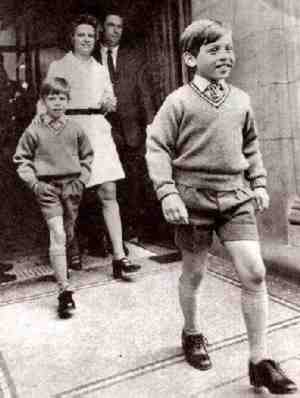
Figure 3.--King Hussein's sons Abdulah and Faisal at an English prep school. |


For most of its history since
independence from British administration in 1946, Jordan was ruled by King Hussein. King Hussein bin Talal claimed to be the
42nd generation direct descendant of the Prophet Muhammad (peace be upon him) through the male line of the Prophet's
grandson Al-Hassan. From his youth, when his grandfather, Abdullah, was gunned down at his side in Jerusalem Hussein's life has been a dramatic one. Hussein ibn Talal, is the third king of Jordan.
Hussein assumed his constitutional powers as king on reaching the tender age of 18 on May 2, 1953. Hussein was at the helm of Jordan and at the heart of Middle Eastern affairs. A pragmatic ruler, he successfully navigated competing pressures from the major world powers, Arab states of widely varing politics, Israel, and a large internal Palestinian population, through several wars and coup attempts. Few in 1953 thought he would succeed. He not only succeeded, but has introduced a level of democracy to Jordon unusual for the
Middle East. He resumed parliamentary elections in 1989 and has gradually permitted political liberalization. He signed a formal
peace treaty was signed with Israel in 1994. King Hussein died in 199 after a long struggle with cancer.
The British Foreign office after World War I created Jordan (1921). As the French seized control of Damascus and set up a colony In Syria, the British attempted to placate the Arabs by establishing
Abdullah, son of the Sharif of Mecca, as king of the new Kingdom of Jordan. T.E. Larence, the famed Lawrence of Arabia, played a major role in this.
King Abdullah was a major influence on his grandson.
King Hussein's fatherwas King Talal, King Abdullah's son. I'm not sure who is mother was.
King Husein had two brothers, Hasan and Mohammed.
Hussein was born in Amman on November 14, 1935. Despite being a prince, he grew in rather strained circumstances. He recalls in his autobiography that he once has to sell his bicycle to help out in a
family finacial crisis.
Hussein as a boy he appears to have primarily worn English-syle clothes. This included short pants suits.
His Grandfather the King arranged for him to attend Victoria College (a secondary school) in Alexandria Egypt. It was at the time the Arab worlds primeer secondary school. He also attended Harrow, an English Public school to give him a grounding in both Arab and Western culture. He also spent 6 months at Sanhurst, the English military acrdemy. Prince Hussein was at his grandfather's side when the King was shot to death at Jersalem's al-Aqsa mosque in 1951. A bullet also struck Prince Hussein. It was, however, deflected by a medal on his uniform that the king had insisted he wear.
After his grandfather's assasination, his father Talal was ceowned king. Talal's mental illness forced him to abdicate after a year in
1953.
King Talal's abdigation meant that at the age of 17 Hussein became king (1953). The new king faced his first political crisis on May 4, 1954, when he dismissed his first prime minister at the age of 19. Another significant early action was in 1956 dismissed Sir John Bagot Glubb. Glubb was the British General who up up to that time had commanded the Arab Legion which became the Jordanian Army. Glubb left te young king with the most professional military in the Middle East.
Te King ended British quasi-colonial control (1957).
King Hussein later survived a coup by radical Arab nationlist Army officers opposed to the king's moderate policies.
King Hussein has had been married four times, once to an Englishwoman and most recently to an American, Queen Noor. His relationship with his four wives has been uneven at best.
|
King Hussein has 11 children, 5 sons and 6 daughters:
Abdullah was a dashing army officer, King Hussein's eldest son. His mother was the daughter of a British diplomat who his father has since divorced. Abdullah and his younger brother Faisal were educated in England and the United States. He is married to a Jordanian of Palestinian origins. Abdullah ws a Major General and led a special unit in charge of palace security.
Faisal has one son, Omar.
Many Jordanians believed that King Hussein would prefer Hamza to replace him. Hamza's mother is the King's present Queen, the American born Queen Noor. He is, however considered too young, and replacing
his older brother would require a Constitutinal change.
King Hussein has been described as a macho man. Although widely admired in the West, he is a strongman, albeit a benevolent one, at home. He is supported by a personality cult. He is intensely ambitious. He believes that he is a man of destiny. Few
in 1953 thought he would succeed. He not only succeeded, but has introduced a level of dmocracy to Jordon unusual for the
Middle East. He resumed parliamentary elections in 1989 and has gradually permitted political liberalization.This strongman has few political prisoners (he would argue that he has none). He runs a quasi-democracy with a fairly sound economy and he gets along, with
some ups and downs, with Jordan's Islamists -- in sharp contrast to his fellow Arab rulers. His personality cult is less extreme than many. And there is no law against being intensely ambitious. If he had mottoes, two would suit him: "Moderation, stability and tolerance forever" and "My Hashemite family forever". He would see no contradiction.
King Hussein is one of the longest serving heads of state, Among world's heads of state and government, only Queen Elizabeth II has held office longer. King Hussein has achieved this by being a clever tactician: asserting early on in his reign his independence from Britain, but retaining close ties with the country where he was educated; establishing good relations with the Americans, and more importantly the Israelis. The King kept Jordan out of the Suez War (1956). He decided, however, to join Egypt and Syria in the Six Days War (1967). Nassar tricked him by provifing fabricated inforation aout military successes. The King managed to maintain Jordan's independence despite many setbacks, including the loss of the West Bank, and a difficult relationship with the Palestinians. The Palestinian Libersatin Organization (PLO) conducted raids into Israel and worked to undrmine his regime
He ordered the Armt to attack the PLO which had created a state within a state (1969).
A pragmatic ruler, he successfully navigated competing pressures from the major world powers, Arab states of widely varing politics, Israel, and a large internal Palestinian population, through several wars and coup attempts. He signed a formal peace treaty was signed with Israel in 1994.
He is a keen radio ham and an accomplished pilot - a complex man, equally at ease at a campfire with loyal Bedouins as at the controls of a Boeing 747.
King Hussein has survived attempts on his life and in August 1998 was revealed to be battling cancer for the second time. He came to the United States for treatment. The King died in 1999 after a protracred struggle.
King Hussein's dream was to lead Aran nationalism. He never managed the appeal of the charismatic Nasser. It is important to assess why King Hussein failed. We suspect it was his moderation, his desoire to avoid war and reach an accomodation with Israel. Leaders like Nasser who genrated more appeal were committed to war and the destruction of Israel. The appeal of violence in the Arab psyche seems a key factor. Perhaps Arab readers can provide an alternative assessment, but it seems to us that apposels of war and violence (like the Grand Mufti, Nasser, and Arafat) have been consistently able to generate more popular support than the appostles of peace and moderation like King Hussein and President Sadat.
King Hussein was succeeded by his eldest son Abdullah. King Hussein dramtically announced a change in the assumed succession in January 1999, replacing his brother with Prince Abdullah. King Abdullah does not have the experience of his uncle Hassan who was expected to succeed Hussein, but he has his father's carisma and more importantly his ties with the Army were probably critical in the succession. Abdullah has one son, Hussein.
Ashton, Nigel. King Hussein of Jordan: APolitical Life (Yale University Press, 2008), 431p.
Shlaim, Avi. Lion of Jordan: The Life of King Hussein in War and Peace (Knopf: 2008), 723p.

Navigate the Boys' Historical Clothing Web Site royal pages:
[Return to the Main Jordanian royal page]
[Return to the Main royal pages]
[Austria]
[Belgium]
[Denmark]
[France]
[Germany]
[Italy]
[Japan]
[Luxenburg]
[Monaco]
[Netherlands]
[Norway]
[Romania]
[Russia]
[Spain]
[United Kingdom]
[Yugoslavia]