|
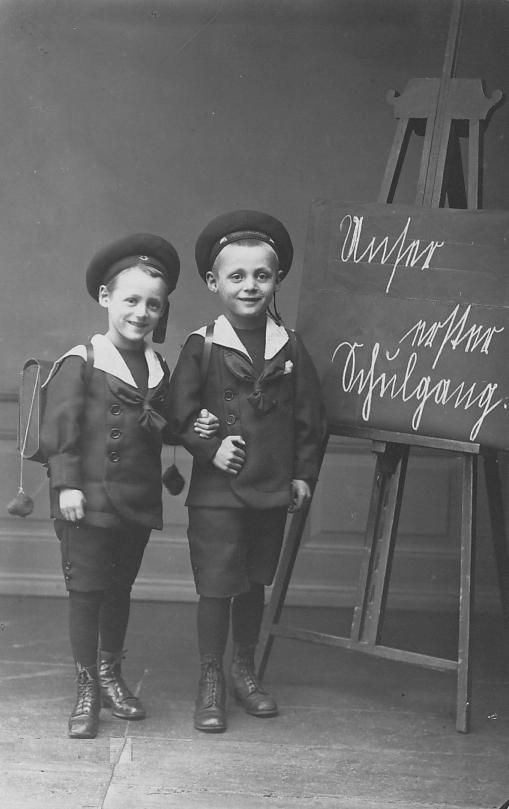
A child's first day at school is another major event in his life. For some it is the hardest day in his life and often his parents--especially mom. It is probably not as important as it used to be as many children now are taking care of in pre-school daycare, often from an early age. Even so that doesn't always make the event easier for some and tears may still be shed. Before World War II (1939-45), school was more commonly the first important event away from home. It could be a heartwrenching experience full of big and small worries for the boy and for his parents. Children were and still are uneasy about starting a new routine, getting along with other kids, and being away from mommy and daddy. While that first day at school was the major event.
Educators now offer parents a great deal of advise on the first day at school or day care. One expert advises parents to "... take heart! Daycare is often one of the most positive experiences in a young child's life. The peer interaction, structured and educational day, and social skills they gain have been shown to help children do well later on in school. Before your child's first day, there are several things you can do to
help your little one adapt to daycare smoothly."
Visiting your child's school for a few playdates before his actual start date will make it a familiar and fun place to go on that first day of school. This often is more feasible at a private than a public school. Even if school's not in session, a quick visit and tour will get your child acquainted with this new place in his life.
Change can be good, but young children thrive with a predictable
routine, and your child may be overly excited, stressed, and anxious
his first week. Try making the first week a short one by starting
daycare on a Wednesday. This is more feasible for day care than actually starting school.
With Every Turn...Change, Change, Change. If at all possible, try not to introduce too many additional changes in your child's life right now. Leaving every morning will be an easier task when he knows everything will be just as comforting when he returns home that afternoon.
A child will be working extra hard playing and taking in new things. You can expect even the most energetic toddler may be a little more tired than usual for a few days to weeks.
A good friend of mine gave me excellent advice on how she handled the eve of her son's
first day. Have a special treat, favorite dinner, or new present waiting for your child when he returns from his first day. He's had a big change in his life, and he's earned it!
Such careful planning has not always been the case. Until recently, the boy was simply decked out in what mom considered to be the proper school attire and sent off to school. This could be quite a different experience, depending on whether a school reqired a uniform or not.
Often mother's judgement proved widely out of line with what other boys were wearing, but many moms until recently gave relatively little weight to their son's suggestions. Thus school clothes for that first day and the younger children in general could be quite different than that for the older children.
Boys attending a school with a uniform often had an easier time as the boys were often dressed alike. The younger boys at these schools were often proud of their uniforms, but this began tonchange as they got older and more sophisticated.
Childrenn in different contries often were outfitted very differently for their first day of school. Often moms bought new clothes for each new school year. This was especially the case in the 19th and early-20th century while there were significant county differences in children fashions from country to country. Curiously, one commion phenomenon around the world is that we do not see these photographs being taken until after the turn-of-the 20th century. A major factor here was the appearance and proliferation of the family snapshot. It was often possible to discern the nationlity of the children in photographs based on how they are dressed. In the late-20h century a kind of standard European fahion developed meaning that this was no longer possible. Some but not all of these differences have declined in the modern day. When we began working on this subject we were thinking about photographs taken by parents before semding their children off to school on their big day. We have since noticed pictures taken at the schools showing how the children were received and first introduced to school. This is also an interesting subject, but a little more complicated today when many children attend pre-school than was the case before World War II when the vast majority of children began school at about 6-years of age without ant pre-school experience. .

Navigate the Boys' Historical Clothing Web Site:
[Return to the Main school event page]
[About Us]
[Activities]
[Chronology]
[Clothing styles]
[Countries]
[Debate]
[Economics]
[Garment]
[Gender]
[Hair]
[History]
[Home trends]
[Literary characters]
[School types]
[Significance]
[Transport and travel
[Uniform regulations]
[Year level]
[Other topics]
[Images]
[Links]
[Registration]
[Search]
[Tools]
[Return to the Historic Boys' School Home]