|
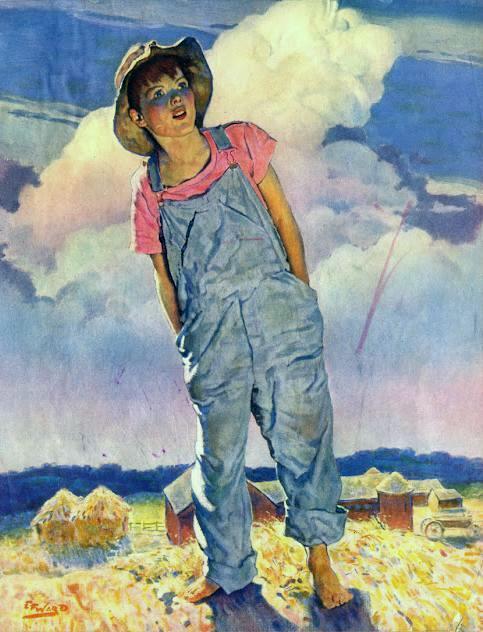
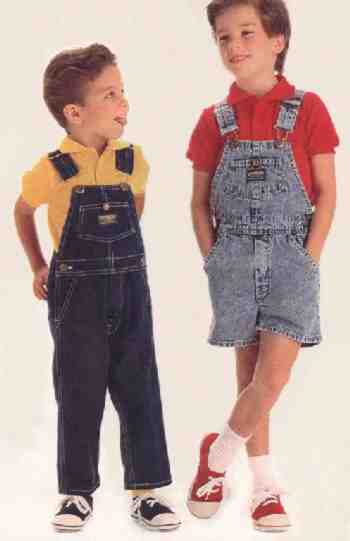
No clothing item as assumed more importance in a boy's wardrobe during the second half of the 20th century than blue jeans. The first jeans worn by boys, although it was not a boys' style, were overalls. We ave collected dome information on this style. Overalls are esentially Aerican. They were first worn by miners and factory workers, but eventually vecame associated wih American farmers. We do not see children wearing them to any extrent in the 19th century. After the turn of the 20th century, we begin to see boys wearing then extensively at rural schools (1910s-30s). They were vinexpensive, practical, and duranle. We still see them in the early-40s, but they then rapidly diappeared. School systems began closing small rural schools and the rural children wanted to dress like the other kids in trendy tyles. Overalls were seen as hickish and old fashioned--the death knell for children's fashions. Jeans ewnt on to become not only popular wih boys, but girls as well, especially when designer jeans appeared. in ame very popular, but bib-front overalls disappeared as children's wear. Overalls were worn mostly in rural Americaas work clotyhes, but in the 1990s has become stylish for both boys and girls. And after World War jeans became an unternationa; phenomenon, although the popular syle was the jeans without the bibs. At time, however, even the bib-front styles became popular.
Overalls were created as work pants for men in the mid-19th century. And they retined that image throughout the 19th century. Curiously, although the modern image is a farmers' garment, they were at first primarily worn by miners and factory workers. We are not sure precisely when oiveralls became standard farmwear. It seemsto be about the turn of the 20th century, but we can not confirm this. We see very few children wearing them in the 19th century. We note a few images in the 1890s, mostly at the end of the decade. And ironically they do not seem to be working-class children, but middle-class children. We are not entirely sure of the conventions involved here. But we see a few portraits of boys wearing very fancy blouses with overalls. And we see mothers takibg their children to be photograhed wearing overalls. And then about 1910 we suddenly see large numbers of boys in rural areas. Levi Strauss in 1912 introduced its first playsuits for children, known as Koveralls. Simon Davis, the son of Jacob Davis designed the Koverall. Blue jeans without the bibfront seemed much more acceptable to urban boys. Many city boys first saw blue jeans in cowboy movies and liked the look. American boys as knickers disappeared in the 1940s, American boys began to wear blue jeans. The availability of jeans was at first limited by the War. By the 1970s jeans had become almost a uniform of American and soon worldwide youth and increasingly a fashion statement. One HBC contributor suggesed in 1998 that bibfront overalls reached their peak of popularity in the mid-1990s. He believes that while still worn, the popularity among older boys has begun to decline. A follow up report indicated that inj 2000 Koveralls have all but disappeared in California. They were very popular in the early 90's in the shorts versions. They were mostly the bleached denim color and the "cool" boys (around the Junior High age) wore them with one strap unfastened. They usually came to the top of the knee. Some times the longer shots we rolled to above the knee length. The long pants version are usually just seen on toddlers nowadays.
|
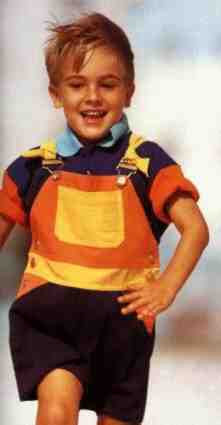
Overalls were created as hardwearing pants for miners in California. For sevral decades they continued to be primarily won by miners and then factory workersin the East amd Midwest as America industrilized. We are not less sure about European workers. Overalls were not worn by children and as far as we can tell farmers throughout the 19th century. This is something we are still investigating. We are not sure why they were not immediately popular with farmers especially because they were subsequently to become so identified with farmers. This for some reason changed after the turn-of-the 20th century for reasons we can not yet explain. American Farmers began wearing ovealls, we are not sure just when. We do know that rural children, especially boys began wearing overalls about 1908-09. We are not sure why, but we can trck it very precisely in school photograpy. Then shortly later, bif-front jeans called Kveralls were offred to middle-clss urban children (1912). Overalls in the late-19th and early-20th Century were worn by boys of all ages as well as adult men. The Koveralls introfuced in tne 1920s were primarily for younger boys. I'm not positive about this, but I think they were mostly worn by relatively younger boys, up to about 8 years of age. (This needs to be confirmed.) The coloful overalls that appeared for younger boys in the 1980s
were generallys for boys of up to 5 and 6 years of age. The overalls, especially the denim and other muted color overalls were worn by boys of all ages.
One of the central symbols of modern American culture are blue jeans. They were in fact the creation of a 19th century German Jewish immigrant--Levi Strauss. Levi Strauss overalls began appearing in the 1870s and by the 1880s had become enormously popular as work clothes. The original jeans were workclothes and the idea that they would one day be fashionable would have been inconceivable to 19th century children. The most popular style of jeans were initially overalls. They became very popular throughout the 19th century with miners and factory workers. They were also worn by raileoad men. Curiously, although the modern image is a farmers' garment, they were at first primarily worn by miners and factory workers. We are not sure precisely when oiveralls became standard farmwear. We think that may have been in the 1890s or perhaps the 1900s. We have not yet beenable to confirm this. Nor are we sure why overalls did not become common in rural areas earlier. We don't see children wearing them in the 19th century photographic record, except at the very end of the century we see a few images.
We note a few images in the 1890s, mostly at the end of the decade. And ironically they do not seem to be working-class children, but middle-class children. We are not entirely sure of the conventions involved here. But we see a few portraits of boys wearing very fancy blouses with overalls. W are not sure about the colors. And we see mothers takibg their children to be photograhed wearing overalls. The best indicator as overalls as school wear is school portraits. Amrican children did not wear uniforms. Thus the clothing they are wearing in the school portraits are a good idicator of popular styles.
We do not begin to notice them at schools until the turn of the 20th century. We note a boy at at a rural Tennessee school in 1902 wearing what look like home-made overalls. We do not know why they suddenly became so common. It was not until the end of the decade, however, that we note them beng commonly worn to school and only at rural schools. Boys in rural America commonly went to school in overalls through the 1930s abnd into the early 40s.
Levi Strauss in 1912 introduced its first playsuits for children, known as Koveralls. Simon Davis, the son of Jacob Davis designed the Koverall. Davis was the superintendent of the Levi Strauss Valencia Street factory. Levi Strauss & Co. advertised the Koveralls widely and the Koveralls became the first product sold nationwide by Levi's
the 1920s introduced "Koveralls", a denim play garment. This was quite a novel idea at the time. For the first time in America, some affluent city boys were esentially wearing overalls. Levi Strauss in the 1920s introduced "Koveralls", a denim play garment. They were conceivedf of by ??? Davis, son of Jacob Davis This was quite a novel idea at the time. For the first time in America, some affluent city boys were esentially wearing overalls.
The overall was generally seen as workingmen's clothes and a symbol of poverty by urban Americans for decades. Blue jeans without the bibfront seemed much more acceptable to urban boys. Many city boys first saw blue jeans in cowboy movies and liked the look. American boys as knickers disappeared in the 1940s, American boys began to wear blue jeans. We see movie cowboys wearing jeans in the 1930s. This must have helped to popularze them among boys. The availability of jeans was at first limited by the War. By the 1970s jeans had become almost a uniform of American and soon worldwide youth and increasingly a fashion statement.
Overalls reemrged in the 1980s as a child's garment. They began to be worn by small children. Shortalls became less commonly worn by boys in the 1970s and by the 1980s mothers had begun to repalce them with
overall-like garments. Overalls until the 1970s were almost always made with long pants.
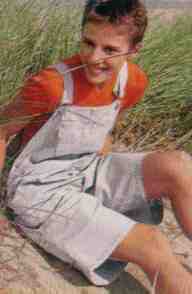
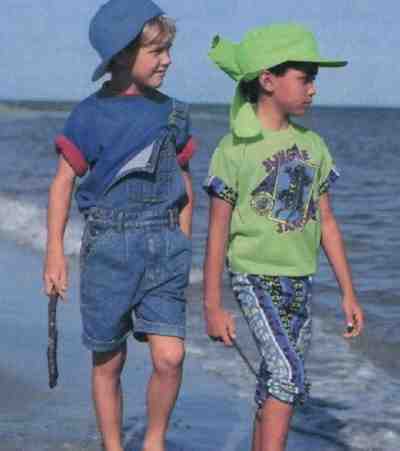
Younger children began wearing short bib-front overalls. I'm not sure when this was. Clothing ads in the 1920s show all long pants overalls for boys. As classic shortalls began to decline in popularity by the late 1970s, they began to merge into a sdhort bib-front overall garment. Short pants overalls for older boys also began to appear. Even younger teenagers began wearing them--usually with long baggy shorts. Bibfront shorts have been worn by the boys as well as girls, but an HBC contributor reports that in the late 90s that they have been much more popular among girls than boys.
After bib-front overalls declinecd in popularity for boys--even on the farm in the 1940s they were no commonly seen again for boys until the 1980s. Overalls were adopted by girls and boys of all ages as a fashion statement. Often a kind of anti-fashion statement. Boys bdegan wearing them as play clothes in the 1980s. They were at first primarily for very young children, but older boys also began wearing them. By the 1990s older girls began to wear them and by the mid-1990s were wearing them mpre commonly than boys.
|
The topic of overalls is primarily an American story. They were invented in America by Levy Strauss and as far as we know were only worn in America, perhaps Cnaada. We do not see themmbeing worn in Europe during the 19th century. After the turn-of-the century we see American children wearing them. Rurl children wore overalls. City children began wearing Levi Strauss Koveralls or similar play outfits made by other versions made by other companies. We do not see these Koveralls in Europe even though related suspender shorts and H-bar shors were common, the bib aspect simply did not cross the Atlantic. This is not surprising because few amerucan fashions (except the Fauntlkeroy suit) crossed the Atlantic until after World World war II. We do begin to see bib-front shorts and later longs as well s overalls in Europe after the War. Both the increasing popularity of casual styles and the culltural imprint of america were presumably factors. Also involved was the connction with denim jeans. And in America we big to see bib-front shorts and overalls. Until World war II, Koveralls were almost always a long pants outfit.
|
Overalls were long pants work outfits for men. This continued for decades afer Overalls first appeared (1840s). And even when American children began waring them (1910s), they continued ti be a long pnts garment. They were the first long pants garment that many American children wore. We begin to see short pants bib-front shorts after the War. Actual bob-front overalls came later. We are not sure if this occurred first in Europe or america. It is a topic we are still looking into.
The original overalls were made of canvas sheeting. Blue denim soon followed and became stromgly associated with overalls. Overalls were, hpwever, made in many different materials--not just denim. Both blue and black denim were available. There were overalls in also khaki cloth. There is also safari drill--I'm not sure what this was. One popular style was stripped drill--often referre to as railroad overalls. The overalls available for boys in the 1990s was a much larger range of materials, including corderoy, canvas sheeting, and other materials.
We have only limited information on the color of overalls at this time. It is, however, a topic we are working on. The original overalls were made of canvas sheeting that presumably means an off whire. . Blue denim soon followed and became stromgly associated with overalls. There was also black denim. Striped overalls associate with the railways subsequenly appeared (1890s). We are not sure what colors the Koveralls of the 1910s were made. They may have been done in stripes to destinguish them from the overalls factory workers wore. Railroad worker striped overalls seems to have been more acceptable. The practicality for workmen was thge same that made bib-fronts practical for children. But Levi Straus did not think mothers wanted to dress kids like workers. Eventually we see color choices as well. Brigter colors appeared, we think, after Worldwar II. Dennis the Menace was famous for red overalls. The overalls that appeared for younger children in the 1980s began to appear in a wider range of bright colors that appealed to young children. The overalls that older boys started wearing in the 1990s, however, were blue denim or other plain colors, commonly blue.
|
The original overalls all had long pants. Shortpants would have been unheard of in the late 19th Century. The Koveralls for boys introduced for younger boys in the 1920s also had only long pants. The bib-front overalls appearing in the 1980s had both short and long pants versions. They were often made to be worn in large baggy sizes.
The original Koveralls had long pants. Often boys in the 1920s and 30s who mostly wore short pants had a pair of Koveralls for rough outdoor play wear. They may have influenced the shortalls which appeared in the 1950s, althout shortalls were worn for could be worn for dressy as well as play wear. Koveralls in return began to replace shortalls which by the 1980s were being worn by younger boys, mostly todlers. Koveralls began to appear in both long pants and shortpants styles. Koveralls by the 1990s began to be worn by boys of all ages as well as girls.
CPSC and Levi Strauss in 1999 announced an infant and toddler Koverall and
shortall recall. In cooperation with the U.S. Consumer Product Safety
Commission (CPSC), Levi Strauss & Co. of San Francisco, California, voluntarily recalled about 3,000 Little Levi's Koveralls and Shortalls. The snap fasteners on the
inside legs of these garments may separate, creating a potential choking risk
to children. CPSC and Levi Strauss are not aware of any injuries involving these garments. This recall is being conducted to prevent the possibility of injury. The recalled Little Levi's brand Koveralls and Shortalls styled for boys in sizes 12 to 24 months and 2T to 4T were all sold in indigo denim with product codes: 29028-2891 and 22028-2891 (Koveralls) and 22020-2891 and 29020-2891 (Shortalls). Koveralls is a youth version of traditional adult overalls and Shortalls is a short pant length version.
Levi Strauss is also recalling infant sizes 12 to 24 months of its Levi's brand Girlswear Koveralls and Shortalls with product codes: 38806-0817 and 38806-0881 (Koveralls) and 39867-0881, 39867-0817, and 39867-9281 (Shortalls). The girls garments were sold in stonebleach denim, pink twill, or pink check fabric with an elastic back. The product codes are located on the back of the care label sewn in an inside seam of each garment.
Retail stores sold the garments nationwide beginning in November 1996. Consumers should immediately stop using these garments and return them to the store where purchased for a full refund. Consumers with questions about the recall may call Levi Strauss & Co. at 1-(800)USA-LEVI, or write to the company at: Levi's Plaza, P.O. Box 7215, San Francisco, Calif. 94120.

Navigate the Historic Boys' Clothing Web jean pages:
[Return to the Main jean page]
[]
[Cutoffs]
[Jean shorts]
[Koveralls]
[Denim]
[Baggy jeans]
Navigate the Boys' Historical Clothing Web Site:
[Introduction]
[Activities]
[Biographies]
[Chronology]
[Cloth and textiles]
[Clothing styles]
[Countries]
[Topics]
[Bibliographies]
[Contributions]
[FAQs]
[Glossaries]
[Images]
[Links]
[Registration]
[Tools]
[Boys' Clothing Home]
Navigate the Historic Boys' Clothing Web chronological pages:
[The 1840s]
[The 1870s]
[The 1880s]
[The 1890s]
[The 1900s]
[The 1910s]
[The 1920s]
[The 1930s]
[The 1940s]
[The 1950s]
[The 1960s]
[The 1970s]
[The 1980s]
[The 1990s]