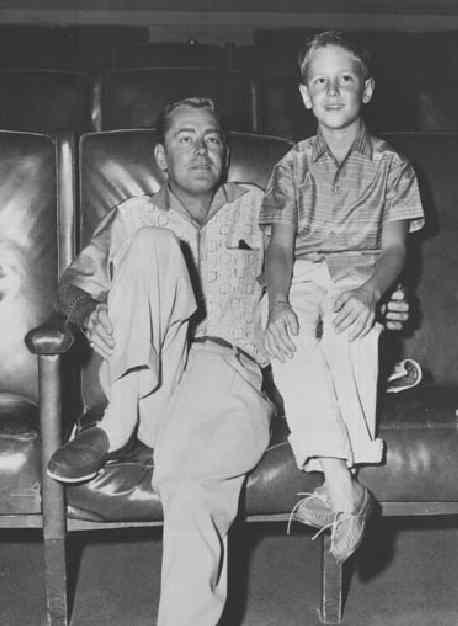
Figure 1.--David Ladd with his film star father here watch the rushes from "Buffalo Grass". |

|
Information about child actors also provodes a great deal of fashion information. Both clothes these children wore as well as the costumes they wore in their films and shows provide much valuable information. These childrens often dressed very fashionably so information about them provides insights into contemprary fashions. The costumes they wore in films also provides useful information--although it must be treated more cautiously. HBC is preparing an alphabetical listing of child actors in movies, plays, and television.
David was the son of film star Alan Ladd and his second wife, Sue Carl. He was borm in 1947, of course in Los Angeles. He reprtedly loved to dance and won selveral awads. I do not a great deal about his film career. I'm not sure whose idea it was to start acting. Presumably his creer mostly resulted from the fact his father was a star. We note he got generally good, if not glowing reviews. He had a small role in The Big Land, but then was featured in four substantial films. He best parts were those of a gentle boy, perhaps those suited his personality best. His fathers roles were quite different. In one film, Rayme (1960) he plays a boy who likes animals. Three of David's best known films are The Proud Rebel (1958); A Dog of Flanders (1959); and "Misty" (1961). The only one in which father and son played together was The Proud Rebel. He also made a few appearances on major TV programs, Including "Gunsmoke," "wagon Train," and "Bonanza" between 1955-59. He made appearances as a young adult in 1970s films, with little success. His basic gentle demeanor fit several child roles, but that was not movie goers were looking for in young adults. He eventually gave up acting and became a producer. He married Cheryl Ladd.
Engaging little boy with massive bangs on the Nell Carter show. "Gimme a Break." Most kid actors appeared on only one TV-series. Joey viually grew up on television, appearing on popular shows at many different ages. I do not have complelete details on his career at this time. I never saw any really interesting episodes, but I do recall seeing him in shorts at least once--unusual for an American sitcom. As a teenager he starred on another sitcom, "Blossom". He played a vacuous girl chaser and became a real heart-throb, even launching a music career. He got his own show Brotherly Love (1995) with his real life brothers. The boys all wear longs, even the little one in bangs. In one episode he poses in an art scene and teases his little brother for playing a fairy in a school production.
|
Baby LeRoy was a popularAmerican child asctor during the 1930s. His real name was Ronald Le Roy Overacker. He was born in Los Angeles (1932). Few actors even child actors got an earlier style than Baby LeRoy. He began his film career when he was less than 1 year old. He appeared with Maurice Chevalier in 'A Bedtime Story' (1933). He is particuilarly well known for his appearance in several W.C. Fields films, including 'Tillie and Gus' (1933) and 'A Bedtime Story' (1934). As he played a baby, he became known as Baby LeRoy. The relationship was notable. Baby LeRoy when he was 3 years old became drunk and was noticiably staggering after Fields spiked his orange juice with gin while making "It's A Gift". And in their previous film, Fields kicked Baby LeRoy while filming a gag scene. He kicked the child sdo hard that studio executives were disturbed, afraid of how the public would react. Fields defended his action and the scene, saying that men who had to deal with young children would understand. Baby LeRoy for a time was the only child actor at Paramount. Two other boys (Billy Lee and David Holt) were signed at Paramount to provide Baby LeRoy some welcomed company. The camaraderie of the three boys became the source of some amusement on the Paramount lot. His last film was a cameo role playing himself in 'Cinema Circus' (1937). A comeback was planned for him in 1939, playing the main character in 'The Biscuit Eater'. While on location in Georgia, however, LeRoy become very ill following the first day of shooting on the film. Le Roy had been called on to swing on a rope across a lake in the opening scene of the film. But what the camera caught, was Le Roy falling into the lake on each of the two times he attempted the take. Although he was thoroughly dried off both times that he fell into the lake, by the next moring completely lost his voice, suffering from a terrible head and chest cold. The doctor who examined Le Roy insisted that he would need 2 weeks to recover. With cast and crew on location in Georgia, it would have been very costly to wait for the young actor to recover. And he played suchg a central role in thre film, it was impossible to shoot around him. He was in just about every scene. Paramount executives thus decided to recast the part and replace him so as not to hold up the production. Billy Lee stepped in to play the role which became one of his best films. Paramount announced that another Le Roy would appear in a different film after he recovered. That never happened. Thus Baby Le Roy lost his last real chance to make a comeback and demonstrate his acting abiliities. He is thus remembered primarily as comic prop for W.C. Fields. , had slipped out of his hands. As a young adult he became an alcoholic. He appeared as an adult in the role of a guest challenger on the TV panel show 'To Tell The Truth'. He died in Van Nuys, California (2001).
A boy star during the 1930s and appeared in over 43 movies. He is probably best remembered for "The Biscuit Eater" (1940?), "Wagon Wheels" (19??), "Sons of the Legion" (19??), and "Hold Back the Dawn" (1941). Billy Lee, whose birth name was Billy Lee Schlensker, was born on March 12, 1929, at a farm near Terre Haute, Indiana in a tiny area known by local residents as "Nelson's Bend". In 1931, before Billy's 2nd birthday, his father, Peter Schlensker, who suffered from asthma, temporarily moved the family to the west coast, hoping that a change to the warmer climate of Los Angeles would help ease his condition.
Lee Jun-fan (李振藩) better known as Bruce Lee (李小龍) was born in Chinatown, San Francisco (November 1940).
He became a noted movie actor, film director, martial artist, martial arts instructor, and philosopher. Although he dies at a very young age, he stands as th most influnetial Chinese individual in the movie industry.
While born in America, he grew up in Hong Kong. His parents especially his mother were from prominent Hong Kong fmilies. She was the prominent Cantonese opera star Lee Hoi-chuen of uncertain Eurasian parentage. Incredably they decided to return to Hong Kong only a few months after Pearl Harbor and the Japanese seizure of Hong Kong (December 1941). The Lee family thus lived under Japanese occupation for over 3 years. Because of the families show business connections, Bruce appeared in many low-budget Hong Kong films beggining as a baby. He was not a good student and misbehaved in school. He goy inti fights at school and on the street. His father decided he better learn martial arts. Here he had a problem because many martial arts enthususts believed that only pure-blooded Chinese people should be taught the discipline. When Lee beat uo the son of a Tong (gangster) his parents sent him back to Ameruca to complete his education. There he made his name, not only in martialrts, but the fikm industry. He is widely credited to be the most influential martial artists of all time. In addition he bcame a pop culture icon, helped popularize martial arts with non Asian Americns and helped change the way Asians were depicted in Hollywood films. He died in Kowloon Tong (July 1973, only 32 years old.
Davey Lee was a popular child actor at the time that silent films were giving way to the talkies. His brother Frankie Lee was also a child actor. I know very little about him at this time. He was born in California during 1924. He appears to have appeared at a very young age. Silent films had a very wide distribution. Thus he was popular both in Europe and America. His films and roles included: "The Squealer" (1930) .... Bunny Hart, "Skin Deep" (1929) .... Son of District Attorney, "Say It with Songs" (1929) .... Little Pal, "Frozen River" (1929) .... Billy, "Sonny Boy (1929) .... Sonny Boy, and "The Singing Fool" (1928) .... Sonny Boy. Has most of his films were silent movies, we are not yet familiar with them.
|
Mark was born in Oxford, England on July 11, 1958, the offspring of two acting parents. His parents began entering Mark in auditions at an early age and by 7 years he was a season performer on British television. He appeared in small roles in "Allez France!" (1964) and "Spaceflight IC-1" (1965). His first important role was in "Fahrenheit 451" (1966) where he played an angelic-looking school boy, appropriately dressed in shorts and knee socks. His next role was the stuttering Jiminy in "Our Mother's House" (1967). Jack Clayton directed the offbeat film and Mark made a big impression on the film maker that was to play big dividends. Sir Carol Reed was at the time preparing for the film "Oliver" (1969), a musical version of the Dickens' classic. The book had been done several times before: Jackie Coogan played Oliver in 1922, Dickie Moore played the part touchingly in 1933, and John Howard Davis appeared in the 1948 production that featured Alec Guinness' marvelous interpretation of the sly Fagin. Sir Carol needed to find a child that could sing and dance as well as act. About 2,000 boys applied and 250 actually auditioned. Clayton recommended Mark to Sir Carol and he was offered the role soon after his audition. "Oliver" emerged as one of the colossal productions of the 1960s. It was that film which first caught my eye, I was most taken with Mark's lovely performance. Some believe that Mark's performance was lost in the competition with the strong cast. One reviewer wrote "The focus of the movie is so wide, and the logistics of the production is so heavy, that Oliver himself, dutifully played by 9-year old Mark Lester, gets flattened out and almost lost, as if he had been run over by a studio bulldozer." I think, however, that Mark's performance was superb. He played a boy completely adrift, totally incapable of controlling his situation and swept along by events and the people he comes into contact with. The feeling of powerlessness and vulnerability were critical to the part and perfectly executed by Mark. In fact Mark had some fine moments: the singing of "Where is Love?". "Who Will Buy?", and "I'd Do Anything" with an almost angelic quality. I rather agree with a New York Times reviewer who wrote "Young Mark Lester as Oliver has a kind of golden innocence, untainted by self-conscious adorability of the typical child actor, and a marvelous pure boy soprano voice. He is shy, yet game and a perfect foil for Jack Wild's Artful Dogger." Gene Shalit noted "Mark is an ideal Oliver; angelic and sweet voice..." The film was a huge financial success, grossing over $16.8 million in the U.S. and Canada alone and won the 1969 Oscar as the Best Picture. His parents said at the time that they would not force him to continue in films, but Mark decided to do so. I don't think, however, that any thing else he did ever approached "Oliver!" His next film was "Run Wild, Run Free" (1969). Some reviewers were impressed. One reported "Mark Lester, the endearing Oliver of "Oliver!", is charming and affecting as the blond, inhibited boy desperate to communicate who finally finds his voice and the communication he yearns for through his colt and patient friends." Mark joined Jack Wild again in "Melody" (1971), the story of two rebellious boys of opposing backgrounds who study at a depressed London elementary school. Unfortunately the boys all wear longs, what a pity. Next he played in "Eyewitness" ("Sudden Terror") (1970) and he and his family traveled to Malta. "Eyewitness" was a remake of the Cornell Woolrich story, "The Boy Who Called Wolf" which Bobby Driscoll played in "The Window" (1949). Next Mark came to the United States for a multi-part Disney special, "The Boy Who Stole the Elephant." While in California he appeared on several TV series as a guest star. He returned to England for the rather absurd gothic thriller "Who Slew Aunty Roo?" (1972). He was the older brother in a "Hansel and Grettle" type story. He was costumed in short, but rather long shorts, apparently to make him look like a little boy even though he was 14 years old. His career declined after that and he found it difficult making the transition to teenage roles. His performance in "Scalawag" (1973) starring Kirk Douglas was disappointing. In reviewing the inept pirate story set in Mexico during 1840, but filmed in Yugoslavia, one journalist reported that Douglas "so mishandles Mark Lester that his `Englishness' looks like embarrassingly bad acting." Plans for Mark to play Jim Hawkins in a remake of Treasure Island fell apart and "The Dream Time" closed production in 1973 after filming part of the story. One reviewer reported that Mark looked "uncomfortable" in his role as the intellectual son of a university professor "All `Aperto" ("Dance Under the Elms") (1975) set during a Tyrolean vacation.
Cute little guy with a darling Dutch-boy haircut. I first noticed him in a McDonalds TV ad where he grabs his short pants an exclaims he's ready to go to Disneyland. He then appeared in several other TV adds. The first movie appearance I know of is the replacement for McCauly Caughlin in "Home Alone 3" (1997). Nothing of special interest, but he gives a creditable performance.
Barry Livingston was born on December 17, 1953, in Los Angeles. He had early, uncredited roles in The Errand Boy (1961) and My Six Loves (1963). He is best known for playing Ernie on the long running American TV series, "My Three Sons". Ernie was first Chip's best friend, and later his adopted brother. As Chip got older, there was a need for an younger brother on the series. He was in fact Chip's real-life brother. I rather liked him in the part, one of the few child stars to wear glasses. Ernie loke his TV brothers generally wore popular contemprary casual, but nevre sloppy, clothes. Chip and his mothers were an excellent example of contemprary American boys clothing. He never, however, appeared in any fancy costumes to my knowledge. He eventually made the transition to adult roles in movies including Easy Wheels.
A HBC contributor reports Jake Lloyd saying that he wished they wouldn't use his image on underwear ("Star Wars" tie-ins); I can't remember the exact quote. I also seem to recall that many publicity photos showed him in a Darth Vader T-shirt. Jake played Anakin Skywalker in Star Wars; The Phantom Menace.
|
T.J. Lowther was born in Salt Lake City. Utah. His first important appearance was as Kevin Costner's surrogate son in Clint Eastwood's rather terse chase picture, A Perfect World. He also provided the required boyish cuteness as one of the younger kids of single mom Kathy Bates' brewd for Tony Bill's tearjerker, A Home of Our Own". His most extensive performance was the role of Buddy in the 1994 production of Triman Capote's Christmas saga, One Christmas. He appeared in Mad Love in 1995, then appears to have been inactive until landing the staring role in Mr. Atlas (1997).
A child actor on Broadway, he began making films as a teenager in 1939. He made a long list of films in teenage roles during the 1940s, most prominently in the "Henry Aldrich" series. His most interesting role was Tom in Tom Brown's School Days (1940). He also play Henry in Henry Aldrich Boy Scout (1944), although he was 20! He played one of the older boys in the classic Life with Father (1947), despite being a rather ancient 23. Alas he plays the part in longs, although his two youngest brothers were nicely togged out. He was popular as a juvenile, but his adult acting career experienced little success.
Richard Lyon was born in London (1934). He was the adopted son of Ben Lyon and Bebe Daniels, silnt film actors, Daniels of some promiance. Both were Americans, but did not make the transition to the talkies. Instead they established a new career in Britain, sage, radio, and eventually television. They adopted Richard while in Britain. And when Britain was plunchd into War, both they and their children, Richard and older sister Barabara spent the War in Brutain. Ben served in the U.S. Army Air Force and rose to the rank of Lt. Colonel in charge of Special Services for the U.S. Air Corps which had a masive presence in Britin. Soldiers, sailors and airmen (from 1939) listened to Ben and Bebe weekly on the air waves with their popular, long-running BBC broadcast "Hi, Gang!" Richard became a child film star. He is best known for his roles in 'Anna and the King of Siam' (1946), 'The Tender Years' (1948) and 'The Great Lover'
He also played several adolescent/teen roles in film and then transitioned to his family TV program. The Lyon family bcame Britain's radio and TV's version of Ozzie & Harriet Nelson & family. The program began on radio as 'Life with the Lyons" and then continud on TV (1955). It ran on TV for five seasons (1955-60). After this acting career, Richard became an established photographer.

Navigate the Boys' Theatrical Pages:
[Return to the Main child actor page]
[Return to the Main movie page]
[Return to the Main play page]
[Return to the Main television page]
[Child actors G]
[Child actors H]
[Child actors I]
[Child actors J]
[Child actors K]
[]
[Child actors M]
[Child actors N]
[Child actors O]
[Child actors P]
[Child actors Q]
Navigate the Historical Boys' Clothing Website
[Introduction]
[Activities]
[Biographies]
[Chronology]
[Cloth and textiles]
[Clothing styles]
[Countries]
[Topics]
[Bibliographies]
[Contributions]
[FAQs]
[Glossaries]
[Images]
[Links]
[Registration]
[Tools]
[Boys' Clothing Home]