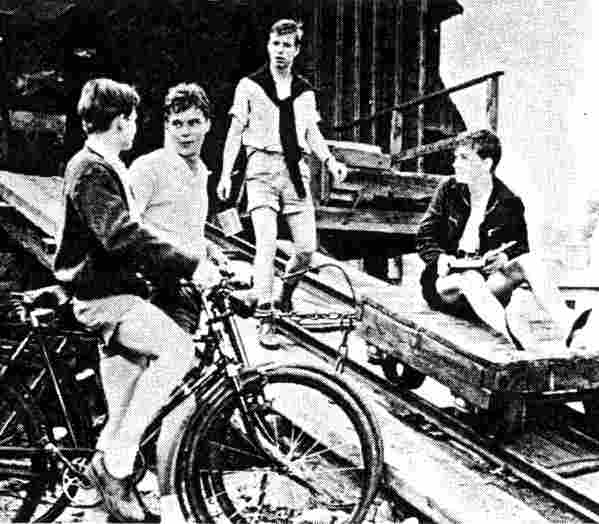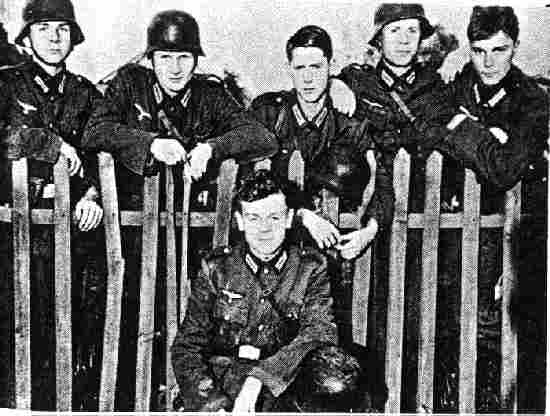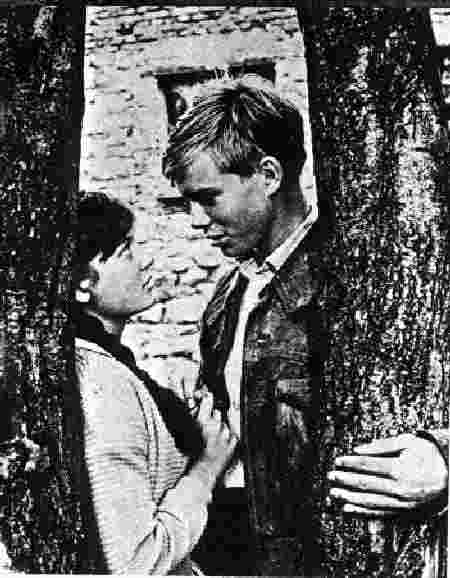
Figure 1.--At the beginning of the 'The Bridge' (Die Brücke) film we are introduced to very ordinary boys with interets and feelings just likke any other boys. There is no hint tht they are about to be thrust into combat. |

|
'The Bridge' (Die Brücke) featured a cast of young actors who proved supremely talented. It is the last days of the World War II in a small German town. The principal characters are depicted as typical 15/16 years old schoolboys in shorts and knee socks at school. Their town is about to confront the advancing American soldiers, and the boys are called up to active service
in the German Army. As the 'Amis' (Americans) approach, the boys' are ordered to hold the bridge into town at all costs. With limited training and inadequate arms they have no chance. The task is futile, and they should have surrendered, but they were, as the SS motto went, "Treu auf bis dem todt" (Loyal unto death). Also, communication with their headquarters was lost. In the end, they are all killed, and the bridge turned out to be meaningless. A really good, post-war, self-examination film. It is based on an autobiographical novel by Manfred Gregor. We note no similar films from Japan.
The Bridge was produced in 1959 and released in the United States during 1961. It is based on an autobiographical novel by Manfred Gregor. It is an important and very honest film about the War. It is a film that is widely known in Germany. and should be viewed by anyone with the slightest interes in the War.
Near the end of World War II, a small German town braces foyr the onslaught of American troops. Eight schoolboys are conscripted into the army. This was not fiction. It happened all over Germany in 1945. Boys in fact were more willing to do execute these futile defensive actions then actual adult soldiers. There first ordered is to defend a bridge leading to their town. Fired by bravery and juvenile bravado, they set themselves to the task. Unknown to them, however, their oders have been changed atv the last minute. Armyofficers decide the brudge is insignificant and should be destroyed for strategic reasons. Unfortunately the orders are lost and never reach the boys at the bridge.
At first the boys are ecited about going to war. They are boys and of course have never experienced the grim realities of war. The German newsreals and their Hitler Youth training had made it all seem so glorious. Their commanding officer gives them a rousing speech and exhotrs them not to "yield one inch of soil". They recall his words as they defend the bridge. The film cuts away to show the reactions of veteran combat soldiers who vow that the war is lost and have no intention of becoming "11th hour casualties". The boys, however, defend the bridge against an overwealming American force of tanks and infantry and pay the ultimate price.. The boys resist with only small arms. Their reaction varies. Some are bewildered, others acared senceless, and a few are cool under fire. The film features frequest closeups to capture the boys' reactions. As the boys are killed one by
one, their surviving comrads become more and more determined than ever to hold the bridge and avenge the death ofvtheir friends.
The main caracters are eight schoolboys. They are all 16 years old, younger boys could not be conscripted, but could volunteer for the Volkstrum (Home Guard). The boys come from various backgrounds. Other chracters include their parents (principally the mothers), the schoolmaster, and various army officers.
|
The movie is set in a small German town during the final days of World War II as the Western Allies drive into the Reich and towns and villages as the Wehrmacht fell back had to decide wethr or not to resist. Unlike the industrial cities, mall towns and villages had been left realtively untouched by the War other than the men and youth that had been called up fir military service. .
The film is quite faithful to clothing styles representative of the World War II era.
There were no school uniforms in NAZI Germany, interesting in that the NAZIs had a uniform for just about everyone else. At school the boys wear the same clothes that they wear at home. They wear either long or short sleeved shirts, many with buttoned sweaters or pullover short sleeve sweaters. A few boy wear army-style jackets. All of the boys wear short pants, cut at fairly short lengths. Much shorter than what English boys were wearing at the time. A few boys wear light-colored kneesocks. Most of the boys wear modern-looking white or dark ankle or "crew" length socks. Dark lace up shoes are the most common footwear, although one boys wears athletic shoes and another wears closed toe sandals.
All of the boys in the film wear short pants. HBC is not sure how common this would have been in 1945. Certainly many German boys, including boys this age, wore short pants. My general feeling, however, is that clothing would have been more varied. Only a few boys wear kneesocks. After all, the school did not require short pants. It was up to the parents. Thus such uniformity seems unlikely. HBC believes that the short pants were a dramatic device to stress the youth and innosence of the boys.
|
The boys appear to have been inducted into the Whermacht as they wear regular army uniforms and not Volksstrum arm bands. An HBC contributor reports that the boys were conscripted in to the Volksstrum, but their uniforms look like the regular Whermacht. Often the Volkstrum was not outfitted in proper uniforms. Boys wore whatwver uniforms or uniform garments that were available. Someyime men wore only arm bands. HBC notes, however, that defending your own town was the kind of assignments given the Volkstrum. In the film one of the boys remarks that he's just turned 16 and is now eligible for military service with some of the other boys. Also, once conscripted, they are serving with some soldiers who
appear to be a bit old for the Wehrmacht, but within the Volkssturm's age range, 16 - 60. According to The Encyclopedia of the Third Reich, edited by Christian
Zentner and Friedemann Bedurftig, the Volkssturm was created for the purpose of defending the "home soil". Because the Volkssturm men had combatant status, they shared the fate of regular soldiers--or worse--if captured, according to this source. Also, it states
that their military value was minimal; they built tank barricades, dug trenches at the front, and put up emergency shelters. On the other hand, this source also notes that the Volkssturm men wore armbands with the legend, "German Volk Storm Wehrmacht", and clearly
the boys are not wearing such an armband in the photo. So, they may be Wehrmacht.
The Bridge is a graphically powerful film depicting the horrors of war in a realistic and grisly manner--stressing of course the futility of war. Of course the Germans in 1960 saw war as futile, because the NAZIs lost the War. Many people in many other countries bordering Germany had a very different view of war, realizing what life would had been like had they noy fought the NAZIs. The author, Manfred Gregor, often speaks to German school groups. The modern more sophisticated generation always asks him. "Why were you so stupid to go along with this?" Gergor can only ask, "Thank God you can ask that question. We couldn't." We note no similar films from Japan. One of countless differences betwwen how the two countries deal with the War.

Navigate the Boys' Historical Clothing Web Site:
[Return to the Main World War II movie page]
[Return to the Main Hitler Youth page]
[Return to the Main alphabetical movie page]
[About Us]
[Introduction]
[Activities]
[Biographies]
[Chronology]
[Clothing styles]
[Countries]
[Girls]
[Theatricals]
[Topics]
[Bibliographies]
[Contributions]
[FAQs]
[Glossaries]
[Images]
[Links]
[Registration]
[Tools]
[Boys' Clothing Home]