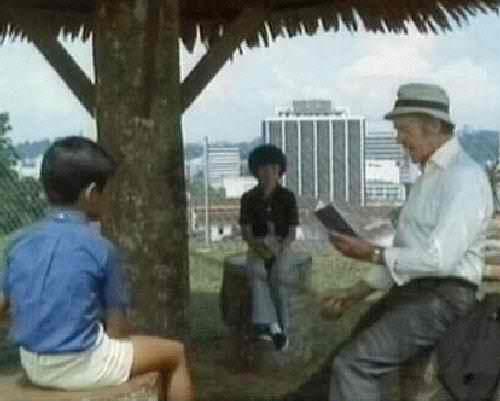
Figure 1.--The Japanese boys in film generally appear in casual clothing, like this boy in an English movie about the son of a Japanese ambassador. |

|
HBC has little information on the Japanese film industry and Japanese films. Hopefully a Japanese reader will provide some information to us. Te Japanese film industry developed in the inter-War eram but was unknown in the West. Anerican filns were shown and wee popular. This is primarilt where the Japnese militarists, few who ever visited America, got their ideas about the Uninted States, populated by gun-toting, gimswilling gangsters and women wjo domibated their mem. They concluded that despite all their factories, that American men coukd nevr go toe to toe with Imperial Japanese soldiers and sailors. Stange as it may seem, Holluwood was a major factor in the Pearl Harbor attack and the pacific War. It worked both ways. Hollywood also perpetuated the idea that Japnese men were weak and had poot eyesight-pne reason thatbJapanese milutary aviation as not taken seriously. We believe that as war approached that the military government began discouraging showing of Japanese films. The film indistry was used for propaganda during the War. This initself was not unusaal. All the beligerant countries did so.
The various momsters filns like 'Godzilla' appeared after the pacific War. We are not entirely about the Japanese adinity forvmonster films. They have been widely shown on American television and they often have roles for children in which the boys usually wear the short short pants so popular beginning in the 1950s. In a few instances there are also parts for American boys who always wear long pants--often jeans. Occasionally the Japanese boys appear in traditional clothing. There are also some American and other foreign films set in Japan.
HBC has little information on the Japanese film industry and Japanese films. We know nothing about the pre-World War II film industry. It did exist, developing in the inter-War eram but was unknown in the West. Anerican filns were shown and wee popular. This is primarilt where the Japnese militarists, few who ever visited America, got their ideas about the Uninted States, pipulated by gun-toting, gom swilling gangsters and women who domibated their mem--especially offensive to the hyper chavenist Japamese male. They concluded that despite all their factories, that American men coukd nevr go toe to toe with Imperial Japanese soldiers and sailors. Stange as it may seem, Holluwood was a major factor in the Pearl Harbor attack and the pacific War. It worked both ways. Hollywood also perpetuated the idea that Japnese men were weak and had poot eyesight-pne reason thatbJapanese milutary aviation as not taken seriously. We believe that as war approached that the military government began discouraging showing of Japanese films. The film indistry was used for propaganda during the War. This initself was not unusaal. All the beligerant countries did so. Hollywood was also mobilized for war. Tese differebcde was the accuracy of war reporting. Jaoanese audiences were never shown anyrging like the fim repots of the Tarawa landings. There was not a hint of Japanese massive and continuing defeats beginning with Midway. (The Imoerial Navy did not even inform the Imoerial Arny about what happened at Midway. Any school boy styding geography, however, could not help but notice that the island battlefields kept getting closer and closer to Japan nor were rgeir a hunt od tge nassive atricties being cinducted by the Japanese Army. When the Americam bombing began, it was treated as a war crime. We are unsure how many Japanese people remnenbered it was Jaoan that began bombing undefendend Chinese cities (1931) and continued doing so for more than 10 years. After the War a very active film industry emerged. It was best known for the cheaply made Godzilla films--at least in the West. Gradually the production qualities of the Godzilla films improved, but never reaching levels in the West. Japanese films in fact became a subject of satire in the West. Saturday Live had a Samari chracter played by ??? Belushi. Woody Allen even took an entire Japanese action film and replace the dialog with English text making it a commedy--"??? ??? Tiger Lily". Besides the monster films, there was also a series of nostalgic films. They were somwhat similar to German Heimat films, but not as unrealistically sentimental. I forget now just what they were called. We note that Sony bought Universal Stydios. I'm not sure what impact that had on the Japanese film industry. One interesting recent development is the growing importance of Japanese animated films. Japanese movies have never cutting edge, but the Japanese animated films are today cutting edge. Hopefully a Japanese reader will provide some information to us.
We believe that the costuming in many Japanese movies is a relatively accurate relection of actual Japanese children's fashions. This in part because so many Japanese films were low budget productions. One way of limiting costs is to have actors wear their own clothes when the film has a contemporary setting. This thus guarantees that the children's clothes in many Japanese films are an accurate depiction of actual clothing styles. A reader writes about the costiming of a Japanese monster film pieced together from a TV series-Voyange into Space' (1970). "I have seen that series. Definitely a good show for kids. While American kids would not be impressed with Johnny 's wardrobe I am guessing this was normal for Japanese kids during the era the movies were made." He vwas trffering to doubl-breasted short pants suit, the main character, Jphhny Sokko, wore. Now Japanese noys did not commonly wear short pamts suits, nut many had them. It was common to buy a boy a short pants school when he began school, in part for school interviews. Boys dis not wear these suits commonly, but they dis wear them for spexial pccasions. Many schools had uniforms, some of which were suits. Others were blazers. At many schools boys wore a more uniform, often white shirts and blue shorts. Other schools did not have uniforms, but mothers commonly purcgased shirt pants. This varied over time, but at the time the monster films were made, shorts pants were very common. Which we caommomlyb ee in thevfilms like 'Voyage into Space' which include children. In thae film, the nain cgacter wwas costumed, but we suspect the other chukdren justvwore their own clothes. .
We have only limited information on individual Japanese Films. The various monster films like 'Godzilla',, have been widely shown on American television and they often have roles for children in which the boys usually wear the short short pants so popular beginning in the 1950s-80s. In a few instances there are also parts for American boys who always wear long pants--often jeans. Wehave also found a few ordinary Jaoanese filns, all from thevpost-War period. Occasionally the Japanese boys appear in traditional clothing, although this was becoming much less common after thevWar. The best known Japamese film is Samuri saga 'Ronin', but does not concern children. There are also some American and other foreign films set in Japan. The only Japanese films to have madeit in theWestatae the mobster films. We know vurtually no Japanese filns appearin in America for several years. We are unsure if they have proven popular in other foreign markets. Or why such a major film industrybhas such limited foreign distribution.
Japanese film makers have made numerous films about monsters. In fact Japanese film makers virtually created a whole new genre of movie makiung--the ninster film (kaiju eiga). We are not sure why these monsters have proven so popular to Japanese moviegoers. We are not sure, but we do not think it was just children who attended these films. For most people the monster film are the only Japanese films they have ever seen. Most Amweicans believe that they are a reaction to the devestatiin of World War II, especially the two atomic blasts. That the bombs ans nuclear tests spawned a host lizaedly scaled mutants. This certainly was the naratibe that was common in the West, especially with the ban the bomb crew. This theme was not absent in the Japanese films, but it was surprisingly rare. It was actually a minor paert of the host of monster films made. There are far more monsters gnerated by space invaders and natural disaters. One Japanese source writes, “The original Godzilla and other monster films in the Toho franchise do not necessarily deal with nuclear threat.” Hidetoshi Chiba, a professor at Tokyo's Digital Hollywood University and an expert on kaiju films. They created the cycle included other famous monster titans of mass destruction (Mothra, a colossal moth, and Rodan, a mutated flying dinosaur). Chiba maintains that the Western narative that scaly, nutated fiends arise out of nuclear testing sites can be seen as both a nuclear age parable and an anti-war allegory. He believes, however, that kaiju are more a warming about the wrath of nature, human hubris, and dark immutable forces rather than science gone awry. It is no accicent that Jaoan siuts on the western wing of the Pacific Ring of Fire. The Japanese experience volcanos, earthquates, tyhpoons, and tsunamis. Godzilla is the most famous Japanese monster. Gamera rajs second,
Japan has a very large and active movie industry. Unfortunately we have very limited information about Japanese actors or the films themselves. We have several clips from Japanese films, but have been unable to identify the specific films involved. Hopefully our Japanese readers will help us here. Many of these films until relatively recently were rather low budget productions, usually set in modern times and thus relatively accurate reflections of contemprary fashions.
Fitzpatrick, Michael. "Godzilla: Why Japan Loes monster mpvies," BBC Cukture (Nay 16, 2014).

Navigate the Boys' Historical Clothing Web Site:
[Return to the Main country movie page]
[About Us]
[Introduction]
[Activities]
[Biographies]
[Chronology]
[Clothing styles]
[Countries]
[Girls]
[Theatricals]
[Topics]
[Bibliographies]
[Contributions]
[FAQs]
[Glossaries]
[Images]
[Links]
[Registration]
[Tools]
[Boys' Clothing Home]