|
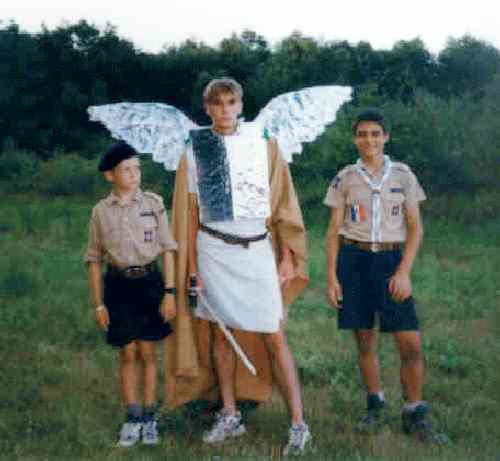
France adopted the Scouting movement in the 1900s. HBU knows of no uniformed youth groups in France before the introduction of Scouting. Unlike England and America, several competing Scouting associations developed in France, organized primarily around relogious groups. I do not know of other youth groups organized. Some political parties may have had youth groups, but HBU does not believe they were of great importance--having trouble competing with Scouting. The only other French group that HBU is aware of at this time is the youth group by the Vichy political group duruing World War II.
We do not know of any early youth groups in France before Scouting. Youth groups appeared in America, Britain, and Germany before Scouting and those groups all had a major influence on the Scouting program that eventually emerged. This did not occur in France as far as we can tell. We are not entirely sure why that was. We also notice considerable resistance to Scouting when it first emerged. This may have represented an anti-British bias. It certainly represented a resistance from the Catholic Church toward competition over the right to mold character and morals of young people. Resisting Scouting proved to be losing struggle, too many boys wanted to participate in Scouting. The Church eventually had to yield, but only after founding a Catholic Scouting association. Scouting emerged as a major activity for French boys, primarily middle-class boys in the inter-War era. After the Germany World War II occupation, Vichy attempted to promote a nationalist youth movement, but it did not attract the interest of large numbers of French boys like Scouting.
We have found quite a number of different youuth groups in France over time. The single most important group has been the Scouts. France has not had (like America and Britain) one single Scout assocation. Rather many associations were organized, including many small groups. Some of these associations were religiois based. The French Catholic Church was very suspicious about Scouting, thinking that it would undermine the boys' religious convictions. Other youth groups were formed by political parties, although this was primarily for teenagers and youths. There were also nationalist groups, although they were not nearly as important as in neighboring Germany.
We note some local French youth groups that do not seem to be associated with any national group. We think that these groups may have been loosely organized, often by a Parish priest, before Scouting was established. We do not know know much about these groups. As far we can tell,they were esentially curch based. We have not yet noticed secular groups. While church-bsed, we do not notice any central organization. Here ome parish priests seemto have taken an interest in organizing challenging activities for boys. We do not know just when this began, but we see groups in the very early 20th century. There was initially some suspicion in France about Scouting, especially within the Church. First Scouting was an English creation. Second, England was a Protestant country. The ideas was so compelling, however, that Scouting soon took over from these local groups.
France has had one of the most active Scout movements in Europe. The
movement quickly crossed the Channel only a few years after it was founded by Lord Baden Powell in England. Like many European countries, there is no single country-wide association in France, but instead several different associations, including some divided largely on religious lines and some secular groups. This has
been furthur complicated bt the appearance of disident Scout groups objecting to some of the modern trends in the established Scout associations, especially the declining attention to uniforms. Generally speaking, the Scout movements began in France in 1911. A lot of independent troops sprung up in the 1910s, then
formed associations, mainly accordingly to religion: Catholic, Protestant, and Jewish. That creation of separate, independent ssociations has continued to this day.
The authors have little information on non-Scout nationalist boys uniformed groups in France. HBU has no information on the early 20th century. Uniformed youth groups other than the Scouts had formed in America, England, Germany, and other countries. HBU has no information about such groups in France. Political partities often had youth sections. The Government, however, banned the wearing of political party uniforms. After the German victory in June 1940, everything changed. On June 22 an armistace was signed at Compaigne, in the same railway car that the World War I armistace had been signed. Only part of France was occupied. This was the only such agreement that Hitler signed with one of the occupied countries. The new French Government was installed at Vichy and is this known as the Vichy Republic. For most Frenchmen the War was lost. Many saw no alternativem but to collaborate with the Germans. At this time youth groups were organized and many French boys joined these groups.
Some political parties may have had youth groups, but HBU does not believe they were of great importance--having trouble competing with Scouting. There has been at least one pre-war French youth organization based on socialism/communism : the Mouvement des Jeunes Socialistes was active in the 1930s. They were nicknamed Les Faucons Rouges (the Red Falcons). Unfortunately, we have virtually no information about them at this tume.
We have noted some French boys in uniforms that we can not identify. These may be small Scout groups that had destinctive uniforms oe Scouts who are not wearing the correct or full uniform. They could also be a natioanalist group or one related to a political movement. There were also groups based in the different French regions. Our knowledge of these different groups except for a few of the larger ones is still quite basic. Thus we have difficulty identifying the available images of these groups. In this regard the 1930s was a particularly turbulent time. Hopefully our French readers can provide further information here.

Navigate the Historic Boys' Uniform Web Site:
[Return to the Main Countries page]
[Activities]
[Biographies]
[Chronologies]
[Countries]
[Essays]
[Garments]
[Organizations]
[Religion]
[Other]
[Introduction]
[Bibliographies]
[Contributions]
[FAQs]
[Questions]
[Unknown images]
[Boys' Uniform Home]