The Hitler Youth (HJ) conducted a wide range of activities to achieve its primary objectives. Here there were a lot of similarities with the Scouting program. Both heavily emphasized outdoor activities, especially hiking and camping.. Major difference was fund raising and religion. There were also differences in emphasis, such as para-miltary training and pagentry. To a large extent, however, the two programs pursued many of the same activities. This of course was it part determined by the activities which interested boys. The difference between the HJ and Scouting were more with how the program was run and family involvement.
We see quite a few HJ boys involved in biking expeditions. These were trips of varying length and with various destinations. One interesting aspects of these trips was that many HJ members did not own bikes. Bike ownnership was not as widespread in Germany as it was in America at the time. Most HJ boys did not have bikes. Wome middle-class boys had bikes, but it was rare for working-class boys. Their fatgher may allow them to use his bike, but they rarely had bikes of their own. Few working-class families had cars. Fathers might bike to work, but it was big purchase for most familkies and few could aford to buy the children bikes. The Hitler Youth organization bought bikes so the older youth could use them for trips and activities. We note one such expedition in a scrapbook kept by an HJ boy.
Perhaps the most famous HJ cyclists were groups that began touring Britain (Spring 1937). The leader was a Herr Hahn. Another leader was Hartmann Lauterbacher. We do not yet know anything about wither. The British media labeled them 'spycalists'. A newspaper claimed that they had been given spy instructions. This probably was not the case. We are mot sure whose idea it was, but the purpose was most likely a propaganda exercise designed to establish links with the Bitish Boy Scout movement. Lord Baden-Powell, head of the Scouting movement, and Joachim von Ribbentrop, the German ambassador, met a part of the visit. Baden-Powell as part of building the Scoting movement had some hope of drawing the HJ into the world Souting mobement. The German boys stopped at schools, Rotary clubs, factories and churches. At the time, Britain was finally beginning to rearm as aresult of the German arms program. People throughout Britain seemed to think that the HJ boys were on a clandestine inteligence assignments. Even the security service took note. Despite the concerns of mny, the boys were given a warm warning, especially by local Scout groups.
Hitler Youth camping varied widely. It could include a range of activities. A small group of boys might go camping over a weekend. Or the whole unit could go camping. The most extensive camping priogram was during summer. Here thousands of booys and girls (in separate camps) would assemble for a wide range of activities. There was also Whitsun Camp. This was not a specifically HJ tradition, but a common tradition of the German Youth movement before the NAZIs seized power. Pentecost or Whitsun has always been an important holiday and continued to be so even under Hitler's dictatorship. The most important holiday was Christmas followed by Easter. Whitsunday was the third most important holiday. These are official holidays. Schools, banks, and most shops are closed on Sunday and Monday. Even if people were not religious, they enjoy the days off. During the NAZI era Pfingsten (Whitsun) continued to be a popular holiday to go hiking and do other outdoor activities, because it took place in the spring, That is why the Hitler Jugend would organize events since so many children did not have to go to school those 2 days. It had nothing to do with the Christian religion. The Holidays simply were an opportunity to use that time for their own advantage. We are not sure how common it was, but of course with the NAZIs it was entirely devoid of religious content. A good example is a small group during World War II. A we can see here, this was small-group camomg. A 2-day holiday was not enough ime to organize camping on the scale of the maive summer gatherings.
|
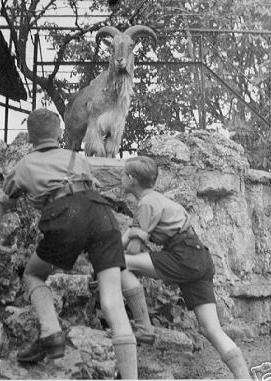
We know that the HJ organized a range of trips for their members. This was done at the local level, athough there may have been guidelines from the central office. We do not have any details at this time on the nature of these trips. The photographic record provides some information about the trips. DJ boys may have taken field trips similar to Boy Scout Cubs, meaning trips generally close to home. There there was a difference in age as Cubs began at 8 and the HJ at 10. Thus the DJ was mealong with smewhat older members. We do not have much information on these trips such as what the popular destinations were. We know from cubbing that trips were commonly made to museums and zoos. This appears to have also been the case for the DJ. We do have one portrait of an unidentified DJ boy at the Berlin Zoo in the 1930s. The age range of the DJ was different than Cubs, thus field trips may not have been as common as was the case for Cubs. We think that field trips of a more patriotic nature mat have been more common for the DJ, meaning visits to sites of importance to military history. This may have included castles, battle sites, milutary shirines and other sites. We are less sure about the older HJ boys. They certainly may have been involved in trips furrther from home and of a more phyically demanding nature such as bike rides. They woild have been less likely to go on visits to museums and zoos like the younger boys.
Physical fitness was a strong priority for the Hitler Youth. We are not sure to what extent this included manual combat skills like boxing and wrestling. We do note that activities included wide games that usually descended into a large scale brawl between oppossing groups. There are reports of boys being severly injured in these games. Orfinary meetings were somewhat limited because the boys were living at home ajhd their parents would have noticed if they were being roughed up. At camp there were far fewer constraints. Some boys liked the games. Other boys found them a grueling experience. We are less sure to what extent boxing and wrestling were taught. There were annual events which we believe included both events. We are less sure to what extent boys were trained for these events or if they just included interested boys who wanted to compete. We do see images of what looks likes boys wrestling and we have seen boxing competitions. We also are not sure id the training program was mandated by the central organization or if local leaders were allowed to crraft their own training program.
|
Military descipline was an activity involved in a wide range of HJ activities. One purpose of the HJ was to begin to instill military descipline. We see children involved in all kinds of activities lining up in military formations. Boys involved in pagentary or camp activities would line up in formations. This would also be the case at meetings and a range of other activities. We are not always entirely sure just what is involved in the various formations we see.
The Hitler Youth boys and girls were extensively used to collect funds. This began befor the NAZIs seized power, but was greatly expanded after the NAZI take over in 1933. The children were a common site on street corners shaking cans toreceive coins. The funds were not to support the Hitler Youth program, but for he NAZI Party. Often some charity was promoyed, but as the funds went to the NAZI Party, no reliable piblic accounting was ever made. he use of the children to collect funds was quite different to the Enlish Scouts which Baden Powell never let be used to solicit charitable donations.
Hiking was an important activity in the HJ. This seem to have been an activity that the HJ was especially noted for organizing. The Germans have a traditional love of their countryside which was clearly seen in Wondervogel. This tradition was continued in the HJ. A range of benefits were seen in hiking, not only did it help build physical stamina and discipline, but also a variety of useful military skills like map reading. Hikes might be an outing into the countryside meerly for fresh air and exercise. Or the units might hike to see various landmarks of historical or geographic interest. The length and pace would vary depending in the age of the boys involved. While marching the boys would sing approved HJ songs. This seems to have been a more common activity for the HJ than the BDM. Normally the hikes would be organized by the older boys acting as leadrs without adult supervision. Often hikes would be organized on sundays to draw boys away from church attendance and other churc-related activities. Availavle images suggest that the boys always dressed up in their uniforms for these outings. There may have even been an inspection before they started out, although I do not yet have details.
|
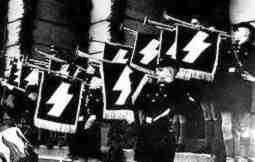
Music and singing was an important HJ activity. Drum and bugle corps were often associated with HJ pagentry. We do not notice larger orchestras and bands. We understand some were formed, but they do not form an important part of the photographic record. They were not useful for ordinary HJ activiyies. But we karge numbers of images of HJ boys with drums and buggles. This seems less true for the girls. Drums seem to have been a special favorite with the HJ. Boys began to learn to master these instrumnts in the DJ. The music activities were an area in which boys not atletically inclined could excell. Such boys might be subjected to hazing when they had trouble keeping up with other boys in physical activities. The music activities not only provided them an area in which they could pursue an interest in music, but provided a way of avoiding some of the activities in which some found it difficult to compete. It was also a way of renewing Germany's martial spirit. I'm not siure if it was Hitler or Giebbels that wrote about the impact of a simple marching band on the German spirit. I need to find that quote. Von Schirach had no doubt about the importance of music in saping the minds of the boys he was assined to mold. And as part of the program he designed, hegave a special importance to music and group singing. HJ prgamizers were instructed, "... precisely during celebrations and singing events [that] we have an excellent opportunity to have a political effect wide beyond the typical formation Songs possess the strongest community-building power. Thus we use them deliberately at those moments when we want to waken the consciousness of being part of a community, in order to deepen the power of such an experience." Schirach chose Wolfgang Stumme to over see the HJ music program. Schirach correctly saw the importance and power of music and song as part of the HJ's ideological training effort. Schirach even penned HJ songs himself. Music was a prominent feature. And the HJ did not only use boys that had music skills, but has an active program to train young musicians. There was also fomal vocal training. In addition to unit drum and buggle coros, the HJ formed aznd trained hundreds of HJ music groups. They performned at birthday parties for high-ranking Party officials. Hitler's birthday was a national holiday. Thus Gaulitiers and other important Pasrty officials wanted their birthday's celebrated. The HJ boys anf BDM girls also were popular participants in Party nd civic festivals. There were even some international performnces. But it was the ability of group singing in building group cohesion and obedience that attracted Schirach's artention. Mamy songbooks were published duing the NAZI era precisely for this purpose. The HJ adapted many Scouting fratures, but the music and song component was more of a featire of Communist and Socialist groups.
|
One of the main functions of the Hitler Youth was to participate in the parades, pagents and public events the NAZIs were so fond of. The HJ organization gave the youth the chance to find their place in life. The colorful banners, parades, uniforms, status and sense of purpose were all aspects of the organization that the youth bought into and encouraged them to join. The HJ was the youth�s way of making their voice heard and acknowledged. The Hitler Youth drum and buggle corps was an important part of the pagentry in which the units participated.
Physical training and calesthetics to an extent is associated with the sports program. The sports program to an extent, however, was voluntary. Boys did not have to participate in the important competions, although sporting activities might be a part of weekly meetings and camp activities. Pysical training and calesthetics on the other hand was required part of the program. While sport attracted many boys to the HJ, the constant drill and calesthetics alienated others. And the HJ persued it to a degree beyond any other youth group which we are familiar. Strengtening the bodies of future soldiers was surely a factor. But the HJ appears to have essentially evolved a system of juvenile basic military training. Military recruits in basic training are subjected to extrene physical demands. The point appears to be to make the recruits MORE maleable and thus more subject to miltary discipline. Boys were made to run for extended perios are do large numbers of pushups or other exercises. [Ringlet, p. 78.]
Racism was an important part of the HJ program. A range of racist ideas were common in Germany as they were in many other countries, including America. It is impossible to quantify this, but elections before the NAZI take over suggest that virulent racism was a minority view. Thus Hitler needed the vHJ to bring German youth along tonhis point of view. The focus was on anti-Semiism, but the Jews were only one of the groups targeted by the NAZIs. We think that the great bulk of the racist activity as part of the HJ program was aimed at the Jews, but here actual information is limited. There are two aspects of the HJ racist activitities: 1) training and 2) actual racist activities. We know that the ideological training program included instruction in anti-Semitism or other aspects of NAZI racist doctrine. This complimented actual school work. In the Hj I don't think there was actual school work. Rather it was mostly lectures and guided discussions. This occurred in weekly metings as well as summer camps. We are less sure to What extent the boys engaged in anti-Semetic activities. And here it is difficult to destinguish between the individual actions of HJ and organized actuivities of HJ units. We know that after the NAZIs seized power that attacks on Jewish boys in and outside of school increased. This was primarily in the early years (1933-36) when Jewish children were still permitted to arttend state schools. Boys and girls were pressured to break off friendships with Jewish boys and join in tauting of Jewish children. Not all of this came from the HK. Parents and teachers were also involved to varting degrees. To what extent HJ units actively pursued the ostrization of Jewish children or attacks on them we do not know. There are many reports from the Jewish children of their friends refusing to speak to them or of being attacked. Some Jewish children, as a result, left school before they were legally expelled. An example from a Hamburg Jewish orphanage (Boys' Orphanage at No. 3 Papendamm) reads, "For some time they [the orphans] had not been able to move so freely as before in the small streets, passages and yards of the Grindel quarter. Older boys, with the peaked caps of the Hitler Youth, lurked behind the archways leading to the houses in the yards at the rear. They would suddenly appear in front of the Jewish children, blocking their way, jostling and abusing them. This occured ever more frequently." HJ racist actions were not limited to these school boy sctions. Older HJ boys were mobilized for more overet actions. We know that HJ older boys joined SA squads for Kristalnacht actions. Largfe numbers of peopl were needed to ran sack Jewish shops, destroy synagogues, break into homes, and arrest adukt male Jews and older teenagetrs. W have also read about HJ boys joining community groups in hunting down Jews trying to escape during the War. We also know that BDM girls were usedto assist in the deportation of Poles from occupied areas during the War. They engaged in activities ensuring that they did not remove anything of value as they were foirced from their homes.
Our information about HJ school activities is very limited at this time. We believe that such avtivities were limited, in part because the HJ did not fully trust the schools. When the NAZIs seized control (1933), there were many reachers who were not sympthetic to the NAZIs or actually hostile. While open defiance was quickly eliminated, covert resistnce was more of a problem. It took several years to gain full control over the schools and curiculum. Another factor was that a good report from their HJ unit was important to persue one's education. We do not note HJ boys and girld wearing their uniforms to school very commonly. We think there my have been some special celebrations at school where the children wore their uniforms such as, for example, Hitler's birthday. We do not in school portraits that occassional a boy or two are wearing their uniforms. There may have been some after school activities.
Shooting was a required activity from the time boys entered the HJ at age 10 years. This was an activity most boys would have found to be fun. Virtually any boy would love to shoot a gun, any gun. The younger DJ boys began to hone their markesmanship with air rifles. The HJ grew rapidly after the NAZI take over (1933). Youthbleaders were badkly needed for the expanhding Reich. Schirach decided to open Reichsf�hrer (leadership) schools). A 3 week cram course was developed which included NAZI political and racial indoctrination, the NAZI view of history, leadership training, strenous
physical activity, and rifle shooting. As part of the regular training, older HJ boys were introduced to small caliber rifles. We should stress that rifles, unlike in America, were not common in Germany, especially in urban areas. Not only was the shooting popular with the boys, but the culture of the HJ made it even more popular. [Kaufmann, p. 329.] Shooting matches were expanded once the war broke out, authorized by an ordinance (October 15, 1939). Boys who achieved a certain level of competence were awarded markesmanship badges. During the War, hand guns were issued to some older HJ boys. There were incidents of accidents which occurred as a reult of the boys playing with these weapons. [Amtsgericht München]
We have no details about skiing as a Hitler Youth activity. I am not sure how common skiing was in Germany. It does snow a great deal during the Winter. How common it was for German boys in the 1930s to have skis. Surely it was common in some rural areas, especially the southern alpine region. I think it was less common for city boys unless they came from affluent families. We note HJ activities combining skiing with military activities such as rifelry, although we have few details at this time. The HJ Organization opened a rifle school (1937). About 1.5 million boys were trained in rifle shooting and military field exercises over the next few years. Some 50,000 HJ boys earning a marksmanship medal that required almost perfect shooting at a distance of 50 meters. The shooting activity ws sometuhing all boys participated in and before para-military training began for the older boys.
We notice arange of special activities that were organized by both the national organization and local Hitler Youth units. This included athletic events, book displays, choral programs, drama plays, musical concerts, and much more. We do not know a great deal about these various eforts. It is in these activities that you are most likely to find boys and girls together at the same activity. We note that some of the older children found that they could get out of boring meetings largely involved with indicrtination by getting involved in music or drama programs. Many boys liked the highly physical HJ progrm, including activitie like fightijg and weresling and contact wide games. his was, however, not the case for all boys. And these activities provided a way out for mild mannered, less aggresive boys. Many of these activities were not part of the HJ core mission and included cultural activities and evebts. Apparently the national leadeship felt compelled to include such activities as necessary for a comprehensive youth movement. We think this was a kind of self directed effort as most HJ leaders believed they were pursuing an important national effort to mold German youth. Culture was not high on the NAZI agenda but not absent. Top NAZIs like to considered themselves cultured--especilly Hitler himself. The arts were such an engrained aspect of German culture that it was not something that could be ignored.
We notoice HJ boys involved in sports, especially athletics. Boxing seems to have been especially important, presumably because of the element of combat involved. Various HJ accounts describe just about all sports including fencing, skiing, and swimming. There were also team sports like soccer, the most popular sport in Germany. Sport never was a major school activity in Germany as it was in America. Sports clubs had been very important. After the NAZI seizure of power, the Party achieved a monopoly over German sport. The NAZIs and Hitler Youth interest in sport was not because of its recreational benefits, but rather the fitness and health benefits. A healty fit Volk was seen as necessary for Hitler's New Order. And there were obvious military implications, not only to a healty pool of recruits, but also specisalized skills that could be used by the military services, such as skiing. Thus this assignment was given to the Hitlet Youth, the only German youth organization to organize a national sports program. [M�ller, p. 92.] As soon as taking power in 1933 the HJ began organizing sports competitions and both the regional and national level. This also had the advantage of drawing sports minded boys into the HJ. The HJ sporting events were given considerable publicity. We can clearly see HJ sporting events because he boys are wearing HJ singlets.
|
An important part of the Hitler Youth program was the summer camps. The camps were designed to toughen boys most physically and mentally. There were a lot of exercizes of a militay natue suchbas laing communications cable. Older boys might do actual fire arms training. HBU does not yet have any actual accounts from any of the boys. One interesting account comes from Richard Windmark, the American movie actor. He had just graduated from college in 1937 and as student of political science wanted to see what was happening in NAZI Germany. He and a friend spent the summer in Germany. They asked to see the Dachau Concentration Camp which was believed to be a intetnment camp for political discedents. The NAZI official they asked laughed at them and told them they didn't want to go there. Instead they were sent to a Hitler Youth camp. He took color movies there. The boys wore the standard Hitler Youth uniform of brown shirts and black short pants. As it was summer they often didn't wear their shirts. Windmark says that the boys were constantly being lined up in military ranks by "bullies"--but the boys loved it. He said some of the boys were as young as 6 years, I think he may have been wrong about that.
HJ boys had to participate in forced tests of courage. Many were compeled and others complied because of the group dynamics, afraid of being stimatized as cowards. Here I am unsure to what extent this was mandated by HJ headquarters or more the product of local HJ leaders, both the adult staff and senior HJ leaders. This was a product of the Social Darwinism which became part of NAZI docrine and taught in the schools. We note a range of actual tests employed by the HJ. Here an element of hazing by the older boys was also involved. Hazing such as fratenrnity hazing is often controlled by the larger community such as the university. In the HJ this kind of activity was often promoted as a useful toughening up exercize. Some of the tests were relatively mild, such as jumping off high boards into water. Sometimes boys who could not swim were made to do this. More dangerous was climbing sessions where boys had to scale cliffs without any safety equipment. There were injuries and mortalities. [Metelmann, p. 129.] As far as I know, however, the HJ never compiled statistics on this.
There was no doubt in Hitler's mind from the point that he learned about the armistice (1918) that war was the solution to Germany;s problems. Afew years kater when he dictated Mein Kampf he goes on at great length about the East and Germany's need for Lebenraum (living s[ace). And although he did not talk about war, Hitler knew and any one with any sence knew that land land in the East could only be obtained through war. The early HJ focus was largely political, teenagers used to promote the NAZI effot, including political violence. After the NAZI seizure of power the focus chahanged. While Hitler continued to insist that he only wanted peace, the HJ program developed by Schirach was to prepare boys for war, both mentally and physically. Commited trained troops would be needed to use the new arms pouring out of German factories as the country remilitarized. Schirach both prepared a program that could train younger boys and which had a significant military component. The HJ program included both indirect and direct military training. Indirect military traing included both phyical training anf hiking to build strength and stamina as well as Wehrsport (war sports) to develop aggressive fighting spirit. Indirect activities were lrgely staples of the geberak youth movement and not much different than what one kmight find in Boy Scout programs. Boxing was a mainstay of the HJ sports program and the only sport Hitler thought important. There was also direct military training. This was an aspect of the Hitler Youth program that was different from that of other German youth movements and the Boy Scout movement. Direct military training included discipline, military drill and marching, skills (building dugouts, gas defence, map reading, range finding, sending and receicing morse code, setting and penetrating barbed wire, stinging communicatioin lines, trench digging, and much more. [Tunus]
Hitler Youth boys engaged in a wide range of other activities. Many activities like hiking and singing were staples of any uniformed groups. The Hitler Youth borrowed liberally from other youth groups like the Scouts. Some activities, however, were rather surprising--like sewing.
Amtsgericht München. Judgement against Rudolf Stimmel, May 16, 1941. ARL, L� 6.1.2. Munich. This was a Munich court case dealing with an incident involving a Hitler Youth boy and a gun incident.
Kaufmann, Günter. "Die deutsche Jugend im Zeltlager, Das Junge Deutschland (1937).
Metelmann, Henry. A Hitler Youth: Growing up in Germany in the 1930s (London, 1977).
Müller, Albrecht. Wir werden dad Folk: Wesen und Forederung der Kitlerjugend (Breslau, 1935).
Ringlet, Ralf Roland. Illusion einer Jugend: Lieder, Fahnen und das bittere Ende: Hitlerjugend in Osterreich: Ein Erlebnisbericht (St P�lten, 1977).
Tunus, J.R.

Navigate the Historic Boys' Uniform Chronology Pages:
[Return to the Main chronologies page]
[The 1900s]
[The 1910s]
[The 1920s]
[The 1930s]
[The 1940s]
Navigate the Historic Boys' Uniform Web Site:
[Introduction]
[Activities]
[Biography]
[Chronologies]
[Countries]
[Essays]
[Garments]
[Organizations]
[Other]
[Bibliographies]
[Contributions]
[FAQs]
[Questions]
[Unknown images]
[Boys' Uniform Home]
Navigate the Historic Boys' Uniform Web organization pages:
[Return to the Main Hitler Youth activities page]
[Return to the Main youth activities fund raising page]
[Boys' Brigade]
[Camp Fire]
[National]
[Pioneers]
[Royal Rangers]
[Scout]