
Hitler Youth International Activities: Axis Allies
|
|
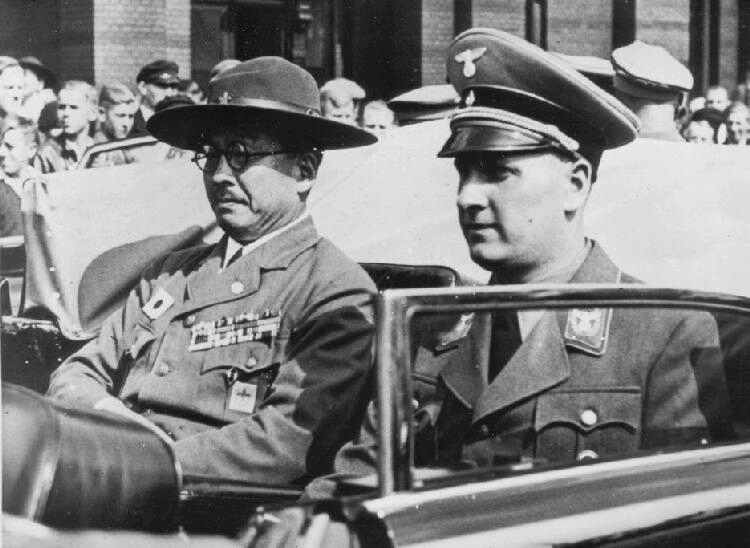
Figure 1.--The German Presse Hoffmann caption read, " Der japanische Jugendführer Graf Yosinori Fhutaras in Deutschland. Am Sonn bend Mittag traf der japanische Jugendführer Graf Futaras auf den Bremer Hauptbanhof ein, wo er von Reichsjugendführer Baldur von Schirach herzlich empgangen wurde. Graf Fhutaras nimmt am Gebietsaufmarsch der Nordsee-H.J. und an den anschliessend stattfindenen Kampfspiele der Hitlerjugend teil."
This translates as, "The Japanese youth leader Count Yosinori Fhutaras in Germany. Saturday afternoon the Japanese youth leader Count Fhutaras arrived at the main railroad station in Bremen where Reich Youth Leader Baldur von Schirach welcomed him warmly. Count Fhutaras participates in the regional parade of the North Sea Hitler Youth and the afterwards following combative games of the Hitler Youth." The name Fhutaras does not sound Japanese to us. We think that the German press misunderstood the name and the spelling. The word for Saturday in Northern Germany is Sonnabend, in the South it is Samstag. The German-speaking reader who translted this passage tells us, "You might wonder why I omitted the letter n in Kampfspielen. The German word for game is Spiel (all nouns start with a capital letter), plural is Spiele. However, what's written here is correct: Kampfspielen, because it is a dative sentence. That's German grammar!" We are not sure that Fhutaras was the Japanese Youth Leader. He looks to be wearing a Boy Scout uniform. The photograph was dated August 15, 1937. Japan had not yet signed the Axis alliance, but the two countries were already cooperating diplomatically.
|
The Axis alliance joined NAZI Germany, Fascit Italy, and Imperial Japan. There were also the junior parners in Eastern Europe (Bulgaria, Croatia, Hungary, Slovakia, and Romania). There were also junior partners in Asia (Manchuko and Thialand). We note no contacts between the HJ and Japanese youth. Here the distance and cost of such exchanges were probably the main factor. The Axis Alliance was formed during the War (although before Japan entered the War). Thus there was even less ability tooganize events. Racial differences might have caused a problem if exchanges had been possible. NAZI Germany's principal ally was Italy and after the Anchluss, the two countries shared a common border. Thus here exchanges were feasible and could be conducted at reasonable cost. We know that there were some such exchanges. We are not sure, however, about the extent of the contacts between the Hitler Youth and the Italian Balilla. We note HJ and Baliall leaders attending a celebrtion together, but have no details on an actual meting together. We have no information at this time as to the extent to which joint activities were planned. We also note photographs of HJ and Balilla boys. We are unsure to what extent there were actual joint activities conducted by the two groups. Many of the images of HJ boys with foreign boys are with Balilla boys. "The Italian fascist youth and the BDM didn't have very much in common. [Ruediger] Another observer writes, "The BDM vistors were pretty shocked when they saw that the Italian girls were being trained to shoot rifles and drive trucks, and prior to their going to Italy, they were warned not too closely associate with the Italian youth." [Crawford] We note contacts between HJ and Japanese youth leaders, but not events with German and Japanese youth. The distances involved would have made this very expensive.
The Axis alliance joined NAZI Germany, Fascit Italy, and Imperial Japan. There were also the junior parners in Eastern Europe (Bulgaria, Croatia, Hungary, Slovakia, and Romania). Romania and Bulgaria joined reluctantly. Hitler tried to force Yugoslavia into the Axis, but his attempt backfired. There were also junior partners in Asia (Manchuko and Thailand). The Axis began and the Rome-Berlin Axis (1936). The relationship was extended by the Anti-Cominter Pact which did include Japan. (1936-37). Japan joined the Axis primarily as a way of discouraging American military actions (Sepember 1940). A year later, Japan attacked the United States bringing America into the War. It also brought merica into the war in Europe, because Hitler declared war on America. Japan did not, however, join the German campaign against the Soviets. Unlike the Allied war effort, there was virtually no coordiation of the Axis war effort.
Imperial Japan
We note contacts between HJ and Japanese youth leaders, but not events with German and Japanese youth. The distances involved would have made this very expensive. We thus note no organized contacts between the HJ and Japanese youth. Here the distance and cost of such exchanges were probably the main factor. The Axis Alliance was formed during the War (although before Japan entered the War). Thus there was even less ability tooganize events. Racial differences might have caused a problem if exchanges had been possible. The NAZI obsession with race is well known. Less well known is the Jpanese belief in their racial supperiority.
NAZI Germany's principal ally was Italy and after the Anchluss, the two countries shared a common border. Thus here exchanges were feasible and could be conducted at reasonable cost. We know that there were some such exchanges. We are not sure, however, about the extent of the contacts between the Hitler Youth and the Italian Balilla. We note HJ and Baliall leaders attending a celebrtion together, but have no details on an actual meting together. We have no information at this time as to the extent to which joint activities were planned. We also note photographs of HJ and Balilla boys. We are unsure to what extent there were actual joint activities conducted by the two groups. Many of the images of HJ boys with foreign boys are with Balilla boys. "The Italian fascist youth and the BDM didn't have very much in common. [Ruediger] Another observer writes, "The BDM vistors were pretty shocked when they saw that the Italian girls were being trained to shoot rifles and drive trucks, and prior to their going to Italy, they were warned not too closely associate with the Italian youth." [Crawford] We have very little informaion oin organized German-Italian youth group events. The photographic record, however, clearly shows that they did take place.
Junior Partners
We do not know of any organized events with the youth groups in the Axis junior partners. There almost crtainly were instances when youth from these countries attended Hitler Youth camps. We are less sure about HJ boiys attending youth group events in these countries. And we do not know of any specificially organized events with the Hitler Youth and youth groups in these countries. We are not entirely sure why such events did not take place. One factor may have been the importance of Scouting in these countries. Another factor may have beebn racial issues. As the children in these countries were not of Nordic origins, the HJ may not have wanted to incourage contacts. This is, however, an issue that merits investigation.
Sources
Crawford, Chris. E-mail message, June 7-8, 2005.
HBU

Navigate the Historic Boys' Uniform Chronology Pages:
[Return to the Main chronologies page]
[The 1900s]
[The 1910s]
[The 1920s]
[The 1930s]
[The 1940s]
Navigate the Historic Boys' Uniform Web Site:
[Return to the Main HJ international page]
[Introduction]
[Activities]
[Biography]
[Chronologies]
[Countries]
[Essays]
[Garments]
[Organizations]
[Other]
[Bibliographies]
[Contributions]
[FAQs]
[Questions]
[Unknown images]
[Boys' Uniform Home]
Navigate the Historic Boys' Uniform Web organization pages:
[Return to the Main Hitler Youth page]
[Boys' Brigade]
[Camp Fire]
[Hitler Youth]
[National]
[Pioneers]
[Royal Rangers]
[Scout]
Created: 3:48 AM 3/13/2008
Last updated: 1:05 AM 1/16/2009