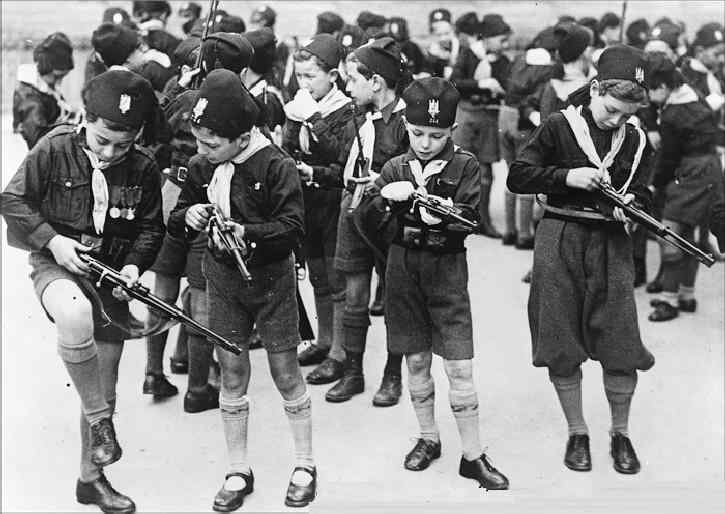
Figure 1.--Here Balilla boys in 1937 are loading their replica rifles with cartridges. Older boys had more advanced military training at summer camps. |

|
There was some basic para-military training conducted by each unit. Glorification of the military and war was a basic feature of Fascism and Italian Fascism was no exception. There were Fascist Saturdays and summer camps. Of course more rigorous military training could be conducted at camp than during the fegular Saturday meetings. Para-military training was an important objective of the program. We have, however, few details on the training at this time. The program was structured for the different age levels of the group. We note younger children handling replica rifles and learning to load them. More intensive para-military traing was coducted at camps. We do not have information at this time on the para-military activities of older boys. What ever the nature of the training, it seems to have had little impact on the martial spirit of Italian soldiers in World war II. This contrasts sharply with the impact of Hitler Youth training. It is not entirely clear to us why the military training of the two groups had such widely varied results. We suspect that both the character of the two groups as well as wider social factors were involved, but our limited information on the military training program preclude any conclusions at this time.
Mussolini ordered the compulsory military training of children and youth beginning at age u8 years (1934). We believe this had begin before 1934, but Italian newsoapers carries 'huge' headlines triumphing the 'revival of the spirit of the ancient Romans' and articles with details of what Mussoloni planned. [AP. 'Italy's little boys'] All boys beginning at the age og 8 were to receive military training. It would be provide through the Balilla. Missolini intended to create an 'armed nation'. He prommised more and better training. Mussolii sppech announced a decree issued by the Italian Council and told the Italian people that, 'The functions of the citizenamd the soldier are indivisable in the Fascist state.' The announcement was billed the most sweeping peacetime mobilization in history. TheFascist Council stated in the decree that 'Military training is an integral part of the national legislation. ... it begins as soon as a boy is old enough tom learn and continue as long as a cutizen is able to carry arms in defense of the country." The Balilla boys were ordered not 'to shrink their military school work. Students will not be promoted to higher classes [grades] or receive degrees without having followed the military courses with profit." The decree further proclaimed, 'Boys from the time they are eight years olduntil they are called to arns at 21 will be prepared spirtitually, phyically and militarily by the civil organization of the Fascist balilla and by the Fascist youths of combat. Thus when they enter the armed fiorces, they can dedicate themselves exclusively to warlike professiinal and soecialized training in arms.' The youth training is to be divided into two sections, first (8-18 years) and second (18-21 years). The idea was to fan the 'love of war' in Italy's youth. The Decree states, "The purpose of this first stage of compulsiry pre-training is to give boys a passion for military life through frequent contacts with the armed forces whose waelike glories and traditions will be re-evoked.'
Glorification of the military and war was a basic feature of Fascism and Italian Fascism was no exception. Musolini like Hitler served in the World War I military. Italy entered the War on the Allied side attracted by Allied offers of territory to be won. The War aversely affected the economy and Italy did not get all of the territiory they expected. Fascist attitudes toward the military were in part an expression of the xenephobic nationalism which was also a feature of Fascism. If Fascist countries were to achieve their nationalistic goals, it could only be done through war. The primary Fascist objective was to seize territory. Here a factor was that because of the rule of multi-ethnic empires like the Hapsburg Austrian-Hungarian and Ottomon Empires there was a great mixing of ethnic groups. Even after the territory gained in World War I, there were Italians in neighboring countries. The same of course was true of Germany and other countries like Hungary. Mussolini not only wanted the territory where Italians lived, but also a large empire to govern and where Italy's population could colonize. And only military prowess could gain Italian Fascists such an empire. But the Fascist mindset was also a stidently male could be expressed on a national basis through agressive militarism.
The Bsalilla program included some psra-,ilitary training, but we do not yet have much detail on this. There was some basic para-military training conducted by each unit. We do not have much information on just what was involved. One press photo before the War pictures Balilla boys "studying picture books on military training". We note images on boys handling fire arms. And many imsges show boys marching and lining up for insoection. There were Fascist Saturdays and summer camps. Of course more rigorous military training could be conducted at camp than during the fegular Saturday meetings. Para-military training was an important objective of the program. We have, however, few details on the training at this time. The program was structured for the different age levels of the group. The military activities for the Figli della Lupa and the Balilla were limited, but substantial in the Avanguardisti and Giovani Italiane (14 to 18 year olds) and include fire arms training. We note younger children handling replica rifles and learning to load them. More intensive para-military traing was coducted at camps. We do not have information at this time on the para-military activities of older boys.
What ever the nature of the training, it seems to have had little impact on the martial spirit of Italian soldiers in World War II. This contrasts sharply with the impact of Hitler Youth training. It is not entirely clear to us why the military training of the two groups had such widely varied results. Of all the major World war II combatants, the Italians despite Mussolini's threats of 6 million bayonets proved to be unprepared and inept at war, especially the Army. Despite large numerical advantages, the Italians failed to in their invasion of British Egypt (September 1940) and Greece (October 1940). Italian soldiers in North Africa often looked on being taken prisoner by the British and later the Americans as a welcome end to the War. The Germans in North Africa as elsewhere fought with great ferocity, often when there was no prospect of victory remaining. We suspect that both the character of the two groups as well as wider social factors were involved.
One basic difference was that despite seizing power about a decade earlier than the NAZIs, the Italian Fascists never succeeded in recruiting more than 50 percent of Italian children to their youth movement. There are factors more attributed to the militaru=y than the youth program. Italian soldiers were poorly equipped a traine. In addition, Italian officers did not have the same concern for their men as was often the case for Wehrmacht officrs. Our limited information on the military training program preclude any conclusions at this time.
AP report. 'Italy's little boys to discard their marbles and study machine guns,' The Spartangburg Herald (September 18, 1934), p. 1.

Navigate the Historic Boys' Uniform Web Site:
[Activities]
[Biographies]
[Chronologies]
[Countries]
[Essays]
[Garments]
[Organizations]
[Religion]
[Other]
[Introduction]
[Bibliographies]
[Contributions]
[FAQs]
[Questions]
[Unknown images]
[Boys' Uniform Home]
Navigate the Historic Boys' Uniform Web organizatiion pages:
[Return to the Main Italian Fascist youth activities page]
[Return to the Main Italian Fascist youth page]
[Boys' Brigade]
[Camp Fire]
[Hitler Youth]
[National]
[Pioneers]
[Royal Rangers]
[Scout]