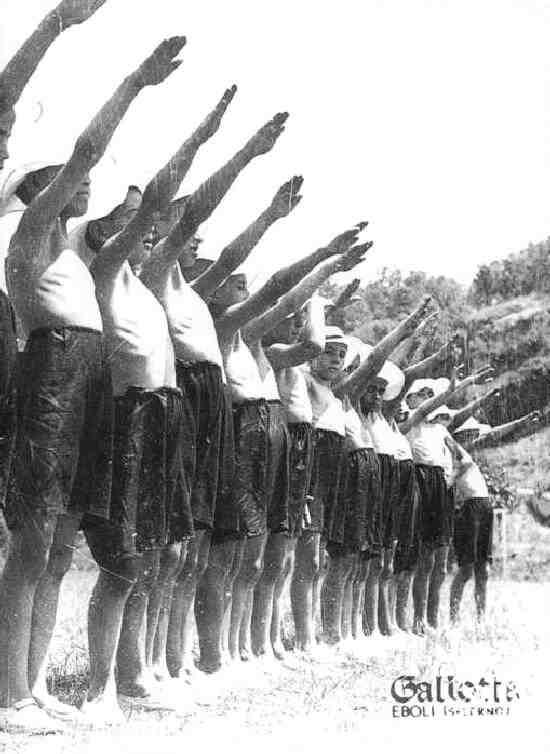
Figure 1.--Many imahes of the Balilla and Hitler Youth at least superficially look very similar. The two groups, however, different significantly in their success in indoctrinating their members. |

|
We wonder about the effectiveness of the Balilla. The Italian Fascists seized power a decade before the NAZIs in Germany. The Balilla was thus the sole youth movement for Italian youth for a much longer period than the Hitler Youth in Germany. The Balilla was designed like the Hitler Youth to create a young generation firmly committed to Fascist rule and Mussolini/Hitler's leadership. Both groups had summer camps that promoted para-military activities. Even so, the Italian commitment to and readiness for war were far below the level achieved in Germany. The Hitler Youth boys delivered youths to the military with a wide range of useful military skills as well as military discipline. Hitler Youth boys fought with great intensity oin the War. The Hitler Youth Division in Normandy was a noted example of this. The Balilla appears to have failed to achieve little to enthuse Italian boys with a martial spirit. Italian army failed repeatedly in operations against the French, Greeks, British, and Americans, often facing numerically uinferior forces. We are not entirely sure why these two youth movements have such different records. We do note that the Baillal, unlike the Hitler Youth, did not seek to destroy the influence of the Church and family.
We wonder about the effectiveness of the Balilla. The Balilla ws a huge mass organization sponored by the Fascist Government. The Italian Fascists seized power a decade before the NAZIs in Germany. The organization opperated for about 20 years. The Balilla was thus the sole youth movement for Italian youth for a much longer period than the Hitler Youth in Germany.
The Balilla was designed like the Hitler Youth to create a young generation firmly committed to Fascist rule and Mussolini/Hitler's leadership and personal rule. The German title Führer was not a commonly used German term before Hitler seized power. It was in fact a translation of the Italiannterm Il Duce (the leader).
From the outside looking at the countless images of the Hitler Youth and Balilla, they certainly look very similar. Despite their varying effectiveness had many of the same trappings, goals, methods, and activities. They were both uniformed youth groups. They adopted similar salutes. Both were mass organization in which the children were required to participate. Other youth groups were banned. They both participated in civil events and partriotic events as part of the pagentary of the regime. Both groups had summer camps that promoted para-military activities which extoled military values and war. Both engaged in ultra-nationalistic Fascist ideological education. Both idealized their national leaders, Hitler and Mussolini. Both attempted to create the ethos of a united, unified national enterprise. And in group activities the children were theoretically treated the same regardless of their social background. (Here we are more sure about the HJ than the Balilla.)
We are not entirely sure why these two youth movements have such different records. There were differencs in the two programs, but some of the differences would seem to favor the effectiveness of the Balilla. Balilla had some mportant advantges over the Hitler Youth. Mussolini and the Fascist seized power a decade before Hitler and the Nazis. In addition, children joined the Balilla at a younger age than the Hitler Youth which began wih 10-year olds. Some might argue that the differences were more a matter of the differences in the German and Italian character. We are inclined to believe that while that may have been a factor, the nature of the two organizations and programs were also important, if not more important. Certainly the nature of the two regimes were different. NAZI Germany was a totalitarian state without any effective centers of power to rival the NAZI Party. Fascist Italy was a dictatorship, but totalitarian in name only. There were pluralstic centers of power, especially the Church. We do note that the Balilla, unlike the Hitler Youth, did not seek to destroy the influence of the Church and family.
We suspect that one of the primary reasons that the Hitler Youth and the Balilla have such different impacts is that the nature of the children was different. Italians had different attitudes toward their giovernment than the Germans. Italians, especially lower-class Italians, were used to being exploited by land owners and the social structure in general. As a result, they were less likely to find leadership blindly than the Germans. And the Church continued to play a major role in the life of the children. Unlike the Hitler Youth, the Balilla did not make a major effort to undercut the Church's access to children.
These differences seem to insulate Italian children to a degreee from regime propaganda. This is a little diffucult to assess because we have found so few personal accounts. Perhaps our Italian readers will know more. German children on the other hand had no buffer than the family, which was often afraid to intervene. And when drafted into this Army, this attitutude was confirmed by the life style enjoyed by the officers and their lack of concern for their men. This was very different from the ethos of the Whermacht.
While the Fascists goverened Italy since 1922, the youth movement
appears to have been much less effective than the NAZI Hitler Youth movement in Axis partner Germany. The Fascists had nearly two decades to prepare Italian youth for battle. Hitler and the NAZIs on the oher hand had only 6 years. The Hitler Youth provd extrodinarily syccessful in preparing German boys for war. Not only was their some actual military training, but the boys were prepared pscholgically for war. So effective was this that the Wehrmacht received boys that in effect had already gone through basic training. In addition the Hitler Youth ditcted the older boys into brnches of the militry. Boys that demonstrated particular promise were directed unto the SS for officer training. Unlike the HJ, the Balial failed to intill Italian youth with
the same martial vigor as the Gemans. The Italian commitment to and readiness for war were far below the level achieved in Germany. The Hitler Youth boys delivered youths to the military with a widec range of useful military skills as well as military discipline. Hitler Youth boys fought with great intensity in the War. The Hitler Youth Division in Normandy was a noted example of this. The Balilla appears to have failed to achieve little to enthuse Italian boys with a martial spirit. Italian army failed repeatedly in operations against the French, Greeks, British, and Americans, often facing numerically inferior forces. At the end of the war, a hole armored division was formed out of HJ boys that proved to be one of the most tenacious in the Germany militry. Even after the war was lost, HJ boys would fight to the death. None of this occurred in Italy. In fct the performanceof the Italian army ws the worst of any major Wrld War II combatant. Virtually all of the solddiers involved would have been involved in the Balial. One has to ask why the HJ leaders were so successful and why the Balial leaders filed in their efforts to instill martial spirit.
Hitler at the end of the War concluded that the alliance with Mussolini and the Italians was the greatest mistake of the War. That is arguable, but it seems correct that the Italians caused a great deal of trouble for the Germans and returned very little. Mussolini and his 8 million bayonets failed in every military campaign they initiated, except the invasion of Albania and this was because the Albanians did not resist. The Italians failed in France (1940), Greece (1940), Egypt (1940), and East Africa (1941). Italian troops performed badly in the Western Desert (1941-42), Soviet Union (1941-43), Tunisia (1943), and Sicily (1943). And at the end the Army failed to resist the NAZI take over of their country (1943). After the Italian Armistice, the great majority of the Italian army, left without orders, or was disbanded. Thousands of soldiers were killed by the Germans in attempts to quell any move by the former Axis nation to join the Allies or the partisans, while tens of thousands were disarmed and deported to Germany as prisoners. The Italian Navy and Air Force performed better, but were hampered by inferior equipment. Italian special forces, however, had some impressive achievements. Overall the performance of the Italian military must be ranked as the greatest martial failure of the War. Had the Italians been even marginally effective, they could have easily taken Egyot and Suez early in the War. The question arises as to why. Various reasons had been offered. Hitorians have suggested factors such as ineffective leadership, poor training, obsolete equipment, and inadequate supplies. Italian officers often took little interest in the well being of their men. Certainly poor equipment was a factor. Fieldmarshall Rommel who had extensive experience with the Italian Army said of the Italians, "They are worthless fighting a war, but we should not judge people whether they make good soldiers or not, otherwise there would be no civilisation." [Young] I'm not sure that it was the Italian character. Some have claimed it is the Italian interest in "La dolce vida". That may be a factor. The Hiter Youth movement effectively prepared German youth for war. The Balilla was also a major youth movement promoting Fascism with many of the same ideals of the Hitler Youth. Italian soldiers did not, however, persue the war with the same itensity as the Germans.

Navigate the Historic Boys' Uniform Web Site:
[Activities]
[Biographies]
[Chronologies]
[Countries]
[Essays]
[Garments]
[Organizations]
[Religion]
[Other]
[Introduction]
[Bibliographies]
[Contributions]
[FAQs]
[Questions]
[Unknown images]
[Boys' Uniform Home]
Navigate the Historic Boys' Uniform Web organizatiion pages:
[Return to the Main Italian Fascist youth page]
[Boys' Brigade]
[Camp Fire]
[Hitler Youth]
[National]
[Pioneers]
[Royal Rangers]
[Scout]