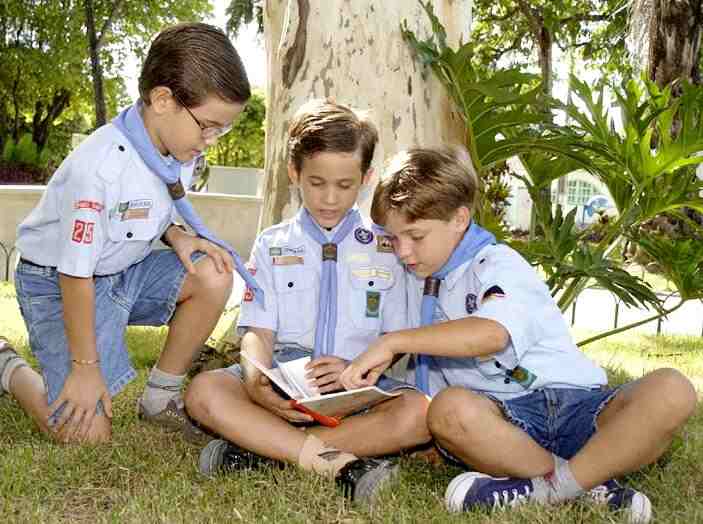
Figure 1.--Here we see a Brazilian Scoting image. We think that the boys are Cubs. I'm not sure when the photograph was taken, probably the early 2000s. |

|
The Scouting movement is relatively weak in South America. Unlike countries like America and Britain, relatively few boys have particioated in the Scouting movement. This is in part because Scouting is predominately a middle-class mpvement and the middle class is only a small part of the population in most countries in the region which are predominately low-income countries. Most boys can simply not afford to be Scouts. Even so there are enthusiastic Scouters in each country. Please have a look at available information on Scouting in the following countries and the development of the various national uniforms in each different country.
We believe that Argentina has a substantial Scouting movement, but have little information at this time. The largest Scouting organization in Latin America appears to be Argentina, although Brazil is a much larger country. As far as we know Scouting is the only important uniformed youth group in Argentina. We have few details on Argentinde Scouting. There appears to be a separate Catholic Scouting association. The image here suggests considerable attention to the unidform. As with most groups, there a destincr Cub and Scout uniform. We are not sure if any other youth groups have been active in Argentina. There does appear to be a popular youth hostel movement in Argentina.
Bolivian Scouts played a role in the bloody Chaco War (1932-35). Clashes in the Chaco began before the war broke out. This press photo shows Bolivian Scouts forming military brigades. The caption read, "Bolivian Boy Scouts form military brigades in possible clash with Paraguay: Even the Boy Scouts of Bolivia have demonstrated desires to be recognized as ailitary unit should the war clouds hovering ver their country burst into war over the surprise attack by Paraguasyan forces. Their request follows the call to covers of the 1929 [age] class by the GeneralmStaff. Photo shows a Boy Scout brgade drilling at La Paz Bolivi." The photo was taken Secember 12, 1928. The war would break out 4 years later. Scouts in both countries served among other duties as postal mail carriers and litter bearers for the wounded. As a result, there were very young boys at or near the frnt lines. One Paraguayan source reports the boys resisting being moved to the rear.
Brazil is the largest country in South America. Over half the area and population of the continent is Brazilian. I am not sure, however, about the size of the Scout movement in Brazil. The only Brazilian youth group we know of is Scouting. We have virtually no information on Braziian Scouting at this time. Give the size of Brazil, you would expect the country to have a very substantial Scouting movement. We do not know if there is one national association or different association. One report indicates that Brazilian Scouting became coeducational (May 1997). We note the groups in 2004 were Cubs (7-10), Scouts (11-14), Senior Troops (15-17), and Rovers (18-21). We have a few images of Brazilian Scouts archived on HBU, but wechave very little information on the Scouting movement. Hopefully our Brazilian readers will provide us some information.
The Chilean Scout movement was founded in 1909 after a visit to Santiago by Baden
Powell. There are in Chile more than one Scout assoction, however, the main group is the
Agrupación Nacional de Boy Scouts de Chile. Like many Latin American Scout
movements, only a very narrow sector of the population could participate, mostly
middle-class boys that could afford the uniform and other costs. Scouts in the 1990s
continued to wear a traditional uniform.
Scouting began in Praguy on a small scale before World War I, although the modern association (ASP) was not funded until 1960. The first Souting activiies were reported (1913). The Sciuting movement was small because the country was small and poor. Scouting has amiddle class movement had only asmall demofraphic base. As ws common at the time, separate units were fored for Boy Scouts and Girl Guides. The first national association was the Federación Paraguaya de Scoutismo (Paraguayan Federation of Scouting-FPDS). It united all activities and institutions of Scouting in Paraguay (1928). Four years later the Chaco war erupted. AParaguayan Scouting source reports, "In the Chaco War, the young Boy Scouts participated as couriers delivering letters and parcels to the men in the theater of operations, thanks to their organization and discipline. The then Scout president was Mr. Hipolito Carron. During one bombing, a result of numerous wounded , the Boy Scouts also had to act as stretcher bearers and nurses. They were soon removed from the battle front, because most of them were just kids (although they resisted going to the rear). For services to the nation of Paraguay, the National Government awarded to the current Scout Association of Paraguay the 'Medal of Recognition Paraguay'." After the Chaco War, Scouting appes to hae dippeard in aauay. Some Scout leaders travelled overseas for training and so try to continue this movement (1948).
The Peruvian Scout Association is the Asociación de Scouts del Perú (ASP). It was founded (1911). It became a charter member of the World Organization of the Scout Movement (1922). The ASP like many other Scout associations in Latin america is a relatively small group, only about 5,500 members (2008). The best known Peruvian Scouter is Dr. Elias Mendoza H. who was awarded the Bronze Wolf by the World Scout Committee for exceptional services to world Scouting (1973). The ASP puts an emphasis on Vocational training, conservation programs, and community service. Thy have a close association with the Red Cross. Peru is a country with a very destinctive geofraphy, an arid coast, Andean highlands (sieera), and Amazonian jungle. In recent years the ASP has developed conservation programs. Scouts can visit Amazonian jungle villages and learn about the conservation of nature. Tree planting is a popular activity. Scouts also work to restore and maintain indigenous (Native American) pre-Colombian sites. Peru was the cebnter of the Inca civilization and Machu Picchu is one of the most important Inca sites. Other Scout projects deal with increasing food production and improving nutrition. There are several Scout levels: Lobatos/Cubs (ages 8 to 11), Scouts (ages 11 to 14), Caminantes/Venturing (ages 14 to 17), and Rovers (ages 18 to 21).
HBU has obtained a number of images of Scout uniforms, but can not identify the nationality. If you can figure out what country these boys are from, please let HBU know.

Navigate the Historic Boys' Uniform Chronology Pages:
[Return to the Main chronologies page]
[The 1900s]
[The 1910s]
[The 1920s]
[The 1930s]
[The 1940s]
[The 1950s]
[The 1960s]
[The 1970s]
[The 1980s]
[The 1990s]
[The 2000s]
Navigate the Historic Boys' Uniform Web Site:
[Return to the Main national Scout page]
[Activities]
[Biographies]
[Chronologies]
[Countries]
[Essays]
[Garments]
[Organizations]
[Religion]
[Other]
[Introduction]
[Bibliographies]
[Contributions]
[FAQs]
[Questions]
[Unknown images]
[Boys' Uniform Home]
Navigate the Historic Boys' Uniform Web organization pages:
[Boys' Brigade]
[Camp Fire]
[Hitler Youth]
[National]
[Pioneers]
[Royal Rangers]
[Scout]